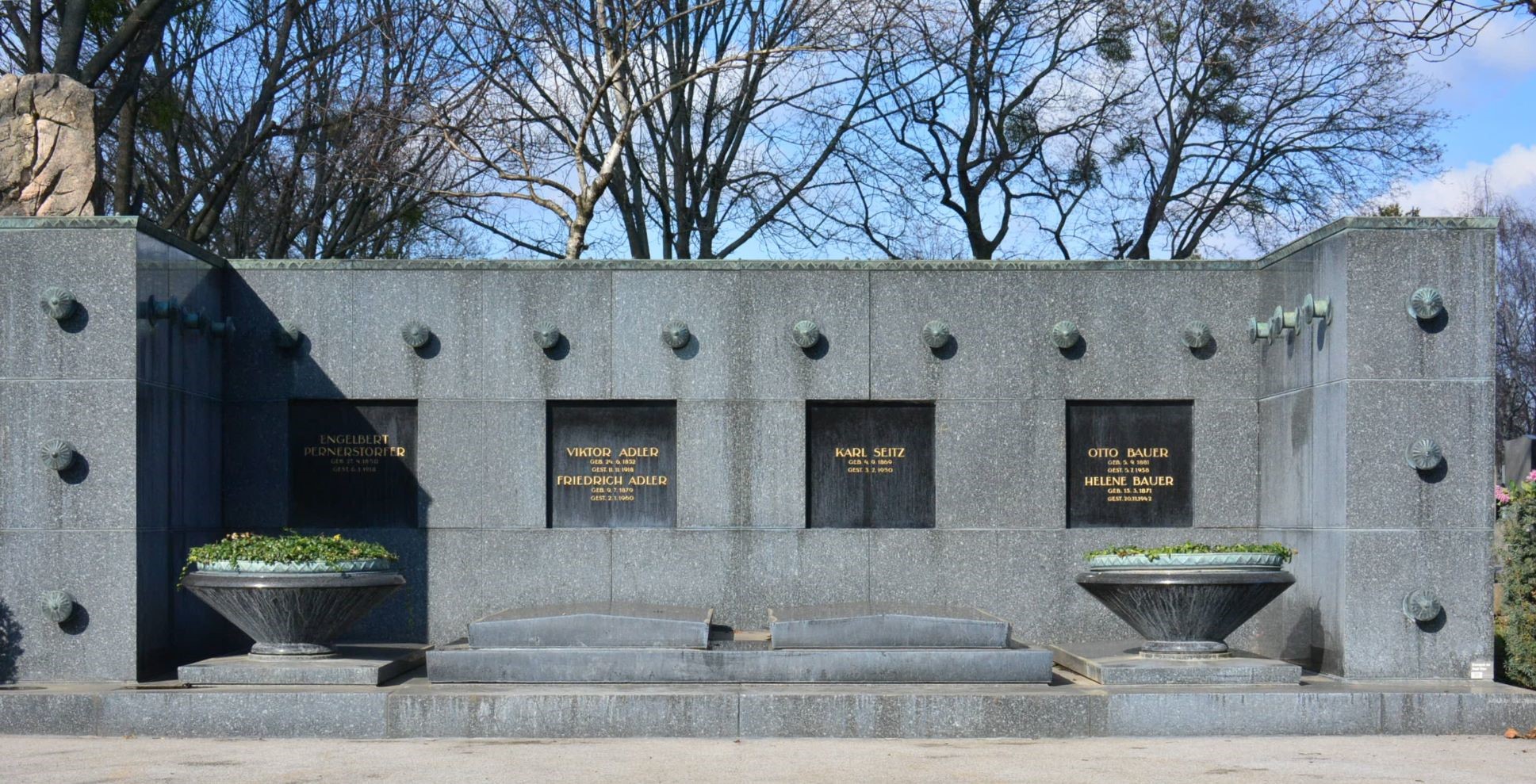
Austro-Marxism and its theoreticians get a sharp critique from Nikolai Bukharin.
‘The Austrian Social-Democrats’ New Programme’ by Nikolai Bukharin from Communist International. Vol. 3 No. 1. October 15, 1926.
THE Austrian Social Democratic Party has published the draft of a new Party programme, which will of course be accepted by the next Party Congress. In the official introductory article printed in the “Arbeiter Zeitung” along with the draft, it is stated that the “entire trend of ideas in the draft is Marxist” (“der ganze Gedenkengang des Entwurfes ist Marxistisch”) But the great thinker, by whose name Messrs. Bauer, Renner and Co. swear, was right when he said: “I sowed dragons, but the harvest I reaped yielded fleas.”
The Austrian Social Democrats are fleas–fleas of quite a special kind. They differ from the more bloodthirsty animals of the type of Noske, Wels and Co. They are considerably more moderate, more accurate, and one might even say, more clever. Their work–that of serving capitalist society-is performed much more thoroughly and in a more refined way. They have been able to cling to the body of the working class much more firmly than any of the Social Democratic parties of other countries. Nevertheless–they are only fleas. As we have said they swear by Marxism. But actually the new draft programme is a critical capitulation to the purest reformism. The authors of the programme state that they have learnt something from Bolshevism (they are not joking) and that they have paid tribute to the “spiritual current” (“Geistesströmungen”) in the bosoms of the British “Independents” and the “Young Socialists” in Germany. Actually they have vulgarised a few Bolshevik conceptions and eagerly crammed the programme with feeble sanctimonious moralising drivel, so characteristic of those philanthropic old women who try to find spiritual consolation for themselves in the innocent rose water of the theoreticians of British opportunism.
Capitalism Omitted

It is easy to see that for any workers’ party the lessons of the world war and the questions of the post-war crisis of capitalism and of imperialism have a primary and decisive significance. But such happy people as the leaders of the Austrian Social Democrats pass by all these questions. They literally slide away with one or two phrases. Before the war even the Austrian Social Democracy made imperialism the centre of its party work. The war showed with terrible force what this question means in practice. Versailles bent Austria to her knees. The entire world is now writhing in the convulsions of post-war contradictions. But the priests of Austrian Social Democracy are deaf and dumb to all this!
Instead of giving a theoretical analysis of the main lines of the development of modern capitalism, they have preferred to give a couple of quack prescriptions in the spirit of “Socialised” pacifism. From the theoretical point of view, this is bankruptcy, and an intolerable cowardice. It is characteristic that in order to please “Young Socialism” and the British opportunists the makers of the new draft have scratched out all of the old
Social Democratic programme that touches on the historic necessity of Socialism. People bow to “Scientific Socialism,” but they have forgotten the most important thing in this scientific Socialism: they have forgotten the scientific proof of its inevitability. In vain do search among the “Austrians” for even the slight trace of Marx’s courageous theory of the development in the internal contradictions of capitalism, of the inevitable growth in class antagonism, of the contradictions between the stage of development of productive forces already reached and the shell of capitalist production. In vain do we seek in this programme a reply to the question–what was the importance of the world war from this viewpoint? In vain do we seek a reply to the question that follows from this: what is the fate capitalist world economy? There is nothing of this in the programme.
Imperialism Not Mentioned
Why? Because these questions lead straight either to an undistorted Marxist (i.e., Bolshevik) position, or else to a frank denial of Marxism owing to its being “out-of-date.” And it is precisely the task of the “Austro-Marxists” to manoeuvre in a cowardly way on this issue. Their “view” is expounded in the following manner:
“The capitalist classes of the highly capitalized States endeavour to conquer economically backward areas outside the European cultural circle, for markets, sources of raw material, and spheres for the investment of capital. Competition in the struggle for colonies begets more and more new contradictions among the capitalist world powers. The penetration of capitalism into non-European cultural circles overthrows their traditional social regime and evokes in them a defensive struggle against foreign domination. As a result of these upheavals there is a constant war danger. Simultaneously, along with the development if the technique of capitalist big industry, military technique changes also. The development of capital thus threatens to destroy the whole of civilisation its terrible wars. (The end of the first section “Capitalism.”)
That is all. What is there interesting to see here? First, there is not even the word “Imperialism” here. Second, there is only an empiric description of facts, in no way explained theoretically. Third, nothing is said as to the inevitability of wars under the capitalist regime; that is, we have here a complete renunciation of one of the main ideas of Marxism, which was defended even by the old Social Democracy.
Hilferding at times used to display a faint heart and in spite of his knowledge of monstrous armaments, secret treaties, and imminent conflicts, used to put forward theses on the new shape of capitalism, which he thought compelled us to recognise that the idea of inevitability of wars under Capitalism is incorrect. The authors of this programme do not answer either “Yes” or “No” they maintain a shameful silence, in practice abandoning Marxism.
Fourthly, it is actually untrue to say that the struggle goes on for the backward regions (cf. for example the question of Alsace-Lorraine and the French occupation of the Ruhr). Fifthly, the draft programme, in the most shameless and scoundrelly manner, lays the blame on the colonial peoples. Indeed, what is actually written in the sentence quoted? Capitalism “penetrates” into the colonies. Risings start there. And as a result of this there is a danger of “terrible wars.” What a fine formulation! Instead of saying that the causes lie in the imperialist policy of the capitalist States, which plunder the colonies and fight for the loot amongst themselves; instead of recognising the right of the oppressed peoples to rebel and pledging themselves to support the national revolutions against imperialists (it is characteristic that the programme does not even call these revolutions by their name) the leaders of the Austrian Social Democratic Party speak of these colonial movements as the main reason for the danger of war!

Such a position is contemptible. It is nothing more nor less than a repetition of the falsehoods and slanders which the British imperialists and their hangers-on let loose when, for instance, they represent the Chinese revolution as being the main threat to peace, and accuse the Soviet Union of being mainly responsible for the infringement of the wonderful “peace” which the imperialist politicians and Social Democrats of the Vandervelde type created at Versailles.
Finally we should point out that in the whole of the draft programme there is not a word about the Soviet Union. Herr Bauer, who is naturally connected with the draft programme, has been compelled to acknowledge, in the “Arbeiter Zeitung,” the Socialist elements in our economic system and the corresponding nature of our State. Has he renounced this or not? There should have been an answer to this question in the programme.
Does Soviet Russia Exist?
We by no means demand our recognition on the part of Messrs. Bauer and the like. But the fact that the question of the Soviet Union is passed by can be nothing less but cowardice. It would be more honest to say something anti-Communist, but at least say something! All international policy to a considerable extent depends on this question. But here also the priests of “Austro-Marxism” hypocritically evade the issue.
Such is their “theoretical” analysis.
The conclusions which are drawn in the sixth section of the programme (“Die Internationale”) correspond fully with the rest of it.
They mention first of all the “League of Nations.” The Social Democrats, you see, are fighting against the “distortion” of the League of Nations and its transformation into an instrument for defending the capitalist social regime. (“Sie bekämpfen die Verfälschung des Völkerbundes zum Werkzeug der Verteidigung der kapitalistischen Gesellschafts-ordnung”). This is an opportunist, anti-Marxist and anti-revolutionary presentation of the question, through and through. The programme is hypocritically naive. Its authors know very well that the League of Nations is a League of the governments of the victorious imperialist powers, directed against the colonies, against the U.S.S.R. and against the conquered States which it wants to tame. They know very well that an attempt at “correcting” such a “League of Nations” is pitiful nonsense. It is absurd to represent the “League” as a virgin, deprived of her innocence through no fault of her own. The essential fact about the League of Nations is that it is a capitalist and imperialist group. It has not been “distorted” into an instrument for defending the capitalist order; from the very first it has been such an instrument, has acted as such, and will continue so to act in the future. The programme conceals this from the workers in order to screen the treachery of Messrs. Boncour, Thomas, Vandervelde and the other “functionaries” of the League, who at the same time are members of that fraternity called the Second International, in which Herr Bauer is also to be found.
The policy of “reforming” the League of Nations is a most pitiful reformist utopia. The “Holy Alliance” of European counter-revolution is a battle ground for Social-Democratic manoeuvres, now that the Social-Democrats have left off being Socialists, and some of them even have left off being Democrats.
The League and the Republic
On international questions, then, the programme stands entirely on the basis of the “existing order.” Support for the League of Nations, with utopian attempts at its “reform”; protests–under the pacifist flag–against the colonial-revolutionary struggle of the awaking masses of humanity; a cowardly pose of silence on the question of the Soviet Union
Such is the position of the Austrian Social Democrats. We find the same way of looking at things in respect to “domestic” policy.
Here also the main Marxist principle is forgotten the principle of a consistently conducted class struggle. On international questions there was neither a class analysis of the League of Nations, nor a class analysis of power in the Soviet Union, nor a class analysis of colonial movements. On internal questions the main thing lacking is a class analysis of the present Austrian State. The entire paragraph on this question is filled with empty phrases about the defence of the Republic–the Republic and again the Republic.
Instead of opening the eyes of the workers as to the bourgeois nature of this Republic, denouncing it as a form of rule by the bourgeoisie, the programme stands firmly for accepting this Republic and strengthening it in all ways.
For a real revolutionary Party, radical and democratic demands are merely a means of shaking up the existing bourgeois apparatus: these demands are a wedge which the proletarian party drives into the State apparatus of the bourgeoisie in order to smash it. By the Austrian Social Democracy (which even before the war got the nick-name of “the Imperial Royal Social Democracy”) these demands are worked out as part of a “serious,” “orderly” and “honourable” task the task of helping to strengthen and “perfect” the present Austrian State. That is why the old slogan: “Not a penny for the gendarmes!” has been replaced by a new slogan: “The maintenance of troops adequate for defeating any counter-revolutionary rebellion. Guarantee of the Republican nature of troops. In the same manner it is necessary to guarantee the Republican nature of the police and gendarmerie.”
It is worth while examining for a moment these “Marxist” (you might at least be ashamed, kind gentlemen!) conceptions. “Adequate troops” are not by any means needed in a bourgeois State in order to suppress counter-revolution. In such a country as Austria, which to a considerable extent exists by the grace of the victorious powers, the bourgeois State (be it thrice Republican!) needs troops, police and gendarmes first and foremost in order to suppress the working class. For this the Republican (bourgeois-Republican) nature of a gendarme, a General or a policeman can be “assured.” The Republican generals of present-day France, with their banner of “Liberté, Egalité, Fraternité,” fire on the workers or smash whole towns to the ground with their artillery in the colonies, while the detectives of the Republic perform their “Republican” work excellently. There is no harm in remembering also the United States, where even the electric chair applied to revolutionaries is decorated with the coat-of-arms of the Republican benefactors. Messrs. Otto Bauer and Company ask that the gendarmes and policemen should be “trained” in the spirit of devotion to the Republic, and do not say a word about propagating the class ideas of the proletariat among the troops. Marxism, which is used for mercilessly removing all formal wrappings and destroying all fetish-like absurdities, revealing the class content of any social institution, is transformed in the hands of the prophets of Austro-Marxism into a mass of jelly at which a real revolutionary can only be nauseated.
Form “Republican” police! Form a “Republican” gendarmerie! Form “Republican” troops! Support the sacred, innocent, democratic, non-class Republic.*
(*It goes without saying that there can be moments of concentrated struggle against a Monarchist danger. But the corresponding tactical steps serve as a means for the subsequent development of the class struggle, and have nothing in common with support for the policy or structure of the bourgeois Republic.)
Policy in Industry
Since the Austrian Social Democrats approach their class enemy, the bourgeois State, in this way, it is not surprising that they approach in exactly the same way the question of economic policy and of bourgeois production.
Here also the main viewpoint is very “constructive.” The Austrian Social Democratic gentlemen have assimilated excellently this “constructive” music, from the Sunday sermons in the temple of Mr. MacDonald, who long ago “abolished” and “conquered” Marxism as “out-of-date.”
The first phrase from the paragraph on economic policy begins like this:
“Social Democracy helps to increase the efficiency of labour, as a prerequisite to the rise in the standard of living of the toiling masses of the people.”
Such a formula would be quite in place in a proletarian State. But the Austrian Social Democrats regard their own bourgeois republic and “their own” bourgeois industry with such esteem that, unnoticed by themselves, they assume on their shoulders tasks which in effect are the tasks of the bourgeoisie.
Among the concrete demands put forward there is much that is “correct.” But just think a little, gentlemen!–is not this formula entirely covered by the “rationalisation of production” aimed at by the bourgeoisie, with all its baits? Of course! And the publicists of German Social Democracy have been transformed into the pillars of capitalist reorganisation on the assumption that Social Democracy under capitalism should “help to increase the efficiency of labour.”
Fake Factory Committees
Here again a revolutionary party’s economic demands sharpen the class struggle to the greatest possible extent at any given moment. The position from which the Austrian Social Democracy starts is anxiety for the capitalist “whole.”.
This explains the fact that instead of a struggle against the tariffs and the increasing cost of living, the wise authors of the programme write about “a permanent international decrease in the system of protective (!) tariffs.”
In the light of this, the slogan of “democracy in industry” put forward in the section on “Social Policy” assumes a quite definite meaning: it implies the capitalist “constitutional” factory where the corrupted upper strata of the workers help the capitalists to simplify their management and improve or conceal the productive relations of capitalism.
To a revolutionary party of the proletariat, the struggle for extending the rights of factory committees, etc., is a means of class struggle against capitalist production. But the fakirs and magicians of Austrian Social Democracy are following the path of the Gompers and Greens with their “labour banks,” the path of the British reformists who are trying hard to create a “community of interests” between capital and labour. This honourable, “Marxist” task, however, astonishingly resembles a thorough and “well thought-out” betrayal of Marxism.
The Conquest of Power
If we must build up the “Republic” under capitalism (and not undermine it) then what is the use of talking about revolution or dictatorship?
And if under capitalism we must help the bosses in every way in their “social” anxieties as to the “efficiency of labour,” then how can we even offend these people, let alone use destructive methods?
In his letter to Weydemeyer, dated March 5th, 1852, Marx wrote:
“As far as I am concerned the service of discovering classes in modern society does not belong to me, nor the service of discovering the struggle among them. Bourgeois historians long before me expounded the historic development of this struggle, while bourgeois economists expounded the economic anatomy of classes. What I did new was to prove the following: (1) that the existence of classes is connected only with definite historic forms of struggle, peculiar to the development of production; (2) that the class struggle inevitably leads to the dictatorship of the proletariat; (3) that this dictatorship itself is merely a transition towards the abolition of all classes, and the establishment of a social order in which there will be no place for separation into classes.”
Thus Marx himself personally pointed out that the conception of the inevitability of the dictatorship of the proletariat is the basis of Marxism. Herr Karl Kautsky, to please the bourgeoisie, transformed this basis into a “little word” that Marx let slip by chance, and did this just at the time when the proletariat had come face to face with the problem of conquering power. What does the Austrian programme do with all this? Oh, it acts awfully shrewdly, don’t you know!
As the main path it puts forward that the Social Democratic Party may “conquer power thanks to a decision on the basis of universal suffrage.”
“Only then,” the programme suddenly bursts out “will the democratic Republic be transformed from an instrument of the class rule of the bourgeoisie” (Aha! and what about support for the gendarmes, dear gentlemen?) “into an instrument for the liberation of the toiling people.”
On the way towards this there may also be an equilibrium of forces-and then the working class “shares” power with the bourgeoisie (coalition!)
Finally the programme puts forward the following conception:
“The bourgeoisie will not yield its positions voluntarily it will overthrow the democratic republic: it will endeavour to set up a Monarchist or Fascist dictatorship if universal suffrage threatens to hand over State power to the working class, or has already done so. If by such attempts bourgeois democracy were to be undermined the working class could only conquer State power by civil war, and during the civil war could use its power only with the aid of methods of dictatorship.”
These extracts, it seems to us show with sufficient clarity all the eclecticism, all the helplessness, all the opportunist confusion, the whole assortment of contradictions into which the creators of the new programme fall in “manoeuvring” between “democracy” and proletarian dictatorship.
If the bourgeoisie inevitably arrives at Monarchism and Fascism, then it is absurd to have faith in its Republican benefactors; then it is necessary to denounce in advance its class position and prepare in advance the proletariat for the struggle for the dictatorship.
If the bourgeoisie will not yield its positions voluntarily, then it is absurd to think of a coalition with it.
If bourgeois democracy is an instrument of bourgeois rule, then it is absurd to support the gendarmerie, troops and police.

The Republic then becomes not an abstract “idea” of a Republic but a real State power belonging to a real class.
If the bourgeoisie will not yield its positions voluntarily, then even the winning of a parliamentary majority is not the conquest of power, but is only a vote which does not yet solve a problem that can only be solved by force. The real force must then be created in advance, by organising the proletariat, arming it, etc., etc.
The programme says nothing about this. It talks about just the opposite: about faith in the bourgeois Republic, about the need to build it up, etc. In such a context, phrases about dictatorship remain phrases, and “real policy” will be simply a repetition of the same criminal policy by which Bauer helped to crush the Soviets in Hungary and betrayed the Soviets in Austria ad majorem gloriam of bourgeois democracy.
All this part of the programme is permeated through and through with legal cretinism.
The economic programme for the transition from capitalism to socialism, developed in the fifth section of this document, is also penetrated with the same cretinism. Here the main “axle” consists of the idea that the process of socialising industry, economy and the preliminary “expropriation of the expropriators” will proceed in such an idyllic manner that there will not be even temporary damage done to production. In full accord with the peaceful “conquest of power” through universal suffrage we have a peaceful liberation from “capitalist commands” in the field of production.
This idyll is so bright that it does not need any special criticism. The programme leaves open the question of compensation, and triumphantly promises that there will be no need whatsoever for such a barbaric thing as the monopolisation of the “means of spiritual production–the press, publishing houses, theatres.” In other words here again the talk of the dictatorship is forgotten; it looks like the “free State” of the Gotha programme, about which Engels wrote to Bebel in his letter of March 18-28, 1875:
“As the State is only a transition institution, it has to be utilised in the struggle, in the revolution, in order to suppress one’s opponents by force; it is pure nonsense to talk about a free people’s State; while the proletariat still needs a State, it needs it not in the interests of liberty, but in order to suppress its opponents; and when it becomes possible to talk of freedom, then the State as such ceases to exist.”
Religion and Education
We should say a few words also about such “higher matters” as religion. On this question the programme says:
“It (i.e., Social Democracy) considers religion as the personal affair of each individual. Social Democracy thus does not fight against religion.” (Our black type- N.B.)
This is not the viewpoint of a proletarian party. Even in his early work: “On the criticism of the Hegelian philosophy of the Right” Marx wrote:
“The struggle” (hearken, hearken!–N.B.) “against religion is…an indirect struggle against the universal order of which religion is the spiritual aroma.” (Nachlass, III ed., p. 384.)
“The criticism of heaven is turned into a…criticism of earth, the criticism of religion into a criticism of law, the criticism of theology into a criticism of politics.” (P. 585.)
“It (religion) is opium for the people” (Ibid).
And in the famous “Criticism of the Gotha Programme” we read in reference to the slogan of “freedom of conscience”:
“’Freedom of conscience!’ If they wanted to remind Liberalism of its old phrases used during the ‘Kulturkampf,’ this could be done in such a form: ‘everyone can satisfy their religious needs without the police poking their nose in.’ But a workers’ party is nevertheless bound to express its view, viz.: that bourgeois ‘freedom of conscience’ is simply a tolerant attitude towards all possible kinds of religious freedom of conscience (Marx’s black type) and that it (i.e., the Workers’ Party) strives on the contrary, for consciences free from religious garbage. However, people do not like going outside the limits of the ‘bourgeois’ level.'”
Indeed, Austrian Social Democracy does not like going outside these limits! It prefers to sit in the “religious garbage” and, proud of this free thought, to go on repeating phrases about Marxism. It is not interested in the fact that Marx branded with contempt and sarcasm its attitude. It is not interested in the fact that Marx found the most venomous words for this enfeebled petty bourgeois spinelessness, which in reality is one of the manifestations of opportunism. The leaders of the Austrian Social Democrats have so inflated all the “spiritual tendencies” in their own Party that not a trace of Marxism is left.

At the same time, allusion should be made to the “pacifist,” “tolerant,” etc., viewpoint of the programme on questions of education. We will not refer here to details. What is the main thing here? “The Republican spirit,” “peace among the peoples,” “respect for the rights and properties of other people,” etc. All this is very fine. But in vain do we seek for the class idea of the proletariat, the gospel of the class war, or education in the spirit of hate for the cursed capitalist order, for the bourgeoisie, for imperialism.
In effect not a trace of militant Marxism (from which Austrian Social Democracy has always been far distant) is preserved in this programme. Everything is painted in tones of drawing-room tolerance and the humanitarianism of philanthropic old ladies; everything blooms. with the wreathes that testify to the absolute purity of the intentions of such “statesmen” as Messrs. Bauer, Renner and the rest of the “Austro-Marxists.”
We have not referred to the question of the land policy, already accepted. We also have not examined certain fairly important features of the programme, its attitude towards the peasantry, etc. Here the Austrians have “learnt” a few things from the Bolsheviks. But all these ideas are in essence presented in an anti-revolutionary context. In linking themselves up with the peasantry, the Austrians are not leading the latter into the struggle against capitalism, but on the path towards strengthening capitalism. Their main position is such that a number of correct ideas are wound on to a thoroughly reformist reel. The Austrians are compelled “to manoeuvre”; they are turning their eyes to the left. That is why they are particularly harmful. Their ideology bears the label “Marxism,” but this should read: “Reformism. Opportunism. Eclecticism.” May the name of this trinity be sacred in the Social Democratic heaven!
The ECCI published the magazine ‘Communist International’ edited by Zinoviev and Karl Radek from 1919 until 1926 irregularly in German, French, Russian, and English. Restarting in 1927 until 1934. Unlike, Inprecorr, CI contained long-form articles by the leading figures of the International as well as proceedings, statements, and notices of the Comintern. No complete run of Communist International is available in English. Both were largely published outside of Soviet territory, with Communist International printed in London, to facilitate distribution and both were major contributors to the Communist press in the U.S. Communist International and Inprecorr are an invaluable English-language source on the history of the Communist International and its sections.
PDF of full issue: https://www.marxists.org/history/international/comintern/ci/vol-3/v03-n01-oct-15-1926-CI-grn-riaz.pdf
 Revolution's Newsstand