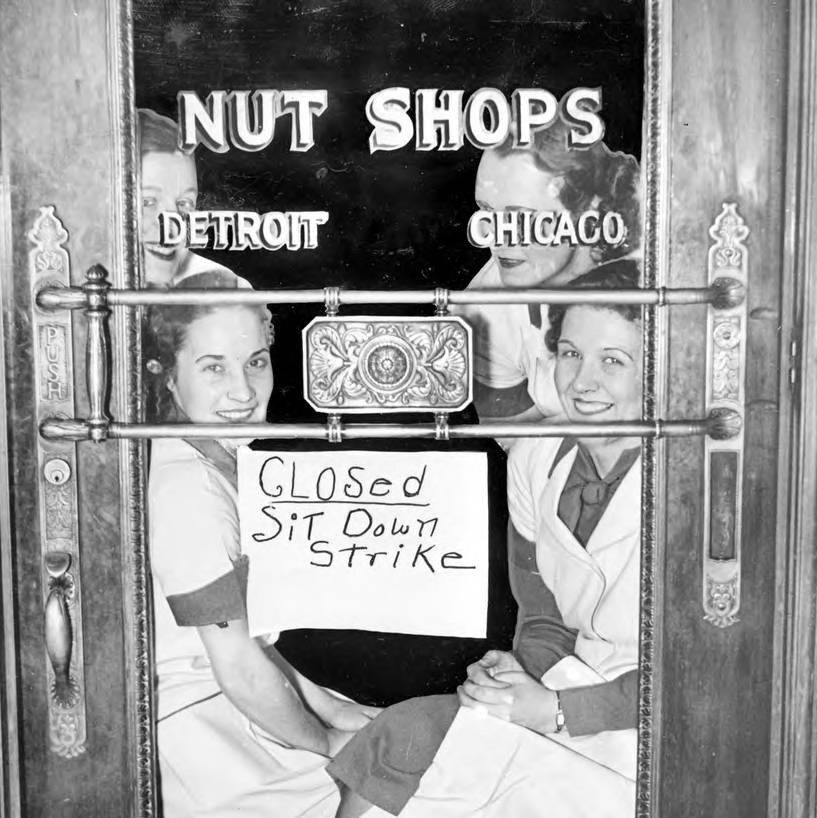
The Spirit of ’37 forever changed the U.S. labor movement. Flint autoworkers threw the stone into the waters of the class war, and the ripple of that sit-down strike began immediately. Beginning with thousands and swelling into the summer with hundreds of thousands participating in job actions across the country, many for union recognition. Here is a look at the first wave of strikes that followed the victory at General Motors in leather goods, steel, war production, department stores, mines, rail, maritime, seemingly the entire city of Detroit, and many more places.
‘Sit-Down Strikes Spread as Labor Militancy Grows’ by Jack Fahy from Socialist Call. 2 No. 103. March 6, 1937.
The loudest noise on the labor front in recent years was made by the United Automobile Workers Union in Michigan. The famous 42 day sit-down strike finally won most of its demands. Within a week after the strike ended payrolls jumped $100,000,000 in the Detroit area alone…
Proving once again that the wider the labor front is the better are its chances for success, dozens of strikes were speedily settled following the victory at General Motors. In many sections big corporations are voluntarily granting wage increases rather than risk a shutdown,
Other companies however, are die-hard conservative and would rather spend a fortune than share the crumbs of their big profits.
Leather
Most important victory outside the automobile industry was that won by 17,000 members of the United Shoe and Leather Workers Union in Massachusetts and New Hampshire. The union, a CIO affiliate, put across a 15 per cent wage increase after less than a week of strikes. Powers Hapgood was instrumental in bringing the dispute to a successful conclusion.
War Goods
Makers of war materials have gained a reputation for brutal tactics in dealing with labor. Since they don’t sell to the public they don’t worry about public opinion. So it is only natural that the hardest struggles are going on at the Groton, Connecticut plant of the Electric Boat Company, makers of submarines, and the Douglas Aircraft factory in Santa Monica, California.
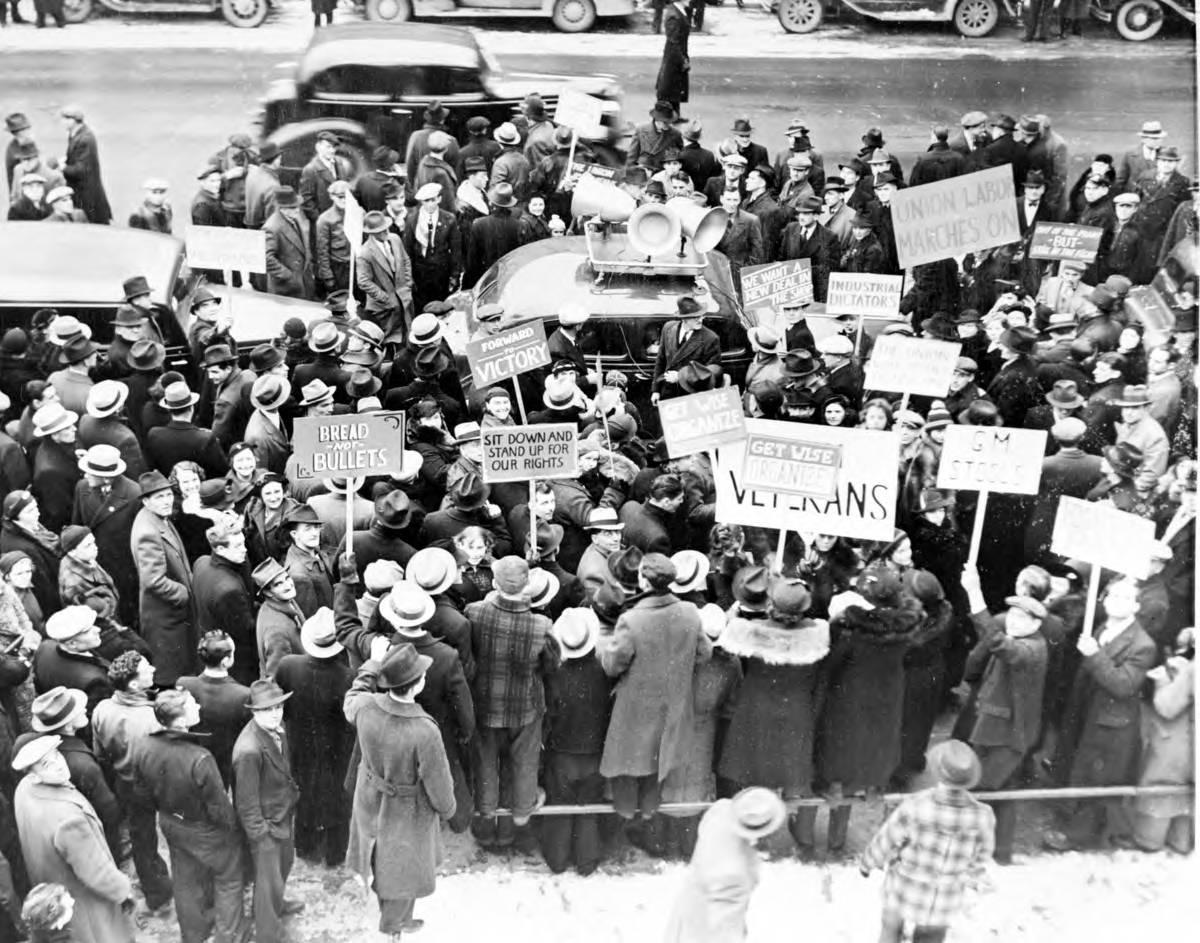
At the Douglas plant president “Donald Duck” Douglas quacked so loud he got 341 strikers thrown into jail until the CIO arranged to free the men on bail of $1000 each. Though the sit-down tactic failed, a heavy picket line has been established.
Steel
The organizing battle in steel is coming to a head. Suddenly steel the Carnegie-Illinois steel company announced readiness to hold conferences with the CIO. Carnegie-Illinois heads the list of world steel makers.
The union is demanding a minimum wage of $5, instead of the present $4.20; a 40-hour week in place of the usual forty-eight; union recognition with a written agreement; time and a half pay for overtime; no discrimination against union men.
To keep the workers from walking out on them–or even worse, staying in on them—a number of other steel companies rushed to announce “voluntary” wage increases. These came so thick and fast, that it is estimated they may pile up to one hundred million dollars.
The steel bosses are scared stiff that their present super-prosperity–thanks to war budget orders–may be sadly deflated by a steel strike. And some of the so-called independents want to get the U.S. Government orders for naval steel. That means that the firm must comply with the Walsh-Healy Act providing for forty-hour work week in the plants getting the contract.
Although Senator Walsh, himself, showed a readiness to reinterpret his law for “the emergency” at a time when the steel companies were refusing to submit bids, à few independents may seize the opportunity to save the government embarrassment and to pocket some coin to boot.
Railroads
Sixteen railroad unions combined their efforts to obtain a pay increase of 20 cents an hour for 800,000 members. They also demand that stand-by crews who work only part time be guaranteed two thirds of the pay of full time railroad men. The railroad companies claim that they will deal with each union. and each proposal separately, a process that would take many months to accomplish. No strike has been called as yet.
Detroit
In the Detroit section 22 strikes are in progress. Some employers settled quickly; Ferry-Morse Seed Company granted a 40 hour week and upped the hourly rate by 10 to 25 cents; laundries agreed to pay the union scale of 75 cents an hour for men and 65 cents for women.
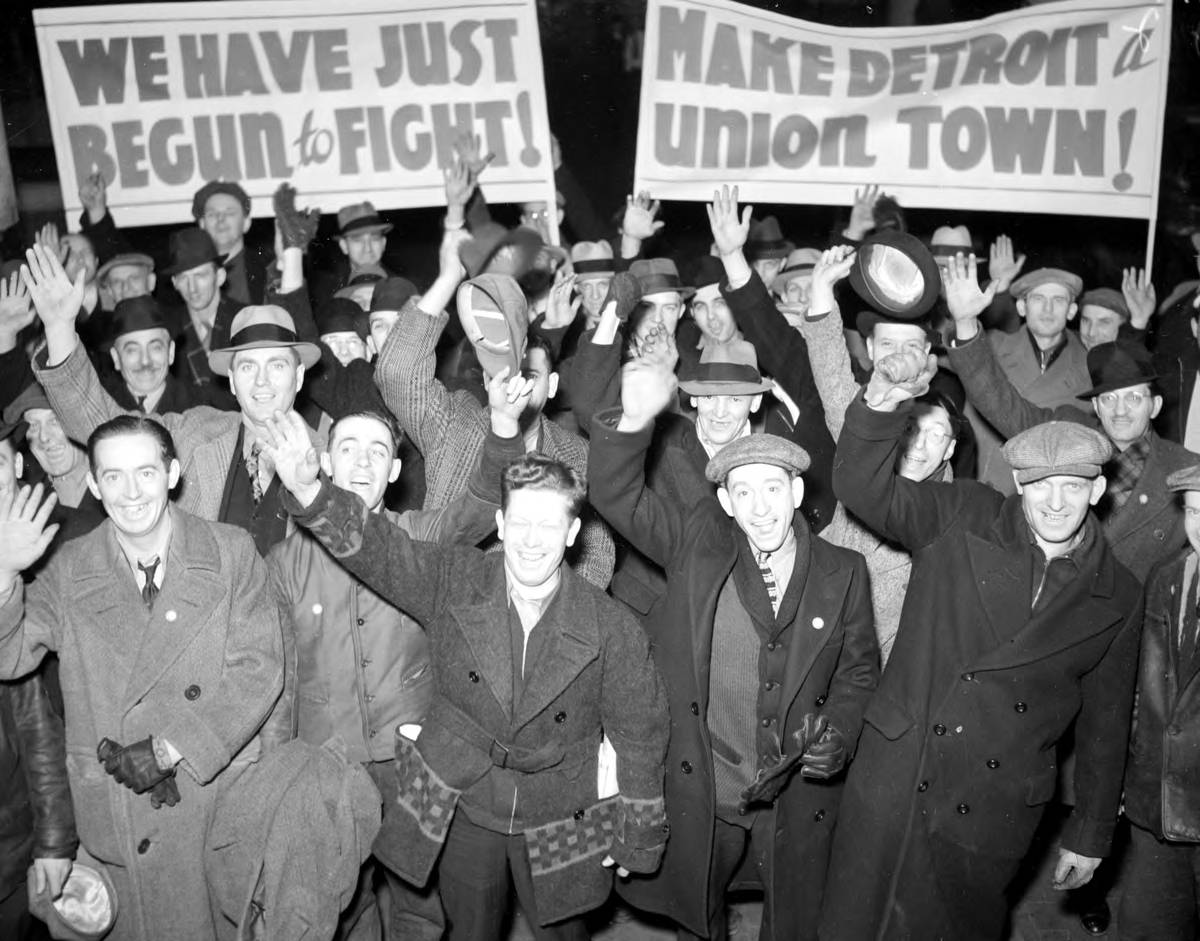
When a new strike was called at the General Motors plant at Janesville, Wisconsin, officials of the United Automobile Workers Union showed they intend to keep their part of the agreement by ordering the men back to work.
Purses
In Bridgeport, Connecticut, 150 pocketbook workers are on strike in protest against being forced into a company union. They demand that the Style Craft Leather Goods Company recognize the official union.
Fansteel
The most severe blow dealt labor recently was the vicious attack of police on sit-down strikers at the Fansteel plant in North Chicago. Using a tower mounted on a truck police fired vomit gas into the building where unsuspecting strikers lay sleeping at 5 A.M. As the men staggered out, a foreman with twenty years service in the company–and not on strike–cut a hole in the fence. For this the foreman was immediately fired by Fansteel. But the end of the sit-down does not mean the end of the strike.
Pickets will make every effort to prevent scab labor from entering the plant.
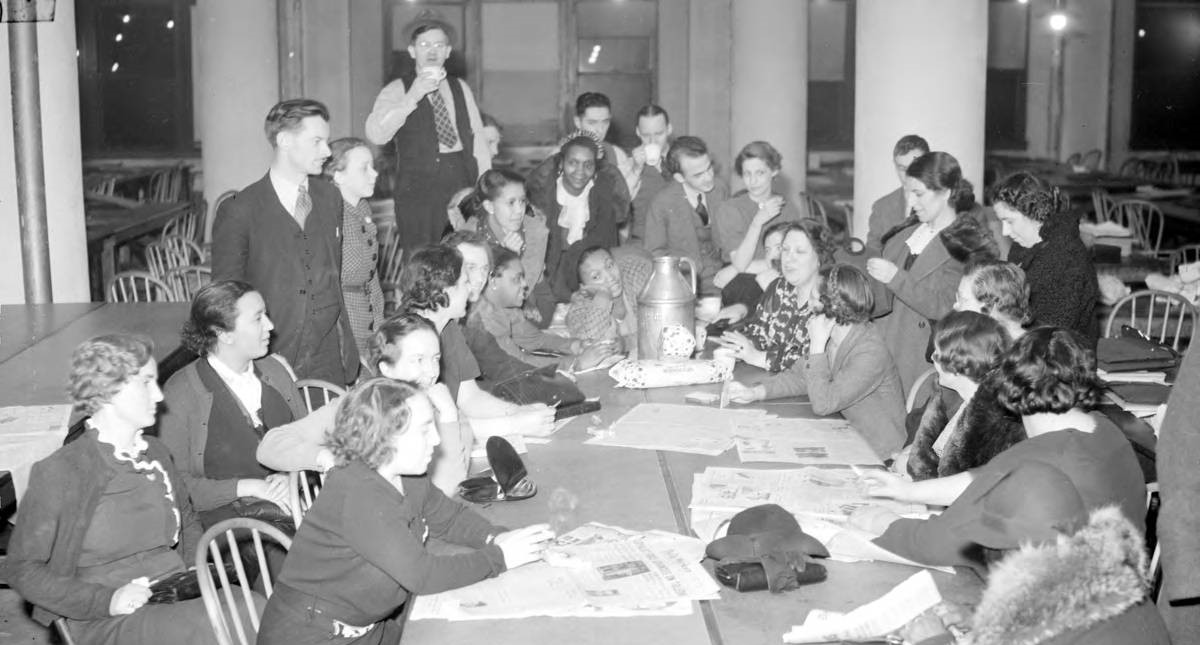
Several corporations averted strikes by voluntarily raising wages. The American Aluminum Company gave 10% increase to 1600 workers at Edgewater, N.J. The Eastman Kodek Company at Rochester announced that their employes would now earn as much in a forty hour week as they formerly had in a forty- eight hour week.
Maritime
Scores of smaller strikes are in progress throughout the country. The sit-down tactic has proved effective in many cases. Courts, according to union officials, will eventually recognize it as a legal labor weapon. An example of why the sit-down method must be used is the case of the Lehigh Valley who refused to reemploy striking seamen on their ships. “There is no reason now,” said vice-president M.F. Hanlon, “why we should dismiss them (scabs) and take back men who quit their posts.” In other words, a men who goes on strike for his rights loses his job for good, according to this executive.
A Pacific Coast tie-up of shipping is again threatened because steamship lines insist on the hated “discharge books” which seamen claim are used to black-list men active in union organization of their fellow workers. The House Merchant Marine Committee in Washington is holding hearings on the issue.
Beware
In Washington the Social Security Board warned workers throughout the country that many corporations are issuing fake blanks in order to get information about their employes. The companies ask about the workers’ union affiliations and activities though no Social Security blank requires any data of this nature.
Hosiery
In the Reading, Pennsylvania, region more than 2,000 hosiery workers are out on strike. Union leaders predict that the total will be swelled to 6,000 within the next few days. In five of the mills the sit-down technique is being employed while picket lines have been thrown around two other plants. The American Federation of Hosiery Workers issued the strike orders.
5 and 10
The most significant strike of the week was that called in two Detroit Woolworth five-and-ten cent stores. Girl employes make organization difficult due to rapid turnover. Now, however, they have made a start. Notoriously underpaid, they demand a 10-cent per hour increase and a forty-eight hour week. Men are asking for a fifty-four-hour week. The Woolworth Company owns 2,000 stores in the United States.

In Rhode Island 2,000 truck drivers have refused to work until their demands for better working conditions are met.
Miners
Three hundred miners elected to remain below the earth’s surface in a coal mine near Uniontown, Penn. Paralleling the recent strike of coal miners in Hungary these United Mine Workers members declare that they will stay in the mine until the Jamison Coal Company signs’ a new agreement with the union.
Estimates place the number of striking workers throughout the country at between 50,000 and 75,000. In the majority of the strikes now in progress union recognition is the major issue.
The Blind
The sit-down technique has proven such a success that even workers who can not see can see that it is to their benefit. Thus, sightless employees of the Pennsylvania Association for the Blind in Pittsburgh started a sit-down strike, demanding better wages and work conditions. 107 are participating.
Socialist Call began as a weekly newspaper in New York in early 1935 by supporters of the Socialist Party’s Militant Faction Samuel DeWitt, Herbert Zam, Max Delson, Amicus Most, and Haim Kantorovitch, with others to rival the Old Guard’s ‘New Leader’. The Call Education Institute was also inaugurated as a rival to the right’s Rand School. In 1937, the Call as the Militant voice would fall victim to Party turmoil, becoming a paper of the Socialist Party leading bodies as it moved to Chicago in 1938, to Milwaukee in 1939, where it was renamed “The Call” and back to New York in 1940 where it eventually resumed the “Socialist Call” name and was published until 1954.
PDF of full issue: https://www.marxists.org/history/usa/pubs/socialist-call/call%202-103.pdf
 Revolution's Newsstand