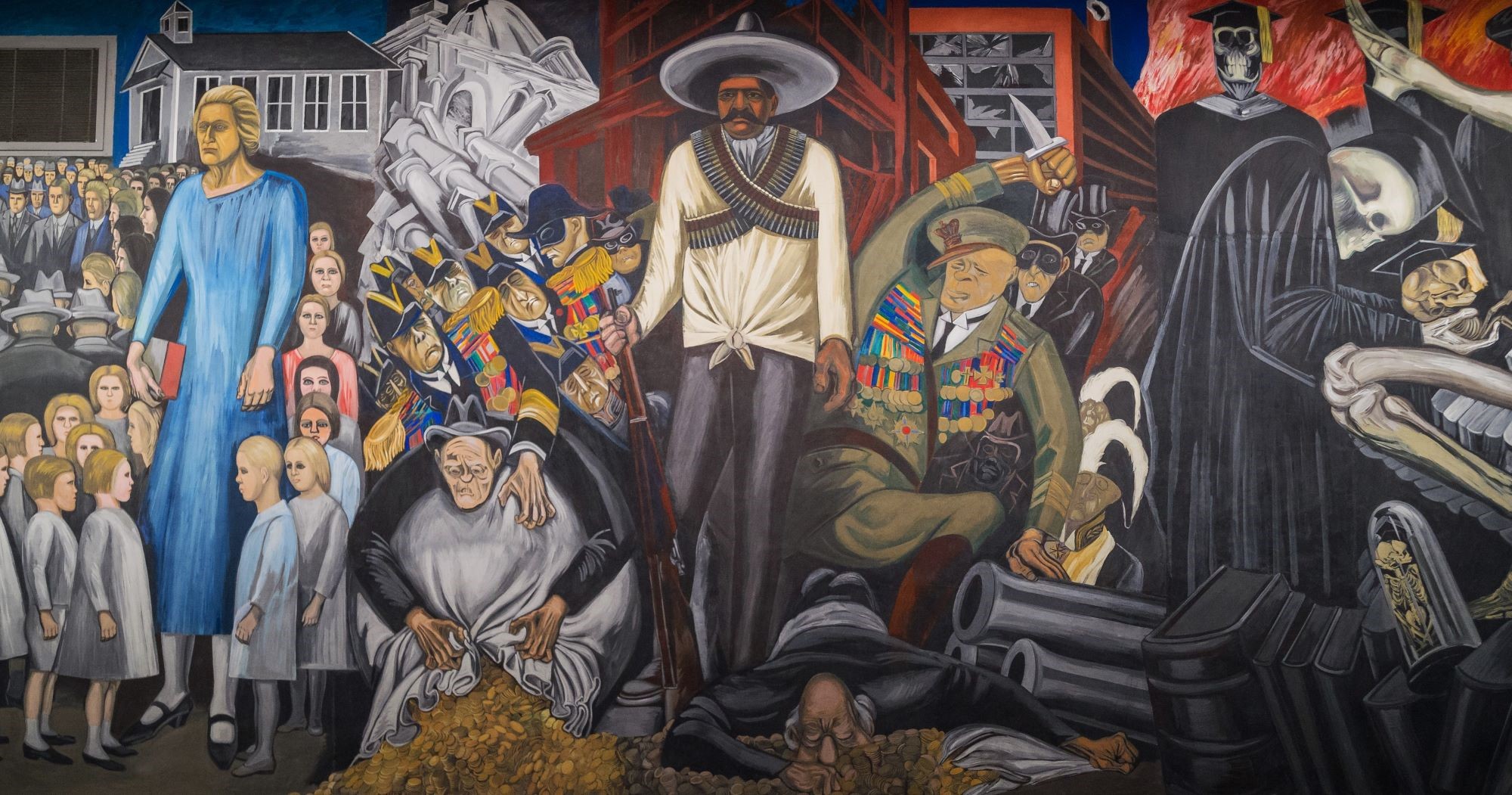
Charmion von Wiegand reviews José Clemente Orozco’s fresco ‘The Epic of American Civilization’ painted for Dartmouth College and finished in 1934. Today the mural is protected as a National Historic Landmark.
‘Our Greatest Mural Art’ by Charmion von Wiegand from New Masses. Vol. 15 No. 1. April 2, 1935.
JOSE CLEMENTE OROZCO’S frescoes in the Baker Memorial Library at Hanover–the largest in the United States–were completed a year ago. For a while the critical battle raged violently. Some partisans of Orozco fell into a coma of mystical veneration; some reactionaries rang the fire alarms for the Ku Klux Klan and the American Legion to destroy the murals. Now that the dust and heat of the conflict have died down, it is possible to estimate the work soberly. It is no exaggeration to say that these frescoes, in regard to color, composition, organic relation to architecture, and grandeur of concept, surpass by far any other frescoes in this country.
Dealing with the epic theme of Man and Culture on the American continent, these frescoes are a vast indictment of contemporary civilization. The indictment proceeds from a humanitarian semi-anarchist viewpoint and attacks with extraordinary force and sincerity the whole of bourgeois culture, including patriotism, religion, imperialism and their subservient academies.
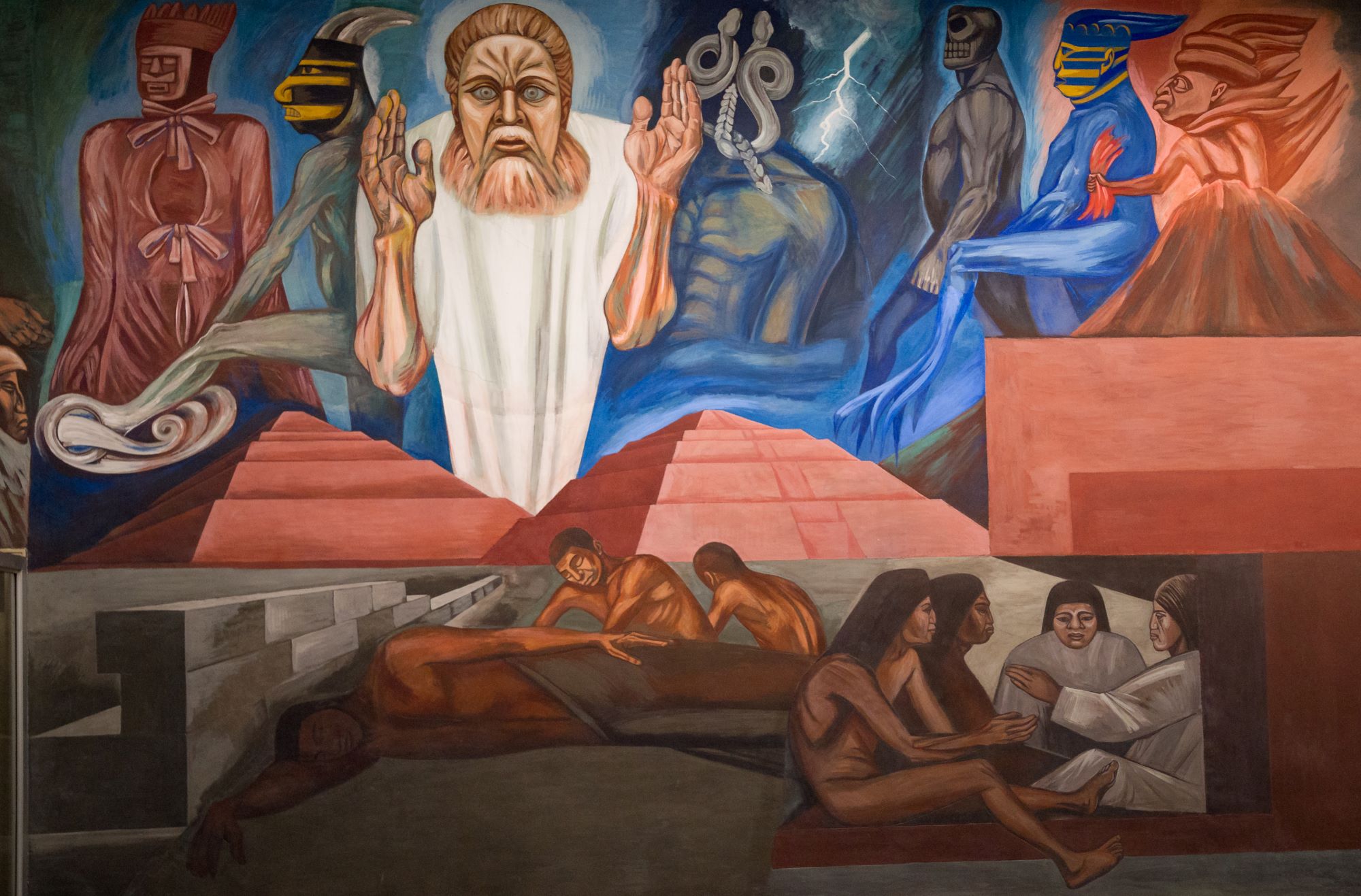
The scene of Orozco’s epic is the western hemisphere, the culture of the Americas. The images are taken from Mexican legend and the history of the United States. Formally, the fresco has two movements: the main figures are vertical, like architectural pillars, and sustain the entire composition, merging into the architectural surroundings; the backgrounds are diagonal, and carry the idea forward visually. With these planes and with the legends of Quetzalcoatl and Cortes, the artist formulates his ideas of good and evil in present civilization. Out of the shambles of the world–the sacrifice of human life for imperialist greed–rises the final panel in which the worker possesses the machine and with it leisure and learning.
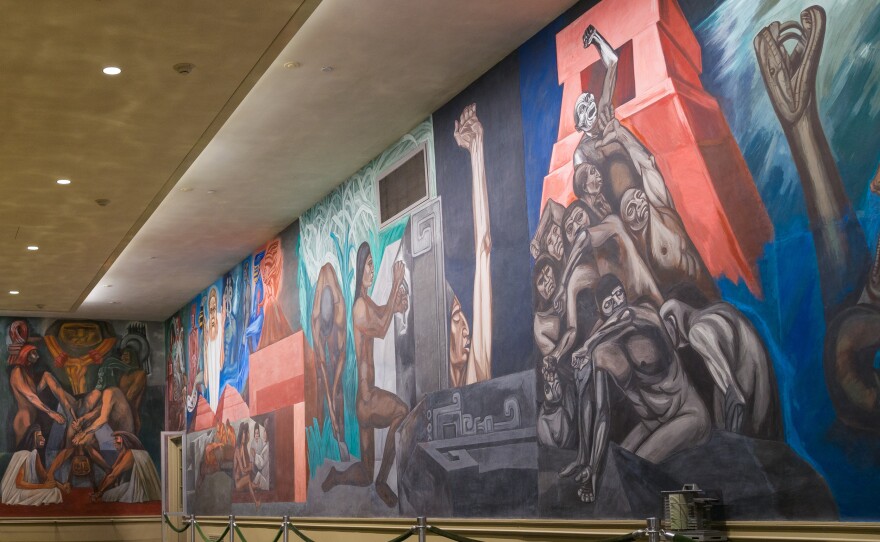
It is unfortunate that most people cannot see the original frescoes; but the twenty-four page brochure just issued by Dartmouth College contains intaglio reproductions of all the panels, which make Orozco’s work to that extent available to a larger audience. The black and white illustrations can give no idea of the coloring, intense and deep like medieval stained glass; nor can they convey the monumental size of the original panels, most of which are nine by nine feet. But the reproductions are clear and give us an idea of the details of the composition. It is a pity that the brochure devotes part of each page to a text “interpreting” the fresco in polite aesthetic terms; but this interpretation cannot weaken the power of the pictures themselves. Nevertheless, the text represents a social force which had its effect on the concept of the fresco. The panels are critical of bourgeois civilization; they move toward the final triptych in which the central figure is a worker stretched at ease before the gaunt skeleton of a skyscraper and peacefully reading a book. But there is nothing in the fresco to indicate the process by which the worker achieves control of the machine, leisure and learning. There is no indication of the struggle necessary for the worker to make the transition from the evil past and present to the desirable future.
Orozco is aware of that struggle. His earlier Mexican murals depict the struggle of the agrarian revolution with great emotion and with specific images. But in Mexico the artist’s audience were peons, workers and militant intellectuals. In Dartmouth the audience consists chiefly of students from well-to-do homes, professors whose economic security comes from the ruling class, and tourists who can afford to visit frescoes in distant places. The murals speak in the language of their audience; the symbols are literary, legendary, oblique, static. In the cloistered buildings and transcendental atmosphere of New England, the class struggle does not intrude. The students are diverted from the needs and battles of the textile and shoe workers outside the academy to the cultural heritage of a dead Europe. Their ignorance and indifference, the frozen ivory tower in which they live and in which Orozco has painted his masterpiece have unconsciously influenced the frescoes, leaving them iconoclastic rather than revolutionary.
But Orozco’s talent has been moulded by the Mexican revolution, in which he participated and which is part of his interior world. He is today once more back in his native country, once more under the influence of its revolutionary movement. Recent photographs of the new mural which he has just completed in the National Theatre of Mexico City indicate that he has advanced far beyond the Dartmouth frescoes, both formally and conceptually. His latest work is a single integrated composition in which the vast struggle raging over the earth’s surface between the exploiters and the exploited is visualized with terrific intensity. The whole fresco is dynamic, full of movement and struggle–a struggle which culminates in the image of three workers’ heads moving against a red flag, toward the future.
THE OROZCO FRESCOES AT DARTMOUTH, Dartmouth College Publications, Hanover, New Hampshire. $1 post-paid.
The New Masses was the continuation of Workers Monthly which began publishing in 1924 as a merger of the ‘Liberator’, the Trade Union Educational League magazine ‘Labor Herald’, and Friends of Soviet Russia’s monthly ‘Soviet Russia Pictorial’ as an explicitly Communist Party publication, but drawing in a wide range of contributors and sympathizers. In 1927 Workers Monthly ceased and The New Masses began. A major left cultural magazine of the late 1920s and early 1940s, the early editors of The New Masses included Hugo Gellert, John F. Sloan, Max Eastman, Mike Gold, and Joseph Freeman. Writers included William Carlos Williams, Theodore Dreiser, John Dos Passos, Upton Sinclair, Richard Wright, Ralph Ellison, Dorothy Parker, Dorothy Day, John Breecher, Langston Hughes, Eugene O’Neill, Rex Stout and Ernest Hemingway. Artists included Hugo Gellert, Stuart Davis, Boardman Robinson, Wanda Gag, William Gropper and Otto Soglow. Over time, the New Masses became narrower politically and the articles more commentary than comment. However, particularly in it first years, New Masses was the epitome of the era’s finest revolutionary cultural and artistic traditions.
PDF of full issue: https://www.marxists.org/history/usa/pubs/new-masses/1935/v15n01-apr-02-1935-NM.pdf
 Revolution's Newsstand