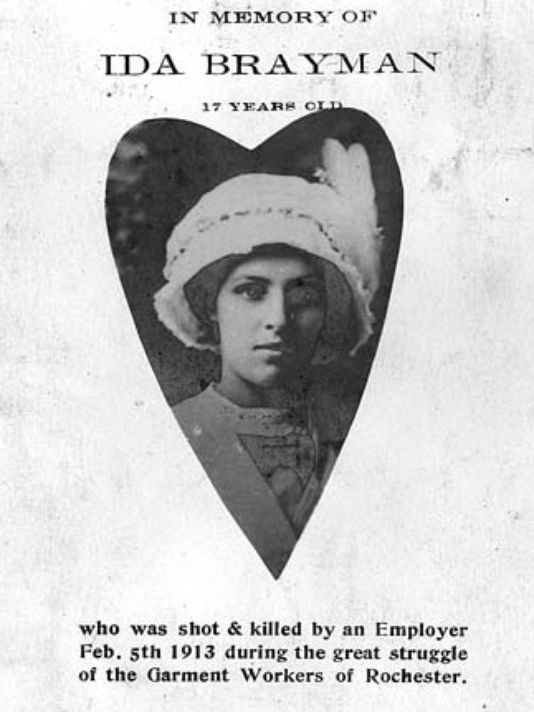
Report on the death of fellow worker Ida Braymun (Ida Braeman), who was shot on February 5, 1913 during a United Garment Workers strike in Rochester, New York. Striking with her father, they were recent immigrants from the Russian Empire.
‘Boss Kills Seventeen-year-old Girl Striker’ from Solidarity. Vol. 4 No. 8. February 15, 1913.
Shot to Death by Garment Boss in Rochester. No Provocation.
(Special to Solidarity.) Rochester, N.Y., Feb. 9. “Striker Shot by Employer” in “scare heads,” was how the pink extra announced the murder of Ida Braeman, 17 years old, a striking clothing worker, just nine months over from Russia.
She, with a number of other strikers, principally girls was picketing the establishment of Valentine Sauter, when he thrust a shotgun through one of the windows and, in the interest of his class, exacted a toll of human life. There was no provocation, no scenes of disorder, no threats, nothing that could justify even a call for police, let alone a resort to arms.
Ida Braeman’s father had just arrived froth New York. That same morning the had despatched a letter to her mother in far-off Russia. The whole of that fatal day was filled with the joyous anticipation that comes but once in girlhood–that night the public announcement of her betrothal to her Russian school boy lover to be made. But Sauter with the short ceremony of assassination wedded her to Death. She wore the bridal wreath of working class martyrdom.
The sound of the fatal shot bad scarcely died out before the pencil-pushing prostitutes of the capitalist press were cooking up a story that would brand this child and her companion as a riotous, life-threatening mob whose actions demanded summary treatment.
“Did you make any hostile demonstration at all, Bessie?” I asked one of the picketing party.
“No, honest to God we didn’t,” replied this 90-pound “amason.” Continuing, “I’ll tell you. We went up there to see his (Sauter’s) people. We were nearly all girls. I was right up at the door, when he came with his revolver that big (stretching out her arms). I laughed at him and said: You old coward, you daren’t shoot. Then I went away again across the street where my friend and some other girls were, and it was after that I heard the shot, and Ida was lying on the sidewalk.”
“Wasn’t she killed in Sauter’s yard?” I asked in amazement.
“She was not” was the emphatic reply. “She was killed on the sidewalk.”
“Say Bessie, weren’t you afraid when you saw Sauter with the gun that close to the door?”
“I wasn’t. We were doing nothing, no why should I be afraid?
Now, I know Bessie Miller, have known her for quite some time. She is a shrinking, timid, mouse of a girl who could not lie successfully if she would, and would not to me anyway in a case of this kind, as she [unreadable] reliable in labor matters. The capitalist kept press printed columns depicting turbulent scenes covering quite a period of time. Stones, bricks [unreadable] and other missiles, it is alleged, were hurled through the windows. The papers cheerfully enough, but very inconsistently. There was a telephone in the shop. Why were the police not notified of these alleged occurrences? Why was it only after Ida Braeman was murdered that the telephone was requisitioned? Is it not more than likely that the first demonstration was one of resentment at the killing of their fellow worker. Bessie Miller was at the door previously, had gone across the street, and spent some time talking with her friends before the shot was fired. Sauter had the gun all this time. He had left the door, and later fired through one of the windows. If there was danger, why did he leave the door to fire through a window? One would think that the door was the logical point to defend. This assassin is represented as acting on impulse and under stress, yet he had the gun in his bands for a lengthy period. WHY WAS THAT TELEPHONE NOT USED?
The crowning infamy of the whole regrettable incident was that the A. F. of L. “leaders” did not have anything to say. Not one word of condemnation for this brutal outrage; not one word of protest at the manifest attempt of the local press to prejudice the balance of the workers came from the strike committee or the officials. The only protest came from the I.W.W. The Herald, February 8, has the following item:
“I.W.W. Talks on Shooting of Striker.
“Alleging that the press of the city deliberately misrepresented the facts of the shooting of Ida Braeman on Wednesday, the I.W.W. last night passed a resolution protesting “against this attempt of the local press to try the case in their columns regardless of its merits.” Following the paragraph of censure, was another of sympathy for the bereaved family. The charter of the sect is to be draped for 90 days, and a copy of the resolution was ordered sent to the young girl’s family.
“The resolution alleges that the shooting was unjustifiable and deliberate murder and refers to the shooting as “this murderous act.” It says that there seems to be an organised effort to misrepresent the facts of the case, and alleges, not upon information and belief, but as fact, that the dead girl was “’peacefully picketing.’”
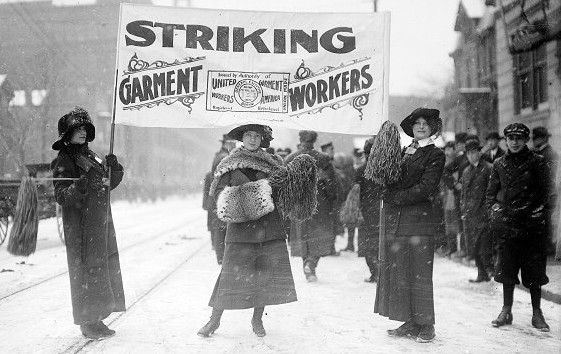
When the police arrived THEY ARRESTED ALL THE WOUNDED on the charge of inciting to riot. These are all held for the grand jury under $2,000 bonds each. The press, the police and the district attorney’s office have all assumed a criminal responsibility on the part of the strikers. Why men and women on strike should be presumed to be criminally inclined in view of the forbearance they manifest in times of industrial conflict and the victims they invariably furnish on these occasions, is not clear to the working class mind. The district attorney has put a fitting climax on the infamous conspiracy to exonerate Valentine Sauter of the murder of Ida Braeman. The Democrat and Chronicle, Feb. 7, chronicling the activities of the district attorney’s office, says:
“Twenty-six employes of Sauter, who were in the shop when the riot that resulted in the killing took place were taken to the district attorney’s office yesterday afternoon by Captain Stein and Sergeant James M. Ellis and examined by First Assistant District Attorney James Mann and Detective Captain Whaley.”
Progress of the Strike
James McManus, state mediator, and incidentally A. F. of L. blue label cigarmaker, is here making “an attempt to bring the manufacturers and strikers together as a step toward the settlement of the strike.” He appears to be having a measure of success. The Adjustment Committee, in deference to a suggestion of McManus, has been sidetracked. The employers and their employes through committee elected by their respective working forces, will deal directly with each other. Recognition of the union has been dropped as a demand.
What is on foot? Why this change of front? Thinking workingmen are asking themselves these questions. The third week of the strike has ended and the education of the workers has been neglected. The management and control of the strike in the hands of the A. F. of L. officials has been of no practical value to the striking workers. Has this abandonment been due to a feeling that the class spirit of the garment workers makes delivery impossible or at best renders it difficult and dangerous? Have funds been slow in coming in? Have the official family had a quarrel? Is there some conspiracy to demonstrate that workers can be more easily dealt with and controlled through efficient “labor lieutenants” than when they recognize the power of solidarity? Haskins, who looked with equanimity on the reluctance of the cutters to strike, and ordered Goldwater’s people back to work, is now shouting himself hoarse for “a general settlement,” “All in together or all quit together,” is now the Haskins-Flett A. F. of L. official cry,
What in hell is the game, anyway? There is a game, for the tiger does not change his stripes nor the leopard his spots. Neither does an A F. of L. gang grow honest or democratic. What is the game?
The most widely read of I.W.W. newspapers, Solidarity was published by the Industrial Workers of the World from 1909 until 1917. First produced in New Castle, Pennsylvania, and born during the McKees Rocks strike, Solidarity later moved to Cleveland, Ohio until 1917 then spent its last months in Chicago. With a circulation of around 12,000 and a readership many times that, Solidarity was instrumental in defining the Wobbly world-view at the height of their influence in the working class. It was edited over its life by A.M. Stirton, H.A. Goff, Ben H. Williams, Ralph Chaplin who also provided much of the paper’s color, and others. Like nearly all the left press it fell victim to federal repression in 1917.
PDF of full issue: https://www.marxists.org/history/usa/pubs/solidarity-iww/1913/v04n08-w164-feb-15-1913-solidarity.pdf
 Revolution's Newsstand