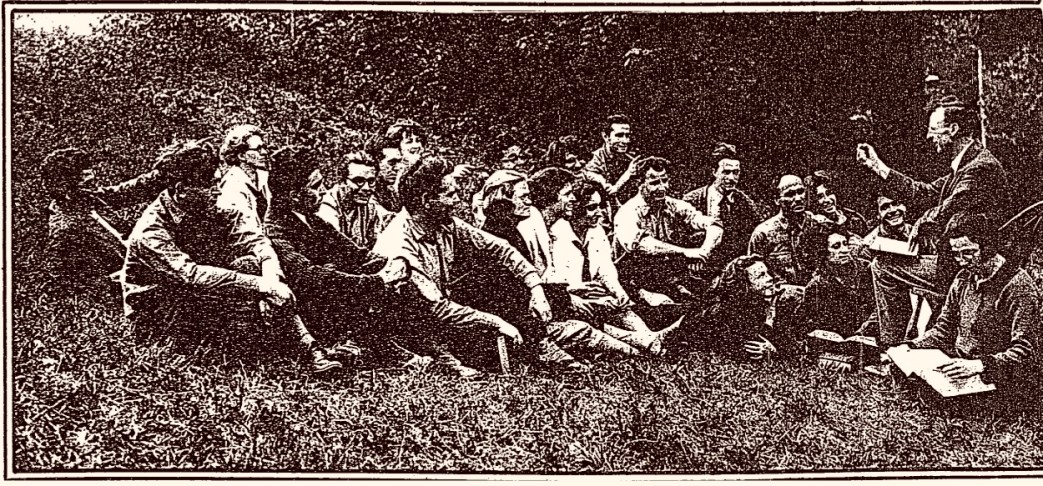
A.J. Muste describes a day of activities at the Brookwood Labor College in Katonah, New York during the summer session of 1925.
‘From Dawn to Dusk at Katonah’ by A.J. Muste from Labor Age. Vol. 14 No. 8. October, 1925.
How They Do It ‘In the Good, Old Summer Time’
WHAT do trade unionists do when they go to summer school at Brookwood? Let us take a day during the Railroad Labor Institute. At seven o’clock in the morning you might see individuals or small groups coming out of the dormitory and taking a stroll down the Brookwood road while the dew is still fresh on the grass. At eight o’clock all hands report for breakfast in the attractive, newly-decorated dining room, whether or not they have had their constitutional. As they enter the dining room they find awaiting them mimeographed copies of The Safety Valve, a daily paper, mainly humorous and interestingly illustrated with cartoons of the members of the Institute. The editors, including a locomotive fireman and a boilermaker, have been sitting up until the wee hours of the morning in order to get out this paper, which frequently contributed to the hilarity of the members and guests of the Institute.
After breakfast groups went for a stroll or gathered on the veranda of the Main House, overlooking the beautiful valley in which nestles the little village of Katonah, for the discussion of more or less weighty problems. In one corner, for example, you may hear a general chairman on the Chesapeake and Ohio system explaining how it is the most wonderful railroad in the world, to a B. & O., a Canadian National and a New York Central man. One of his auditors innocently inquires whether it is true that the Chesapeake and Ohio runs downhill all the way!

Promptly at 9:30 Arthur Calhoun of the Brookwood faculty, who served as educational director of this summer’s institutes, rings the bell and the students gather to attend “class.” The “teacher” this morning is Otto Beyer, Jr., consulting engineer of the Railway Employees’ Department of the A. F. of L. He is conducting a course outlining the history of railroading, organizations, management and financing of railroads, phases of government control, the history of the railroad labor unions, the development of union management, co-operation, etc. Toward the end of the week his “class” was conducted for a few sessions by George Soule of the Labor Bureau, who outlined the sources from which higher wages may be derived and the means by which organized labor may effectively tap those sources.
Pipes, Cigarettes and Discussion
One must not get a mistaken impression, however, from the use of the word “class.” The railroad men in this “class” were not afraid to interrupt the “teacher” to ask questions, to cite illustrations from their own experience, either bearing out the teacher’s contentions or seeming to throw doubt upon them. In several instances more sessions of the “class” were devoted to discussions by the members, interspersed with occasional comments by the “teacher.”
At 10:45 the session is interrupted for fifteen minutes. In the meantime the morning mail has arrived and those who have received any hastily glance at its contents. Naturally everybody takes the opportunity to take up a pipe or a cigarette. Here and there groups are eagerly discussing the problem which has been placed before the class, or have the instructor in a corner and are trying to get further information from him.
At eleven o’clock Arthur Calhoun again rings the bell and the class reconvenes. Somewhere between 12:15 and 12:30 the morning session comes to an end and after the men have had another opportunity for a walk or for tossing about an indoor baseball or. a medicine ball, they welcome the luncheon bell at one o’clock.
A baseball game is scheduled for 2:30 in the afternoon. The battery on one side consists of the athletic Miss Clara Cook, assistant to Mr. Keating, the editor of Labor, as pitcher, and a machinist as catcher. The battery on the other side consists of a professor of labor problems as pitcher and a locomotive fireman as catcher. The boilermaker at bat succeeds in getting a healthy crack at the ball, only to have it caught in deep center field by Jimmy Thomas, the son of the well-known British railroad union leader, J. H. Thomas, who is at the present time connected with the office of the president of the Canadian National Railway.
The baseball game, the exact score of which is still in doubt, might have been followed by various groups going on automobile rides through the beautiful Westchester hills or Hudson River country, or by the more active ones supplementing baseball with a game of tennis. This afternoon, however, there is an extra speaker on and Mr. Whiting Williams, the well-known publicist, author of “What’s on the Worker’s Mind,” recounts his experiences as a laborer in various industries, and advances the contention that security of employment plus the sense of working at something that is of service to society as a whole are the main drives in the industrial worker’s mind.
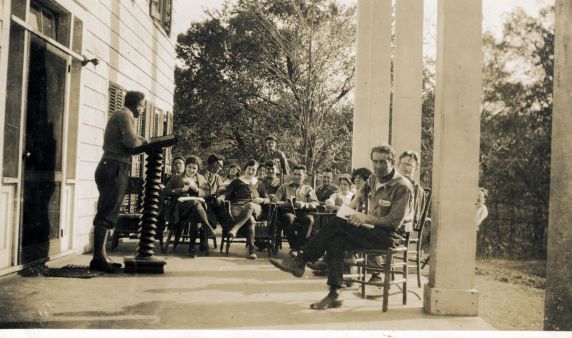
After dinner at 6:30 the evening session convenes at eight o’clock. Donald Richberg, attorney for the railroad labor unions in many famous cases, delivers a masterly address, suggesting how labor’s representatives may effectively present their case before grievance boards, in conference with management and before public or private boards of arbitration and conciliation.
“Education Will Help Unions”
On the opening night of the Railroad Labor Institute, Bert M. Jewell, head of the Railway Employees Department of the A. F. of L., delivered the keynote address, in which he outlined the development of railroad unionism and suggested the problems confronting labor organization and railroad management at the present time. In concluding the address, which will be printed in full in the Brookwood Review, Mr. Jewell said: “Co-operation between management and employees, like all human progress, depends upon education and dissemination of facts…As one of the essential prerequisites to the further extension of collective bargaining, to the inauguration and natural development of this new spirit, this new policy, trade unionists must and they will attach a greater and greater value to education, and as rapidly as railroad workers and railroad management can educate themselves, gather and disseminate facts and be guided by them, just so rapidly will the preservation and advancement of our railroad industry, in which we railroad workers have invested our lives, be established and assured.”
This first railroad labor institute ever held in the United States may yet prove to have been an epoch-making event. The Institute will doubtless become a permanent feature of the Brookwood summer program. The success of the experiment, in co-operation. with the railroad labor unions, suggests the advisability of similar experiments. with textile, building trades, mining and other groups. It seems certain also that the inspiration and the ideas received by the representatives of the ten standard railroad labor unions who were at Brookwood this past summer will lead to the development of a substantial program of labor education in various railroad centers throughout the country.
The daily program of the General Labor Institute which was held during the second and third weeks of the month followed the same general lines as that of the Railroad Labor Institute. Those in attendance included representatives of the electrical workers, textile workers, motion picture operators, molders, railroad telegraphers, teachers, federal employees, garment workers, painters, carpenters, cap makers, lithographers, subway and tunnel constructors, machinists, miners and boilermakers. Some of these were officers, others active members of the rank and file.
“The Control of Wages”
At the morning sessions of the first week of the Institute a study was made of Hamilton and May’s book on “The Control of Wages.” During the second week the history of the war and post-war period was studied from a labor viewpoint, the problems discussed including the trend of real wages during the period, the trend of unionism, important industrial struggles, efforts of labor on the political field, international relations of the A. F. of L., as expressed for example in the relation of the A. F. of L. toward the Mexican labor movement and the recent pronouncement of President Green on the situation in China.
At the evening sessions Professor Illtyd David of the University of Wales, a prominent figure in the British workers’ education movement, Robert Fechner of the General Executive Board of the Machinists, F. M. O’Hanlon, secretary-treasurer and legislative representative of the New York State Federation of Labor, A. Lefkowitz of the Teachers’ Union, L. D. Wood of Philadelphia, expert adviser to Matthew Woll, chairman of the A. F. of L. committee on life insurance, Ben Selekman of the Research Department of the Russell Sage Foundation, and Robert W. Bruere of the Survey, introduced discussions on such subjects as the British labor movement and workers’ education, railroad union organization in Cuba, labor legislative activities, union labor and life insurance, the company unions and giant power.
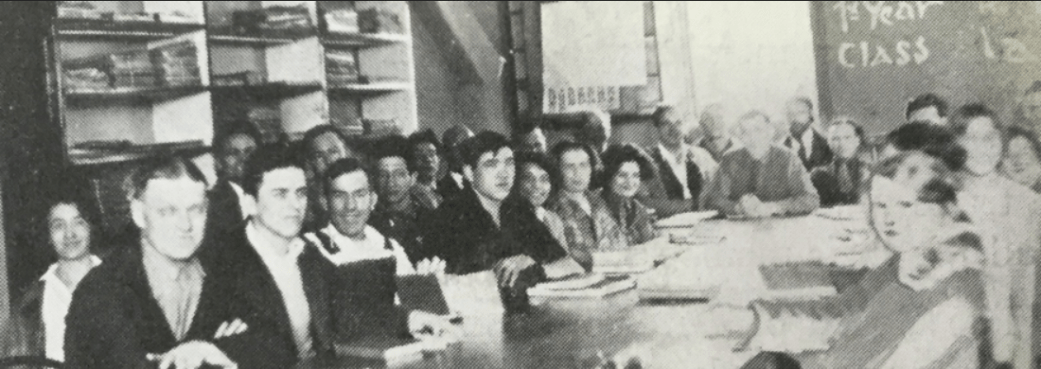
Several things seem to be clearly brought out by Brookwood’s experiments with summer sessions. For one thing it is evident that trade unionists at least in considerable numbers are deeply and genuinely interested in getting the practical education that will pretty directly help them to be more intelligent and efficient members of their organizations. They like to “talk shop” with fellow workers from other parts of the country or from other industries and with students of economic and labor problems who have given thought to the theoretical aspects of the matters in which labor is interested.
Renewing Inspiration
It is also evident that an increasing number of trade union officials desire the development of education of this sort and are willing to assist in such development. In connection with the Railroad Labor Institute, Brookwood had the enthusiastic assistance of Bert M. Jewell, Railway Employees Department head, as well as of the editors of a considerable number of the official railroad labor journals. In connection with the General Labor Institute Brookwood had the assistance of a committee representing organizations as varied as: the Central Trades and Labor Council of Greater New York and vicinity, the International Ladies’ Garment Workers’ Union, the Printing Pressmen’s Union, the New York Council of the International Brotherhood of Painters, Paper Hangers and Decorators, the Women’s Trade Union League, the Amalgamated Association of Lithographers, the International Furriers’ Union, the Upholsterers’ Union of North America and the United Cloth Hat and Cap Makers. It would seem also that summer schools may furnish an opportunity to those who as organizers or teachers are doing the actual work of the workers’ education movement throughout the country to get together in order to compare notes and have their inspiration and enthusiasm renewed. Many of these people, whether teachers or trade unionists, cannot get away from their localities at any time except during the summer. No movement can succeed, however, especially in its early experimental stages, unless those who are engaged in the work have an opportunity to check up on each other’s experiences. This opportunity the summer school would seem to afford to a great many. During August there were at Brookwood representatives of workers’ education enterprises in Baltimore, Minneapolis, St. Paul, Milwaukee, Philadelphia, Washington, D. C., New York City, Salem, Mass., Sub-District 5 of the United Mine Workers in Illinois, the International Ladies’ Garment Workers’ Union, and representatives of the Workers’ Education Bureau of America.
Stirred by this success, Brookwood is already beginning preparations for carrying on summer sessions on a more extensive scale next year.
Labor Age was a left-labor monthly magazine with origins in Socialist Review, journal of the Intercollegiate Socialist Society. Published by the Labor Publication Society from 1921-1933 aligned with the League for Industrial Democracy of left-wing trade unionists across industries. During 1929-33 the magazine was affiliated with the Conference for Progressive Labor Action (CPLA) led by A. J. Muste. James Maurer, Harry W. Laidler, and Louis Budenz were also writers. The orientation of the magazine was industrial unionism, planning, nationalization, and was illustrated with photos and cartoons. With its stress on worker education, social unionism and rank and file activism, it is one of the essential journals of the radical US labor socialist movement of its time.
PDF of full issue: https://www.marxists.org/history/usa/pubs/laborage/v14n08-oct-1925-LA.pdf
 Revolution's Newsstand