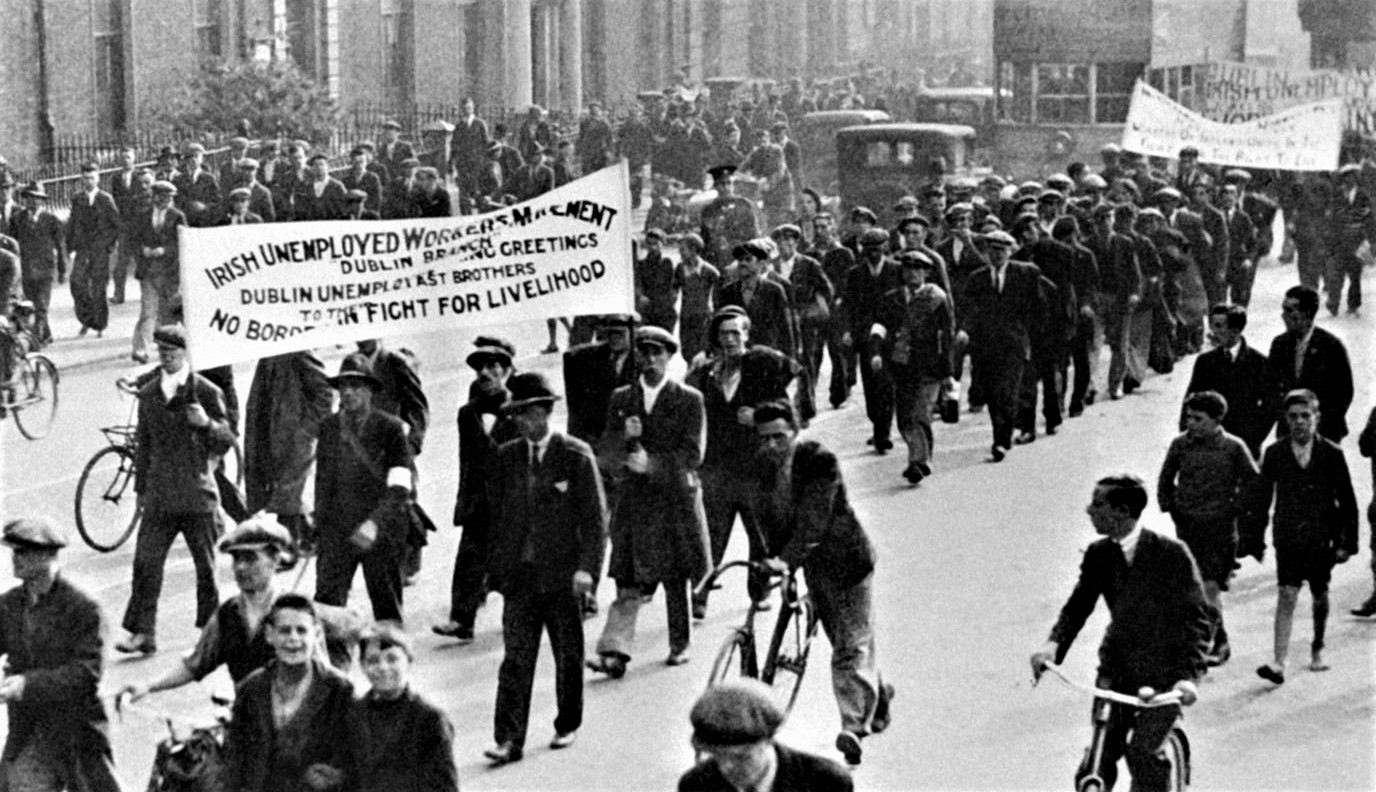
Spread over three issues of Inprecor, this detailed report on the (re)founding of the Communist Party of Ireland as local Revolutionary Workers’ Groups united in 1933 includes transcriptions of speeches from Sean Murray and Jim Larkin, Jr. Debates from the congress are also transcribed, mostly centered on the unfinished national revolution and the inherent difficulties of organizing a working class divided by sectarian and state allegiances in a country still dominated by British imperialism
‘The Foundation Congress of the Communist Party of Ireland’ from International Press Correspondence. Vol. 13. Nos. 34, 35, & 37. August 4, 11, & 25, 1933.
The foundation Congress of the Communist Party of Ireland, which took place on the 3rd and 4th of June in Dublin, a report of which appeared in our issue No. 26 of June 16, is an exceedingly important event in the history of the Irish working-class movement. We are therefore publishing in serial form a detailed report of the proceedings and the speeches delivered at the Congress. EDITOR.
Chairman’s Speech: Jim Larkin, Junior. In declaring open the Inaugural Congress of the C.P. of Ireland I welcome the delegates on behalf of the Secretariat and National Committee of the Revolutionary Workers’ Groups.
We meet to bring into being the General Staff of the whole of the struggle of the Irish working class and working farmers. The Congress is of significance not only to the Irish working class, but is also of great importance to the workers and peasants throughout the British Empire struggling against British imperial- ism. We have in Ireland great traditions of revolutionary struggle, but until now the Irish working class have not had the necessary revolutionary leadership which only the Communist Party and the Communist International can give. We meet today to give that leadership to the Irish workers’ struggles. Our Party has the historic duty of leading the working class of Ireland in the development of the struggle for the emancipation of the Irish working people and the socialist revolution.
Comrade Larkin then outlined the class struggles of the workers and their participation in the revolutionary national struggles. Continuing, he said, in all this the working class were unable to separate from the leadership of the petty bourgeoisie in the national movement. The historic background for the Inaugural Congress is the age-long struggles of the Irish people, which is pregnant with lessons for the Communists of Ireland and the working class.
The utmost need in the struggles to-day is the need for a resolute rank and file leadership of the struggles and the creation of a mass Communist Party. The absence of a C.P. in the economic struggles of the railwaymen, in the struggles of the Belfast unemployed in October had the effect in the inability of the revolutionary movement to organise these struggles and to connect up the many isolated struggles that are taking place everywhere in connection with the crisis.

We must see that these lessons are learned and that the inauguration of the Party will meet the long-felt need for the development of a real leadership of the struggles of the working class. The situation was never more favourable. We do not always feel that we are part of the world movement. The period is one not of quiet and calm, but one of wars and revolutions. Capitalism is in the melting pot. The capitalist crisis still deepens and extends and the impoverishment of the masses abounds. The growth of fascism and the ever-growing menace of new imperialist wars are present. In the Soviet Union the workers are marching forward to new successes of socialism. New Soviets are born and strengthening in Soviet China. The upsurge of the Irish masses, which brought De Valera to power, is part of the world upsurge of the masses against world imperialism. Communism and Marxism are the weapons of the working class. Marxism has been justified up to the hilt. In the same degree the policy of social democracy has been condemned in the eyes of the million masses, and to-day they (the S.D.s) are lying at the feet of Hitler. The Irish struggle is part of the international fight. We have the task before us of creating a leadership based on Marxism and Leninism, the only theory which will guarantee the success of the struggle.
Resolutions of greetings were then read to Germany, America, Britain, and the national and class war prisoners and the prisoners in the colonies.
Comrade Murray, dealing with the importance of the Congress, said that the present Congress was a break with the old traditions of the class fight in Ireland and a step from the position of the scattered groups without very much leadership. The translation into life of the resolutions and decisions will mean a solidifying of the R.W.G. from Belfast to Cork.
He welcomed the delegates to the Congress who had come from the shipyards and the linen mills of the north, from the mines and mills of Kilkenny, as well as from Dublin and Donegal, and the working farmers of Leitrim. With all the handicaps this proves that there is growing a very strong consciousness of the need for a class party of the workers, despite the reaction. It is a proof of the growth of the revolutionary movement. The C.P. is the united Irishmen of the 20th century.
What are all the resolutions and material before the Congress? We are living in a nation that is torn asunder and ruled by imperialism, betrayed again and again by the Irish capitalists. It is clear that we must devise ways and means of breaking the imperialist rule and uniting the revolutionary forces as a first step on the road to social emancipation. How are we to achieve this? The documents before the Congress help to clear this question. It is necessary that we see what are the conditions under which the struggle is going forward. If we cannot see the differentiation among the enemy and see the difficulties among the imperialists, then we will be the blindest of the blind. This is the first thing mentioned in the manifesto. “Revolutionary Ireland obtains a mighty international ally such as it never had before in all its history.” The British imperialists are in difficulties they never before experienced. The plundering power of the British Empire is lessening. In India a tremendous revolutionary struggle is going forward. British imperialism is losing its power as an imperialist world nation. It has to grant economic concessions in order to safeguard its military and political power. It has been forced to make concessions at Ottawa to the Dominions in order to make ready for the coming war. In addition, there are the great struggles of the colonial peoples. On the other hand, the supreme conflict is between the forces of imperialist capitalism and the forces of the national liberation and socialist movements, which will force capitalism out of existence.
The national struggle is the prime question. The resolution deals with the different forms of the revolution, and in Ireland it is necessary that we understand the stage we have reached. If the Irish capitalists had done what they should the national question would be solved. They also shout loudest about nationality who fight against the independence struggle. The Communists are internationalists because they are the greatest exponents of the national independence struggles. The struggles of the past in Ireland prove that the Irish capitalists have deserted the struggle. They now no longer even worship the past leaders of the national movement. Tone is a “cut-throat.” Emmet is denounced. The capitalists are against national independence. They are the people who have betrayed the struggle for national independence. The capitalists are afraid that the solving of the national question will clear the way for their own destruction and the building of socialism. They see clearly that the Republic will weaken the capitalists and lead to the social revolution. The formation of the C.P. will drive forward the national revolution. This is proven in the Congress, where the Belfast workers come together with the best national fighters of the South. The national struggle under the leadership of the Communists takes on a class form and makes clear to the Northern workers that the national struggle is the way to the smashing of the class power of the capitalists.
The manifesto points out that the national struggle is a class question, and victory or defeat will depend on which class is at the head of the fight. In the past our weakness was that we did not see clearly that it was necessary to change the class leader- ship of the national struggle. What class have we to lead the struggle? The whole history of Ireland shows that from the time of the Gratton volunteers the capitalists have betrayed and deserted. In 1782 Gratton Flood prevented the movement from developing into a struggle for national independence. The merchants took care that the movement stopped when the parliament was gained for the merchants. In ’98 the working class was not nearly so powerful as it is now. The United Irishmen leadership were forced to see that the merchants were the first to betray the struggle. McCracken said: “My experience of the movement teaches me that the rich will always betray the poor.” The manifesto points out that the merchants were prepared to sell the independence fight for certain privileges for the middle class. In 1848, as the manifesto says, both O’Connell and the Young Irelanders interpreted the national movement in their own class way. The capitalists were prepared to betray their own country in order to prevent the workers from getting control of the movement. In all the movements the leadership was in the hands of the representatives of the capitalists. This is driven home in the manifesto, and the delegates will do well to remember this. We come to the conclusion that the class interests of the Irish capitalists are in contradiction to the national struggle and the national demands of the Irish people. The Irish capitalists need the aid of a foreign imperialism in order to hold down the working people. Can the peasants lead the struggle? We must conclude that they cannot. The farmers have always been under the leadership of the middle class. The farmers are not concentrated and are difficult to organise. Also the farmers themselves are divided into classes, and at the present time the big farmers have come out openly on the side of the imperialists. However, the working class in the national revolution must find allies in the masses of the peasantry, and no movement for social and national liberation will be successful that does not take into account the reserves of the revolution. The working class as the leader is not clearly understood yet. At the Saore Eire Congress a delegate said that the farmers were the chief class in Ireland. Our first word in the manifesto is to the workers. It is necessary to burn into the minds of the workers that they alone are the class to lead the national struggle. We must tell the farmers that there is no hope of escape from poverty without an allied fight under the leadership of the workers. Finally, we come to the working class, and have taken our stand to proclaim to all Ireland that the working class is the only class that can lead the national struggle through to an end. The working class, like the capitalists, is concentrated in towns and factories, even though the factories in Ireland are small. The working class is superior to other classes in that it is concentrated, can be easily organised, and has not got small property ideas. British imperialism has divided the country into two, and divided the working class by religious methods, and in this way has found a way to split the people on non-essentials. That phase is passing because revolutionary forces have come to consciousness and see from the class point of view the way to unite the workers. We say: only the working class can unite Ireland. This is proven by the growth of the movement in Belfast, surmounting religious and racial differences. It is untrue to say that the Communists are doing anything against the interests of Irish independence. We are breaking down the barriers and bringing together workers from Waterford and Shankhill in Belfast. This is the best proof the Communists are travelling the correct road to national unity and independence. The nationalist movement has got to break away from a religious sectarian basis in the North if it is to come to the real fight against British imperialism. It is significant that De Valera declared that on the question of partition he could not see any solution to the problem. Anybody who stood on the grounds that the fight is divorced from the class issues must admit the same. Sinn Fein must admit this and their bankruptcy. By their sectarian anti-working-class attitude they drive away the only class who can unify the country. De Valera spoke the mind of the whole class in admitting bankruptcy on partition. Only the working class can solve the question of partition.
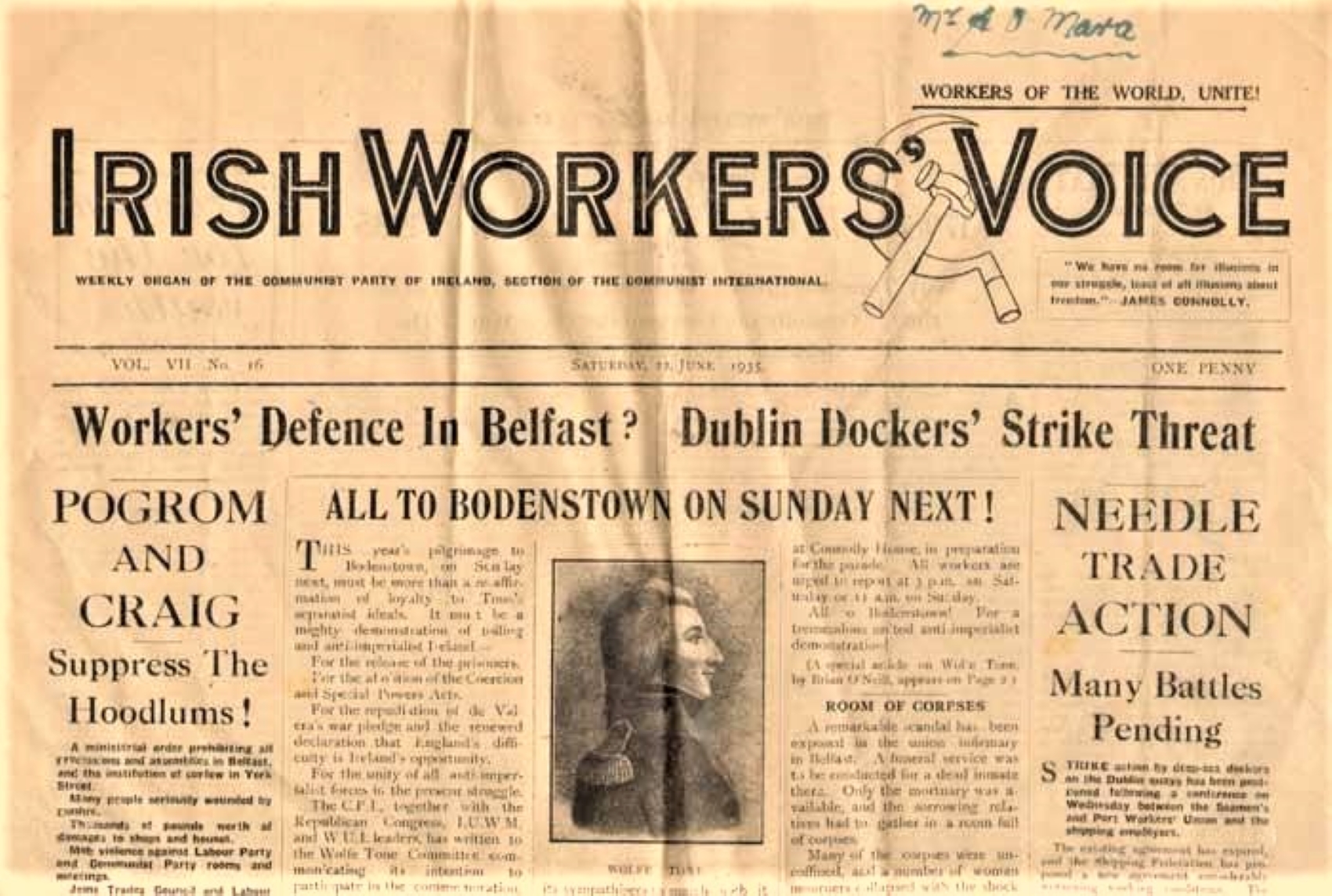
We have in the document covered the ground from 1782 to 1932. An important question raised in the manifesto is the international allies of the Irish people. And if we go into the past we will find that this was not the only time we had international allies. The capitalists do not like internationalism, but they are already at Rome, and for a definite political purpose. It is not for the internationalism of Jesuitism or Rome that we stand, but for the international fight against imperialism, and with the millions of our Irish emigrants abroad in exile. It is an internationalism that brings us into direct contact with the first country to break with imperialism–the U.S.S.R. International working-class unity is in line with the best traditions of the Irish struggle. Some people will say: “Why not cut out all the talk about Russia?” But this would not solve anything. It is not only that the Communists speak of the achievements of the Soviet Union. If it were only talk, the capitalists would not mind, but it is the living fact of the Soviet Union which raises the question so sharply, which makes the capitalists write so much about Russia. The capitalists would like to prove that this one country which has destroyed the rule of the imperialists could not succeed under the rule of the workers. They cannot do this, so they bring in the question of religion. Rather should we say to those who declare to us: Why not stop talking about Russia? Why don’t you demand that the capitalists stop waging slanderous attacks on Russia and preparing intervention? We must note the success of the U.S.S.R. as a powerful weapon in our hands. Then we hear that it would be better not to use the name “Communist.” The rulers used the same tactics against Tone and the Republican movement, so what can we expect them to say about the workers’ party? The C.P. is the only way forward, and the capitalists have made Communism the bogey because it menaces them. The Saore Eire was a body of workers and farmers, but it, too, soon came under the barrage of the bogey-makers. It is not the name but the content of the Party they fear, and they would denounce the St. Vincent De Paul Society if that body attempted to try and solve the social problems of the people. We are going forward, and the campaign against us cannot stop the class fight in Ireland and the growth of the Party. We ought to learn from the old parties. Sinn Fein could see that the course of events would bring them to the head of the mass fight.
Comrade Murray, continuing, said: There is no mention of religion in the document, and this is not done for tactical reasons, but as a question of principle. Religion is not a fundamental question, and it is on the economic and political issues that we must lead the fight. The capitalists are pressing into the fight the powerful weapon of religion. They are over-reaching themselves, and our Party stands and will insist on our members giving first allegiance to our class, our Party, and the cause of the Irish people. The clergy are making it clear, as Marx once said, that “they are the spiritual police of the master class.” In the Soviet Union the solution of the religious issues was reached by breaking the secular power of the church. This is the solution to the questions here. While it is not a fundamental question, we must make our position clear. The main thing is to see that the class struggle is sharpening. The next period is going to be one of very acute class struggle. The October relief fight, the railway official and unofficial struggles, are signs of the growth of the mass fight against capitalism. The De Valera Government, far from solving the questions before it, finds itself more and more faced with the opposition of the workers. The situation is one of deepening crisis. The capitalists know that they cannot stop the class struggles, and the period ahead is fraught with possibilities for mass struggles. They hope, however, to be able to crush the leadership in advance. I would estimate the situation as follows: the De Valera government will go on the way of a compromise on the constitution. The De Valera government is unable to lead the struggle for the Republic because it is tied to the capitalists. The role of the F.F. government is to hold back the mass movement and to discredit the national movement. This will happen unless the revolutionary workers get the leadership of the mass movement. In the North of Ireland the imperial government is attacking the unemployed through a new Bill. There will be a great increase of class activity and economic battles, though Devlin may be able to hold some influence over the national movement.
Our outward appearance will remain the same for some time. It is the mass economic struggles that we must pay particular attention to and get the leadership of in the North of Ireland. attitude to the national forces in the North will have a big effect in winning over to the movement the Northern workers.
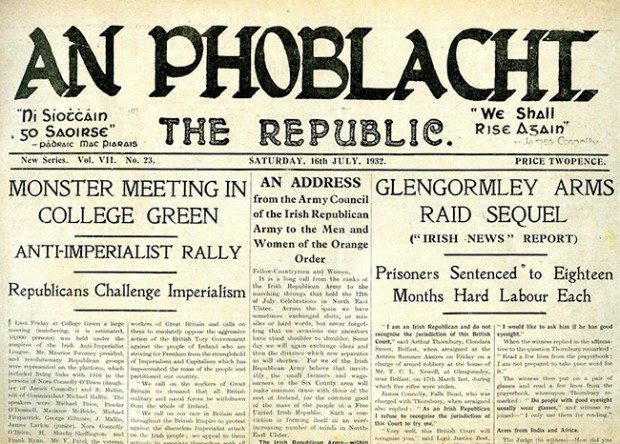
The further big question is the position of the “Left” national Movement in Ireland as a whole. There is a complete change taking place inside the national movement. There is a steady advance of the rank and file Republicans to the “Left.” An indication of this is the support we received in the attack on Connolly house and the Gilmore case. Just as surely as the rank and file is going to the “Left,” the leadership of the movement is moving to the Right. The day was when the leaders said they were opposed to Communism “because the rank and file was not ready for Communism,” but this situation has changed. Everything is now done to prevent the rank and file from coming to Communism. The whole direction of the leadership has been to please the middle class and to hold back the rank and file. The last few weeks the “Phoblact” had gone back to the Republic of Mary MacSwiney. There is a shift of the Republican movement to the Right. Such a move backward can only lead to disaster for the national cause. We are correct when we try to win the revolutionary workers into the C.P. This will strengthen the revolutionary nationalist movement. Some say that the Right leaders will go to open attack on the workers. This is not so. They will play with “Left” slogans and hesitate in the struggle against Irish capitalism and British imperialism. We have no secrets as to our policy in the national revolutionary movement. Our forces must be strengthened and the “Leftward” moving workers drawn to our policy. This will strengthen the national movement and guard against retreat.
Finally, if we accept the manifesto the task we have to do is to popularise it among the workers. On the basis of the manifesto we must proceed to recruit more and more workers into the Party and build powerful groups. We must develop our propaganda so that we will be able to meet the barrage that is against us and reply to the attacks. We did get out a pamphlet, but there are still thousands of these still unsold. The “Workers’ Voice” must be made an obligation to push by every comrade. We must get into the factories and the trade unions. We must build up the strong local and national leadership which we have not got at present. We must have a strong Central Committee, representative of the best in our movement. We must break with the isolation of our groups in the different parts. We must have a stronger spirit of discipline and the loyal carrying out of decisions. Finally, the manifesto should be closely studied by every member. I am convinced that we are following in the best traditions of the Irish fight for freedom. We are taking the best road to the Party of the Irish working class, to national independence, and to the social emancipation of the Irish toilers.
Comrade Crozier (Belfast). Comrade Murray has given us an extensive outline of the manifesto. The whole country of Ireland is the history of struggle. Every struggle in Ireland was abruptly terminated when it came into conflict with the class interests of the Irish capitalists. At the present time the De Valera government stopped short at the point of incomplete national separation. Only the working class with the C.P. at its head can carry through the struggle to the end. The workers are under reformist leadership and will be held back as long as this is so. We are now in a position to get the workers together and let them see that the best road is the road of struggle. We have got in on the railways and we do not hide our Communism from the workers. We have got in Belfast a new leadership that will lead the future struggles. In Dublin we have been able to let the workers see that the same thing may happen here. In Belfast we have got a conference of railway workers to lead the men against further cuts. The conference will show the railwaymen that only under rank and file leadership will it be possible to fight for their demands. The work on the jobs in Belfast is going ahead, and the workers know that the Communists are the best leaders of the workers. The workers must be the main force in the struggle. The more we take on the leadership of the workers the more will they support the Communists. By going into the factories and the railways we will be able to get the leadership of the workers and forge the way for the mass Communist Party of Ireland.
Brian O’Neill (Dublin). I will read two amendments. A very important part of the manifesto is the part dealing with the “Left” petty bourgeois leadership of the national struggle. Petty bourgeois objectors to our Party say: We agree, but let us free Ireland first; then settle social questions. The logical conclusion is that there should be no C.P., and that the class fight should be discontinued until the Republic is achieved. This failure to see the class character of the national fight has been a weakness of the struggles of the past. At the time of the repeal movement it was clearly brought out. They would not see in ’48 that in order to be successful they had to deal with the landlords. In ’60 the Fenians had masses of workers and directed in no small way against the landowners, but the movement was in the hands of the petty bourgeois. Even then they would not see the interconnection between the land war and the national struggle. The agrarian revolution of the 19th century was the basis of the struggle against the imperialists. To-day the struggle against capitalism is linked in the same way with the struggle for the emancipation of Ireland, as numerous instances of the stranglehold of British economy on Irish industry show. To ensure success of the national fight the national movement should take steps to (a) participate in every working-class struggle, (b) support the unemployed, (c) take part in the agrarian fight, (d) mass agitation and propaganda. These are not being done because the leadership are too busy absolving themselves of the tenets of Communism! The duality of the economic battles and the national struggle was ably brought out in the October struggles in Belfast. We must say to the petty bourgeois leaders that their failure to see the interconnection of the movement is proof of their incapacity to lead the struggle. The leadership of the industrial struggles must be won from the hands of the reformists. The Labour reformists are the reserve side of the national reformists. The recent movements (October, unemployed, railways) show that the upsurge is here and growing. These struggles of the workers are the best blows that can be struck against the imperialists. We must be able on the basis of the manifesto to convince the workers that the C.P. is the only Party capable of leading them to success.
Ganner (National group, Dublin) said he felt proud that the Party was being launched. He thought, however, that members of the national movement were not out for a “capitalist Republic,” but were in for the same reason as Connolly, to take part in every anti-imperialist fight. One big drawback was that the bourgeoisie had the leadership. We were going to challenge them. The views of the leadership were not those of the rank and file. Resolutions were shelved. There was no use in camouflaging the name of the Party, it was what you preach they will attack; Connolly house was an example. In the industrial North the industrial side is revolutionary and the national side reactionary.
D. O’Reilly (Dublin). I support the political essence of the draft manifesto. The fact that we are able to show the developments clearly gives credit to the C.P. of Ireland. We have reason to congratulate ourselves on our achievements. Any weaknesses are weaknesses of omission. Connolly created the united front of the workers. Alleged Labour leaders split the movement. Trade union work needs undertaking. Our object is to undermine the influence of the reformists.
Secondly, the North. We do not show the importance of the treacherous partition. We have made mistakes on the national question and have corrected our line. We did not understand that we could base our work on the national movement and strengthen our work. A Leninist line is necessary on the national question if we are to be successful in our work, and avoid repeating errors. This is another of our weaknesses.
Taggart (Belfast delegation). The manifesto lays the basis for the unification of the struggle in Ireland. The manifesto gives the historical record of the struggle. It should contain a fuller analysis of the 1921 struggle. The national struggle is increasing in intensity, bringing out the role of the working class and the C.P. in the struggle. It is taking on a class character to a greater extent. Allegiance to Cosgrave was built on sand. De Valera harnessed the discontent with Cosgrave. The illusions regarding De Valera will be destroyed. Decay of capitalism is manifested in Ireland. Acute struggles are also developing in the North. Murray forecasted no great political changes in the North, but there were cracks in the unionist front. A definite anti-unionist vote is seen in Belfast. The farmers’ movement is growing in the countryside in the North. The Communist candidate in the loyalty stronghold gets 1,220 votes. This shows the great basis for development of the Party. It has been stated that the formation of the Party means it will become illegal. We must use the trade union and democratic movement to fight any attempt to make the Party illegal. It was all right to hold the conference secretly in Dublin. Why not have it held openly in Belfast? Every publicity should be given to the fact of the inauguration of the Party. There was no necessity to hold a secret conference. The “Left” wing in the national movement is trying to find a midway course between the revolutionary and reactionary paths. We should introduce into the manifesto a statement of the betrayal by the reformists in 1921. Must get publicity for the Party and fight for legality.
Watters (Dublin). The main problem running through the manifesto was the national question. This question must not be considered as a barrier. It provides great possibilities to the working class in the struggle for socialism. This was demonstrated in 1920 and 1921 when the class fight emerged in the national movement.
What attempts have we made to find a basis among the small farmers in the past year? We have slogans and directives to the national movement, but we have no great success in securing mass support in the countryside. We are subject to “tailism” in our activity. The question of the conference on the anti-imperialist struggle was taken up, but no conference emerged. There was no serious intention of organising a conference; we remained in- active. Our attitude has been that we have no basis, but the I.R.A. has, and therefore we must work through the I.R.A. We should have tried to break through our isolation. The workers can be organised under Communist leadership. The anti-imperialist forces can be unified under Party leadership.
There was omission of sufficient reference to the North. The Party is the Party of the working class. The working class is numerically and otherwise strongest in the North. We must thrash out the problems of recruiting and organising the workers in the North. The workers in the North do not see the link between the fight for better conditions in the daily struggle and the fight against British imperialism. The “Daily Worker” has linked up the economic struggles of the workers in Great Britain with the struggles in the colonies. We must get down to this question in Ireland, not only in propaganda, but in concrete struggle. Lastly, the danger of lopsided movement–the nationalist struggle in the South, the “economist” struggle in the North.
J. Nalty (National group, Dublin). We must have patience with the members of the I.R.A., who have to conform to military discipline and loyalty to the organisation and leadership. The leadership is taking the I.R.A. to the Right to Sinn Fein or Fianna Fail. Hopes of Saor Eire. Since the Coercion Act the leadership has drifted from us (ban on lectures on social and economic questions, expulsion of Party members from the ranks). There is a definite fear that the Party in the I.R.A. will win the rank and file for our policy.
Inglesby (National group, Dublin). The national question is of great importance if we are to solve the social question. The Citizen Army was a driving force in 1916, the C.P. in the Four Courts in 1922. The degeneration of British imperialism is creating a favourable situation in Ireland for the C.P. The nationalist organisation may be going to the Right, but we should continue to work in the organisation. The Catholic organisation had their finger on the danger point when the agitation against the Party links up the nationalist movement with the working class. Excellent use could be made of the nationalist movement in the event of war, the anti-conscription fight, and the fight against war. The speaker pointed to the importance of literature and pamphlets for educational purposes, and also the border question, the cost of two parliaments, the economic struggle between the two groups of capitalists. These should be used in agitation, as the full weight falls on the working class.
Jim Larkin. The workers are interested in whether the tactics and strategy of the C.P. are correct in the immediate struggles. The manifesto lays great stress on the national struggle, to the exclusion of the class issue. This is the danger into which the national movement had already fallen, creating the illusion that it is impossible to commence the struggle for immediate demands until the national question is solved. The Party can only gain the confidence of the workers by the part it plays in the day to day struggles. We must not only tell the members of the I.R.A. that the I.R.A. needs a class basis, we must try and bring the members of the I.R.A. into action on the question of evictions, housing conditions, etc. In regard to the North, the fight against the economy drive and the attacks on the workers (which are essential to maintain the fabric of the Empire) will assist to bring the workers into line on the national question. The agrarian question is not dealt with fully. The land annuities and the proposals of the Party should be brought out. Suggests some alterations in the manifesto.
Betty Sinclair (Belfast). To-day we are taking a significant step in the history of Ireland by the creation of the C.P. It is no exaggeration to say that the workers of Ireland are ready to move forward to social and national liberation. The national struggle must be linked up with the social and economic fight. The weakness of the past-leadership and incorrect policy–the conference lays the foundation for overcoming these weaknesses. It is true that the national question has not been brought out in the North. The revolutionary national movement has not played the same part in the North. The manifesto does not deal adequately with the North. The barriers are not artificial and the employers are united to exploit the Irish people, but the barrier is used to split the Irish people. In regard to Party discipline, when the Party does not give the lead which the individual member in principle accepts, nevertheless the decision must be carried out conscientiously.
Scarborough (Belfast). After the October struggle the unionists were concerned with winning back the workers and the working-class youth from the Communists. The church in particular tried to win back the workers. The question of national liberation is ineffective in the North; we need to concentrate on the unions and factories.. The economic decline in the North is awakening the workers; we have to lead and organise the workers. We cannot approach the workers on the basis of high political principles, we must begin by working with them in the daily struggles. We received one-third of the electorate vote in the elections, which is a sign of the growing disillusionment of the workers and the growing influence of the Party. We must develop our work on a wider scale if we are to avoid isolation.
P. Gralton (Leitrim). Twelve months ago Pearce Hall was opened in Leitrim. The priests became active and tried to stop the bands from playing in the hall. This would not stop it, so they refused absolution to those who came. This also did not stop the workers attending. Then they openly attacked the hall, first with stones, then bullets, then a land-mine, and, finally, they burned the hall to the ground. Meetings were held indoors at the speaker’s home. They issued a deportation order against Jim Gralton. It is well known in the locality that this was issued at the behest of the priests. They had stated openly that there was one in the parish who should be deported. However, it is significant that the people who were opposed to Jim Gralton at the beginning and who assisted the campaign against him are now helping him to avoid arrest. In the area they had carried out a cattle drive on the big estate and a committee of working farmers had been formed. Undoubtedly the farmers were willing and would accept the leadership of the Party.
Anderson (Cork). The part played by Northern Ireland and Orangemen in the liberation movement was omitted from the manifesto. It is not true that we cannot appeal to the Belfast people on the basis of history. The question of partition is not dealt with in the document. On the question of illegality, to all intents we are illegal now. It was necessary to work inside the national movement. We cannot expose ourselves as Party members. The speaker suggested the formation of some kind of militant organisation in connection with the C.P.
G. Close (Belfast). It is essential to build a youth movement. There had been no previous attempt to organise the youth. Forty per cent. of the youth in the North have never worked since leaving school. There are 59,670 boys unemployed and 8,481 temporarily stopped. The Government spend £58,851 on extra constabulary, and grants for curing tuberculosis from 1925-1928 amounted to £28,346. There are 19,132 children at school from three to six years. Expenditure for elementary education is £1,461,769. There are 7,703 youths from 14 to 16 working in factories and workshops. With the launching of the C.P. it is also necessary to launch the Y.C.L. Communism holds more for the youth than it does for the older generation. The youth of Ireland are suffering terribly under the economic crisis. Apprentices are now faced with nothing but unemployment. In the shipyards boy labour is carried on everywhere. At one time there were three journeymen for every apprentice. Now there are about nine apprentices for every journeyman. The boy’s wage rate is about 16s. 8d. per head. What is true about the yards is true about mills, factories, and all other industries in the North. The hardships which the youth have to suffer is having a great effect on their loyalty and faith in the capitalist class in the North. With the discontent among the youth it a most suitable time to launch a Y.C.L. The Y.C.L. in Belfast has about 16 members at present. They have been carrying on propaganda work by going. for hikes to the country and distributing old copies of the “Daily Worker,” the “Voice,” and pamphlets on Russia. We get into talks with workers and chalk slogans on the roads. We are starting a sports club into which to draw the working youth. It is also intended to start a young workers’ football league and to ask teams from the mills, factories, and shipyards to play in it, and in this way to draw the working-class youth together. By carrying out a sports programme we are working to form a Y.C.L. of Ireland which will work side by side with the C.P.I. in the over- throwing and smashing of the capitalist system.
The decision was taken to combine the two resolutions. That is the manifesto and the resolution on mass struggles.
Jim Larkin then moved the resolution on mass struggles. The organisational manner in which the C.P. can function is the factories, trades unions, etc. With regard to the building strike, despite the fact that there was a rank and file beginning made, there is now nothing to show, and we must commence on the ground upwards. Much has been gained in Belfast from the point of view of influence and strength. The results do not compare with the size of the struggle. In the railway struggle the Party failed during the strike to bring any members round it. Despite the fact that we had at one time sixty members. In Kilkenny, despite the victory, we failed to consolidate the influence of the rank and file leadership. We lack contacts among the workers. We do not speak to the workers on the job. We do not speak to them in the trade unions. That is our weakness. Whether we recognise partition or not, we have two fields to work in. The decline of industry in the North affects the struggle, and is the work of British imperialism. We must show the bread and butter effect of the rule of British imperialism. In the South there is the wage-cutting offensive of the F.F. government. We need to recapitulate the various efforts and attacks on the working class. The building of a national economy in the South will provide Irish capitalism with a greater concentration in the fight against British imperialism. On the railways we can see as a result of the settlement further struggles. Dismissals, redundancy, etc., will lead to struggle. On unemployment, the economy will mean cutting down relief. Workers at the Labour Exchange will be drawn into struggle. The county councils will cut down wages in line with the policy of the F.F. government. We also have attacks on farm labourers. In Dublin, attacks on Dublin labourers. The federated employers will demand reduction in wages to the level of non-federated employees. In the national movement the I.R.A. is going to be forced to support the Fianna Fail or be banned. The speaker disagrees with Comrade Murray as to the possibility of F.F. declaring for a Republic. On the other hand, they realise they are driven to the Right. Necessity of getting in among the masses. The tenants’ organisations give us a good example of the work we can do outside the trades unions. We must know how to assist the workers in their immediate struggles, in addition to a knowledge of our political programme. Cites work of Comrade Flanagan in Inchchore. We must do this work and then say we are making inroads into the masses. We should study trades union rules and constitution, etc. We must give greater attention to the unemployed. We must claim credit for whatever victories the unemployed have had. Yet we could not when Connolly house was raided go to the unemployed for assistance. Our weakness with the unemployed is due not to the activities of the Party members, but due to Party leadership. On Labour reformism we must not gloss over the danger. As F.F. goes to the Right the Labour Party will attempt to step into the breach. There are elements in the Labour Party who are adopting our unemployment programme, and even suggesting united front with the Communists. The Labour Party visualises itself as an alternative to the F.F. government.
P. R. McLoughlin (Donegal). Points out the difficulties of work in the countryside and difficulties of exposing Party membership.
Griffin (Belfast). Struggle in Northern Ireland grew out of the economy drive of the British government in 1931.
Intervention by Comrade Murray. As Comrade Gralton is leaving in connection with the arrest of Comrade Reynolds, who is charged with carrying weapons, I propose that we send greetings to the comrade in jail and also send a message of greeting to Jim Gralton. This is agreed.
Griffin continues. We gained victory in Belfast relief struggle, showing the success of the slogan of mass struggle in opposition to the Labour Party, who wanted to wait until the elections. We got into touch with the illegal group of the I.R.A., but they refused to assist us in the organising of the relief workers. We entered the railway strike with only one contact: now a conference of railway workers is taking place. A further drive against the unemployed is commencing. Perspective of struggle in front. The economy attack and the drive against the workers all originate from the British government. Hence it can be clearly shown that the struggle for the economic demands is a struggle against British imperialism. Hence basis for unity of struggle under the leader- ship of the workers.
Johnston (Belfast). With the perspectives of mass struggle in front the Party must prove itself as the leading force to the workers. The line of the reformists will be proved incorrect. The significance of the railway strike and the struggle of the Belfast relief workers shows the difference between the reformist struggle and the revolutionary struggle. The suggestion made by Larkin and others that the struggle in the North must be economic is incorrect. It means we must desert politics. The national We can struggle is of the greatest importance in the North also. win the workers to the national struggle in the North.
A Belfast delegate. The higher standard of living in Northern Ireland is based on Great Britain’s monopoly position. The undermining of Britain’s position leads to attacks on workers’ standards. Revolutionary groups put forward perspective of mass struggle against the Labour Party’s slogan of waiting until the elections. The Party also put forward the slogan that the struggle of the unemployed was part of the fight of the whole working class. We have also tended to neglect trade union work. There is discontent in the unions and prospects for the development of the rank and file movement. We have failed to build up a mass unemployed movement, except in Belfast and Dublin. We have to build up in the South and in the North. Also we have to build the joint unity of the employed and unemployed workers. The conference of railway workers showed at least a degree of success. We must have the Party paper in the struggle. It must be used to mobilise the workers and unify them. We must show that the same people are responsible for the drive against the workers in the North as for the economic blockade in the South. Thus the importance of the national struggle.
Mrs. Despard. The object of the conference is to declare and pronounce to the world that we have formed the Communist Party of Ireland. It gives me great pleasure to be present. I went to Belfast after October to ” survey the scenes of the battle.” The Glasgow Communists were inspired by the story of Belfast when I told them about it. We want no compromise; no reconciliation of capitalism with the working class. Compromise leads to disaster. We are going to build the C.P.I. even if we have to work underground. We are working for the future, and have the heroism of the working men and women behind us. The world is rich with productive possibilities, and those who create the wealth should share it. The danger of fascism and Hitlerism stands out, but this is only the last flutter of capitalism; it represents the fear of capitalism. I have half a century of work in the movement. This will be looked upon as an historic occasion.
M (Dublin). The crisis in Ireland stirs the masses into action. We have the task of organising this mighty force and from the experience of the mass struggle, teaching the workers, learning from them and building the mass Party. We must seize on every manifestation of discontent. Comrade F speaks correctly when he visualises the united front of the workers as a unity of the masses irrespective of political and religious creed, working with the Communists in the fight for daily demands. The form of the struggles of the workers and farmers will be varied. In Leitrim, cattle driving; in Cork, wage cuts; in Dublin, tenants’ strikes, etc., etc. This makes it necessary that the Party studies methods of mass work and learns from the experience of the other Communists in other countries. The Party Congress and the new Central Committee must fight for the legality of the Party. Around this question will depend many other questions of Party and working class activity. The tendency to go into voluntary illegality must be combated. The Party has standing among the workers. At the Connolly commemoration meeting, the ovation was given to Comrade Murray, a representative of the Party. The workers feel that the Party will give them the clear unvacillating leadership that is needed. Hence the applause for Comrade Murray in the meeting. Illegality is a great danger. It must not be toyed with. We must show that the illegality of the C.P., if this is enforced, will soon bring illegality of all working class organisations. A German comrade states: Give fascism an inch and they will take a yard. Every manifestation of this must be fought. It is very easy for the C.P. to go illegal, but this will not solve the problems of the working class. Now that the whole force of the reactionaries is being directed against the revolutionary movement, the question of legality is no longer one only of the C.P. The I.R.A. is threatened. The C.Y.M.S. meet and demand that not only the C.P., but the I.R.A., not only the Workers’ Voice, but the An Phoblacht must be driven out of existence. We must raise the demand more sharply inside and outside the I.R.A. for legality, not drilling in the mountains but in the streets, and participation in workers’ struggles. Comrades in factories and pits, etc., must learn to work underground and secure their position, while developing mass activity, but the Congress must declare for the fight for the legality of the Party.
C (Dublin). The line of the manifesto is entirely new in Ireland and shows historical necessity for the Party. It shows not individual interests, but class interests. Distinguishes us from bourgeois and reformist parties. The sharp line will allow the workers to see this difference. In addition to the allies of the workers mentioned by Shields, the Soviets, as the workers’ State, represent a most powerful ally. The workers’ State settled the national question. The National and the Labour Parties, representing privileged sections of the workers, cannot lead to victory; only the best elements of the workers, steeled and immune from vacillation and deviation, grouped together in a disciplined Party, can fill this role. The workers will watch us closely and check up on our work. Re the work in the I.R.A. We say we are working there to win over the rank and file to our policy. There is a big possibility that Communists will be expelled. The only reply is increased activity in the ranks.
A woman delegate. The Party must take part in the day-to-day struggle since this is the path to national emancipation. We must show that we can gain victories for the workers. The fight for legality is necessary. The fight for legality requires mass work, in the factories and streets. De Valera said: “No open Communism would be tolerated.” In preparation for the municipal election, we must conduct door to door canvassing. This is the best way to speak to the workers. If we are known as good workers on behalf of the working class, in evictions, strikes, etc., it will be difficult to attack our Party members. Connolly said the Irish workers are quick to jump from thought to action. The capitalists and the clergy fear this characteristic. The Irish workers will link themselves with the European working class.
Another delegate said: The question of the Workers’ Voice is particularly necessary in view of the establishment of the Party. The Voice was responsible for the growth of the Party in Cork and elsewhere. We will no longer be able to use bourgeois channels for the distribution of paper; the Party must build up its own distribution apparatus. We must popularise the manifesto, using also the Workers’ Voice. We should fight to maintain our legal status, even if we have to work underground in some country districts. The question of the legality of the Party will be tested in the coming municipal elections. We must prepare to combat attempted pogroms. One of the first tasks of the C.C. is the Workers’ Voice.
Sean Murray replies to discussion. On the question of illegality, it would be dangerous to let the conception be accepted that we are underground. We must use every channel to safeguard our legal existence. We should, perhaps, have popularised more the formation of the Party, and this is the task that still stands in front of us. On the question of partition the criticism is not justified. The question of partition is bound up and included in the question of the national liberation and national unification. It was not necessary in the manifesto to deal in detail with the day-to-day activities. We must not put the question of the class struggle in opposition to the national struggle or put the latter in the background. The manifesto puts the question of the relationship correctly. Our whole strategy is laid down clearly and simply in the Manifesto.
“The Irish working class will carry on the national independence struggle to the end, attaching to itself the masses of the peasant farmers, so as to crush the power of resistance of the British imperialists, and paralyse the unreliability of the Irish capitalist class.
“The Irish proletariat will bring about a socialist revolution, attaching to itself the masses of semi-proletarian elements in the population, so as to break the power of resistance of the capitalists, and paralyse the unreliability of the peasants and the petty-bourgeoisie.”
This is the strategy which the Party must understand in the fulfilment of the tasks that lie ahead of us. The essence of Comrade Larkin’s amendment is for sectarian emphasis on the class interests of the working class, failing to recognise that these are bound up with the whole question of the success or otherwise of the fight for national independence. The line of the manifesto is correct. The speaker declared he was also opposed to the general elimination of the word “English” from the manifesto, on the grounds that in this word is concentrated the age-long hatred of the Irish people against England. The De Valera Government will continue to manoeuvre with the view to enforcing a compromise on the British Government. The De Valera government will betray the national movement, but we should not let ourselves be disarmed if a manœuvre takes place. The criticism on the manifesto’s “failures” in connection with the Soviet Union is due to a misunderstanding of the purpose of the manifesto. The speaker expressed strong condemnation of the slanderous statements made by Carney, the delegate of the W.U.I., at the Congress, which he characterised as anti-Party. Terrorist activity as suggested by one Cork delegate cannot take the place of mass activity by the Party and is not acceptable to the Party. On the I.R.A. the petty bourgeois leaders are directing their fire against the Communists in the movement. We cannot have a policy of resignation from the I.R.A. We need to develop the Workers’ Defence Force as an avenue for the development of a wide mass movement which will defend the workers in the daily struggles. One of the first tasks of the new C.C. must be really to organise our T.U. work. On the question of finance every effort must be made to build the Party funds, as the lack of finance is strangling our work. Necessity for the delegates to get back and translate the decisions of the Congress into life, building up the Party and organising the mass struggles of the working people in the fight for the liberation of Ireland and the social and economic freedom for the toilers of Ireland.
Comrade Larkin concluded the Congress by a stirring speech, calling for the resolute going forward of the Party in the struggle to build up a mighty mass movement in Ireland, with a mass Communist Party to achieve the aims of the Party and the working class, full freedom from imperialism and Irish capitalism, and the destruction of capitalism and building of socialism.
International Press Correspondence, widely known as”Inprecorr” was published by the Executive Committee of the Communist International (ECCI) regularly in German and English, occasionally in many other languages, beginning in 1921 and lasting in English until 1938. Inprecorr’s role was to supply translated articles to the English-speaking press of the International from the Comintern’s different sections, as well as news and statements from the ECCI. Many ‘Daily Worker’ and ‘Communist’ articles originated in Inprecorr, and it also published articles by American comrades for use in other countries. It was published at least weekly, and often thrice weekly. Inprecorr is an invaluable English-language source on the history of the Communist International and its sections.
PDF of full issue: https://www.marxists.org/history/international/comintern/inprecor/1933/v13n34-aug-04-1933-Inprecor-op.pdf
PDF of issue 2: https://www.marxists.org/history/international/comintern/inprecor/1933/v13n35-aug-11-1933-Inprecor-op.pdf
PDF of issue 3: https://www.marxists.org/history/international/comintern/inprecor/1933/v13n37-aug-25-1933-Inprecor-op.pdf
 Revolution's Newsstand