The wonderful story of Chicago’s short-lived De Luxe Piano Company, cooperatively owned and operated by members of the Piano, Organ, and Musical Instrument Workers International Union.
‘Real Music from Contented Pianos’ by Dorothy Walton from New Majority (Chicago). Vol. 7 No. 8. February 25, 1922.
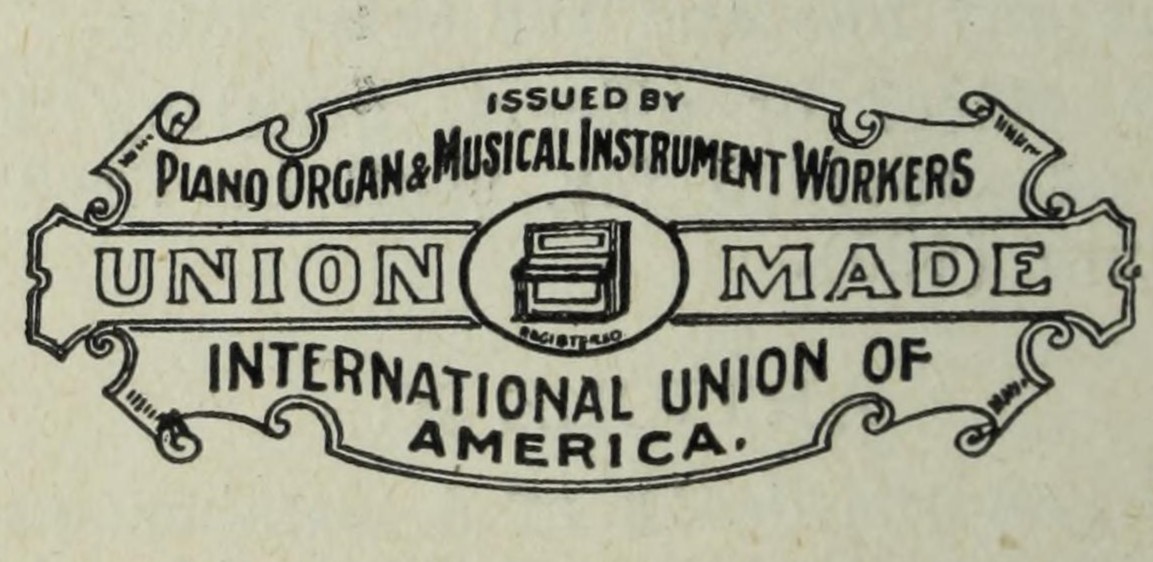
HAVE you a little union made music maker in your home? Does your phonograph, piano or piano player boast a label on the left-hand side underneath the lid? If it does you are one of the rare fortunates of the United States.
For musical instruments are sensitive creatures. They react to environment. They know the difference between being put together by men who love their work and are paid self-respecting wages and men who are driven and cowed and wish that pianos and phonographs and all the rest had never been No invented. You can tell by the tunes. matter how gifted you are, some pianos just sound like a singer with hot mush in her mouth, ineffective, scared. They’ve been made by the poor underpaid slaves of the Piano Manufacturers’ Association. Union made tunes are different. There’s something saucily buoyant and free about them. But you will have to get a union made instrument yourself to appreciate the difference in real music. Only you had better put your order in early before the rush begins.
There is only one union piano factory in the United States. Only one factory where the International Piano and Organ Workers’ Union of America allows its label to be put upon the instruments manufactured. And that factory is not only union from top to toe, it is co-operative. That is, there are no toes. It’s all tops. Everyone works the same number of hours and is paid the same wages whether they do the inlay work on the victrola cases, polish wood or run the business end of the factory in the office.
It’s down on Rees Street, No. 818, this unique factory, and it’s a modest building overshadowed by “Company Union” Armour’s nonunion Quaker elevator recommending Oats for breakfast, lunch and dinner. You climb up some narrow winding stairs, feeling your way, for it’s dark after the brightness outside. But finally the light bursts on you again as you find yourself in a room full of pianos and phonographs and a business desk at one end. This is the show room of the De Luxe Piano Company. The name is misleading. Good enough name for some insignificant little concern. But this is the only union piano factory in the United States. It ought to be written all over the building in great red letters. Every workingman ought to know about it–a successful co-operative piano factory.
Charles Dold sits over at the business desk. He is the secretary and treasurer of the factory. He runs the office end of the concern and can tell you all the facts and figures of this interesting venture ever since it started. On November 24, 1920, following an intense and bitter struggle on the part of the piano Workers of Chicago against the Piano Manufacturers’ Association, who virtually commenced the national open shop campaign, a charter was issued incorporating the De Luxe Piano Factory under the Illinois State laws for $50,000. Eleven men, former employes of piano companies who had fought the union, notably the Starek Piano Company, had come together in an association, fired with enthusiasm to make and sell pianos under union conditions. Each man had brought his savings and each bought 200 shares of the stock at $100 each, half of which was in cash, the other half to be taken out of their wages from week to week. The rest of the money was borrowed.
Today there are sixteen owners instead of eleven, the debts of the company amount only to $3,100 and outstanding debts due the company amount to $15,000. There is no secret about finances. Everything is as open as a book. There was a note of pride in Mr. Dold’s voice as he recounted the history of the association’s financial progress. Last year, even though the factory was not in shape to turn out pianos until May, $40,000 worth of business was done. Next year Mr. Dold expects a return of at least $80,000.
As in other organizations, the board of directors runs the show. The board of directors here consists of the entire sixteen who play the composite role of stockholders, employers (they employ themselves), employes and directors. The board of directors elects a managing committee. The managing committee, in turn, runs the factory. Each year, on the first Monday of January, a new managing committee may be elected. Nearly every nationality is represented and yet, despite the theories of immigrant importers, they do not fight.
This year John Taraba, a Bohemian, is president of the board of directors. P. Vitaloca, an Italian, is vice president, and Chas. Dold, who came here from Germany when a young man, is secretary and treasurer. Ernest Swanson, a Swede, is the superintendent. He has direct charge of the plant. The president and vice president of the board of directors. are under him. Besides these there are a Frenchman, a Pole and a Norwegian and several American born.
Every one starts work at 8:30 in the morning. They stop at 4:30 in the afternoon. Everyone is paid 80 cents an hour. They all do their own “dirty work.” No one is any better than anybody else. There are no bawling foremen, no slave, drivers.
But go through the factory and see for yourself. Here is Mr. Vitaloca, vice president of the board of directors, making inlays for the phonograph cabinets. Ever wonder how it is these charming little patterns of rose and green seem to grow on wood, so deftly are they set in? Mr. Vitaloca is an expert cabinet maker. He does something complicated with the mechanism of player pianos besides which hasn’t anything to do with inlay work. When he is home he plays at fashioning bits of exquisite carving. Some of these he may show you with considerable pride, black eyes flashing. If this clever little cabinet maker had had a real chance back in Sunny Italy who knows what manner of artist he might be today? But perhaps it’s just as well. Certainly the co-operative piano factory could scarcely do without its vice president.
The factory is like a great overgrown carpenter shop. Each worker has his own particular corner. It is quiet except for the roar and whir of machinery. Each man is hard at work at his own specialty. Where you are your own master there is no time to be wasted.
In the middle of the room are stacked boards of various shapes and sizes, the sides, tops, and lids of pianos and phonographs. In a steam heated vault are kept the sounding boards so susceptible to temperature. There is an atmosphere of busy-ness and contentedness. No ogres scaring the mannikins on to work. And this, you realize, is the way men ought to work.
In a room between the main factory and the office is the polisher, rubbing a glorious shine into the beautiful wood which is to be the outside casing of the piano and phonograph. And he does the greater part of it with his bare hands. These hands must be kept as soft as a girl’s, Mr. Dold explained, for the least little callous would scratch the fine surface of the polished wood.
When the piano factory started, the big manufacturers (the ones who pay their skilled workers anywhere from twenty to fifty cents an hour) guffawed loudly and predicted that a factory run by workers could not last three months. When it was still on earth after three months, it was given six. After six months it was given a year. In the meantime all pressure possible was brought to bear so that this brave venture might not survive the shoals. The manufacturers of piano parts delayed deliveries. Every mean little trick that could be played was played. But money talks, as Mr. Dold says, and the De Luxe factory has weathered the worst storms and is finding the sailing comparatively easy now.
Before you leave the factory you are treated to a union tune. Mr. Dold will play it for you on one of the piano players with the union label on the left side just under the lid.
This player piano sells for $600. In mahogany it costs $675. Paid up union men are allowed fifteen per cent off on any purchase. The uprights sell for $325 to $100. The grands from $850 to $900 and you get a ten per cent reduction for cash.
“We are not trying to make a cheap piano,” Mr. Dold explained. “We are competing with the best instruments made and we are selling $150 below the price of a piano of the same quality anywhere else on the market. We are selling our instruments for wages, not for profits. If the average workingman who buys a piano were able to judge the quality of a piano he would realize that he is getting a bargain.”
Some time in the near future the De Luxe Piano Factory, the only union co-operative piano factory in the United States, is going to give a concert at Orchestra Hall to demonstrate the quality of its pianos and phonographs. A concert of union made music! It ought to be the most delightfully harmonious concert that Orchestra Hall has ever sponsored.
The New Majority was the paper of the Federated Farmer-Labor Party, founded in 1918 as the Minnesota Labor Party, and published weekly by the Chicago Federation of Labor beginning in 1919. Mostly edited by Robert Buck, as well as party and labor union activities the paper reported on the vibrant co-operative and workers’ education movements of the time. The Party was did not survive the 1923 attempt by the John Pepper-led Workers (Communist) Party to take over the F.L.P. The F.L.P. attracted many non-Communist leftists in the workers movement and the paper is a rich source on labor activity and union history those years.
Access to full issue: https://books.google.com/books/download/The_New_Majority.pdf?id=aKE0AQAAMAAJ&output=pdf
 Revolution's Newsstand