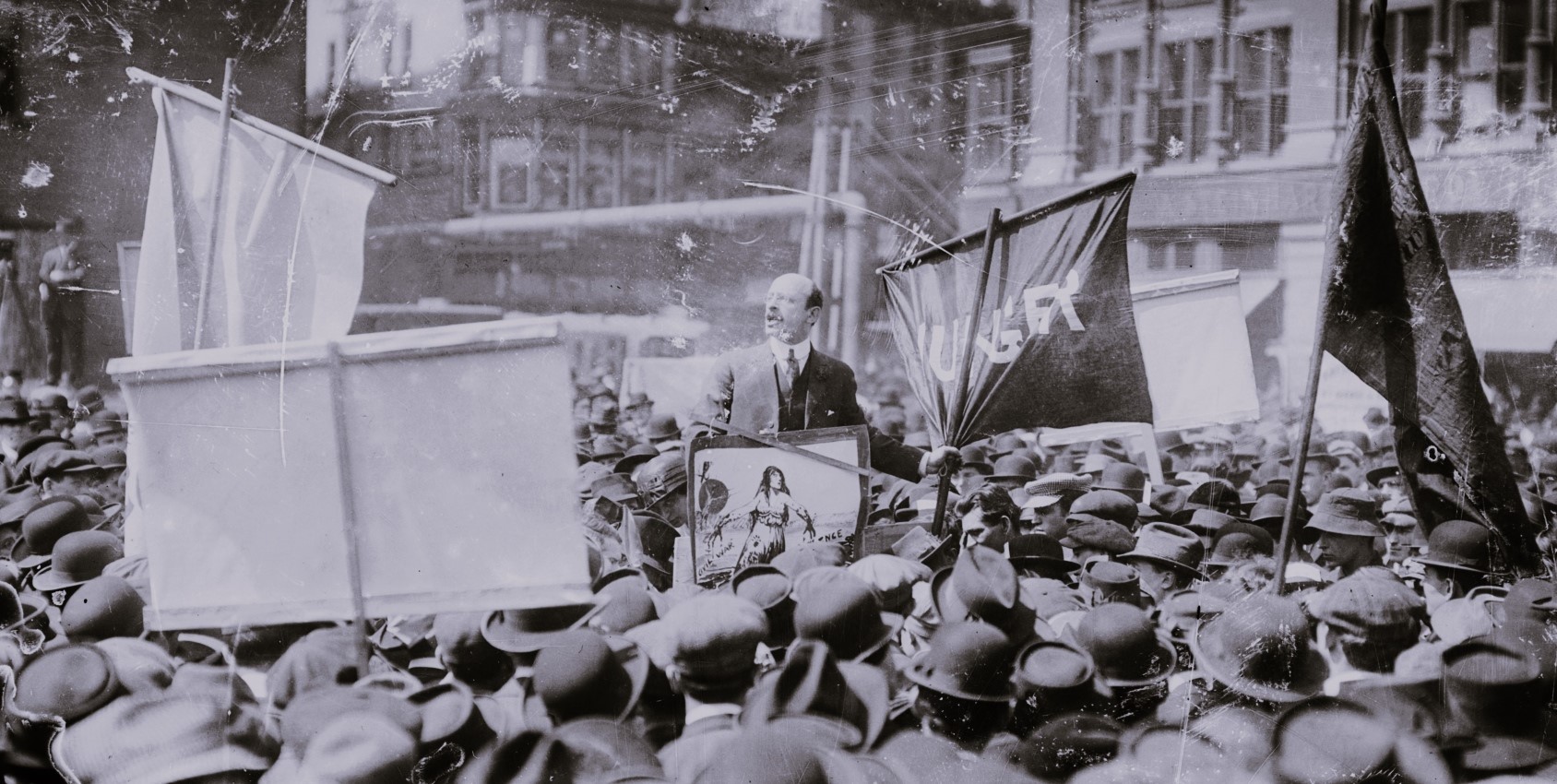
In this famous essay Alexander Berkman responds to the violence-baiting that followed the March 28, 1908 bombing in which Selig Silverstein, a young anarchist, was killed during a New York unemployed demonstration. Berkman was arrested for incitement in the incident, a case later dismissed.
‘Violence and Anarchism’ by Alexander Berkman from Mother Earth. Vol. 3 No. 2. April, 1908.
IT is growing rather monotonous to hear the cry of “Anarchist conspiracy” raised whenever and wherever there happens an “unlawful” shot or bomb explosion.
Let us consider the matter dispassionately. Is violence specifically Anarchistic? Is the taking of human life such a very unusual occurrence among “civilized” peoples? Is our whole social existence anything but an uninterrupted Series of murder, assassination, eradication? All our honored institutions are rooted in the very spirit of murder. Do we build warships for educational purposes? Is the army a Sunday school? Our police, jails, and penitentiaries—what purpose do they serve but to suppress, kill, and maim? Is the gallows the symbol of our brotherhood, the electric chair the proof of our humanitarianism?
“All these things are necessary evils,” we are told by the self-satisfied. True, they are necessary; necessary to preserve society as it is. But has it ever occurred to the “good citizen” whether it is really necessary to preserve things as they are? Is it indeed worthwhile?
Organized society can have but one raison d’étre, namely, the greatest good of its members. Let us examine, then, whether society, as at present constituted, can be justly said to fulfill its mission.
No life, individual or collective, is possible without the means of subsistence. The social members supplying these means are, consequently, the life-givers of the community. And who are they? The question answers itself automatically, so to speak: the producers of the country’s wealth are the conservators of its life. All members and classes of society should equally benefit by the fact of our combined effort as a society. But if, for any reason, distinctions are to be made, the producing class, the real backbone of the social body, should have the preference.
In other words, the workers are the ones who should enjoy the greatest benefits arising from social organization. That is the true mission of human society. Does the latter accomplish it? Does it come anywhere near accomplishment?
By no means. The producers are the very ones on whose shoulders rests the whole burden of our social evils. They are the disinherited, the submerged. Their products are the property of someone else; the land and machinery, without which no production is possible, are not owned by them; as a result, they are forced to sell their labor for whatever pittance the employers condescend to give. Hence poverty, starvation, and widespread misery among the very class which, as the sole producer, has the best claim to enjoy the blessings of organized social life.
To support, defend, and perpetuate these unjust and terrible conditions, it is necessary to have police, prisons, laws, and government. For the disinherited are not content to forever starve in the midst of plenty, and the exploited are beginning to cry out against their cruel bondage.
These cries, these signs of rebellious dissatisfaction must be stifled. That is the mission of law and government: to preserve things as they are; to secure to the rich their stolen wealth; to strangle the voice of popular discontent.
Such is the social life of “civilized” countries. A life of misery and degradation, economic exploitation, governmental suppression, lawful brutality, judicial murder. Sham, injustice, and tyranny are the synonyms of organized society. Shall we preserve it as it is? Is it necessary and desirable? Is it even possible?
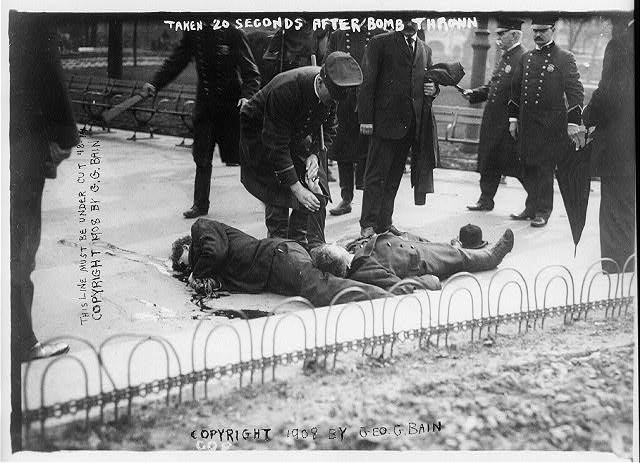
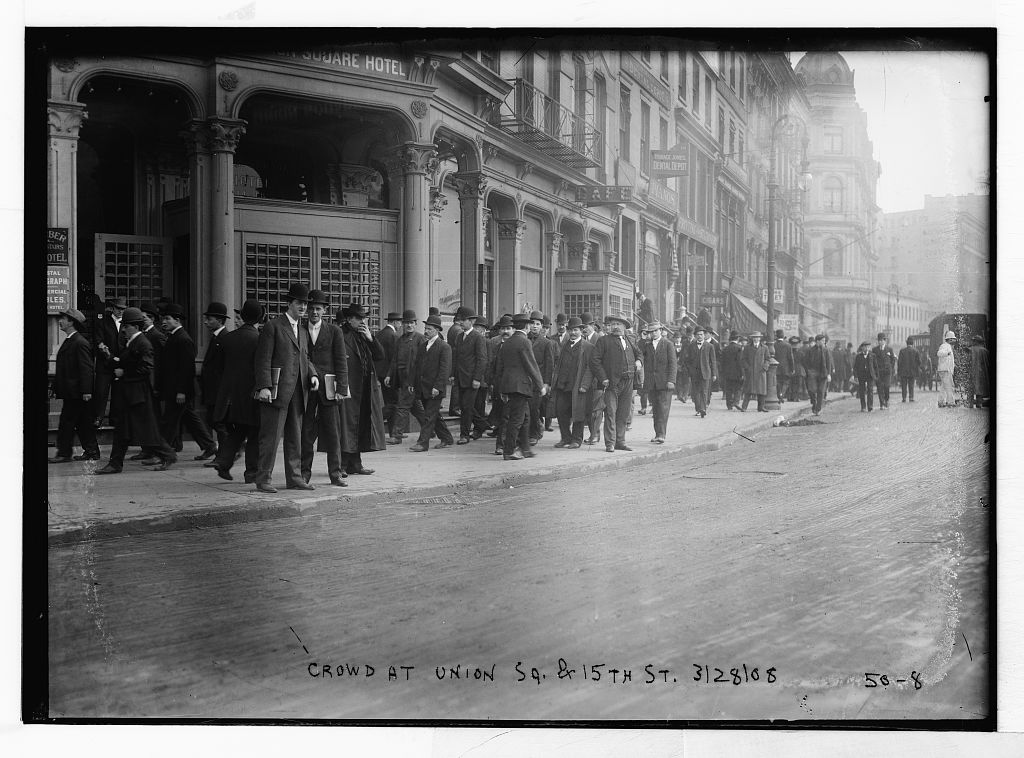
“But you can’t regenerate society by violence, by a Union Square bomb,” the well-meaning people argue.
Indeed, full well we know we cannot. Be fair; give ear. Do not confound the philosophy of a better, freer, and happier life with an act resulting from the very evils which that philosophy seeks to abolish.
Anarchism is the science of social order, as opposed to existing disorder; of brotherhood, as against present Ishmaelitism; of individual liberty and well-being, as opposed to legal oppression, robbery, and universal misery.
This condition of social regeneration cannot be achieved by the will or act of any man or party. The enlightenment of the masses as to the evils of government, the awakening of the public conscience to a clear understanding of justice and equity—these are the forces which will abolish all forms of bondage, political, economical, and social, replacing present institutions by free co-operation and the solidarity of communal effort.
“But the bomb?” cry the judges in and out of court. The bomb is the echo of your cannon, trained upon our starving brothers; it is the cry of the wounded striker; tis the voice of hungry women and children; the shriek of those maimed and torn in your industrial slaughter houses; it is the dull thud of the policeman’s club upon a defenceless head; ’tis the shadow of the crisis, the rumbling of suppressed earthquake—it is manhood’s lightning out of an atmosphere of degradation and misery that king, president, and plutocrat have heaped upon humanity. The bomb is the ghost of your past crimes.
You may foam and legislate, arrest, imprison, and deport. You may still further tighten the thumb-screws of Persecution, erect more gallows, and build electric chairs. Pitiful fools! Thus was Christ crucified as a disturber of “Caesar’s peace.” Did Golgotha suppress his teaching? Have the unspeakable tortures of the Inquisition eradicated free thought? Did Louis XVI. save his crown–or his head—by lettre de cachet? as the cause of the Abolitionists been exterminated by the judicial murder of John Brown?
“Our graves will speak louder than the voices you Strangle.” In spite of all the strenuous governmental, capitalistic, and journalistic efforts to misrepresent and suppress Anarchists and Anarchism—because of those efforts—the people will yet learn the truth.
Though well aware that the Union Square bomb— whoever its thrower—was no result of any conspiracy, the police insisted on my arrest. As usual, they were the first to break their sacred law: my protest notwithstanding, I was photographed and Bertillioned, in contempt of a recent decision of the Supreme Court of the State, declaring such police methods illegal before the conviction of an arrested person. Having absolutely no evidence against me, the police resorted to the ever-ready charge of “inciting to riot.” Naturally, when my hearing took place, the case collapsed like an empty flour sack; however, the authorities grasped the opportunity to air their wisdom. The detectives triumphantly announced that they had made the “important discovery” that I am an Anarchist, and the presiding magistrate assured me that Tolstoi could not possibly be an Anarchist, since “all Anarchism is criminal Anarchism.” The learned Cadi suggested that I “change the name of the party.” “As long as you persist in calling yourself an Anarchist, and evidently take pride in it, it is the duty of the police to keep you under surveillance.” I assured the honorable man that the name suited me perfectly; if it did not sound pleasant in the long ears of authority, so much the worse for the latter.

The brutal stupidity of the police is equaled only by the lack of decency on the part of some Socialists and other kid-glove heroes. These, our step-brothers, try to curry favor with popular prejudice by classifying—against their better knowledge—Anarchists with the police. The Socialists, once themselves the victims of calumny and persecution, have now in their turn become calumniators and persecutors. They have learned and are practicing capitalistic tactics while yet an insignificant socio-political factor. What, then, would be the effect of the “materialistic conception of history” upon the Socialists, if they should ever grasp the reins of government and achieve real power? Will there be found sufficient jailers in the world to supply the needs of triumphant Socialism?
But neither plutocratic nor Socialistic misrepresentation and persecution will halt the march of humanity towards light, liberty, and Anarchy.
Mother Earth was an anarchist magazine begin in 1906 and first edited by Emma Goldman in New York City. Alexander Berkman, became editor in 1907 after his release from prison until 1915.The journal has a history in the Free Society publication which had moved from San Francisco to New York City. Goldman was again editor in 1915 as the magazine was opposed to US entry into World War One and was closed down as a violator of the Espionage Act in 1917 with Goldman and Berkman, who had begun editing The Blast, being deported in 1919.
PDF of full issue: https://archive.org/download/mother-earth/Mother%20Earth%20v03n02%20%281908-04%29%20%28-covers%20Harvard%20DSR%29.pdf
 Revolution's Newsstand