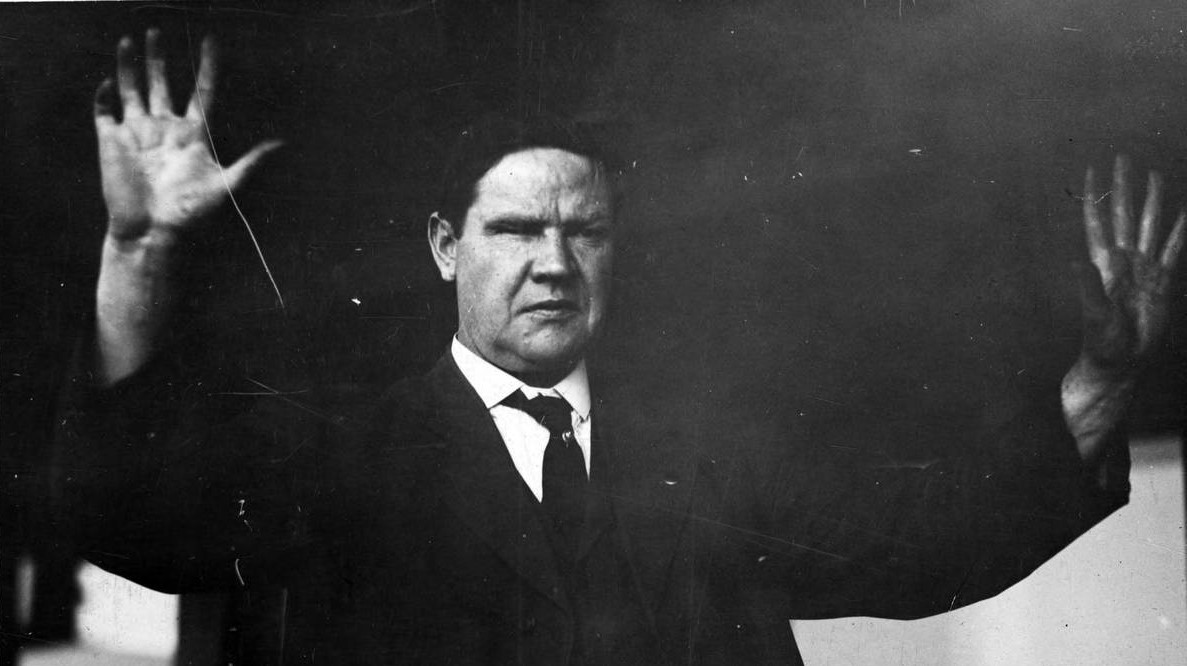
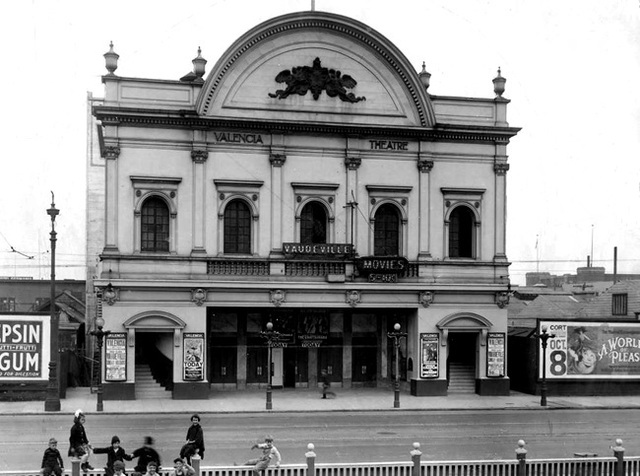
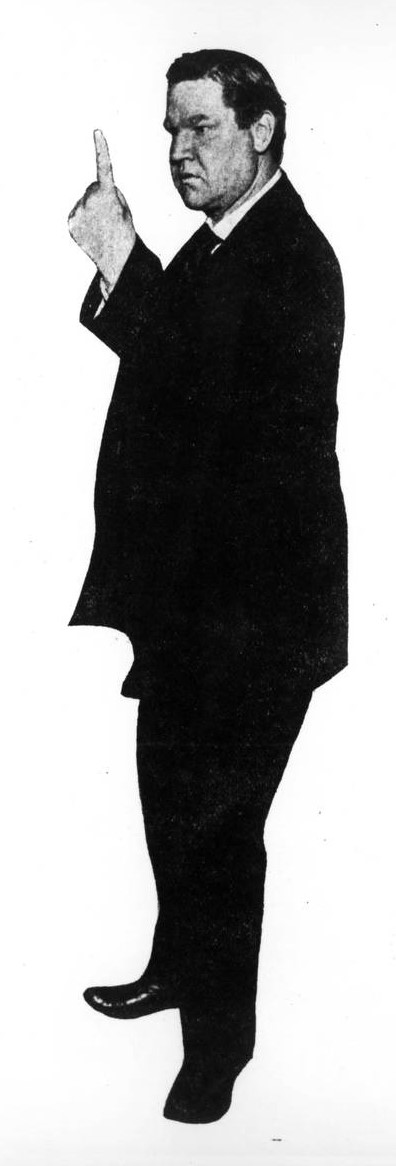
After returning from his 1910 tour of Europe as delegate to the International’s Copenhagen Congress, Haywood joined the editorial board of International Socialist Review and went on an extensive speaking tour of the U.S. Haywood had become increasingly active in the Socialist Party and, as standard-bearer for its revolutionary Left, the tour was part of the campaign to elect Haywood to the Socialist Party’s National Executive, as he was the following year. In the Bay he had strong support from comrades grouped around the ‘Revolt’ newspaper. Revolt hosted Haywood at several events, including this rally at San Fransisco’s Valencia theater.
‘Haywood in San Francisco’ from Revolt. Vol. 2 No. 5. July 29, 1911.
Rouses Great Audience to Enthusiasm.
From the moment William D. Haywood stepped on the stage at the Valencia Theatre last Saturday night until he left it after speaking for more than an hour, the great audience was athrill with interest and enthusiasm.
Reviewing the course of the class struggle in the many countries he has visited in the course of the past year, the man, to hang whom the masters invoked every power under their control, showed how the workers of the world have gained strength in the class struggle in proportion to the extent to which they have come together in class solidarity in their struggle against the common enemy.
“Close up these craft sectional lines,” he said in closing, after pointing out the weakness of the form and principle of labor organization which still is followed in San Francisco. “Join the political party of your class. You can do for the workers of the world what you did for me.”
Haywood always has understood the class character of the movement, and never has shown the slightest tendency toward advocacy of even the most popular of the prevalent reform notions which have no logical meaning to the working class, but he has not always been the effective speaker that he is now. Those who have most often listened to him in the past were amazed at the great increase of power as a platform speaker which he displayed.
Again and again the audience broke into wild. applause and cheering, such as the Haywood of other years evoked but rarely, and then fell swiftly silent in fear of losing something of the impressive address to which they were listening.
Following the course of his journeyings through the European countries which he visited, Haywood spoke of Spain and Ferrer, declaring that the crash of the volley which ended the great educator’s life in the trenches of Montjuich sounded the death knell of capitalism throughout the world.
Speaking of the strike of the coal miners in Wales, he humorously compared their sturdy stand and absolute solidarity with the Labor Day parading of the craft unionists in San Francisco. Roars of laughter and cries of “That’s right!” “That’s true, all right!” interrupted him when he spoke of the paraders in this city being “like the Chinese going to war,” only with little canest instead of fans, and with a multitude of different signs to show everybody how completely labor is divided.
Of Scotland, the country where government and municipal ownership is more absolutely complete than anywhere else in the world except perhaps Japan. Haywood drew a dark picture, telling of the misery of the workers. Thirty thousand families, he said, lived each in one room, a larger number of working-class families having but two small rooms each.
“Municipal ownership is not the solution of the labor problem.” he declared.
Picturing the movement in France, he referred to the case of Durand. Long ago Durand made a speech in which, like Spies, Parsons, Fischer and Engle, he had declared that workingmen attacked by force should repel the attack by force if necessary. Five years later a man known as an enemy of labor was killed, and Durand was indicted for the crime on account of that speech. A form of a trial was gone through. and Durand, whom the master class wanted to get rid of as that class in this country wanted to get rid of Haywood, and now McNamara, was condemned to the guillotine. A general strike was declared and went into effect. At first the government offered to change the sentence to imprisonment for fourteen years. This was refused by the strikers, and in the end Durand was released. “In France.” said the speaker, “every workingman carries the same card, and the women belong to the same organization.”
Haywood told of an effective railroad strike in France effected through this thorough industrial organization, carried out without a single man quitting work. Freight for Paris found its way to Lyons and was unloaded there. The “mistake” being discovered, it was reloaded and moved to some other point. In the case of perishable goods, however, the workers sometimes found it necessary to distribute them in towns where there was a working-class population in need. “The workers were doing no injustice to themselves.” the speaker commented approvingly.
He spoke of the awakening of the workers in India, the impulse toward working-class solidarity breaking down caste lines which had endured through all circumstances for thousands of years.
Tribute was paid to the “Young Chinese” who are shaking the foundations of the age-old empire to the “little brown men” who are organizing the Socialist movement in Japan in spite of the menace of the rope. Haywood spoke feelingly of Kotoku, who, coming in touch with the works of Marx, Engels. Kropotkin and Bakunin in this country, returned to Japan and translated them into the language of his own people–paying with his life for this offense against the dominant master class of Japan.
Mexico was dealt with. Haywood declaring that the change from Diaz to Madero was no more important to the workers than would be a change from Taft to Bryan.
“Let us return now to the land of the free and the home of the brave.” the speaker went on. “In San Diego we find in jail men who fought for freedom in Mexico. Coming to Los Angeles we find more such men in jail, and the Old Gray Wolf howling for the blood of all men who stand for the class interests of the workers.
“Jail birds are the birds of liberty! If there were enough of you who weren’t afraid to go to jail there would be no jail. I have been in jail, and others are now in jail, for those who ought to be in jail.”
Coming to the case of John J. McNamara and his brother. Haywood declared it the duty of workingmen to compel the authorities to return the prisoners to Indiana and force them to obey the laws which they themselves have made. He referred again to the case of Durand; to the case of the cigarmakers of Tampa refused a new trial after conviction by a packed jury and ordered to the penitentiary, and then promptly given a new trial by the Federal court hurriedly reversing itself when the general strike was declared, and of other cases where the machinery of the courts for suppressing the labor movement has been thrown out of gear by the uprising of labor in protest.
“Those of you who will go on strike if the call comes on the day that McNamara goes to trial. STAND UP!” cried Haywood.
It took the crowd by surprise, though it was known that the call would be made by the speaker at some point. For a moment only a hundred or less who had started to their feet at once, were standing, while a startled gasp went up from hundreds of throats. Then the crowd arose, in a mass, cheering.
Revolt ‘The Voice Of The Militant Worker’ was a short-lived revolutionary weekly newspaper published by Left Wingers in the Socialist Party in 1911 and 1912 and closely associated with Tom Mooney. The legendary activists and political prisoner Thomas J. Mooney had recently left the I.W.W. and settled in the Bay. He would join with the SP Left in the Bay Area, like Austin Lewis, William McDevitt, Nathan Greist, and Cloudseley Johns to produce The Revolt. The paper ran around 1500 copies weekly, but financial problems ended its run after one year. Mooney was also embroiled in constant legal battles for his role in the Pacific Gas and Electric Strike of the time. The paper epitomizes the revolutionary Left of the SP before World War One with its mix of Marxist orthodoxy, industrial unionism, and counter-cultural attitude. To that it adds some of the best writers in the movement; it deserved a much longer run.
PDF of full issue: https://www.marxists.org/history/usa/pubs/revolt/v2n05-jul-29-1911-Revolt.pdf
 Revolution's Newsstand