
The Uprising of ’34 begins.
‘Textile Strike Sweeps Over Nation–Flying Squads Strike Fear into Bosses’ from The Militant. Vol. 7 No. 36. September 8, 1934.
10 Killed as Workers Defy Thugs, Armed Scabs, Troops; South in Fore
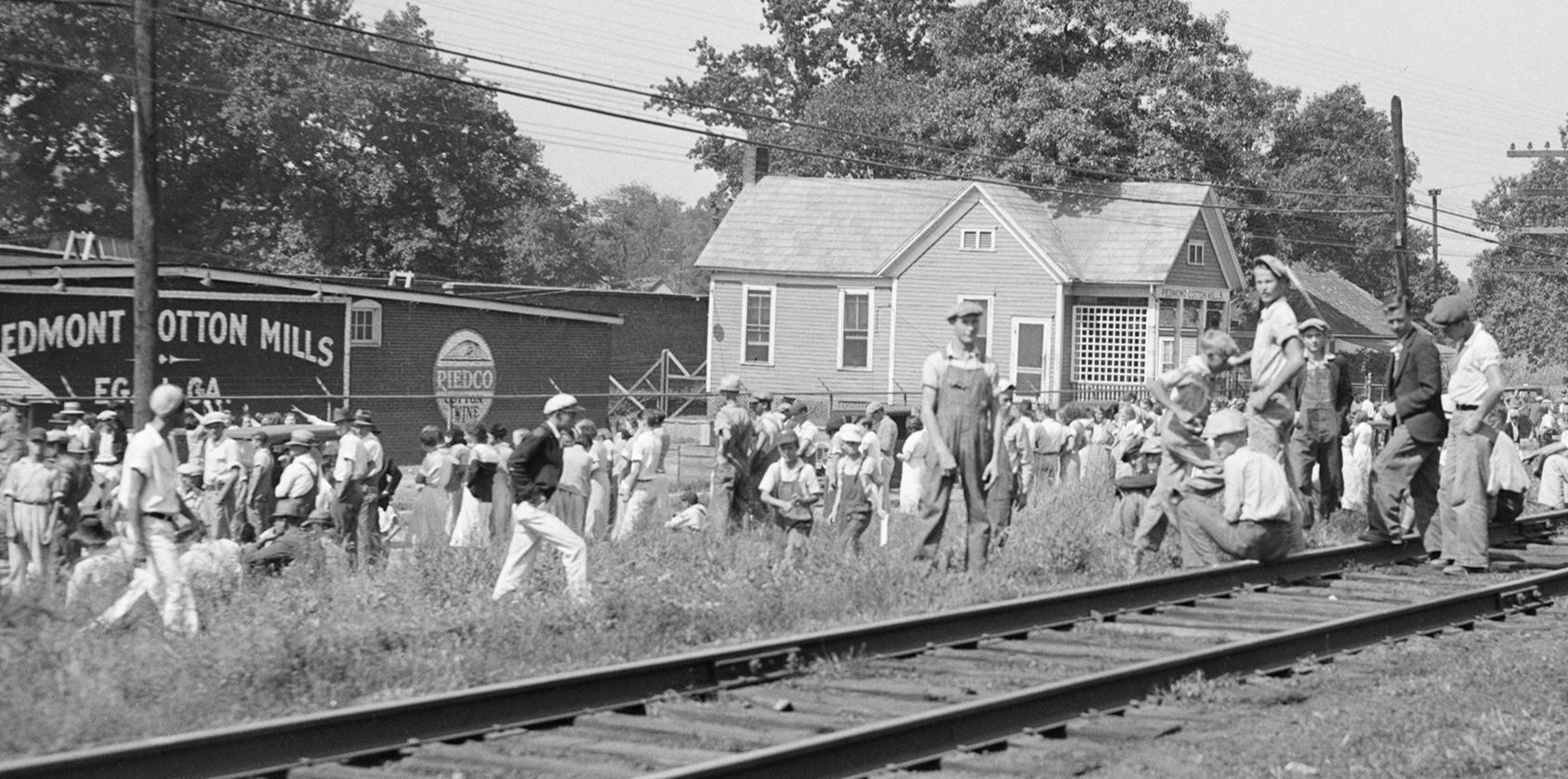
Thousands of armed scabs, brutal deputies, the greatest military display since the World War, the killing of ten strikers and the wounding of scores, have failed to dam the irresistible strike wave that has flooded the textile industry and stopped the looms from Maine to Mississippi.
One half million workers are out on strike, with the flying picket squads swooping down and closing mill after mill, town after town.
Pressed forward by a militant rank and file, ready to brave tear gas and bayonets, prepared to fight to the finish, even the diffident top leadership has been forced to issue bold statements.
“We shall agree to arbitration only after we have closed all mills in all divisions of the industry,” says Francis J. Gorman, heading the strike committee.
Every Loom Idle Is Aim
But the matter has passed out of his hands. The workers will not stop until they have closed every mill in the textile industry.
Far from being dismayed by the blast of gun fire that left ten strikers dead, the Flying Picket Squads have since pressed on to fresh victories.
“The strike is far more serious today than at any time since it began,” Arthur G. Besse, spokesman for the woolen textile manufacturers, admitted. The number of mills closing has been “tremendous,” he added.
Rendered frantic by the successful onslaughts of the workers, the manufacturers in South Carolina have petitioned Governor Blackwood to declare martial law. The State militia, scabs armed illegally with revolvers, with the full knowledge of the authorities, thousands of special deputies, all these are insufficient.
Can’t Get Enough Soldiers
In reply, Blackwood indicated that he might declare sections of South Carolina in a state of insurrection, but, he asserted, he did not have sufficient troops at his disposal to take care of the whole situation.

There are 1,000 Guardsmen on duty in Greenville, S.C. alone. The Governor said it would take three or four thousand troops to enforce a martial law order, and that he did not have that number of troops.
In North Carolina there are more soldiers under arms than at any time since the World War. These include 23 militia units (numbering 1,300 men) with 30 more ready for strike-breaking activities, armed with gas bombs, machine guns, rifles and bayonets.
Nor is this situation confined to the South alone. The Northern manufacturers are mustering their armies of thugs as the workers prepare to descend upon Lawrence, Mass., Dighton, and other centers of scab industry. Their efforts, as they themselves are beginning to admit, will prove of no avail.
Upstate New York has fallen before the march of the workers, New Jersey and Connecticut overwhelmingly won. Massachusetts textile industry is already in the hands of the strikers. Lawrence, once the center of militant union activity, is bound to follow. The bloodiest battlefield is the South, where the manufacturers resort naturally to murder in defense of their divine right to coolie labor, stretch-outs, and preferential wage scales.
U.P. dispatches report that in Greenville, S.C., scabs are carrying firearms to their looms “despite statutes prohibiting such practice. Authorities looked the other way.” The same dispatch states that militia companies were “instructed to shoot to kill”.
It was the armed scabs who shot and killed the six unarmed strikers at Honea Path, and seriously wounded scores, while the authorities “looked the other way”.
The boss-owned militia and police accounted for the other fatalities, with more cold-blooded shooting down of workers everywhere threatened.
South Takes the Lead
Yet it is in the bloody South that the workers have been most militant, defying the militia and the police, and forcing nearly three-fourths of all the mills to close. Virginia, whose 20,000 textile workers are unorganized, has stationed armed patrols at the North Carolina borderline in anticipation of the “raids” of the Flying Picket Squadrons that have been sweeping the South.
Into this tense situation has now arrived President Roosevelt’s milk and water inquiry board, which has authority to investigate and advise, but not to arbitrate. Governor John G. Winant of New Hampshire, chairman of the board, is one of the 129 millionaires in his native state, and has himself called out strike-breaking troops in labor troubles there. The two other members, Raymond Ingersoll, Borough President of Brooklyn, and Marion Smith, attorney of Atlanta, Ga., are nonentities. Nothing is expected to result from this board of inquiry, and nothing will result. When the workers reach the top peak of their power, when the textile industry is crippled, arms, legs and body, then and only then will this or some other board be authorized to act, to cheat the workers out of gains that their power has wrested from the bosses.
Green and Woll Bide Their Time Then, too, the American Federation of Labor heads, Messrs. Green and Woll, may be expected to appear upon a scene they have conspicuously avoided up till now. Hitherto they have been content to issue statements from afar, attacking left wing influence in the textile unions, frowning upon suggestions of strike support from other A.F. of L. unions to the striking textile workers.
These “leaders”, weak in battle, strong in “negotiations” (read betrayal) will then offer their services as peace-makers, after the battle has been won without their aid.
Fortunately, the workers in the textile industry show every sign of fighting to the finish. The strike has revealed to them their Own strength, and they will not be easily cheated out of victory.
Meanwhile, the American Federation of Silk Workers, the weaving section of the industry, has joined in the nationwide textile strike. Latest developments are that 15,000 silk dyers in the Paterson, N.J. area are to join the strike, insuring its success in that area, which is the center of the silk industry. Strike leaders also expect 100,000 hosiery workers to join the strike. The executive board of the American Federation of Hosiery Workers is in session on the question as this goes to press.
The International Ladies’ Garment Workers Union has already voted to strike October 1, unless the employers agree to President Roosevelt’s “sop order” reducing the work hours from 40 to 36 hours a week.
The I.L.G.W.U. has also voted financial support of the textile strike to the extent of $100,000, it was unofficially reported.
Flying Squads Strike Fear Into Bosses
From out of nowhere thick into the heart of struggle, striking terror in the hearts of scabs, dispersing mill guards like chaff; swift, hard. hurricane-like, the Flying Picket Squads.

For this new weapon in the textile strike struggle, as terrifying to the bosses as were the tanks when first they made their appearance in the World War, the workers are indebted to the heroic truck-drivers of Minneapolis.
In Minneapolis the truckmen’s flying squads halted traffic one hundred percent until the town was placed under martial law-a desperate remedy for the bosses to use, and one they will live to regret. Telephone communications sent the pickets speeding to the strategic points, to strike and disappear.
And now, with almost equal effectiveness, the Flying Picket Squads have made their appearance in the textile strike, with what result, let George Sloan, president of the Cotton Textile Institute, testify.
“A flying squadron of workers is going from mill to mill and preventing workers from entering the mills,” Sloan complains. “In face of coercion and intimidation by persons coming in by fleets of automobiles the workers do not dare enter the mills.”
For the rest, let the news reports speak for themselves:
“High Point (North Carolina) police arrested 30 members of a Hying squadron but not before five plants had been closed by them. Barriers of bayonets withstood the assaults of flying squadrons upon two Greenville mills…Time after time the strikers surged forward…The mills finally decided to close.
“Flying squadrons of shock troops ran rampant through the industrial South and there were calls for Federal military intervention. Mill after mill surrendered before the knife-like thrusts of numerous squadrons.”

If Minneapolis did not originate this terrific tactic, it developed it to a point of perfection. It emphasized dramatically for the whole labor movement the value of the squads as a weapon to counteract the new strike weapons of the employers, vomit gas, riot cars and sub-machine guns.
A First Class Weapon
It pressed right into service the automobile. How simple, and yet how effective. Concentration of forces at the right place at the time, mobility and surprise–these important strategic elements are now made available to the workers in the class struggle for the first time.
No longer need workers present a heroic but stolid, inert and helpless mass in front of shop or factory, to be trapped by machine gun fire, or dispersed by thugs.
The use of automobile picket squads has transformed all that. There is no longer one front but a thousand fronts for the bosses to guard. Hired thugs no longer suffice; hence, the increased use of State militia; and even these will prove–have proved inadequate.
The Militant was a weekly newspaper begun by supporters of the International Left Opposition recently expelled from the Communist Party in 1928 and published in New York City. Led by James P Cannon, Max Schacthman, Martin Abern, and others, the new organization called itself the Communist League of America (Opposition) and saw itself as an outside faction of both the Communist Party and the Comintern. After 1933, the group dropped ‘Opposition’ and advocated a new party and International. When the CLA fused with AJ Muste’s American Workers Party in late 1934, the paper became the New Militant as the organ of the newly formed Workers Party of the United States.
PDF of full issue: https://www.marxists.org/history/etol/newspape/themilitant/1934/sep-08-1934.pdf
 Revolution's Newsstand