
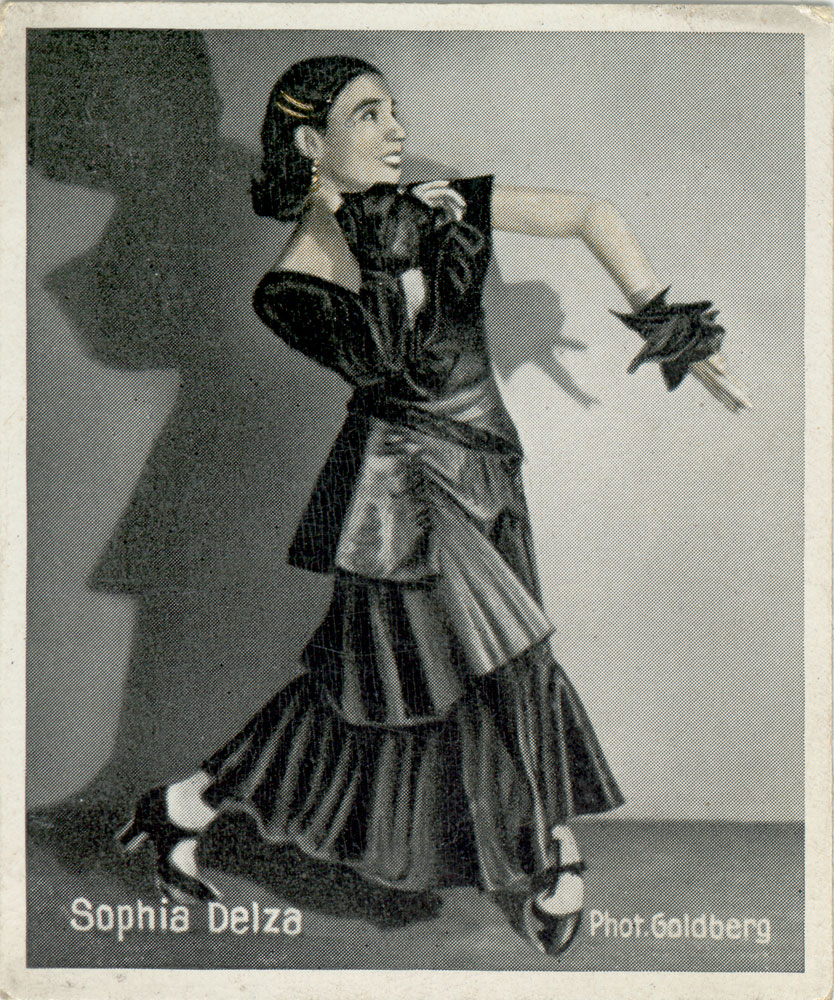
Modern dance legend Sophia Delza, in 1934 a member of Anna Sokolow’s Theatre Union Dance Group, looks at the qualities and conditions that have allowed folk dance to survive and what that may mean for the new, revolutionary dance in this fascinating essay.
‘The Folk Dance’ by Sophia Delza from New Theatre. Vol. 1 No. 10. September, 1934.
THROUGHOUT the ages peoples have expressed in dance their most profound wishes and exultant aspirations their limitless hopes and intense fears, their most exuberant sentiments and frivolous desires. Dance form clearly indicates the character and organization of a society and reveals not only its emotional tone but also its inherited “moeurs” and growing ideology. Variations in dance forms reflect progressions, retrogressions and changes in the ethical, economic and religious structure of a society-reflect them or parallel them or precede them. Between the art expression in life and the organization of the material practices of life such an emphatic correspondence exists, that the oft repeated phrase “art for art’s sake” seems a persistent absurdity. Do we not try to fathom the activities of a lost race by the relics of its arts? Do we not think we understand contemporary peoples by their manifested art expressions?
In societies less complicated than the one in which we live or the ones which have preceded us by calculable years, perhaps because of telescoped information and the perspective of time, there appears to have been a singleness of purpose and a directness of expression which unified organizationally the activity of living and the process of art. The most forceful anxiety in man’s daily life, the most dominating wish, or the most compelling gratitude–all or some of these feelings color the nature of dance. But when the intrinsic need for the particular dance has ceased, and the original forms are merely followed, the dance then becomes degenerate and moribund; if the original purposes are reconverted for contemporary use, however, the dance becomes a vigorous and healthy pastime, as well as a recreation. This is the state of most of the dances of folk people (i.e. agricultural); dances are performed not efficacious rites but as self-sustaining dances which in the light of their origin effect unity and sympathy among the members of the community. These dances have a direct relation to their activities, in practice, not in purpose. To dance a spring dance will understandably not bring a fruitful harvest; doing this spring dance will express an understanding of nature’s work and the common need for a rich harvest.
Folk society was merely a fraction of the structure of a much greater and many classed society. Each class built antagonistic walls of defense against the other, amassing within its own boundaries and forming self-protective communities, accenting distinctions among the many working orders (agricultural and urban) dominating orders, ruling orders and religious ones. These orders contributed to each other’s good in unequal proportions, in a society where benefits of living were disproportionate. Such emphatic distinctions isolated the groups to such an extent that their art expressions found forms self-sufficient to their special demands, unrelated to the life and art of their contemporary classes. Communities developed independently in work and in dance. During these many decades the agricultural peoples, because of the inherent and destined fundamentals of their work, because of the traditional solution of their problems, and the knowledge of ancestral habits which they could follow protectedly or upon which they could institute necessary changes, were able to maintain a cohesion that the industrially progressing peoples have as yet been unable to find.
IN early medieval society, where the un-equalized orders in the social structure had become fixed, there was still to be found, an impulse in religious expression common both to the dominating orders and the populace who were united in their superstitious and fanatic fear of God. But as the. wonder and mystery of the heavens were supplanted by more tangible problems, this shared expression was shattered. And more tangible concerns varied with the given class. Each class retired to the solution of its specific problems, and eventually developed its unique art from its special way of existence. The populace, composed of those who worked for their livelihood, was naturally (i.e. unnaturally) separated from those for whom it worked, from whom its personal life was consequently removed. Since its personal life was so intimately bound up with its economic life, there developed a conscious relation of thought and emotion between the two with the result that any expression during leisure time naturally involved the concern of its work.
THE growing urban communities, by nature of diverse occupations, developed a series of specialized and specializing guilds, none of which were permitted to overlap, dividing and subdividing into innumerable occupational classes. Their dance expressed their work in the same way as the mimetic dances of the primitives reflected theirs. But it must be remembered that in primitive society there was absolute unity of purpose whereas in the Middle Ages there was a like unity of purpose only among the members of the individual guilds which were expressive of a divided society wherein little overstepping was tolerated. And it must also be remembered that this urban society had little to do directly with the other working order (the rural community) which likewise continued to grow Urban community dances lay emphasis on industrial activity and were barely concerned with the nature of family life. They knew only “class” (social) dances, which were being invented and created anew for appropriate occasions, industrial, religious and festival.
Removed from the problems of governmental controversies and from the immediate influence of new inventions and fluctuating manners, rural communities, on the other hand, were more able to sustain and continue their customs than were those who lived in the midst of unceasing upheaval. The demands of agricultural work, being of unchanging nature, emphasized a psychological stability which helped make more or less permanent the habits of those involved in such work. The people were united by similar problems regardless of the particularized phase of the work they pursued. The demands of nature, of growing, of sowing and harvesting, of winter and summer, rain and sun, joined them in their work and leisure. Desires and interests needed the same outlet; joys and sorrows were caused more or less by the same external and unapproachable fact. And so in the light of the problems of their lives, the rural folk of the past had a common and firm basis of sympathetic understanding which united them in joy at a successful harvest, in sorrow at some common misfortune, which stimulated them to express communally their need for fertility, for strength. Here there was no diversity of interests. Their lives corresponded with their arts, expressing immediate concern for their work which was so irretrievably bound up with existence.
Folk dances throughout several centuries have remained consistently the same, firmly entrenched on the land, in the hearts of those recreating them, isolated with reason from the changing concerns of a more rapidly changing world. Essentially, living routines of early folk people have been similar to those of their ancestors, a new gadget or two, changing superficially the method of work, but not the character. Contrast this with urban conditions–constant change of individual type, persistent influx of diverse races, drastic alterations in working methods and repeated disrupting readjustments to life.
The folk dances of Europe which we know today are probably the same in most aspects as of the 17th century, with changes of so slight a nature that our deductions are little affected. The basic generalities of the folk dance exist in all the folk areas regardless of race or nationality. Despite the variations displayed in each ethnological group, we find the basis–religious and economic–common to all; traditions followed by all; purposes and intentions apparent in all; and each group has the personality of its race and environment.
WHY are these dances still alive, healthy, spirited in spite of a traditional style so old, a form repeated again and again? The strength of the mass dance lies in the mutual functioning of many who are dealing with the same material simultaneously. It is re-creation of property common to all; it releases the individual within the accepted limitations which form his life. That interest which first was expressed in the dance is still a vital one; there is a fast bond among those who equally share and divide a common task; and there is a subconscious appreciation of a mass entity.
Our present social dances, fox trot, tango, etc., which keep superficially changing are by this time indirect derivatives of the urban dance. Due, however, to the externality of these changes they have no possibility of important future development. The significant values our age needs cannot be expressed in this social form of the dance which, no doubt, will continue to be varied in trivial ways through sheer inertia.
There is another heritage of which we are the possessors, however, the art dance type. It is this type which, by nature of its being an art and therefore conscious and creative, can express the world of thought and reflect its temperament and which can show a direction and activity that the folk dance cannot by its nature offer.
A dynamic common interest will help perpetuate the art of the dance. The fact that folk dance is still existent as a living recreation and not merely as an historic memory proves in part that statement. The virtues basic in the art of the folk people can be applied to the new dance. The modern dance in order to thrive needs the mass sympathy, the communality (either in direct dancing participation or in understanding the audience relation to dance), and the fruitful direction that has sustained the folk dance for such a long period.
The New Theater continued Workers Theater. Workers Theater began in New York City in 1931 as the publication of The Workers Laboratory Theater collective, an agitprop group associated with Workers International Relief, becoming the League of Workers Theaters, section of the International Union of Revolutionary Theater of the Comintern. The rough production values of the first years were replaced by a color magazine as it became primarily associated with the New Theater. It contains a wealth of left cultural history and ideas. Published roughly monthly were Workers Theater from April 1931-July/Aug 1933, New Theater from Sept/Oct 1933-November 1937, New Theater and Film from April and March of 1937, (only two issues).
PDF of full issue: https://www.marxists.org/history/usa/pubs/workers-theatre/v1n08-sep-1934-New-Theatre.pdf
 Revolution's Newsstand