
A look at the early life of Arthur Lee Emerson, founder and first President of the Brotherhood of Timber Workers, an I.W.W.-affiliated Southern union.
‘Arthur L. Emerson: A Short Biography’ by Dr. C. F. Parker from Solidarity. Vol. 3 No. 37. September 7, 1912.
Newtone, Ala., Aug. 25.
In the Aug. 3d issue of Solidarity, page 2, 1st column, a question is asked, then partly answered. If you can spare the space, I would like to give your readers a short biographical sketch which, I think, will be of interest just at the present time, and will supply the missing link” in the question asked.
Early in the season of 1898 my wife and I were alone in our log cabin on the wild, wooded summit of grand old Lookout Mountain, in northeast Alabama, where we were seeking recovery of health. Needing some one for company for my wife while I was away from home, and to have a little help about the chores, we decided to apply to the Orphans’ Home in Chattanooga, Tenn., 40 miles distant for a small boy. Our request was quickly responded to by sending the only available boy at the home at that time. A tall, slender lad about 13 years old; an orphan boy, with no living relatives, so far as known to the boy, or to the Home.
I shall never forget the sight of the big, homesick tears which were coursing down his cheeks when I met him at the station. To leave his “foster mother,” the matron of the Home, his teacher and the children he loved and go out into the cold world all alone, among strangers, was almost too much for his young heart to bear. On reaching our home, my wife was so touched by his utter loneliness in this big world that she took him at once into her warm heart to be a true mother to him. His tears soon dried up, and he began to feel happy in his new home. My wife, being a teacher, took the matter of his education into her hands, and as he was bright and eager to learn, he made rapid progress in his studies.
His name was Arthur. He proved to be a very respectful and companionable boy; was active and energetic; sometimes a little headstrong, but generally obedient and good natured. He liked to be well dressed and appear well to others; was kind of heart, and full of sympathy for any one in trouble. He would never begin a racket with his associates, but was quick to resent with clinched fists when he felt he was being imposed upon; was keen to make and save a little money, though not “stingy” with his earning. This was the boy. What is he a man? We shall shortly see.
In about three years there came a sad day for poor Arthur, as well as to myself, an aged man. Sickness and death of my wife, made it necessary to find a new home for Arthur. One of our neighbors kindly took him into their home, and he went to work with their young men in the timber; with axes and saw earning wages with which to clothe himself, and go to school when not at work. Three or four years of such lite, part of the time about a saw mill, brought him to the period of the Spanish American war. He went to Chattanooga to enlist as a private, but for some physical defect was not accepted. So he enlisted as a teamster and went out with Gen. Shafter’s army to Porto Rico. It was not long, however, before he was stricken with the deathly typhoid fever then prevailing in the camp, and was placed on a hospital ship and sent to New York. As soon as he had recovered sufficiently to travel by rail, be was sent to my mountain home to fully recover.
When able to go to work again he “knocked about” at various jobs for awhile, then went off southwest, and for a year or two I lost track of him. Then be finally turned up in a lumber camp in the Texas-Louisiana timber regions, where he has remained most of the time for several years, an expert workman in various lines of the lumber and saw mill industry. Ever watchful for improvement in his own personality, and with a keen desire to improve the conditions of bis fellow craftsmen, a self-made man, an all-around good fellow, with whom it is a pleasure to be acquainted.
Where is he?
Who is he? You ask.
He is none other than Arthur L. Emerson, the president of the Brotherhood of Timber Workers. The question asked, “Who is Emerson?” is now fully answered.
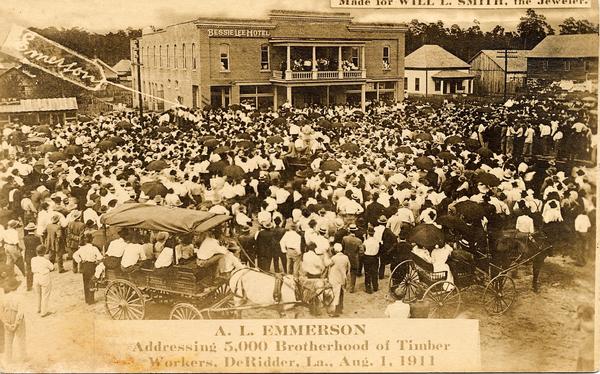
As is well known, he is now lodged in the Lake Charles, La, jail, accused of murder. Whom did he kill? No one, so far as I can learn; nor made any attempt to kill, or encouraged others to do any killing. He us in jail for exercising the boasted “freedom of speech,” which, until of late, has been an accorded right to every American citizen. Another sporadic case, I judge, of the Ettor Giovannitti type of ailments affecting our body politic, which, if not stamped out effectually by protests and votes, may soon become epidemic and then where will the proletariat be in his contest with capitalistic exploitation be?
As A. L. Emerson has been a wage worker–not a millionaire, by any means–I have felt anxious to know if his fellow workers would stand by him in his trial; in his hour of need, or would he be left to stand alone. Not a soul in this wide world upon whom he can feel a natural right to call for help and sympathy. But my heart is cheered by word from him in a letter from his prison home that his men are behind him, and that he feels confident of proving his innocence of the charges made against him. Being a native of Chattanooga, would it not be well for his fellow workers in that city to take his case into special consideration.
Respectfully,
DR. C F. PARKER.
The most widely read of I.W.W. newspapers, Solidarity was published by the Industrial Workers of the World from 1909 until 1917. First produced in New Castle, Pennsylvania, and born during the McKees Rocks strike, Solidarity later moved to Cleveland, Ohio until 1917 then spent its last months in Chicago. With a circulation of around 12,000 and a readership many times that, Solidarity was instrumental in defining the Wobbly world-view at the height of their influence in the working class. It was edited over its life by A.M. Stirton, H.A. Goff, Ben H. Williams, Ralph Chaplin who also provided much of the paper’s color, and others. Like nearly all the left press it fell victim to federal repression in 1917.
PDF of full issue: https://www.marxists.org/history/usa/pubs/solidarity-iww/1912/v03n37-w141-sep-07-1912-Solidarity.pdf
 Revolution's Newsstand