
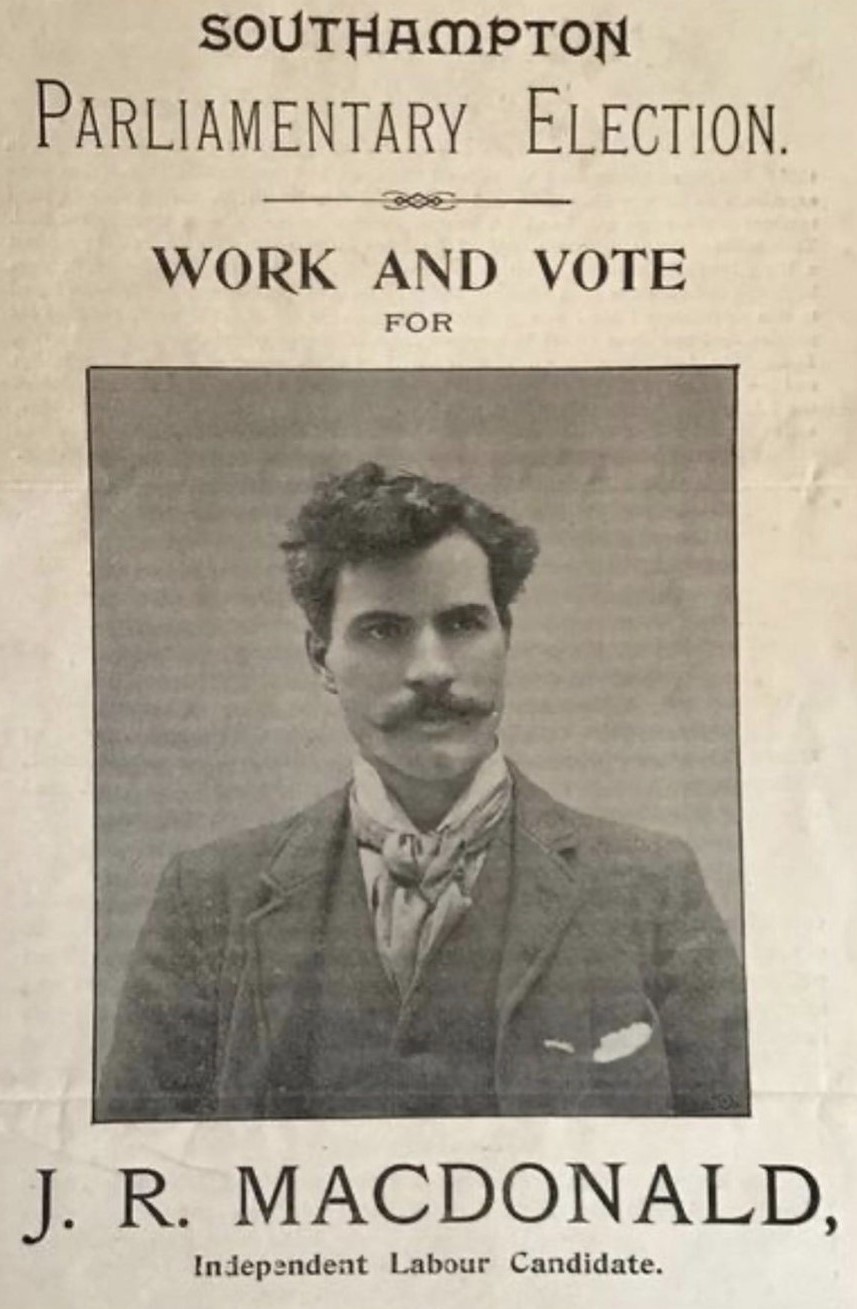
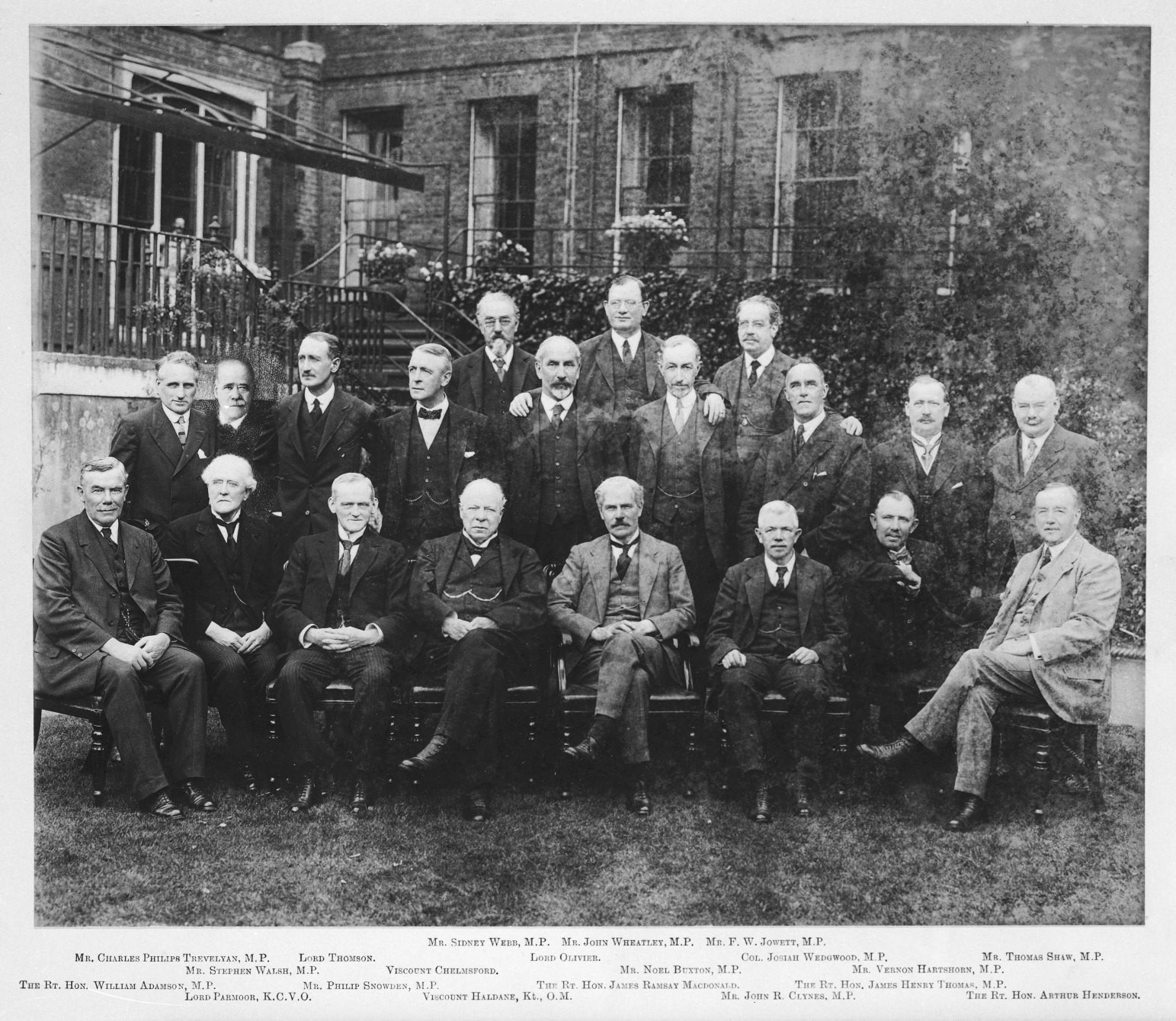
Ramsay MacDonald formed Britain’s first Labour government in 1923. With a minority in Parliament, it depended on Liberal support and claimed the national debt prevented it from fulfilling its campaign promises. Setting its precedent, Labour’s first government’s lock-step support for the Empire of the ruling class is also marked by Karl Radek, who predicts it will end ignominiously and quickly. It did.
‘The Labour Government Disturbs Nothing!’ by Karl Radek from International Press Correspondence. Vol. 4 No. 21. March 20, 1924.
The English Labour Party is in office.
The British Empire holds in bondage 350 millions coloured folk. British governments have changed more than once, but whether they consisted of Liberals or Conservatives, the Hindoo tiller of the soil did not perceive any difference. And now, the Labour Party has come into power. The Labour Party already counts 20 years of existence. During these twenty years, not one of its members has felt the need of helping the Hindoo peasant and worker on the spot. From time to time, eminent representatives of this Party have made the trip to India, have put up at the best Hotels, and, having returned, did not fail to enrich the English literature with sentimental works full of complaints against English Imperialism.
Now the Labour Party is governing. Lord Reading, whose sole aim is to divide the Hindoo nationalist movement, is still Vice-Roy of India. An old colonial functionary, ex-Governor of Jamaica, Sir Sidney Olivier, is Colonial Secretary. In his program speech in the House of Commons, Ramsay MacDonald did not devote one word to the situation in the colonies. The Central Committee of the Labour Party, in a manifesto, has demanded the setting up of a Parliamentary commission in order to study the reforms to be carried out in India. For what purpose is this manifesto? To whom is it addressed? Why a Parliamentary Commission? Has not the Second International, to which the Labour Party belongs, dealt with the colonial question? And if it has not enough authority with the Independent Labour Party, we are in a position to remind it that there exist two excellent books on the Indian question, one of which was written by Keir Hardie, the founder of the I.L.P., who though lacking in clear ideas had a great proletarian heart, and the other written by the present Premier, Ramsay MacDonald. Mr. MacDonald needs only to read this book again and get to work! A Parliamentary Commission will serve no other purpose than to make it appear to the public that something is being done, although all the while nothing is being done. The colonial slaves of the British Empire have nothing to expect from the Labour Government.
The Labour Party succeeds to power in the sixth year of Peace, when he must be blind indeed who does not see that the Imperialist War is not to be the last war and that others will follow if the workers do not prevent it. The Labour Government has recognized Soviet Russia de jure: it merely acknowledges a fact. But the Labour Party has continuously fought against the secret treaties, against secret diplomacy. Commander Kenworthy, a liberal M.P. bearing this fact in mind, asked in the House of Commons whether the Labour Government intended to make known to the public the secrets of the intervention in Russia. Mr. Ponsonby, the Under Secretary of State for Foreign Affairs, a member of the I.L.P., and (together with Morel and Brailsford) original founder of the Union of Democratic Control, the aim of which was to fight against Secret Diplomacy, has vouchsafed an answer to this insidious question. Having come over to the Labour Party from the Liberals, Mr. Ponsonby has obviously forgotten a good deal of what he had previously been preaching. The secrets of Churchill and of Lloyd George, he declared, will not be betrayed. For the rest, Great Britain demands from Russia the recognition of the old debts. Lord D’Abernon, Ambassador at Berlin, where he has never ceased to prosecute the policy of Lord Curzon and to encourage the resistance of Germany against France, in order to enable England to arrive at an agreement with France at some time or other, is still Ambassador at Berlin. The Labour Government declares that it desires the most cordial entente with the France of Poincaré. Regarding France, its situation is more difficult than was that of the Conservative Cabinet of Baldwin. The latter could either come to an agreement with imperialist France, or arm itself against her. The entente with France involves either the cancellation of the French debts or the granting to the French debtor of facilities for payment, without which M. Poincaré on his part cannot make economic concessions to Germany. Mr. Baldwin left this question undecided. Ramsay MacDonald will also not decide this. There remains no other way open than that of armaments. But to commit oneself in this direction would involve such an increase in taxes that, as H.N. Brailsford admits in the “New Leader”, the Labour Party would not be able to maintain power. This is why Ramsay MacDonald pays compliments to France while allowing armaments to proceed their normal course. Those who expected from the Labour Party an energetic defense of peace, are disappointed.
The Labour Party came to power with the promise to diminish the heavy burdens of public debts by means of a capital levy, and to take energetic measures against unemployment. England has an annual revenue of about one milliard pound sterling, of which about 30% is absorbed in the payment of interests and by the amortization of the public debt. This is a reward to the capitalists who caused the war. Singular enough the Labour Government has no scheme for a capital levy. Its President of the Board of Trade, Sidney Webb, one of the most renowned English economists, has treated this question profoundly in his book “How to Pay the War Debts”, and its Chancellor of the Exchequer, Philip Snowden, is the author of a work setting forth an entire program of financial action. The Commission will in this respect also be nothing else than a first class funeral. Ramsay MacDonald has for the rest clearly stated that he does not intend to present a scheme for a capital levy to the present Parliament.
By abandoning the capital levy, the Labour Government renders itself unable to fight against unemployment. On this vital question for the working class, it has no program. It contented itself with uttering the profound truth that it is necessary to fight against unemployment, not only by insuring the unemployed, but also by seeking to increase industrial activity. There is little doubt that Mr. Mac Donald, so far as helping the unemployed is concerned, will go no farther than his Conservative predecessors. Those who were expecting the Labour Government to take determined, even if slow action against capital and for the defense of the cause of the workers, are disappointed.
The English Labour Government will not shake the world…It has no other care than to avoid tremors to capitalist England. It does nothing else than renounce the revolution. It abandons the democratic defense of the interests of the working class. When the Labour Party came to power, Lloyd George wrote: “This Government will not be able to remain in office a single day without our support.” Mr. MacDonald realized this and conducts a liberal policy. The only point where he falls into error is in believing that he can thereby avoid social upheavals. He will shake the working class, he will prove to it that it has nothing to expect from parties which stand in fear of social conflicts.
The international Communist press must follow every day the experiences of the English Labour Government. This experience is destined to reveal once more the difference between the Communists and the Second International Socialists, between the revolutionary adherents of Proletarian Dictatorship and the reformist adherents of Democracy. The difference consists in our will to act against Capitalism and their unwillingness to do so.
International Press Correspondence, widely known as”Inprecorr” was published by the Executive Committee of the Communist International (ECCI) regularly in German and English, occasionally in many other languages, beginning in 1921 and lasting in English until 1938. Inprecorr’s role was to supply translated articles to the English-speaking press of the International from the Comintern’s different sections, as well as news and statements from the ECCI. Many ‘Daily Worker’ and ‘Communist’ articles originated in Inprecorr, and it also published articles by American comrades for use in other countries. It was published at least weekly, and often thrice weekly. The ECCI also published the magazine ‘Communist International’ edited by Zinoviev and Karl Radek from 1919 until 1926 monthly in German, French, Russian, and English. Unlike, Inprecorr, CI contained long-form articles by the leading figures of the International as well as proceedings, statements, and notices of the Comintern. No complete run of Communist International is available in English. Both were largely published outside of Soviet territory, with Communist International printed in London, to facilitate distribution and both were major contributors to the Communist press in the U.S. Communist International and Inprecorr are an invaluable English-language source on the history of the Communist International and its sections.
PDF of full issue: https://www.marxists.org/history/international/comintern/inprecor/1924/v04n21-mar-20-1924-inprecor.pdf
 Revolution's Newsstand