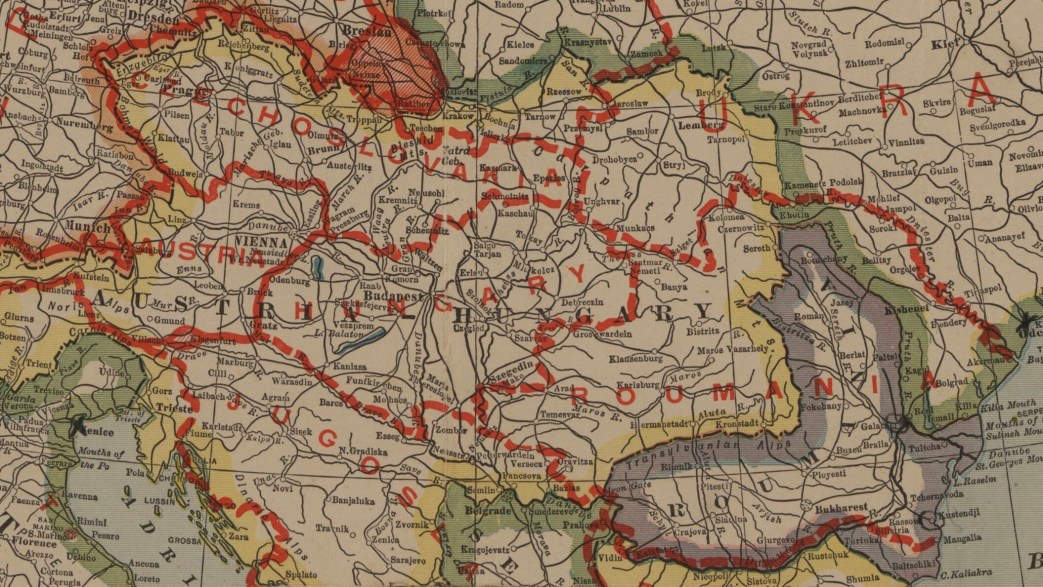
With sections on Ukraine, Lithuania, Transylvania and Dobrudja, Upper Silesia, Yugoslavia, Macedonia and Thrace, Albania, Czecho-Slovakia, White Russia, and the Magyar, this resolution from the Fifth Comintern Congress looks at the many unsolved national struggles in Europe after World War One.
‘Resolution on the National Question in Central Europe and The Balkans’ by the Fifth Congress of the Communist International from International Press Correspondence. Vol. 4 No. 64. September 5, 1924.
The imperialist war, into which the bourgeoisie drew the workers by hypocritical slogans about the defence of small nationalities and the right of self-determination, actually led to the intensification of national antagonism as a result of the victory of one the groups of capitalist powers and national oppression in Central Europe and in the Balkans.
The Saint-Germain, Versailles and subsequent treaties dictated by the victorious Entente powers, created a number of new small imperialist states–Poland, Czecho-Slovakia, Yugoslavia, Roumania, Greece as a means of fighting against the proletarian revolution. These states were formed by the annexation of large territories with foreign populations and have become centers of national oppression and social reaction.
The question of national oppression is now on the order of the day for those imperialist nations which before the war were not the object, but the subject of oppressive policies. An object lesson is supplied by the case of Germany. In regard to the latter, Entente imperialism was not content with the direct annexation of territories inhabited by Germans, which was accomplished on the basis of “peace treaties”. An attempt was also made to dismember Germany by the aid of concealed, refined forms of annexation, either in the shape of the comedy of “national self-determination” or in the shape of unadorned robbery exceeding the provisions of the peace treaties, as for instance in the case of the Ruhr.
The national question has thus attained new importance since the war and has become at the present time one of the essential political questions of Central Europe and the Balkans. At the same time the struggle of the oppressed peoples against national oppression has become a struggle against the power of the imperialistic bourgeoisie who were victorious in the world war, since the strengthening of these new imperialist powers means the strengthening of the forces of world imperialism.
The importance of the struggle against national oppression is still further augmented by the fact that the nationalities oppressed by Poland, Czecho-Slovakia, Yugoslavia, Roumania and Greece, in their social composition, are largely peasants, and the struggle for their national liberation is at the same time the struggle of the peasant masses against foreign landlords and capitalists.
In view of these facts the Communist Parties of Central Europe and the Balkans are confronted with the task of giving full support to the national-revolutionary movement among the oppressed nationalities.
The slogan “the right of every nation to self-determination, even to the extent of separation” in the present pre-revolutionary period must be expressed in the case of these newly arisen imperialist states in the more definite slogan, ‘the political separation of the oppressed peoples from Poland, Roumania, Czecho-Slovakia, Yugoslavia and Greece”.
The Congress declares that there are deviations in certain parties expressed in the attitude of certain comrades and groups who formulate their relations to the national-revolutionary movement on the basis of the sovereignty of the states formed as a result of the Saint-Germain and other treaties. The slogans of these comrades and groups with regard to the national revolutionary movement are directed not against these states founded on national oppression and directed against proletarian revolution, but toward partial reforms in these states, and urge autonomy for the oppressed peoples within the boundaries of these imperialist states.
The Congress vigorously condemns this strong tendency toward Social Democracy, just as it repudiates the tendency toward national Bolshevism which results in the Communist Party’s support of the leadership of these movements by the ruling classes and their parties, which in effect is the surrender of the working masses to the influence and domination of the chauvinist bourgeoisie.
The Congress charges all the Communist Parties of Central Europa and the Balkans with the task of giving complete support to the national-revolutionary movements of the oppressed peoples against the power of the ruling bourgeoisie, and of organizing communist nuclei in the national-revolutionary organizations, in order to win the leadership of the national-revolutionary movement of the oppressed peoples, and to direct it along the clear and definite path of revolutionary struggle against the power of the bourgeoisie, on the basis of the close solidarity of all workers and their common struggle for a workers’ and peasants’ government in every country.
Only by a union of the communist elements within the national-revolutionary organizations can the former secure priority for the toiling masses in the latter, as a counter-poise to the bourgeois-landowning and adventurous elements, which frequently used these organizations for their own class aims, or converted them into the tools for imperialist aims in the various capitalist States.
The Congress imposes on all the Communist Parties the obligation of carrying on an energetic struggle against the provocation of national hatred and chauvinism by the bourgeois and the social-traitor parties, and of explaining to the working masses of both the oppressed and oppressing nationalities, the social character of national oppression and the national revolutionary struggle and the dependence of this struggle on the struggle of the world proletariat for the complete social and national emancipation of the workers.
The Congress similarly condemns separatist tendencies in the solution of the national question, and believes that the realization of the right of all peoples to self-determination, even to the extent of separation, has nothing to do with separatism as such, and in no way interferes with the development of productive forces.
The Congress notes the counter-revolutionary significance of the colonizing of these small imperialist powers carried on by the ruling classes, leading to an aggravation of the national differences. The Congress charges the Communist Parties of Poland, Roumania, Yugoslavia, Czecho-Slovakia and Greece, with the obligation of conducting a vigorous campaign against this colonizing policy.
The Congress approves of the slogan launched by the Communist Parties of the Balkan countries advocating a Balkan Federation of equal and independent Workers’ and Peasants’ Republics.
Considering the extreme growth of anti-Semitism in the new imperialist powers, especially in Poland, Roumania and Hungary, and the attempt of the ruling classes to divert the attention of the working masses from the real causes of their impoverished condition and from taking part in the revolutionary struggle, by stirring up anti-Semitism, the Congress imposes on all Communist Parties the duty of waging a stubborn and vigorous struggle against anti-Semitism, and puts forward the slogan:
The unconditional removal of all restrictions imposed upon the Jewish population, and the guarantee of their free cultural development.
As regards the particular national questions of the different countries of Central Europe and the Balkans, the Congress con- siders the position to be as follows:
I. Macedonian and Thracian Questions.
1. The Macedonian and Thracian questions have during the course of decades been the cause of constant bloody conflicts between Turkey, Bulgaria, Greece and Yugoslavia, and a tool of imperialist policies in the Balkans.
The last imperialist war of 1914-18 ending in the economic disruption of the Balkans, their national enslavement and a new division of Macedonia and Thracia among Yugoslavia, Turkey, Greece and Bulgaria, aggravated still further the national question in the Balkans, and intensified their national antagonisms.
The partition of Macedonia among Yugoslavia, Greece and Bulgaria still further strengthened the aspirations of the Macedonian people in all parts of their despoiled native land for the formation of a united and independent Macedonia.
The same aspiration for the formation of a united and independent Thracia is being manifested by the Thracian peoples who are divided among Greece, Turkey and Bulgaria.
2. The Macedonian and Thracian questions are thus resolved into a single, basic, national-revolutionary problem which can and must be solved only by the Balkan Federation of Communist Parties, by directing it into the channel of proletarian revolution in the Balkans.
The Congress notes with satisfaction that the VIth Conference of the Balkan Communist Federation decided on the correct solution of this important question.
3. The Congress considers the slogans formulated at the VIth Conference of the Balkan Communist Federation “For a United and Independent Macedonia” and “For a United and Independent Thrace” as entirely correct and truly revolutionary.
The slogans of autonomy for the different parts of Macedonia and Thrace within the boundaries of any of the bourgeois States artificially created by the Treaty of Sèvres and other treaties, must be denounced as opportunistic slogans leading to agreement between the richer strata of the Macedonian and Thracian population and the ruling classes, and the further social and national enslavement of the Macedonian and Thracian poor.
4. The Congress at the same time emphasizes the fact that the revolutionary struggle of the Macedonian and Thracian people for their national and social freedom can only be successful, when it is carried on in conjunction with the revolutionary workers and peasants in every one of the Balkan countries.
5. The Communist Parties of the Balkans and the Balkan Federation must vigorously support the national-revolutionary movements of the oppressed peoples of Macedonia and Thrace for the formation of independent republics.
6. On the Balkan Communist Federation rests the obligation of uniting and directing the activities of the Communist Parties of the separate Balkan countries both in regard to the national questions and in regard to the special problems of Macedonia and Thrace.
II. The Ukrainian Problem.
1. The Ukrainian problem is one of the most important national problems in Central Europe, and its solution is dictated by the interests of the proletarian revolution in Poland, Czecho-Slovakia and Roumania as well as in those countries adjoining.
The Congress declares that the Ukrainian problems in Poland, Roumania and Czecho-Slovakia form one Ukrainian national question, demanding a common solution for all these countries.
2. The Ukrainian population in the districts annexed by Poland, Roumania and Czecho-Slovakia in the main is a peasant population and is suffering extreme national oppression, as a result of which the fight for national freedom in these districts is closely connected with the fight against the landowners, capitalists and government officials. This forms a firm ground for the durable union of the peasantry and proletariat in these countries for the united struggle against social and national oppression.
3. The Congress declares that the slogan of autonomy for Carpathian Russia in Czecho-Slovakia, or for Western Ukraine (Eastern Galicia, Volin, Podlyashe, Volinsky Polesye and Kholmschina) in Poland or for Bessarabia and Bukovina in Roumania, is directed towards forming a coalition of the wealthy strata of the Ukrainian peasantry with the ruling classes in Czecho-Slovakia, Poland and Roumania, and serves to strengthen the economic and national oppression of the peasant population in these lands and therefore must be turned down by the Communist Parties of these countries.
4. While supporting the slogan of the Communist Party of fighting against the annexation of Bessarabia by Roumania and the slogan of the state self-determination of this country, the Congress at the same time considers it necessary for the Communist Parties of Poland, Czecho-Slovakia and Roumania to launch the general slogan of separation of the Ukrainian lands from Poland, Czecho-Slovakia and Roumania and their union with Soviet Ukraine and through it, with the Union of Socialist Soviet Republics.
The Congress considers that the Communist Parties of Poland and Roumania are successfully advancing this slogan.
5. At the same time the Congress emphasizes the fact that the revolutionary struggle of the Ukrainian peasantry in Poland, Czecho-Slovakia and Roumania for their national liberation can be successful only on the absolutely essential condition that the Ukrainian peasantry will build all their struggle and organization on a close alliance with the struggle of the workers and peasantry led by the Communist Parties of these countries for the overthrow of the rule of capitalism.
6. The Congress obliges the Communist Parties of Czecho-Slovakia, Poland and Roumania to give all the help possible to strengthen and develop the Communist Parties and organizations in these Ukrainian districts. The Congress notes with satisfaction the results obtained in this connection in these countries.
7. The Congress approves of the decisions of the Second Congress of the Communist Party of Poland and the Fifth Conference of the Communist Party of Western Ukraine (Galicia), directed towards creating advantageous conditions for communist propaganda and organizations in Western Ukraine. The Congress considers it expedient to co-ordinate the actions of and to establish periodical contact between the communist organizations of Western Ukraine, Carpathian Russia and Bukovina and with the Communist Party of Ukraine, retaining however strictly centralized leadership on the part of the Communist Parties of Poland, Roumania and Czecho-Slovakia over these organizations.
8. The Congress recommends the Communist Parties of Poland, Czecho-Slovakia and Roumania to consider coordinated action on the question of the Ukrainian national-revolutionary movement, to publish proclamations, organize general peasants’ congresses, etc. etc.
III. The Yugoslav Problem.
1. Yugoslavia is a State composed of many nationalities. The Serbian bourgeoisie which is imposing its domination, is a nation which forms only 39% of the total population of Yugoslavia. The remaining nations, together forming the vast majority of the population, are subjected in a greater or smaller measure to national oppression. A policy of forcible denationalization is being carried out against them.
2. The Serbs, Croats and Slovenes represent three separate nations. Theory of a united trinity of the Serbs, Croats and Slovenes is only a mask for Serbian imperialism.
3. The tasks of the Communist Party of Yugoslavia are to wage a resolute fight against national oppression in all its forms, to fight for the self-determination of the different nations, support the national liberation movements, constantly strive to remove these movements from the influence of the bourgeoisie and connect them with the common fight of the working masses against the bourgeoisie and capitalism.
4. The national problem in Yugoslavia is not a constitutional question and, therefore, cannot be identified with the problem of revising the Vidovdan constitution. It is in the first place a question of the fight of the nationally oppressed population for the right to national self-determination and secondly, it is a question of ‘the revolutionary struggle of the working masses in the whole of Yugoslavia.
5. The fight against national oppression for the right to self-determination of nations, even to the extent of separation, and the workers’ and peasants’ rule must be connected with the general fight against the aggressive Serbian bourgeoisie, against the monarchy and against the political sanctions of the Vidovdan constitution.
6. Although the national question cannot be solved by a revision of the constitution, the Communist Party of Yugoslavia, nevertheless, must take an active part in the fight for the revision of the constitution that is taking place at the present time, with the aim of overthrowing the present oppressive regime of the Serbian bourgeoisie and obtaining as many guarantees and political rights and freedom as possible for the working masses of the oppressed nationalities. It must constantly strive to unite the working masses in the fight for the establishment of a workers’ and peasants’ government. It must explain to the masses that only a workers’ and peasants’ government can finally solve the national question.
7. Since there exists a mass movement against national oppression in all its forms and a movement for self-determination in Yugoslavia, the national problem becomes actual and acute and directly affects the interests of the working masses.
In view of this, the general slogan of the right of nations to self-determination launched by the Communist Party of Yugoslavia, must be expressed in the form of separating Croatia, Slovenia and Macedonia from Yugoslavia and creating independent republics of them.
8. With respect to the Croatian and Slovene population of those territories occupied by Italy, the Communist Party of this country must carry on propaganda and agitation in the spirit of those slogans mentioned above and in close contact with the brother Communist Party of Yugoslavia.
IV. The Czecho-Slovakian Question.
1. The national relations in Czecho-Slovakia are very similar to those in Yugoslavia. The Congress declares that Czecho-Slovakia is not a single nation, but that besides the Czech nation the State comprises the following nationalities: Slovak, German, Magyar, Ukrainian and Polish.
2. The Congress considers it essential that the Communist Party of Czecho-Slovakia with respect to the national minorities, should launch and realize the slogan of the right of nations to self-determination, even to the extent of separation. The Communist Party of Czecho-Slovakia must particularly support the fight of the Slovaks for their independence and untiringly strive to release this movement from the influence of the bourgeoisie.
The slogan of autonomy advanced by the bourgeois and nationalist parties, is directed towards enslaving the working population of all nationalities in Czecho-Slovakia to their own bourgeoisie in alliance with the Czechs.
3. The Congress emphasizes the fact that the national emancipation of the national minorities of Czecho-Slovakia can only be successful under the condition that the working population of all nationalities will carry on their struggle in close alliance with the fight of the workers and peasants in the whole country for the overthrow of the power of capital for the dictatorship of the proletariat.
V. The Upper Silesian question.
The Congress declares that the plebiscite of 1921 which resulted in the division of Upper Silesia, did not succeed in any considerable measure to eliminate national hatred. Concurrently with the growth of capitalist exploitation in both of the separated parts of the country, there is an increase in national oppression.
Upper Silesia is one of the most important industrial centres of Central Europe and, as a result of the fact that its population is mainly proletarian, it is a natural bridge between the maturing revolution in Poland and Germany.
The national emancipation of German workers in Poland and Polish workers in Germany can only be achieved by overthrowing the power of capital and by establishing the dictatorship of the proletariat.
The Fifth Congress establishes that considerable successes have been obtained by the Communist Party in the German Section of Upper Silesia where the C.P. of Germany, thanks to its resolute revolutionary policy, obtained leadership in the proletarian struggle.
The Fifth Congress calls the attention of the Communist Parties of Poland and Germany to the necessity of coordinating and intensifying their work in Upper Silesia with the aim of obtaining leadership over all the proletariat in both States. Both fraternal parties must collaborate in the fight against national oppression in all its forms, and in their agitation and propaganda they must take into consideration the language differences of the German and Polish workers.
In that part of Upper Silesia now in the hands of Poland, the German workers are being subjected to national oppression as well as to capitalist exploitation. The same state of affairs prevails in the German part of Upper Silesia with respect to Polish workers.
VI. The White Russian Question.
1. The White Russian question together with the Ukrainian is the most important national revolutionary question in Poland, and its solution has the same foundation as the Ukrainian question.
2. The Congress takes responsibility for the correct evaluation of the national and agrarian questions in White Russia made by the Polish Communist Party and for the energetical work of the Communist Party of Western White Russia in this direction, as a result of which the Communist Party of Western White Russia has achieved nearly exclusive influence over the peasants of this country.
3. The Congress approves of the slogan of the State separation of White Russian territories from Poland for its union with Soviet White Russia and through the latter with the Union of Socialist Soviet Republics advanced by the Polish Communist Party.
VII. The Lithuanian Question.
1. The Congress considers it essential to intensify communist activities among the Lithuanian working population in those parts of Western White Russia and Eastern Lithuania annexed by Poland.
2. The Communist Party of Poland must carry out the slogan of the right of the Lithuanian population to self-determination, even to separation from the Polish State.
VIII. The Magyar Question.
The Congress considers it essential to intensify the Communist work among the Magyar population of those territories annexed by Czecho-Slovakia, Roumania and Yugoslavia, and that the Communist Parties of these countries should launch the slogan of the right of these Magyars to self-determination, even to separation from the States that annexed them.
IX. The Transsylvanian and Dobrudja Questions.
The Congress approves of the slogans advanced by the Communist Party of Roumania for the separation of Transsylvania and Dobrudja from Roumania and forming independent regions of them.
X. The Albanian Question.
It is essential to support the fight of the Albanians for their independence, since there is rivalry between the Italian, Yugoslav and Greek governments for the possession of Albania.
International Press Correspondence, widely known as”Inprecorr” was published by the Executive Committee of the Communist International (ECCI) regularly in German and English, occasionally in many other languages, beginning in 1921 and lasting in English until 1938. Inprecorr’s role was to supply translated articles to the English-speaking press of the International from the Comintern’s different sections, as well as news and statements from the ECCI. Many ‘Daily Worker’ and ‘Communist’ articles originated in Inprecorr, and it also published articles by American comrades for use in other countries. It was published at least weekly, and often thrice weekly. The ECCI also published the magazine ‘Communist International’ edited by Zinoviev and Karl Radek from 1919 until 1926 monthly in German, French, Russian, and English. Unlike, Inprecorr, CI contained long-form articles by the leading figures of the International as well as proceedings, statements, and notices of the Comintern. No complete run of Communist International is available in English. Both were largely published outside of Soviet territory, with Communist International printed in London, to facilitate distribution and both were major contributors to the Communist press in the U.S. Communist International and Inprecorr are an invaluable English-language source on the history of the Communist International and its sections.
PDF of full issue: https://www.marxists.org/history/international/comintern/inprecor/1924/v04n64-sep-05-1924-Inprecor-loc.pdf
 Revolution's Newsstand