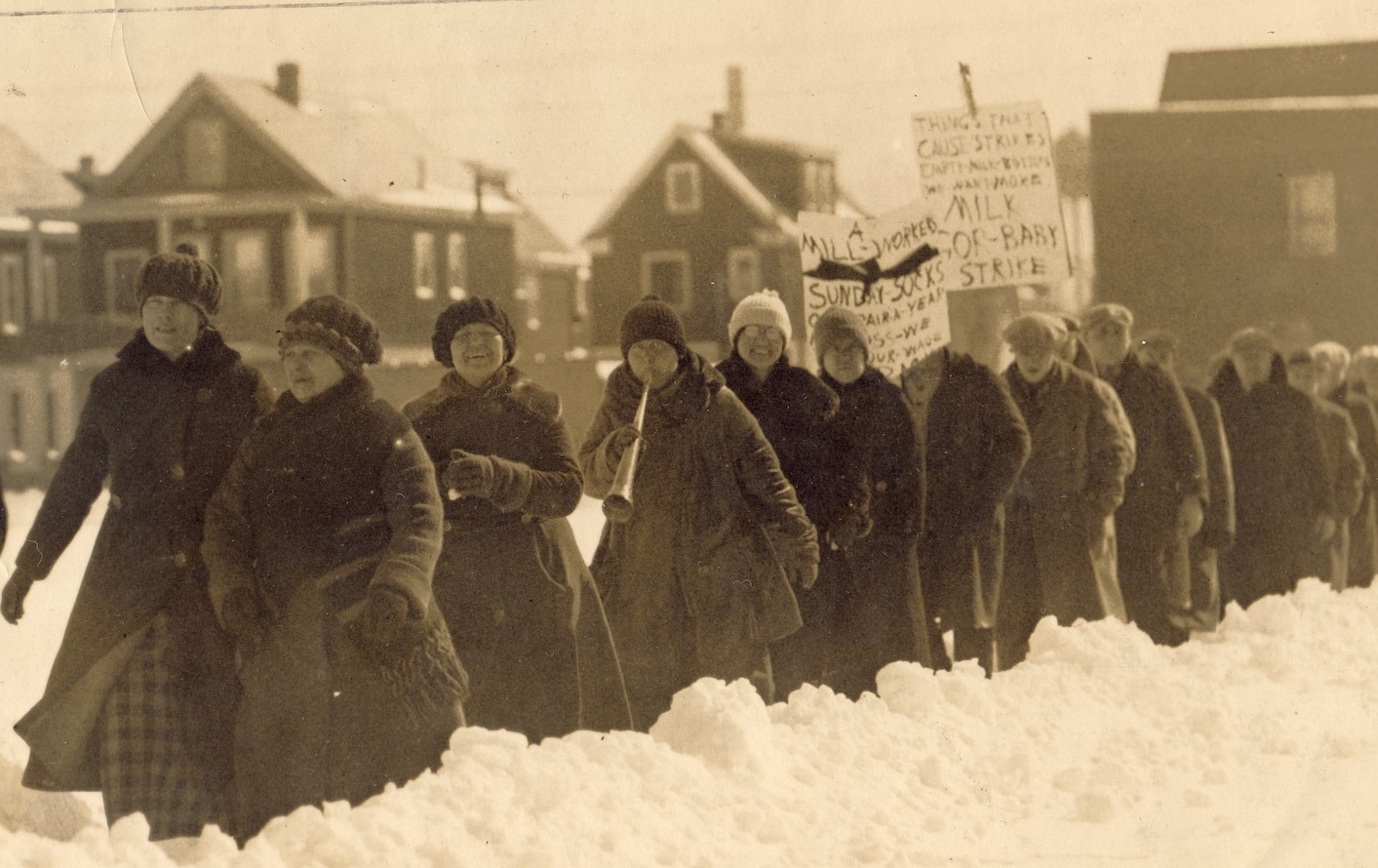
Kate Gitlow, Secretary of the United Council of Workingclass Housewives, reports on the essential role that organization played in the Passaic strike of 1926.
‘Working Class Women Have Helped Win the Passaic Strike’ by Kate Gitlow from The Daily Worker. Vol. 3 No. 278. December 8, 1926.
THE Passaic strike is the first of its kind in the history of the labor movement in the United States. Fifty per cent of the strikers are women and most of them are married and have children. The lot of the women textile workers, before the strike, was even harder than that of the men. During the day, they had to take care of the children and the household, did the cooking, scrubbing, and mending, and tried hard to make ends meet. During the night, instead of resting, they had to work long hours in the mills. That was the life provided for the women textile workers of Passaic by the mill owners in their greed for profits.
Endured Much.
Since women by nature are patient, the women textile workers suffered patiently for a long time, until they could stand it no longer. Husband and wife working together could not earn enough to support the family. Then came the wage cut, and this was the direct cause of the strike. The wage cut awakened the men and women textile workers and made them think, and act together.
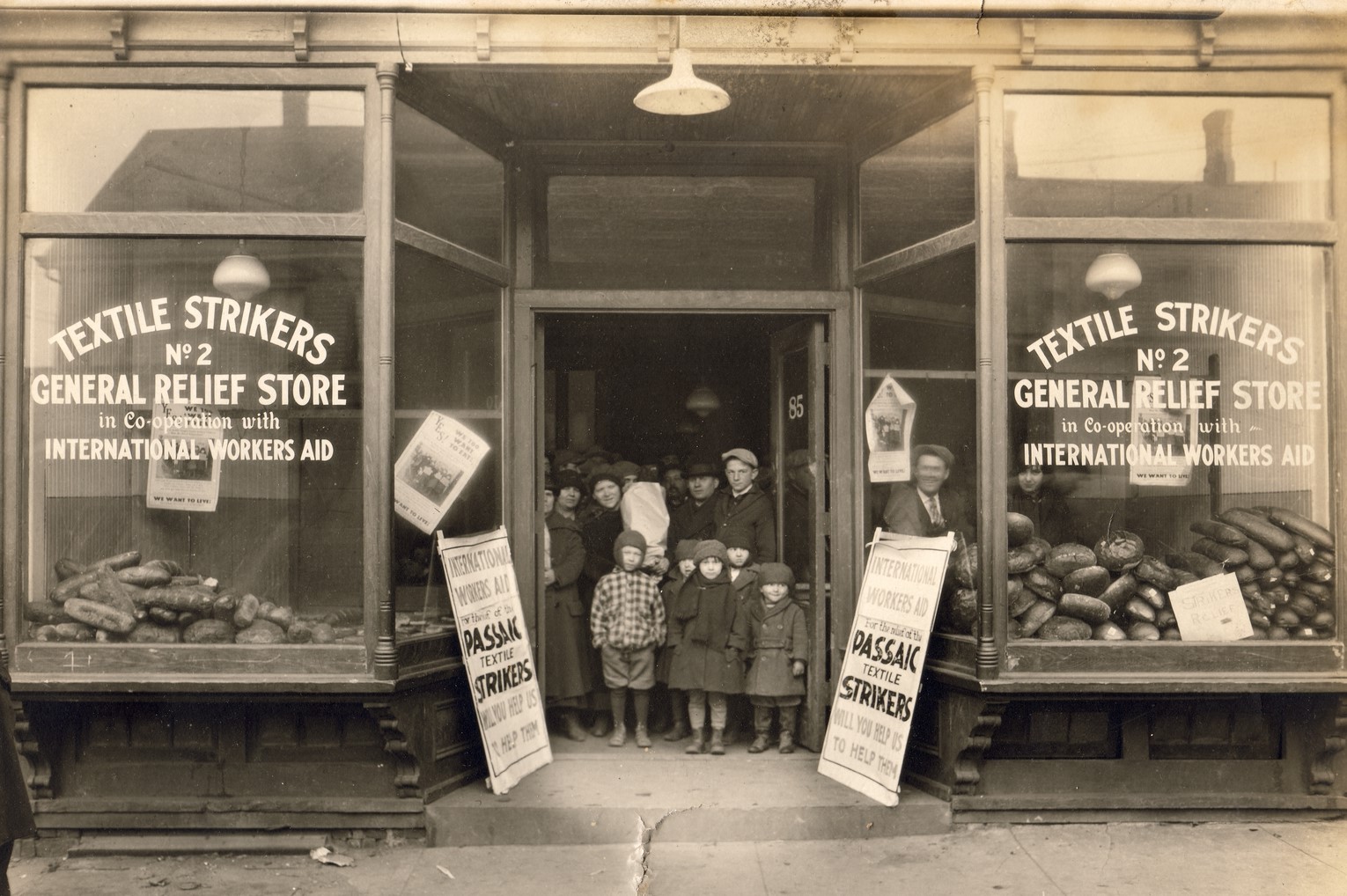
After the wage cut, the textile workers organized themselves into the United Front Committee of Passaic and vicinity. On Jan. 25, 1926 the textile strike was declared. Because they had no union before the strike, and because of the low wages they received, the strikers found themselves immediately in need. Then the Passaic General Relief Committee was organized and an appeal for funds was issued.
Out to Win or Die.
WHY are these striking women and men in the eighth month of the strike as determined as in the beginning? Why did all the clubbing by the police, the arrests and jailings not frighten the strikers back into the mills? Why are sixteen thousand men and women of many nationalities like one family? The striking men and women are determined because the conditions in the mills and the meager wages had become unbearable. All the strikers, especially the women, know what it would mean to go back into the mills under the old conditions. It would mean misery for themselves and their children and life without hope. That is why the beatings by the Passaic police, or cossacks, as the strikers call them, have failed to break their spirit. The women strikers are out to win or die. The strikers speak several languages, but they understand each other well. Those who have suffered under the same conditions, no matter in what mill or under what boss, can understand each other and fight for the same cause.
Proves Women’s Power.
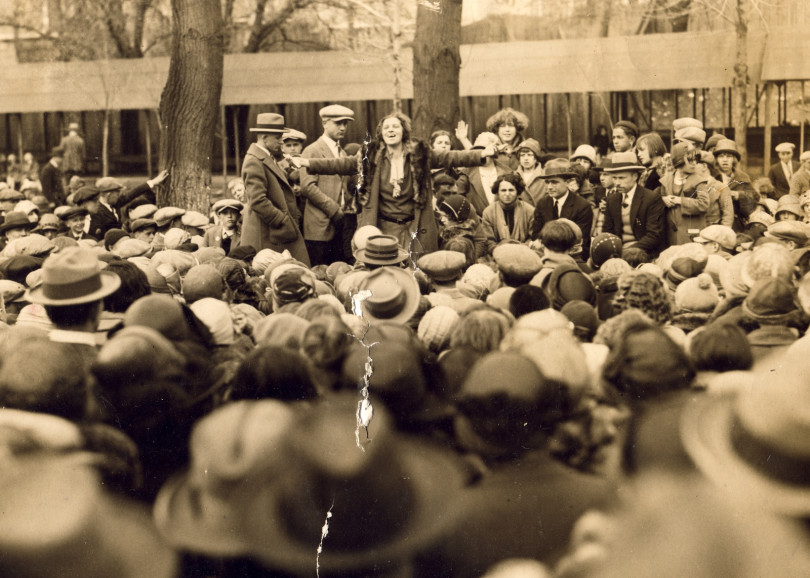
COULD the strike have lasted so long if the women were not directly involved? Could it have lasted so long if the women at home did not know what was happening in the mills? Of course, it could not. If the women did not have first hand knowledge of the conditions, instead of fighting shoulder to shoulder with the men in the front ranks of the strike, they would blame the men and. unconsciously, do all in their power to break the strike. The Passaic strike proves conclusively that the women can and will fight with the men for better conditions, a strong union when they understand. The same is good for the men workers. When they understand why they suffer and know how best to fight in order to do away with this suffering, they fight with determination.
The Important Role of the Working-class Women in the Passaic Textile Strike.
THE United Council of Workingclass Housewives, an organization of proletarian housewives with branches in New York, Passaic and Newark, whose aim is to organize the unorganized housewives and wives of the workers and to unite with existing working women’s organizations thru permanent delegated conferences, and to unite their struggles with those of the men workers, and recognize that they have no struggle apart from the workingman, at their regular delegated central body meeting, Feb. 26, 1926, passed a resolution endorsing and offering to open kitchens immediately to feed the strikers and their families.
Open Kitchen.
ON March 12, the United Council of Housewives opened a kitchen where over four hundred children were fed with wholesome food every day. Enemies of the strike tried hard to find fault with the kitchens and with the food. They sent investigators. But to their horror, they found that some of the children had gained as much as ten pounds within a short time. In April a second kitchen was opened where from four to five hundred children were fed during the months of July and August. At the Victory Playground, which was opened for the children by the Strike Committee, 1,000 children were fed with the help of the United Women’s Conference.
How Funds Were Raised.
THE United Council of Workingclass Housewives is organized on the basis of branches, called Neighborhood Councils, and are numbered as they are organized. These Neighborhood Councils have formed themselves into committees and visited women’s organizations in various neighborhoods, and talked to them about the struggle of the textile workers in Passaic and vicinity, telling them what the United Council of Workingclass Housewives is doing to help win the strike and asking them to join in this work, and appealing for funds.
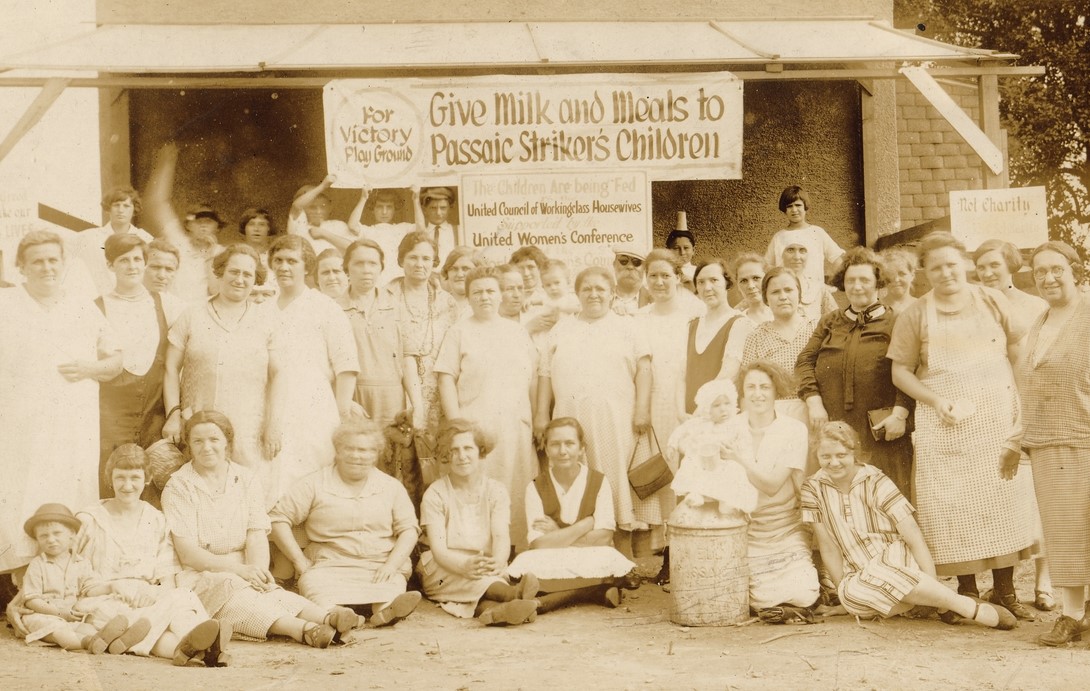
This work of the Neighborhood Councils helped to broaden the scope of the relief, and to acquaint the different working class women’s organizations, as fraternal, benevolent, charitable and religious organizations with the struggle in Passaic.
Open air mass meetings and social affairs were held; subscription lists were circulated, and house to house collections were made. Food and clothing were also collected. All funds for the maintenance of the kitchens and the feeding of the children on the playground were collected mostly by and from women. No circular letter of appeal has been sent out up to the time this article is written to labor unions. Many working women’s organizations that did not understand before, now are helping and co-operating to maintain the kitchens. The following organizations that are helping and actually co-operating in the work of feeding the children are the Lithuanian Working Women’s Alliance of America, a national organization; Community Welfare League, Women’s Educational Club of Passaic and numerous working women’s organizations of all nationalities and creeds who sent in contributions.
Women’s Conference.
ON June 19, a conference of women’s organizations was held in Passaic to devise means for feeding the Passaic strikers’ children. This conference was called by the United Council of Workingclass Housewives and here a beginning was made to bring women’s organizations together to help with the feeding of the strikers’ children. At the conference, a committee was elected which consisted of one representative from each unit represented and the name United Women’s Conference was adopted. The delegates to United Women’s Conference meet regularly once a month. Leona Smith, the secretary of the conference is very able and has been responsible for much of the good work which has been accomplished in Passaic. It is hoped that this conference will broaden its scope and there will be established a permanent delegated women’s conference where problems of the working class women and of the working class as a whole may be discussed, and plans devised and carried out for the protection of the interests of the working class women and the working class as a whole.
Already a joint provisional committee is in existence to further such a conference. To this conference will be invited labor unions and fraternal organizations.
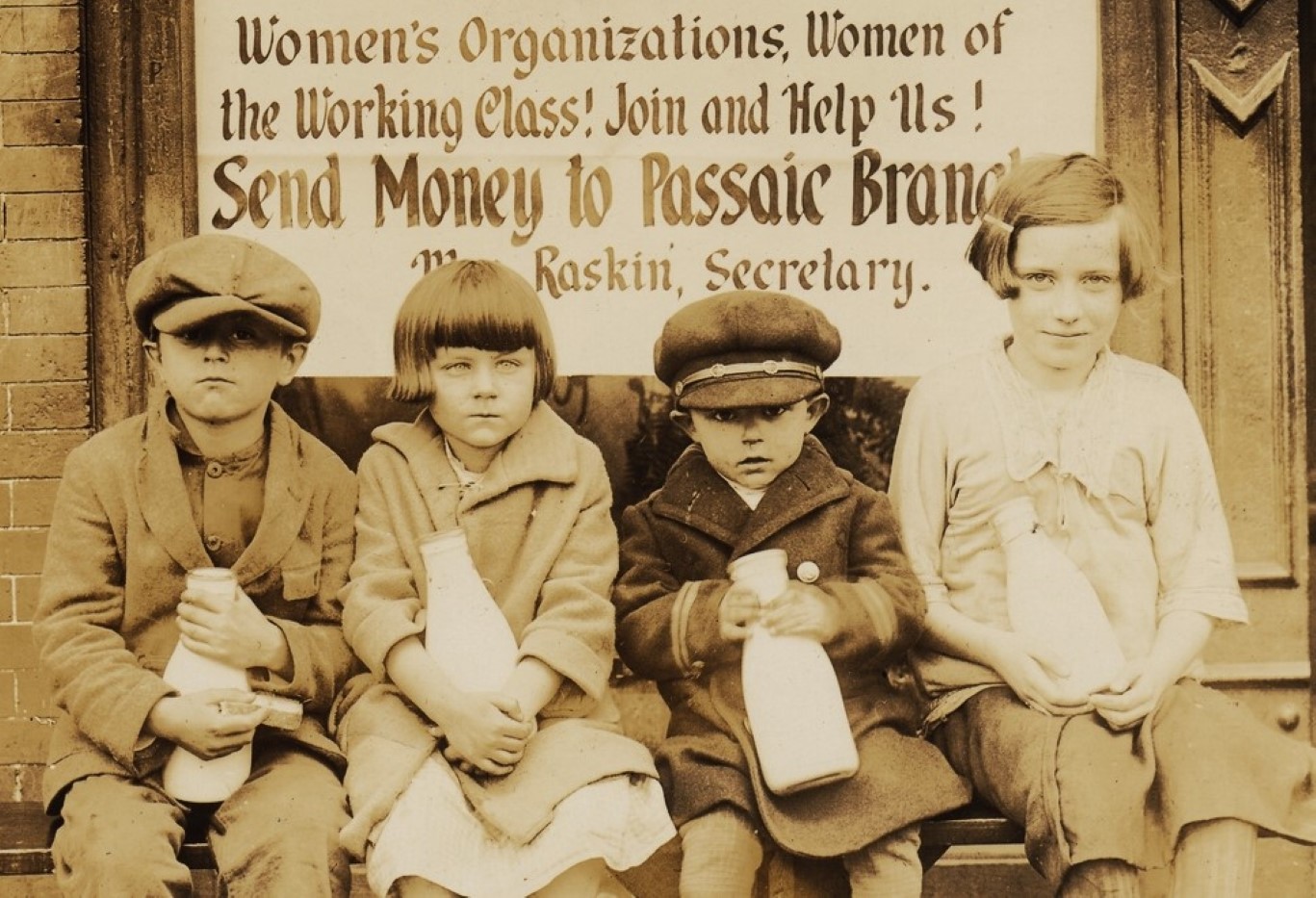
In the beginning, the Housewives’ Council of Passaic thru their comm tee managed the kitchens. They had committees for buying, cleaning, cooking, and for feeding the children. The good management of the women of the Housewives’ Council of Passaic made it possible from the beginning to feed so many children. These women in Passaic, in addition to doing this work, also collected food and money. Most of the money was raised by the New York councils.
What the Workingclass Housewives Have Done.
A MASS meeting was held under the auspices of the United Council of Workingclass Housewives on March 9, in the biggest hall in Passaic, the purpose of which was to acquaint the outside working class women with the striking women and so engaged them in the relief work, The hall was packed early in the evening. At this meeting, a beginning was made in organizing the women for the relief work. The mothers of the children who were fed in the kitchens, some of the striking women and others like the cigar, handkerchief shop workers and housewives were organized into Working Women’s Councils. These Working Women’s Councils, at this time, number ten with a membership of from thirty to fifty in each, and they are of several nationalities. These women had no previous training in organizations. They did not know how to conduct a meeting, or how to act as secretary or chairman. From the beginning, these women were made to serve on committees and to talk in their own language. Business meetings were conducted in English, and those who could understand this language explained to those who could not understand all that was transacted at the meeting. A class for all Council Executive Committees was organized in order to train the women how to con- duct meetings. In a short time the learned, and now the meetings are becoming very lively. Lectures are being held jointly for all the councils. Outline of lectures follows:
Why the Workers are Poor.
The Working Class Mother and her Children.
What the Unions do for the Workers.
Working women’s Movements.
The Working Class Woman and her Home Life.
Sanitation.
Maternity.
On All Committees.
THE women in the Working Women’s Councils are serving on all committees, committees in the kitchens, on the playgrounds, committee’s visiting organizations, collecting food, arranging affairs, and committees for raising funds to feed the children. They have learned by this time that the strikers are helped not as charity but as solidarity in order to help win the strike, and that it is expected that the Passaic textile workers will do likewise when other workers shall be engaged in a struggle with their bosses to better their conditions. Tho the women in the councils are mostly strikers themselves or the wives of strikers, who have been engaged in a bitter struggle for eight months and are in need themselves, they are now raising a little money for the British miners.
The Lesson of the Passaic Strike.
HOUSEWIVES have often been considered of no use except to remain at home and attend to household duties. These housewives have proven, during the Passaic strike what a great help they can be in all labor struggles when they are organized and made to understand. It should be remembered that due to the high cost of living the Workingclass Housewives are leaving home more and more to work in the different industries. It is now almost impossible for a worker to support his family. It should be understood by organized labor that there is already a great mass of working women in the different industries and that more are coming in and that these women are to a great extent unorganized.
Now Important Factor.
THE working women as well as the working class housewives are fast becoming an important factor in the economical and political life of the workers. The master class has learned this long before the workers. This class is doing all it can to use the working class women to its advantage. The railroad workers’ wives are being organized into an auxiliary of the company union.
This Passaic strike proves that the great mass of working class women in the factories, shops, and homes can be made to serve, economically and politically the interests of the workers. It must be understood by all those interested in the labor movement and by the working men and women, that all the struggles of the workers to better their conditions, no matter whether they are fighting for a union, against low wages, for better homes, cheaper rents, better schools, against child labor or for maternity protection, that these struggles must be carried on unitedly by the women and men of the working class.
The Daily Worker began in 1924 and was published in New York City by the Communist Party US and its predecessor organizations. Among the most long-lasting and important left publications in US history, it had a circulation of 35,000 at its peak. The Daily Worker came from The Ohio Socialist, published by the Left Wing-dominated Socialist Party of Ohio in Cleveland from 1917 to November 1919, when it became became The Toiler, paper of the Communist Labor Party. In December 1921 the above-ground Workers Party of America merged the Toiler with the paper Workers Council to found The Worker, which became The Daily Worker beginning January 13, 1924.
PDF of full issue: https://www.marxists.org/history/usa/pubs/dailyworker/1926/1926-ny/v03-n278-NY-dec-08-1926-DW-LOC.pdf
 Revolution's Newsstand