
The background to the mass trials of Kentucky miners for ‘criminal syndicalism’ and murder during the years of ‘Bloody Harlan’ in Eastern Kentucky.
‘The Harlan Trials’ by Lawrence Seco from Labor Age. Vol. 21 No. 10. October, 1932.
HARLAN County, Kentucky, is situated in the southeastern part of the state and borders on Virginia and Tennessee. Coal mining is the chief and practically the only industry in the county. Until early in 1931 the miners had been for some years unorganized. Then Coal Mine Workers Industrial Union No. 220 of the I.W.W. entered the field, and shortly thereafter the United Mine Workers of America attempted to organize. Successive wage-cuts accelerated the progress of the unions. The bosses countered by bringing in gunmen, all under the direction of Sheriff John Henry Blair. A strike called by the U.M.W. of A. local was quickly turned into a lockout.
In outlying sections the strike was partly broken but the “free town” of Evarts, where the I.W.W. miners predominated and which was named “Red Evarts” by the coal operators, remained unsubdued. Evicted miners and their families had been brought to Evarts and taken care of by the union men. There, with fighting spirit unbroken and ranks strengthened by blacklisted miners from other parts of the county, the strikers withstood the onslaughts of the gun-thugs. “Red Evarts” became a thorn in the side of the gunmen and a challenge to open-shop bosses.
The coal operators, fearful that the example of Evarts would spread to other coal camps, determined on a plan to wage open warfare on the town. Squads of gunmen in automobiles would speed through the main street with machine-guns and rifles pointed menacingly at the strikers. Failing to intimidate the miners more drastic action was attempted. One squad under the leadership of Jim Daniels attempted to kidnap and beat a colored striker, Johnson Murphy. Bill Burnett, a white miner, protested and was shot at by the thugs. Drawing his own gun Burnett killed one deputy, Jesse Pace, and wounded another, Frank White. Burnett, badly wounded, was put in jail and charged with murder. Losing in the first battle the company deputies became more careful, and the miners picketing more effective.
The first attempt at “wiping out” the picket lines occurred on May 5, 1931, and resulted in the famous “Battle of Evarts.” Pickets had stopped a truckload of household goods being transported by the Peabody Black Mountain Company for a strikebreaker who had formerly lived at Verda, a few miles from Evarts. Three autoloads of gunmen led by Jim Daniels, sped down from the Black Mountain mine.
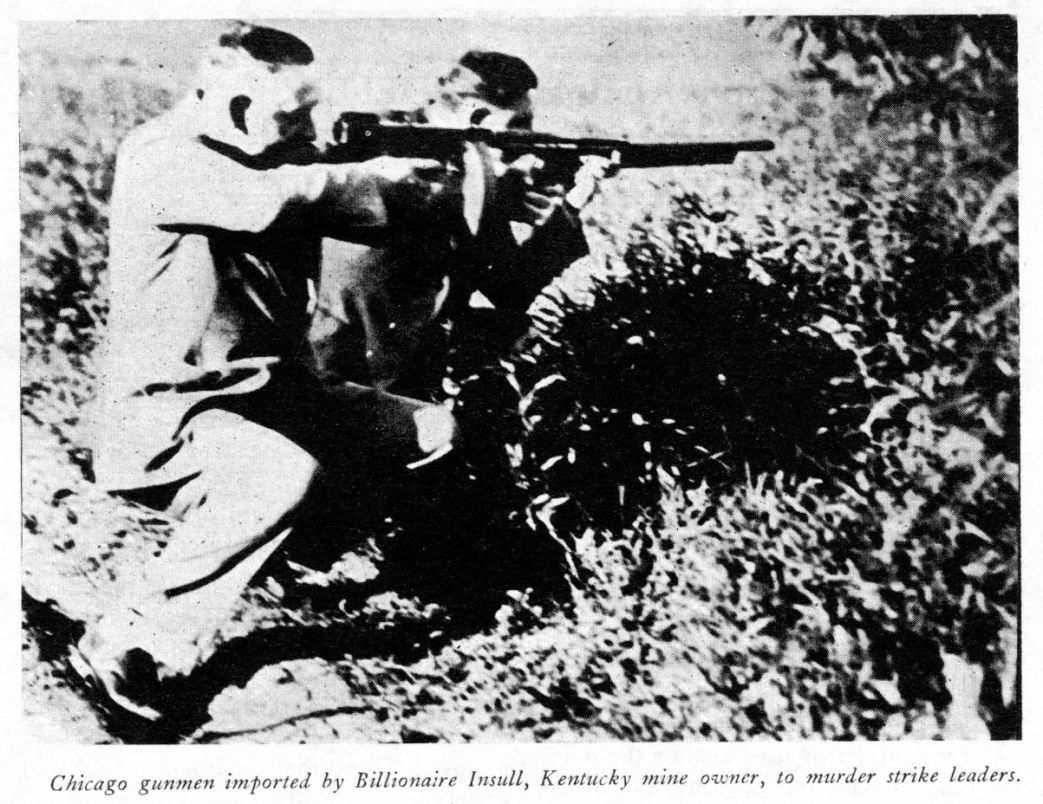
At sight of the gunmen the pickets sought cover behind rocks and bushes. Daniels and his crew immediately began the “wiping out” process by firing with machine guns into the bushes up and down the hillside. Unable to escape the deadly machine gun bullets by running away the miners remained under cover and by lying flat on the ground behind rocks and trees escaped injury. In self-defense some of the besieged men who were armed returned the fire of the gunmen. Fifteen minutes later when the fighting had ended Jim Daniels, the leader of the gun-thugs, was found dead, and with him two other gunmen, Otto Lee and Howard Jones, were killed. One miner, Carl Richmond, was killed by the gunmen.
Within a few hours after the battle the militia was called in and martial law declared. Under cover of the troops 43 persons were arrested and indicted for murder on charges growing out of the clash, and 63 others were charged with criminal syndicalism. Included in the wholesale arrests for murder were the Evarts chief of police and his assistant, W.B. Jones and W.M. Hightower, secretary and president of the Evarts local U.M.W. of A., and other active union men, among them being four colored miners.
The trials were started at Harlan, August 17, Bill Burnett being the first defendant. During the selection of the jury the prosecutor suddenly halted the trial and moved for a change of venue, specifying that the cases should be moved to counties far removed from the mining district. Judge D.C. (Baby) Jones granted the motion and sent the cases to Montgomery and Winchester Counties, two hundred miles distant from Harlan, and in the Bluegrass region where the jurors would be drawn from rich farmers and race horse breeders. Moreover the state of Kentucky does not pay witness transportation and the defense would be handicapped in raising funds to bring them.
Despite the terrific financial handicap the General Defense Committee raised enough money to bring in all witnesses needed for Burnett and on November 20, after a four day trial, he was acquitted. W.B. Jones was the next miner scheduled for trial. He, like Burnett and all the other forty-two defendants, was charged with direct murder. The prosecution, after their defeat in the Burnett case, knowing they could not convict on charges of direct murder had Jones and the remaining defendants indicted for “conspiracy to murder” and by a grand jury in Montgomery County!
W.B. Jones was convicted at Mount Sterling, December 12, and sentenced to life imprisonment. W.M. Hightower was convicted at Mount Sterling on January 14, and also sentenced to life imprisonment. Then the General Defense attorneys succeeded in having all the cases sent back to Harlan County where a special ten-weeks term of court was set to open May 31 to hear the murder cases.
At Harlan the prosecution first brought to trial Elzie Phillips, one of the colored miners. Putting their reliance on race prejudice, so deep-rooted in the South, the prosecution succeeded in securing the conviction and life sentence of Elzie Phillips. His trial was followed by that of F.M. Bratcher, a white miner. The jury from nearby Whitley County stood 11 to 1 for an acquittal and a mistrial was declared. Chester Poore, another white miner, was then tried before a jury from Laurel County, also near the mining regions. Chester Poore was acquitted but remanded in jail to stand trial on a charge of killing one of the other three gunmen killed in the Battle of Evarts.

F.M. Bratcher was brought to trial again, before a jury drawn from Mercer County in the Bluegrass region. After being deadlocked for 75 hours the jury was discharged. Chester Poore, previously acquitted, was placed on trial before a jury from Boyle county, also in the Bluegrass region. Several of his principal witnesses were arrested and charged with murder for alleged participation in the Evarts battle. His second trial was concluded in less than four days. The jury deliberated a few hours and sentenced him to life imprisonment. William Hudson was the next victim. A Bluegrass jury from Madison County “deliberated” exactly 20 minutes and gave him life.
Another special term of court was set for September. Bratcher was brought to trial for the third time. His jury was selected from Owsley County, which adjoins the mountain regions.
That jury promptly acquitted Bratcher. He was remanded to jail, however, for trial on a charge of killing Howard Jones, another of the three gunmen. Bratcher is now out on bond. Jim Reynolds was then brought to trial. The prosecution demanded and obtained a Bluegrass jury, this time from Jessamine County. Once more the frame-up machine functioned smoothly and swiftly. Jim Reynolds was found guilty and given a life term.
Bill Burnett who was tried and acquitted of killing Jesse Pace last fall, was arrested in Bell County in August and was brought to Harlan to be tried for shooting with intent to kill. He was sentenced to three years.
Murder charges against five miners held in jail since May, 1931, were reduced to voluntary manslaughter to which the defendants pleaded guilty and they were given varying terms of two and three years. The charge of murder against five other defendants was dropped and they were released after being confined for more than 16 months. The General Defense Committee which has been defending the miners had nothing to do with the compromise and pleas of guilty. All men were advised to stand solid and fight through to the end. Had funds been available to continue the fight the prosecution would have soon collapsed. Commonwealth Attorney W.A. Brock said in connection with the compromise: “I did not like to agree to these defendants pleading guilty to manslaughter. However, as I believed I was saving the county a lot of money by avoiding costly trials, and the relatives of the slain men agreed, I considered it the best thing to do. The cases against the ring-leaders have not been dismissed and they will not be dismissed. Although their trials will cost a lot of money they must be tried and settled.”
The disposal of ten cases leaves many more to be tried, the cases of the six miners sentenced to life imprisonment must be appealed. Court which has been adjourned temporarily will soon reconvene. All friends of the miners are urged to remember the men who still remain to be tried and those whose cases must be appealed.
Labor Age was a left-labor monthly magazine with origins in Socialist Review, journal of the Intercollegiate Socialist Society. Published by the Labor Publication Society from 1921-1933 aligned with the League for Industrial Democracy of left-wing trade unionists across industries. During 1929-33 the magazine was affiliated with the Conference for Progressive Labor Action (CPLA) led by A. J. Muste. James Maurer, Harry W. Laidler, and Louis Budenz were also writers. The orientation of the magazine was industrial unionism, planning, nationalization, and was illustrated with photos and cartoons. With its stress on worker education, social unionism and rank and file activism, it is one of the essential journals of the radical US labor socialist movement of its time.
PDF of full issue: https://www.marxists.org/history/usa/pubs/laborage/v21n10-oct-1932-labor-age.pdf
 Revolution's Newsstand