
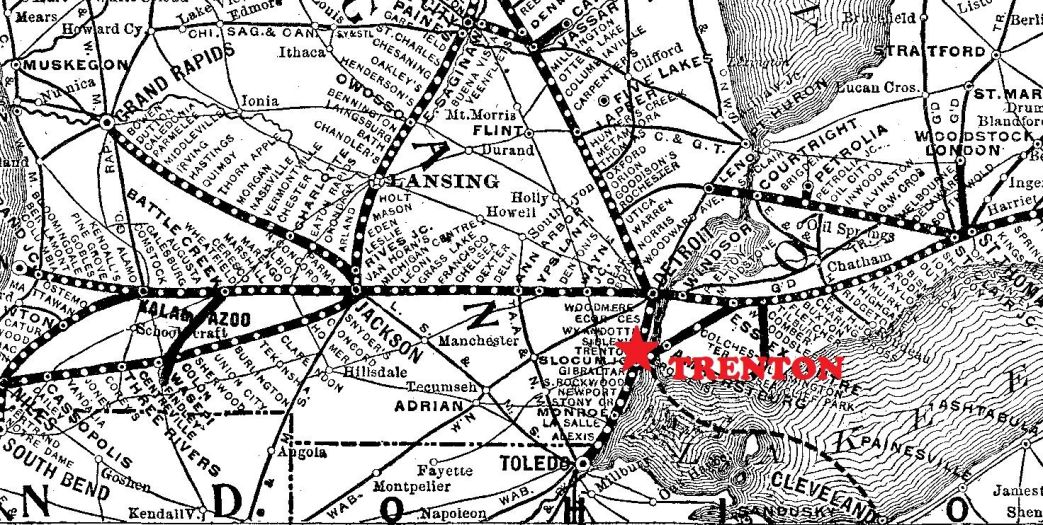
English journalist Charles Lapworth was a chronicler of Debs’ 1908 cross-country ‘Red Special’ election rail tour. Here he records a poignant picture of a seemingly minor moment. South of Detroit, at Trenton, the train made an unscheduled stop to meet a group of young students reported have been let from school in the chance of seeing the train as it passed through town. ‘Gene unboarded and spoke to the gathered children in the steady rain on the reasons for his campaign, to the wet eyes of every adult listening. Wonderful.
‘Debs Talks to Children’ by Charles Lapworth from the Chicago Daily Socialist. Vol. 2 No. 287. October 2, 1908.
Makes Simple Little Speech to Fifty Who Visit Red Special”
On Board “Red Special.” Sept. 28. Just try and visualize this picture and it will do your heart good. For you love children.
The “Red Special” was side-tracked in a little town named Trenton. We had been told that the children were to be let out of school in order that they might see the Socialist candidate for the presidency. But it rained and rained. We waited, and looked up the street towards the school, fearing that we were not to have the pleasure of seeing the little ones. And they doubtless were seated at their desks, paying little attention to their lessons, with their eyes fixed on the windows where the rain beat down without ceasing. But you remember when you were a child and made sad by the rain which interfered with your holiday?
Lapworth Draws Picture
We waited. And soon, despite the rain, we saw the youngsters come running down the street, the girls as fresh as daisies in the shower, the boys barefooted and limber of limb. We crowded them into the day coach, the elders giving way as if they were receiving royalty. And this is the picture I want you to get hold of.
At one end of the coach is the “Red Special” band, and in amongst them are crowded the school children, their curls wet with rain, their cheeks aglow with their running, their eyes wide-eyed and full of wonder. ‘Gene has mounted a seat, and crowded in behind him are the members of the crew, Socialists who are traveling for a day, the railroad officials, and even our dusky brothers who do us the service of waiting on us at the table. All are craning forward, eager to catch every word that falls from ‘Gene’s lips. For all of us feel something somehow.
In soft tones and simple words ‘Gene talked to those dear little ones. In cold type I can’t convey to you the warmth of his words, but I am glad to say that I can at least give you the words.
Debs Talks to Children
Bending over the children, and with voice husky a little through his own emotion, ‘Gene said:
“I wish to say to you boys and girls that I regard your coming here to visit this train and to see us as one of the most beautiful compliments paid us on the entire trip. You have all heard of James Whitcomb Riley, the children’s poet. I happen to think just now of a beautiful poem he wrote a long time ago, which I think will interest you children. I will try to repeat it to you. You know that James Whitcomb Riley wrote Orphan Annie and The Gobble Uns! Get You If You Don’t Watch Out. But one of the most beautiful poems he wrote is called “Clover.” You children who live here in this small place in the country are accustomed to the grass and the clover. You don’t know how lucky you are to live in a place like this. If you went to New York you would see children who never have seen any grass. They have never seen a live chicken or anything of that kind. They live in cellars and crowded places. They don’t know what clover is. Now in this poem Mr. Riley recalls his own childhood.”
Too Young to Know Meaning
After reciting the poem, Gene went on to say:
“You children are perhaps too little to understand the meaning of this special train. This train represents an effort to make it possible for all children everywhere to have time for play, and time to go to school, and opportunity to grow up and be useful. You know in this system there are a good many children, the children of the poor, who have got to go to the mills and the factories and have to work hard, and don’t get any chance to enjoy themselves.
“They don’t get any chance to enjoy life. There are many of these poor little children, and we are going to try to bring about a change so that little boys and girls may have time to enjoy themselves, so that they may have good heal and go to school, and be well fed and educated; so that they get all the benefits possible in order that they may grow up to strong manhood and lovely womanhood.
Will Understand By and By
“You are just on the edge of these things and you will understand them by and by. You will remember, some of you, that you saw the Red Special train that represented the Socialist movement. For when you have you grown up you will get the benefit that these men and women are working for!
“On behalf of the Socialist party, I want to thank each of you for coming here, for having given us this little visit and for having given us a chance to look into your bright faces and shake hands with you.

“I shall ask the band to give you another piece of music. We wish you well in every way.”
Big Folks Look Awkward
And the band did play with pleasure. And ‘Gene shook the children by the hand, not forgetting one dear little bare-legged boy with a crutch. And the big folks looked at one another awkwardly and foolishly, because their eyes were wet with tears. And that’s all–except it was a little drama that none of us will ever forget.
The Chicago Socialist, sometimes daily sometimes weekly, was published from 1902 until 1912 as the paper of the Chicago Socialist Party. The roots of the paper lie with Workers Call, published from 1899 as a Socialist Labor Party publication, becoming a voice of the Springfield Social Democratic Party after splitting with De Leon in July, 1901. It became the Chicago Socialist Party paper with the SDP’s adherence and changed its name to the Chicago Socialist in March, 1902. In 1906 it became a daily and published until 1912 by Local Cook County of the Socialist Party and was edited by A.M. Simons if the International Socialist Review. A cornucopia of historical information on the Chicago workers movements lies within its pages.
PDF of full issue: https://www.marxists.org/history/usa/pubs/chicago-daily-socialist/1908/081002-chicagodailysocialist-v02n287.pdf
 Revolution's Newsstand