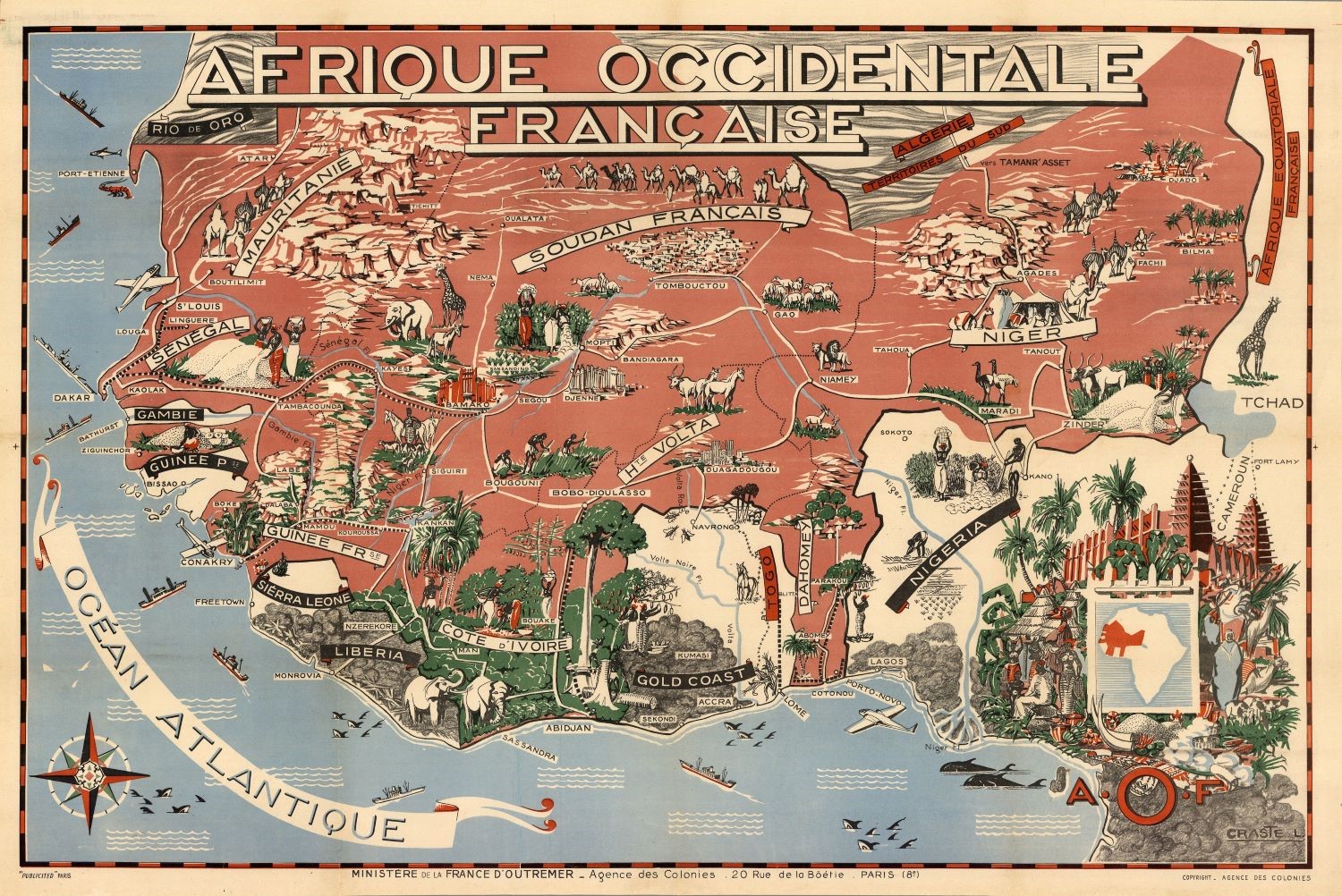
An event deserving much wider renown, the mass rising known as the War of the Hoe Handle, or the ‘Kongo-Wara Rebellion’ of 1928-31, was the largest interwar revolt against French imperialism in Africa. Its consequences still felt today and its tasks unfinished, this article provides valuable background to West Africa’s current revolt against that faded and fetid Empire. Also include an official R.I.L.U. statement on the revolt.
‘The Negro Revolt in “French” Equatorial Africa’ by Barbe from The Negro Worker. Vol. 2 No. 1. January-February, 1929.
What is generally called the French Congo is composed of four districts: Oubanghi-Chari, Gabon, Middle Congo, Hatu Ogoue; since the Versailles Treaty the former German colony Cameroon was added to this.
In 1910 the approximate black population of these four colonial districts–without Cameroon–was 9 million inhabitants. According to the official figures given by the Minister Sarraut in 1912 this population had fallen to 7 million and the last official figure which was given in 1921 it had fallen still lower to 2,800,000. These figures indicate the constant and almost unbelievable destruction of the population which is going on under imperialist colonisation. The disappearance of more than 6 million Negroes is not due solely to reasons of migration nor is it due entirely to military causes such as recruiting for the colonies in Northern Africa and for service in France, but it is mainly due to the policy and practice of French imperialism in these colonies. This constant decrease of the population has been acknowledged by the official representatives of French Imperialism. The petty-bourgeois pacifist deputy Valude; who belongs to the French Radical-Socialist Party, emphasised in 1924 the fact “that the French intervention in these regions has led to a decimation of the population.” The Minister of the Colonies, Maginot, said in December 1928, in a speech on the colonial budget: “we have been frequently reproached for the great mortality which the construction of the Congo-Ocean Railway is causing among the population of French Equatorial Africa. It is a fact that this mortality is extremely high.”
Second Important Revolt in Congo
Now concerning the actual revolt. This is not the first insurrection of the Congo Negroes. Since French imperialism penetrated into the Congo there has been an almost uninterrupted fight of a lesser or greater violence going on between the Negroes and the imperialist warlords. But this is the first time that we meet with an organised insurrection not confined to some places, but extending over the whole of the territory. The first insurrection that may be compared to the present one, but which yet was less important, took place in 1924; it lasted only several days and it was drowned in blood by imperialism. Certain bourgeois sources of Information have consequently given more or less contradictory figures about this insurrection, but all of them state that thousands of persons were killed.
The present insurrection is much more important than the insurrection of 1924; it comprises 12 centres of the colony; Fort-Archambault, Audar, Mayo-Kabi, Callas, Carnot, etc. All the bigger settlements have gone into revolt. One may say that the difference between this insurrection and that of 1924 lie in the fact that this time the revolt against French Imperialism comprises the total population of the French Equatorial Africa.
This is not the only characteristic and the only new aspect of this insurrection. Another one is its duration. According to the latest informations, the insurrection began on November 5,1928, and lasted with the same violence till the beginning of January 20, and still goes on. This is really without precedent.
What are the new forms of this armed uprising, the new forms that developed in this insurrection? The great characteristic of this insurretion is the fight against forced recruitment. The most practical form which this fight has taken is the following: the Negroes in those centers which I have already indicated have killed in a systematic manner all the chiefs of the recruiting troops.
Negroes Capture French Troops
The second phase, one may say, in the development of the insurrection, is the routing of the reinforcements that were sent after the first fights by the Negroes of the villages in revolt.
But this insurrection has adopted an even more important form. Even in the very modest information given in the official press, we find indications that a number of bridges, etc., have been destroyed; that villages have been fortified by the Negroes for resistance and another fact that colonial infantry were taken prisoners by the Negroes which is unanimously qualified by the bourgeois press as absolutely unheard of prior to this.
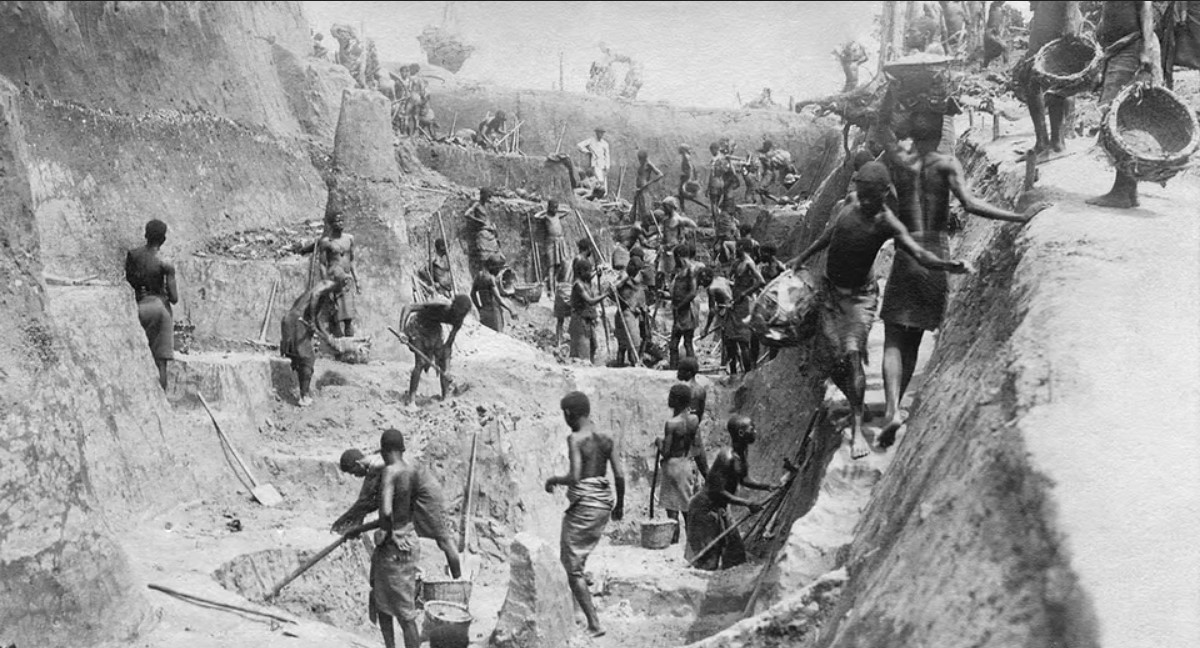
On the strength of these rather general indications, one may say that this insurrection constitutes the most serious and wide-spread insurrection that has ever taken place in French Equatorial Africa, considering the number of Negroes involved, the protracted nature of the fight and the many forms it assumed.
What are the causes of this insurrection? If one were to give a general answer, one night say, that it is the oppression of French imperialism, but examining more deeply, one may find two great general and more fundamental causes for this insurrection:
1. The considerable strengthening of the efforts of French imperialism to realise the economic value of French Equatorial Africa.
2. The stronger efforts of French imperialism to make French Equatorial Africa participate in the reorganisation of the imperialist forces towards a new war. In this connection one must stress the fact, that French imperialism has established a whole plan for what is called “The Black Army”–a black army, which is to be concentrated in French Northern Africa, in Algeria and Tunis as well as around certain industrial centres in France. The first practical results of this plan have already been seen during the recent strikes and particularly in the region of Gard in France, where 18,000 miners were on strike, and where the white soldiers had fraternised with the strikers; there the white artillery was replaced by black troops from Senegal and from French Equatorial Africa
French Equatorial Africa has in fact an enormous economic importance for French imperialism; it is mainly providing France with rubber, wood, certain special kinds of wood, and it possesses natural resources such as mines and copper; it is also furnishing manioc, and finally, it is a region where oil may be obtained. During the last years French imperialism has made great efforts to obtain maximum results in French Equatorial Africa.
Actually, almost 40 companies have been spread on the territory of this colony. These 40 companies occupy a territory of nearly 800,000 square kilometres. One might quote the names of all these companies, but this is perhaps not necessary; what must be stressed is the tremendous increase of the profits of these companies especially during the last four years. The proportions of this increase in general vary from 1 to 6 million.
Concerning the increase of capital of these companies one may find interesting facts. Thus: the Compagnie Equatoriale des lines increased its capital of 7,500,000 francs to 20 millions in five years; the Compagnie Miniere du Congo increased its capital from 1 million in 1906 to 23 millions in 1925. One of the foremost companies the Sangha Oubanghi augmented its original capital of 12 million francs in 1911 to 36 million francs in 1925.
It was on the territory of the Compagnie Forestiere de Sangha Oubanghi that the insurrection started. This company has the monopoly for rubber and manioc in this district. It realised in 1926 8 million francs of net profits plus three millions for amortisation, a total of 11 million francs. The form of exploitation in this district and in, general over the whole of French Equatorial Africa may be characterised as forced labor. French imperialism has already years before the war abolished the slavery laws in its colonies, but instead there has been established a system of forced labor for the Negro population which has in fact re-established the system, that had been legally abolished. It is not only forced labor in the sense of individual production of the Negro but forced labor in the sense of a definite programme of results through the obligation of a whole village to provide a certain production. Thus, all the villages on the territory of the Compagnie Forestiere de Sangha Oubanghi are obliged to provide a certain quantity of rubber and manioc, the amount of which is fixed by the Company. If a village and its inhabitants do not provide every month the quantity assigned to them then violent repressions are applied against the village, which range from the imposing of a fine to the complete destruction of a village. For rubber the Negro worker is paid 1 franc per kilogramme and the Negro has to spend 1 month in the forest in order to obtain ten kilos of rubber (ten francs per month!). For manioc the Negro is paid one franc for a basket of 10 kilogrammes. Whilst this Compagnie Forestiere, which has the rubber and manioc monopoly in this district is paying one franc per kilogramme of rubber and one franc for ten kilogrammes of manioc, in Oubanghi-Chari 12 francs are paid for one kilogramme of rubber, and 2 francs 50 for 10 kilogrammes of manioc. One must emphasise the fact that a permanent repression, which is exercised against the Negroes, and which is also one of the causes of this insurrection, lies in the fact that the Negroes more and more want to give up the gathering of rubber and manioc and concentrate on the gathering of palm-oil nuts. The market for these is divided between a number of companies so that a competition exists, and the Negroes are able to demand much higher prices; (Negroes may harvest approximately 30 to 35 kilogrammes of palm nuts per month for which they are paid from 6 to 7 francs per kilogramme). They are going in for this work all the more readily as it is much less tiresome than the gathering of rubber and manioc and also as it allows them to remain near their village and even to return there every night, whilst the gathering of rubber compels them to go into the forest, which may be far from their residence.
What is the role of the French Government with regard to these capitalist companies? Here one may study the whole hypocricy of the law about the suppression of slavery. In French Equatorial Africa we have in my opinion the most typical example of the connection that exists between the State and the capitalist exploiting companies directed against the native population. The role of the French Government in French Equatorial Africa is that of the recruiting agent of labor power for the capitalist companies. This fact is, besides, legally admitted, as every contract of the capitalist companies contains a concrete paragraph which obliges the French State, its colonial government, and its military forces to recruit as many Negroes for the company, as is fixed in the contract. Thus, the Societe Forestiere, which I have already mentioned is “furnished” approximately 5,000 persons per month. Another company, the Societe du Haut-Oghoue is “furnished” 1,500 Negro workers, and finally, a company which has only of late begun to work there, the Societe des Batignolles, had included in its contract a paragraph about the “furnishing of men”. This Company has been “furnished” 8,000 men for the construction of the Congo Ocean Railway. This Railway is for French Equatorial Africa what the Trans-Saharian Railway will be in Northern Africa for the unification of the African colonies. This Congo-Ocean Railway has a great economic significance as it will permit the speedy transportation of raw materials from the colonies to France. Another consequence will be the abolition of the transport of goods on the back of Negro workers which before the inauguration of the railway has been the means of transportation.
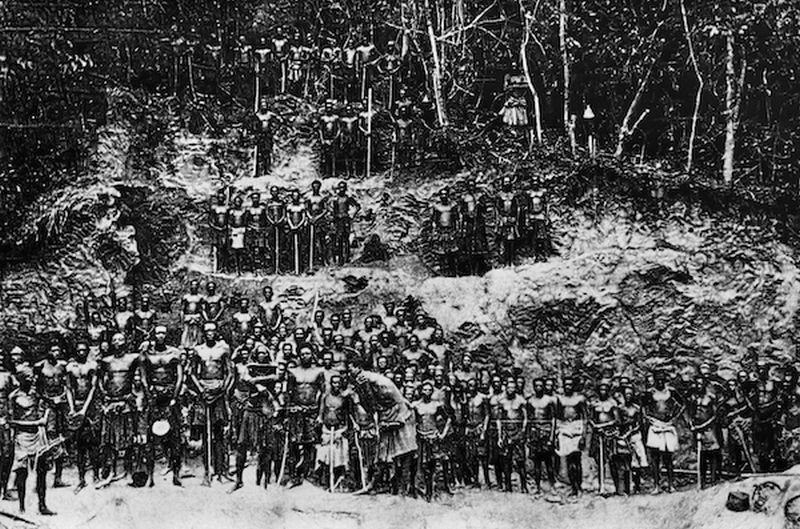
This railway has therefore two significant consequences: greater rapidity of transportation and a greater security for the arrival of goods. The construction of this railway has still another reason: French imperialism states, that this transportation on the backs of the natives was one of the main reasons for the constant decimation of the population. It is clear, that we must not be taken in by the humanitarian phrases, which are at present used by the Inspectors of the Ministry of Colonies who declare that the construction of the Congo-Ocean Railway is the greatest fact towards the civilisation of the country. If French imperialism is constructing this railway, it does not do so in order to suppress the transport on the back of the workers, but because this rail- way will allow it to increase its profits and it will even compensate the shortage of labor due to the decimation of millions of Negroes in the course of several decades, an effect which has begun to disquiet imperialism.
It is quite clear that the construction of this Congo-Ocean Railway has been undertaken because French imperialism did not find enough Negroes for the carriage of goods and in order to make up for the disappearance of millions of Negroes as a consequence of French Imperialist policy.
The second important reason for the construction of this rail- way is the possibility of concentrating greater numbers of troops by Railway in Northern Africa and consequently in France.
The length of the working day for the forest and mining companies and for the Societe de Construction de Chemin de Fer is not less than 15 hours for Negroes. We must stress the fact that during this Congo-Ocean railway construction, according to official figures, 17,000 Negroes have already died of fatigue during the construction work. These 17,000 Negroes have died whilst only 140 kilometres have so far been built, which amounts to 123 dead workers per kilometre!
In this region of Haut Oghoue, where this really unheard of decimation took place, 1,100 Negroes have been shot by the Societe Forestiere in 1927 when a number of villages did not provide the required amount of rubber.
In another region, La Gabon, the population has gone down from 1,050,000 in 1911 to 300,000 in 1921. According to the official figures of the Colonial Ministry, there are in Huta-Oughoue, where the revolt is assuming the most violent forms, approximately 4,000 deaths and even 5,000 per year for every 20,000 inhabitants.
These few facts, perhaps somewhat disconnected, show the actual causes of the present insurrection.
One must emphasise the fact that the present discontent assumed a religious form; the leaders of the present insurrection are the “sorcerers”. This form of insurrection becomes quite understandable if one realises that in Congo there exists no other factor capable of guiding the Negro population. The insurrection develops in a spontaneous manner.
What have been the repercussions of this insurrection in France? French imperialism and the official Government have generally come to the conclusion, that the exploitation in French Equatorial Africa may have been pressed a little too far! It is characteristic, if certain papers, like the “Journal de Debat” declare that the lack of connection with the colonies has allowed certain exactions which must be remedied rapidly.
Another reaction came from the Ministry of Colonies which plans and is already organising the dispatch of what is called “labor power” of greater resistance. This “labor power of greater resistance” shall according to the phrase of Maginot “relieve our tired population in French Equatorial Africa.” It is recruited in Indo-China. Already two detachments of 800 Indo-Chinese have been recruited for French Equatorial Africa.
Among the results which this movement has had in France, it is necessary to point out the attitude of the Socialist Party. The Socialist Party decided to question the Government through its official journal Le Populaire, and it took exactly the same line of approach as the official press; thus, the specialist of the Socialist Party on Colonial subjects, Fontanier, wrote in “Populaire”: “The insurrection must be considered as the reflex of the aggravation of our mistakes down there, but at the same time we must admit the enormous achievement of France in “educating” the primitive population of French Equatorial Africa.” Secondly, we find in the approach of the Socialist Party the idea that the insurrection is particularly due to the excitement of the most backward religious elements of this region against European “civilisation”. Those are the political conceptions of the Socialist Party of the situation in Congo.
What has been done by French Communist Party? The French Communist Party led a rather serious campaign in “Humanite” where it gave all the facts and analysed the results of the policy of imperialist penetration into this colony. It gave some slogans for the fight:
On anti-imperialist Fighting Bloc between the Negroes and the French Workers; liberation of French Equatorial Africa, fight against the Color-Bar, dividing the Negroes of French Equatorial Africa from the French workers; organisation of the Negro Workers in France.
STATEMENT OF THE INTERNATIONAL TRADE UNION COMMITTEE OF NEGRO WORKERS OF THE R.I.L.U ON FRENCH SLAUGHTERING IN EQUATORIAL AFRICA
The barbarous system of colonial exploitation, slavery and oppression is still flourishing in its most brutal form. Forced labor and other forms of oppression by French imperialists in Equatorial Africa has killed off native railroad workers at the rate of tens of thousands and swept away whole sections of the native population. While the International Labor Office at Geneva, in the name of civilisation, is supposed to be investigating the conditions of forced labor among the natives, this barbarous oppression growing out of the conditions of forced labor is going on without any action on their part. part. During a decade the population has been reduced by six millions. For the last several months native workers have been in open revolt against French imperialist oppression. At this moment French Imperialism is crushing native workers, and carrying “civilisation” into Africa at the point of the bayonet. This raping of Africa, the bathing of the struggles of the workers in their own blood and the extermination of whole sections of the population in order that imperialism may flourish is shrouded in silence and secrecy. Only fragmentary bits of news leak out through the strictest censorship about this uprising and the consequent slaughterings by the French Imperialists. This censorship and secrecy has as its object the hiding of the barbarism of the French Imperialists.
Brothers and Workers of the World! Protest in world wide unison against the slaughtering of our African brothers and fellow workers! Unmask the Imposters!
The International Trade Union Committee of Negro Workers of the R.I.L.U. calls upon the working class movement to protest and rally to the support of the African Workers.
We appeal to the French Workers to send a Workers’ Delegation, including Negro Workers, to investigate this blood curdling oppression of French Imperialism.
World Revolutionary Movement: Mobilise the Masses! Unmask the French Imperialist Cut-Throats!
With our African Brothers and Fellow Workers we struggle against French Imperialism and against World Imperialism.
THE INTERNATIONAL TRADE UNION COMMITTEE OF NEGRO WORKERS OF THE R.I.L.U.
First called The International Negro Workers’ Review and published in 1928, it was renamed The Negro Worker in 1931. Sponsored by the International Trade Union Committee of Negro Workers (ITUCNW), a part of the Red International of Labor Unions and of the Communist International, its first editor was American Communist James W. Ford and included writers from Africa, the Caribbean, North America, Europe, and South America. Later, Trinidadian George Padmore was editor until his expulsion from the Party in 1934. The Negro Worker ceased publication in 1938. The journal is an important record of Black and Pan-African thought and debate from the 1930s. American writers Claude McKay, Harry Haywood, Langston Hughes, and others contributed.
PDF of full issue: https://www.marxists.org/history/international/comintern/negro-worker/files/1929-v2n1-jan-feb.pdf
 Revolution's Newsstand