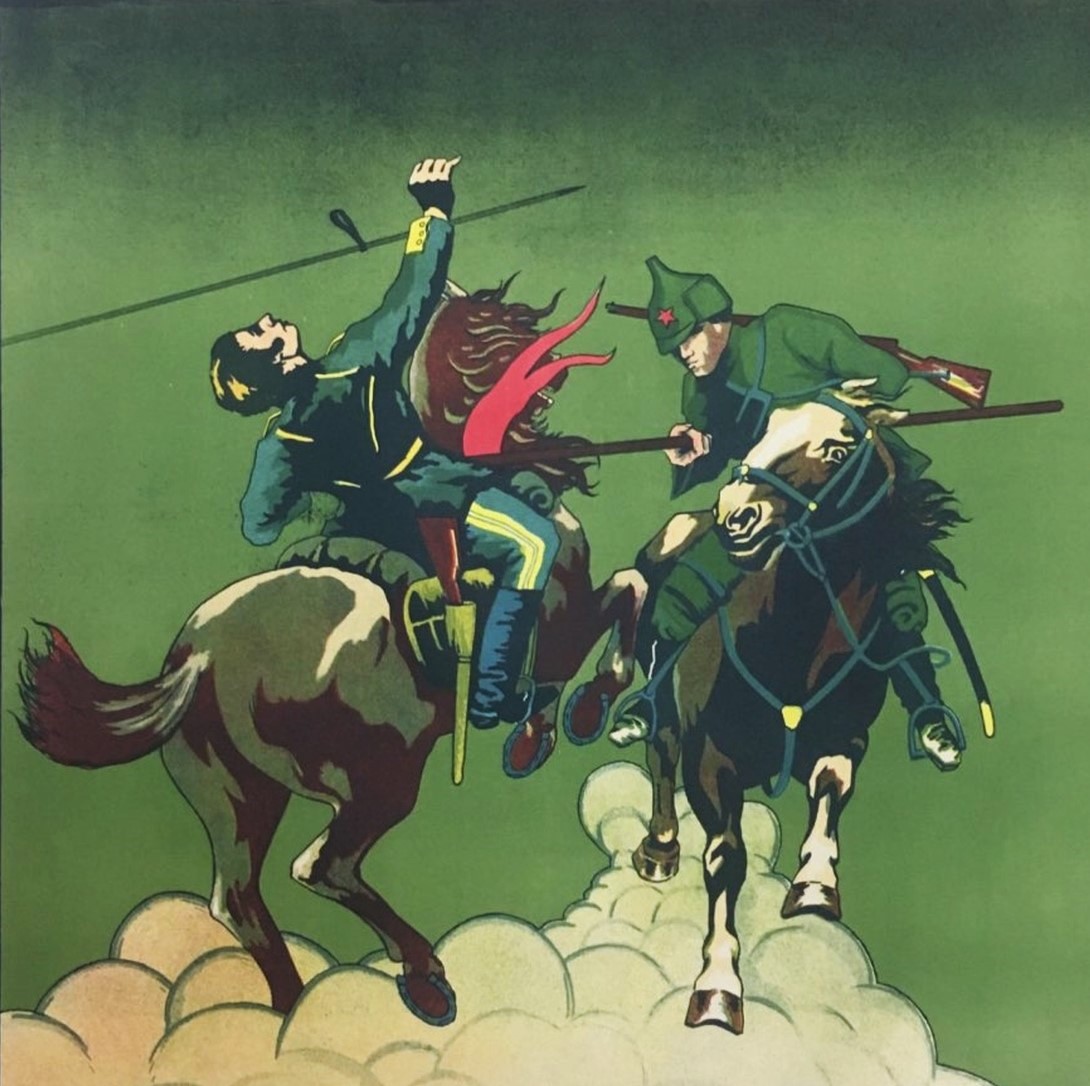
In response to Kolchak’s ‘Spring Offensive’ of 1919 in which a large counter-revolutionary army supplied by the imperialists made large gains on the Eastern Front, the Soviet working class marshaled a superhuman effort to stave off retreat and turn back the advance. The story of the mobilization of the Single Revolutionary Front.
‘The Single Revolutionary Front’ from Soviet Russia (New York). Vol. 2 No. 6. February 7, 1920.
THE counter-revolutionary offensive of Kolchak on our eastern front has been for the Russian proletariat no more than a new touch-stone, a crucible, in which has been tested its political conscience, its organization, and its party discipline. Unprepared to deal a decisive blow, our Red Army, accustomed to a comparative equipoise between the opposing lines, was shaken at the very first, and a breach was made. The rear line, excessively wearied by the assistance it had brought, for a year and a half, to the southern, western, northern, and eastern revolutionary fronts, could not assert a successful resistance to the invasion. We began, step by step, to abandon our positions. But, as fast as we abandoned a series of important points, Kolchak’s movements forced us to fall back to the Volga basin, and a real danger threatened the proletarian republic as well as the conquests of the revolution. Signs of alarm grew stronger and stronger, until they were transformed into a vigorous tocsin over all Russia. The sleeping proletariat awoke by degrees and, as always in the hour of danger, applied itself actively to the mobilization of its forces. The word of command, which resounded everywhere and was widely put into execution was: “Everybody to the front; everybody against the advancing reaction.”

The Russian Communist Party (the Bolsheviki) put itself at the head of the movement to fight against the reaction. Mobilization was proclaimed on April 11th, and on the 12th the Central Committee of the Party published the “Thesis with regard to the situation on the eastern front.” These thesis proposed that all organizations of the Party and trade union organizations should take the most energetic measures to aid and forward the mobilization. Every member of these organizations was to keep a special memoir (note-book) indicating what he was doing to aid the Red army; particular attention was to be paid to the giving of political information to the mobilized troops, who were to be clearly conscious of the reasons for their being called to battle. Each week, every organization was to give an account of what it was doing for the mobilization. In all schools and institutions, women were to replace men as far as possible; in the zone of the front it was found necessary to arm, en masse, members of trade unions. Means of making the peasants participate in the defense of the revolution were likewise pointed out. Special attention was paid to devising means of assuring the existence of the families of those who had gone to the front.
This was the first cry, and it soon encountered echoes everywhere. At first a series of proclamations was published by the “center”—the government of Soviets, the Communist and professional organizations—and in the province; these proclamations played an important role, explaining the meaning of the mobilization and stimulating it.
The idea of the struggle against Kolchak was made the subject of intense propaganda by means of meetings and reunions; the press answered the call to arms. At the center and in the province it was well understood that the Kolchak movement was the last citadel of organized national counterrevolution; that it was necessary to proceed once more to an extreme exertion of strength in order to destroy it, and that then the peaceful and tranquil construction of the Socialist edifice could be entered upon. The results of this campaign of propaganda could be soon ascertained. As early as April 13th, at the plenary session of the general council of the trade unions, held at Moscow, it was decided to take the thesis of the Central Committee of the Communist Party as the foundation on which would be elaborated the plan of mobilization through the medium of the trade unions. The Petrograd Council of the Trade Unions applied itself energetically to the work and the province manifested a lively activity. Information received during these last days establishes the following fact: As early as April 14th, at Penza, at a reunion in which about 2000 men took part, it was unanimously decided to form a regiment of attack composed of peasants and communist workmen (it is interesting to note that at this reunion a — who formerly organized revolts against the Soviets, addressed the meeting, inviting all peasants to fight against Kolchak). At Samara numerous meetings voted resolutions, unanimously accepted, on the necessity of proceeding to the mobilization against Kolchak. At Novgorod, the Conference of Trade Unions decided to bring its best technical forces to the aid of the army and to send its best members to the front; in the province, as at Moscow, there were held meetings and reunions devoted to the aid of the eastern front. On April 16 at Syzran, 1200 men were mobilized; in the province the calling to arms of 50% of the Communists at the order of the provincial committee of the Party was received with great enthusiasm; at Simbirsk the Committee mobilized all the Communists; 500 of them were to be sent to the army, but the Trade Unions decided to arm 50% of the entire membership. At
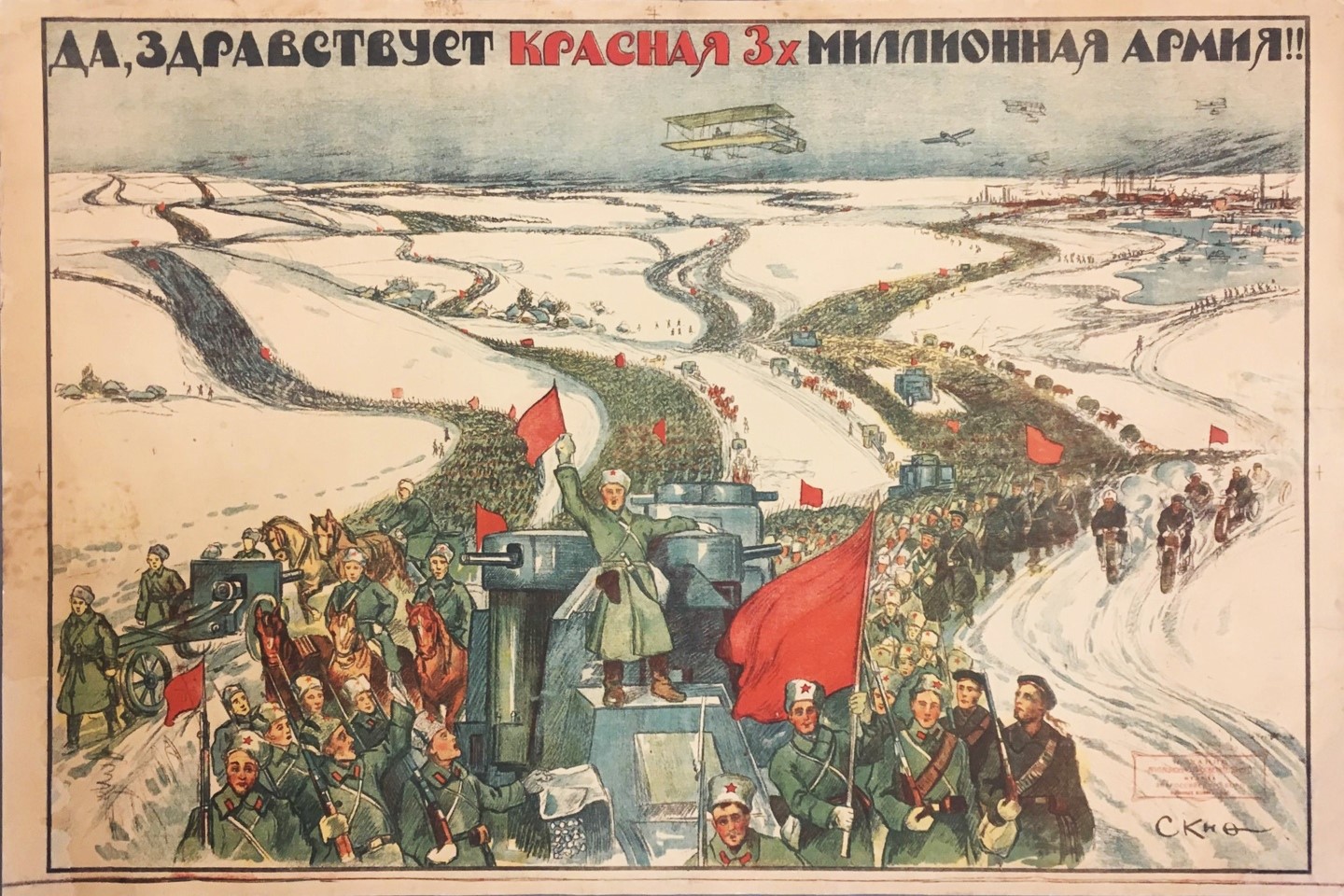
Moscow, the General Council of Trade Unions proceeded to the enlistment of volunteers; the collaborators of the “Proletcult” filled up the lists of propagandists; all the trade organizations gave proof of personal initiative to bring help to the army.
The front, at this critical hour, is certain that aid will quickly come and behind the lines the work is feverishly carried on. On April 17th, at Samara, they were working actively at the formation of the first Samara regiment, composed of Communist sympathizers; women went to the front; the Trade Unions established the positions of their members with regard to mobilization by means of special certificates.
The Council of Trade Unions proclaimed all institutions in a state of siege; workmen furnished the personnel of the Red Cross; the same day a flag was solemnly given to the Mussulman battalion which is leaving for the front. At Melekes and Bousoulouk regiments of volunteers were organized. On April 18th at Kalouga the Communist Conference of the city decided to send to the front the greatest possible number of members. At Penza there was an abundance of volunteers enrolling in the regiment of attack then in process of organization and composed of members of the Party and of the Trade Unions. On April 19th at Alatyr the mobilization of Communists took place; 200 of them have already left for the front. On the 20th, at Pokrovsk, the Soviet, in conjunction with the Trade Unions, decided to mobilize all the members of the latter and the workmen of all ages; on the 22nd at a magnificent review, Samara honored her troops that were leaving for the front; the men are everywhere replaced by women; the Council of Trade Unions of the Province of Vitebsk decided to send to the front 20% of the men from 17 to 50 years of age; the “Bund” and the “Poale Zion” mobilized their members; at Nijni-Novgorod it was decided to call up 50% of the comrades of the Party throughout the entire Province; on the 24th, at Rogatchev, a regiment called “The Red Star” was formed of 50% of the urban population and 67% of the Communist groups. On the 25th, at Staraia Russa 50% of the Communists were mobilized; regiments which are now all ready will soon be sent from there as well as from Borissov; at Carmel a proletarian battalion was organized, 10% of the Communists are sent to the front; the same is true of Kostroma; Voronezh is sending a part of her Communists; at Cherepovets 50% of the Communists are mobilized for the oriental front; the Trade Unions are mobilizing all their members. Unheard of enthusiasm reigns throughout the Province. Moscow and the province burn with revolutionary ardor; a great number of those who do not belong to any Party speak in the papers of the necessity of creating a single Socialist front to oppose Kolchak. On the 28th the Alimentation Union and that of Mailmen and Telegraph Operators decided to call up 50% of the members; at Tver 50% of the Communists are mobilized; at Nijni Novgorod all the members of the unions are mobilized; at Vologda a workmen’s detachment is being formed; at Velsk 20% of the Communists are mobilized; at Kaluga, Viatka, Vologda, in the Province of Tambov, in the district of Kozelsk, the comrades of the Party are being hastily mobilized; at Borissov, members of the “Poale Zion” Party (from 18-25) are mobilized; at Retchit all workmen from 18-25 are sent to the front, etc.

This scanty information is far from complete, but it shows clearly enough the revolutionary ardor that has seized Russia and is increasing unceasingly.
The immediate results were already felt toward April 20th. Until this day we did nothing but retreat; on the 20th we repulsed the attack at Orenburg and at Perm and we even advanced in the direction of Yelabouga. On the 27th in the direction of Bouzoulouk the enemy took to flight, leaving in our hands 20 prisoners, 4 cannon, and a great number of machine-guns and rifles. A little later, in this same direction, our offense was successfully developed. Great results have been achieved by the measures taken to improve the fighting qualities of our army and to make it more conscious of its mission: the sending of reinforcements of conscious Communist comrades from the center and provinces, and the intensification of our propaganda at the front and in the zone of the front. We no longer retreat, anywhere. Soldiers of the opposing army come over to our side; for example, at Orenburg, 560 cossacks with arms and horses joined us. We have even gained victories: during the night of the 27th, at the battle which took place on the bank of the Salmach, northeast of Orenburg, we inflicted a complete defeat upon the second and fifth divisions of the fourth corps of Kolchak’s army, composed of the 18th, 19th, 20th and 21st regiments of the 5th and 6th regiments of Syzran, of the 7th of Volhynia and of the 8th of the Volga. The remnants of the 42nd regiments of Troitzk, of the 4th corps, have been finally annihilated. According to the preliminary estimate, we have taken 1500 prisoners, 20 machine guns, 2 cannon, 50 carts, hundreds of rifles, 100 horses with saddles, and a great quantity of clothing and equipment. Among the prisoners are: the general of the 8th Division, four officers (adjutants of the Volga regiment); the commanding officer of the 21st regiment was drowned. The entire bank of the Salmach is strewn with corpses; 600 enemy soldiers were pushed into the river with bayonet thrusts; the detachment of brigands, under Stepanoff, the man of Pontov, including the famous brigands Kerchounoff and Meizel was completely annihilated. The second division, which has just been defeated, was celebrated for the numerous cruelties and for the fusillading of workmen and peasants.

That does not mean, of course, that we will break Kolchak’s entire front with one blow or annihilate his army. We know that we have yet before us several months of stubborn fighting. But, although Kolchak’s army may continue in its Successes, the certainty of ultimate Victory over the counterrevolution has not weakened for an instant among the workmen and peasants of the Ural and Volga regions. They look upon the invasion of Kolchak as a temporary misfortune which will be brought to an end in the near future. Never, even during the: October days, was there observable among the masses of workmen and peasants, such an eagerness to fight for the Soviet power, as is to be seen now in the zone of the eastern front. Thus at Orenburg literally all the workmen of the factories, tailors, joiners, hairdressers, cobblers, etc., enlist in the volunteer regiments. Auxiliary units are formed by those who are too young or too old to bear arms. An analogous movement is taking place among the peasants and workmen—Cossacks in the Ural steppes; all the men of entire villages enlist in the Red Army while the women, old men, and children are removed from the regions threatened by the enemy. The entire movement goes on with extraordinary enthusiasm. The masses look upon the danger threatening the Soviet Republic as a calamity; Kolchak to them is a new foe of the Asiatic plague. The role and conduct of the railroad workers in the zone of hostilities, deserves attention; it can be truly said that nowhere in Russia do railroad employees work so energetically and so conscious of revolutionary duty as in the zone of the front. Where their work is finished they enter the ranks of the Red Army and distinguish themselves with their heroism. So it was at Orefa and so it is everywhere. If the workers behind the line, in the fight against Kolchak show self-denial equal to that of workmen and peasants in the front zone, our victory is not far off.
Soviet Russia began in the summer of 1919, published by the Bureau of Information of Soviet Russia and replaced The Weekly Bulletin of the Bureau of Information of Soviet Russia. In lieu of an Embassy the Russian Soviet Government Bureau was the official voice of the Soviets in the US. Soviet Russia was published as the official organ of the RSGB until February 1922 when Soviet Russia became to the official organ of The Friends of Soviet Russia, becoming Soviet Russia Pictorial in 1923. There is no better US-published source for information on the Soviet state at this time, and includes official statements, articles by prominent Bolsheviks, data on the Soviet economy, weekly reports on the wars for survival the Soviets were engaged in, as well as efforts to in the US to lift the blockade and begin trade with the emerging Soviet Union.
PDF of original issue: https://www.marxists.org/history/usa/pubs/srp/v1v2-soviet-russia-Jan-June-1920.pdf
 Revolution's Newsstand