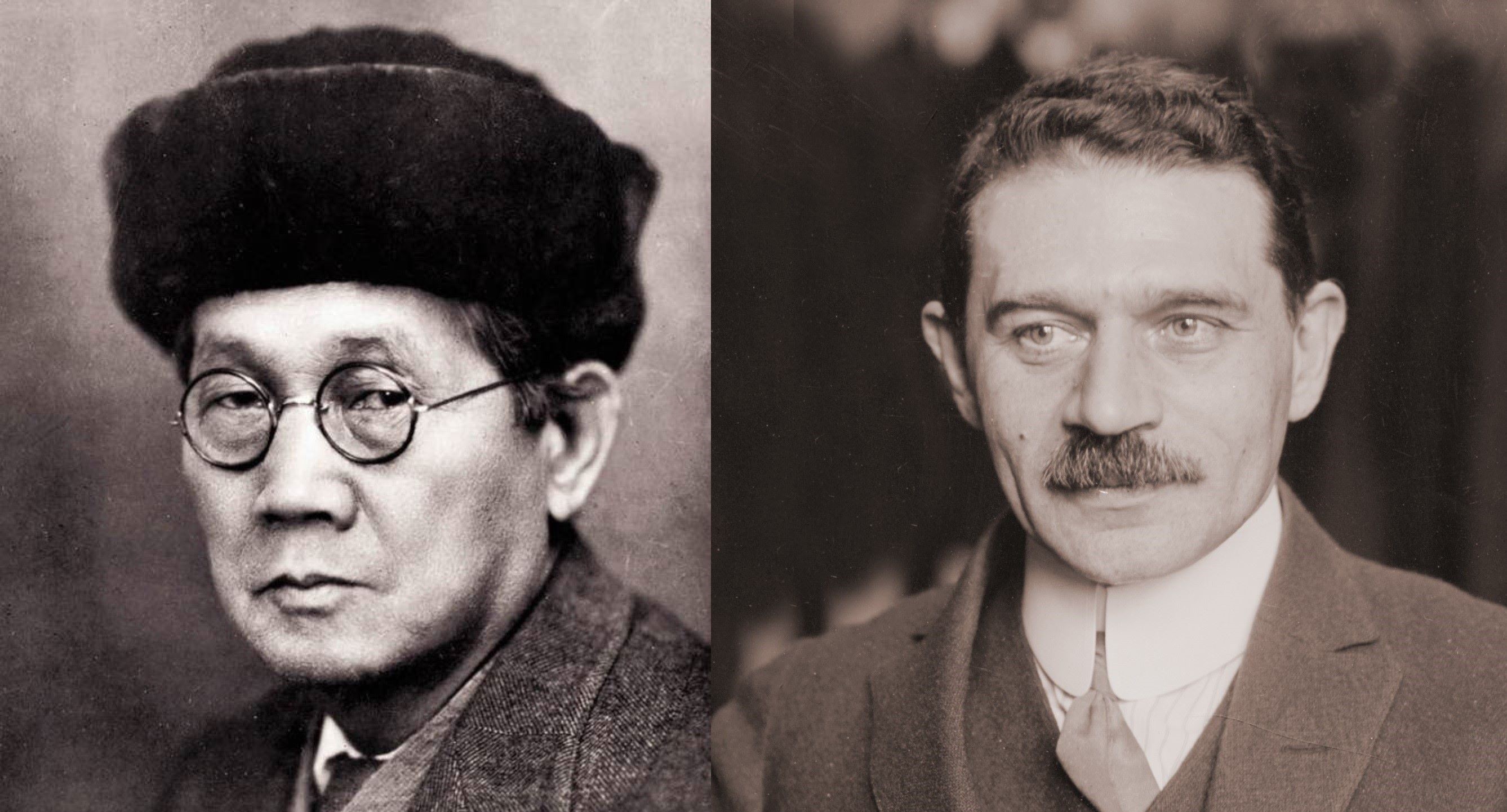
Sen Katayama had long known Socialist Party leader Morris Hillquit. Here, Katayama provides some valuable history on the formation of the Left Wing in the U.S. as he denounces Hillquit’s reformism in the run-up to 1919’s Emergency Convention.
‘Morris Hillquit and the Left Wing’ by Sen Katayama from Revolutionary Age. Vol. 2 No. 4. July 26, 1919.
THE Left Wing position has been firmly established in the American Socialist movement as a result of the National Convention held recently in New York City. The position of the official Socialist Party was somewhat chaotic until Morris Hillquit contributed the now historic document, The Socialist Task and Outlook, printed in The New York Call. Before Hillquit’s utterance the keynote of the Right Wing was unity within the Socialist Party, and they attacked the Left Wing as disturbers and separatists. Hillquit’s statement reversed the official policy and attitude, which now resolved itself into the dictatorship of the Party officialdom over the Party and resulted in expulsion and suspension of Left Wing members.
It may prove interesting to say a few things about Hillquit’s attitude.
The writer has known him since 1904 and took part with him in the International Congress of that year. Moreover, I have taken a part in the Left Wing movement in America. A meeting of Left Wingers was held early in the winter of 1917, in Brooklyn. There were some seventeen or twenty comrades pre- sent: Comrades Leon Trotzky, A. Kollontay, N. Bukharin, S.J. Rutgers, L. Lore, L.C. Fraina, L.B. Boudin, myself and others. At that time the Left was constituted of those Socialists who stood against the defense of the fatherland, the anti-patriotic Socialists. Comrade Williams, representing the Propaganda League of America, which had been started by Boston Comrades and published The International, was present. The Propaganda League was at the time only a wavering Left Wing movement, later it became decidedly Left and published a new organ, The New International.
We intended to organize the Left Wing under the direction of Comrade Trotzky, and Madam Kolontay, who was going to Europe, was to establish a link between the European and American Left Wing movements. But soon the Russian revolution flamed in action. Comrade Trotzky left for Russia and later Bukharin America entered the war against Germany, then came the St. Louis Convention which engrossed the attention of the American Comrades.
But with the Bolshevik revolution the physical as well as the spiritual relation between the American Left Wing movement and the Russian Bolshevik Party was firmly established. The group which first met in Brooklyn continued its existence, with some hesitation and lingering. With the success of the Bolshevik revolution it assumed more and more the Left Wing principles, expressed in its organ, The Class Struggle.
The revival of the Left Wing movement is due primarily to the Boston comrades. As Boston has been the home of revolutionary movements in the past so in this case the Boston comrades started The Revolutionary Age as the organ of the Boston Branch of the Socialist Party, which made a profound and widespread impression on the minds of the comrades all over the country. The New International, the organ of the Socialist Propaganda League, had been boycotted by the New York branches on the excuse that it was the organ of a separate organization, but The Revolutionary Age was the official organ of a Party Local so the Socialist Party officialdom could not very well boycott it, with results that are unnecessary to detail here.
Such in brief is the development of the Left Wing movement in America. Its present situation need not be told in this article. The writer disagrees with Hillquit’s expressions about the Left Wing movement. Of course, Hillquit is a clever lawyer and an extremely able man. He has made a profound impression on the Socialist Party (official) of America and has many followers and even worshippers. He can command the policy of the shippers. He can command the policy of the Party at his will, as in the case of the Left Wing boycott. The policy against the Left Wing was directed by Hillquit’s article in The New York Call. “I am one of the last men in the Party” he says “to ignore or misunderstand the sound revolutionary impulse which animates the rank and file of this new movement, but the character and direction which it (the L.W.) has assumed, its program and tactics, spell disaster to our movement. I am opposed to it not because it is too radical, but because it is essentially reactionary and non-socialistic; not because it would lead us too far, but because it would lead us nowhere. To prate about the ‘dictatorship of the proletariat’ and of ‘workers’ soviets’ in the United States at this time is to deflect the Socialist propaganda from its realistic basis.”
He goes on to say that social reforms are the concrete expressions of the class struggle. “The Left Wing movement, as I see it, is a purely emotional reflex of the situation in purely emotional reflex of the situation in Russia. The cardinal vice of the movement is that it started as a wing, i.e. a schismatic and disintegrating movement.
“The Left Wing movement is a sort of burlesque on the Russian Revolution. Its leaders do not want to convert their comrades in the Party.”
Such are Hillquit’s opinions about the Left Wing and he complains that the Left Wing leaders refuse to co-operate with “the aforesaid stage Centrists and Right Wingers.” Again he thinks that “the Socialist Party of America as a whole has stood in the forefront of Socialist radicalism ever since the outbreak of the war,” and “many of its officers and leaders have exposed their lives and liberties to imminent peril in defense of the principles of international Socialism.”
To the writer Hillquit’s “Socialist radicalism” and “principles of international Socialism” do not seem clear. In effect Hillquit says that the Russian Soviet Government has a legitimate place in the International Socialist movement, so has Hungary and the class conscious, radical Socialist movement of Germany, but he wants the American Socialist movement to be of a moderate type–that the socialization of industries and national life shall not be attempted by one master stroke but shall be carried out gradually and slowly. The working class shall not immediately assume the sole direction as a working class (even if it were possible), but it shall share government power and responsibilities with the capitalist class at least “during the period of transition.” He does not say exactly these words but this is the inference from what he does say. He wants to keep all social reform planks in the Party platform as the everyday practice of the concrete class struggle. Hillquit must have approved Lee’s position on the war with Germany and his voting for Liberty Bonds in the Aldermanic chamber. If this is so then his position seems practically the same as that of Scheidemann and the social-patriots of Europe.
No wonder Hillquit does not like the Lef Wing movement. No wonder he speaks of it as a “purely emotional reflex of the situation in Russia” and as a “schismatic and disintegrating movement, essentially reactionary and non-Socialistic” and that it would lead us nowhere.”
He is mistaken in so styling the Left Wing. It is not a purely emotional reflex of the situation in Russia. It is not emotional but rational, not disintegrating but constructive. Further Hillquit says: “Its leaders do not want to convert their comrades in the Party.” Convert them to what, we would like to know? The large majority of the rank and file of the Socialist Party are on the side of the Left Wing already. We, the Left Wing, do not co-operate as Hillquit would like with the social-patriots like Algernon Lee or the opportunistic Berger, who was pro-war on the Mexican question and anti-war against Germany!
Hillquit wants the Socialists of America to wait patiently until the bad after-war conditions “arouse the American workers from the narcotics of their leaders’ empty phrases.” The workers of America look for new light and guidance, and then the Socialists of America will have their hearing and their opportunity.” A fine Fabianism! The workers of America are already looking for the new light and guidance that abundantly emanates from Russia and Hungary. We need not defend the position of the Communist Congress at Moscow against Hillquit’s emotional criticism. The revolutionary Socialists of the world are better judges than he. When he says the Socialist movement of the world has been in the state of physical disunion, moral ferment and intellectual confusion, he speaks for himself and his like.
The delegates to the Communist Congress at Moscow were not men and women of intellectual confusion, but were sound in their judgment as is evidenced in their wise choice of Eugene Debs instead of Morris Hillquit as the leader of the American Socialist movement!
Hillquit may be a good lawyer, who can win a case with his remarkable skill in using English, and has been no doubt a good international Socialist with perhaps the exception of the question of Asiatic immigration, just as his colleague Berger, but his judgment and criticism of the Left Wing movement are entirely wrong and outrageous. “I am one of the last men in the Party to ignore or misunderstand the sound revolutionary impulse which animates the rank and file of this new movement.” By saying this Hillquit is really condemning himself.
The Left Wing has a big but inspiring task: To preach the principles and tactics that were adopted at the recent National Left Wing Convention among the members of the Party. But we must first tell the members how their foremost leader, Morris Hillquit, thinks and attacks the Left Wing as reactionary and non- Socialistic.
During the coming weeks before the Socialist Party Emergency Convention, Hillquit and his followers will attempt to mislead the Party members by desperate attacks upon the Left Wing movement. But falsehoods and misrepresentations will not succeed in destroying the truth about the Left Wing movement. To attack and misrepresent the Left Wing is to serve the capitalist class, and such attacks are welcomed in the pages of the bourgeois. No wonder Hillquit does not like the Left newspapers. Don’t be misled, comrades!
The Revolutionary Age (not to be confused with the 1930s Lovestone group paper of the same name) was a weekly first for the Socialist Party’s Boston Local begun in November, 1918. Under the editorship of early US Communist Louis C. Fraina, and writers like Scott Nearing and John Reed, the paper became the national organ of the SP’s Left Wing Section, embracing the Bolshevik Revolution and a new International. In June 1919, the paper moved to New York City and became the most important publication of the developing communist movement. In August, 1919, it changed its name to ‘The Communist’ (one of a dozen or more so-named papers at the time) as a paper of the newly formed Communist Party of America and ran until 1921.
PDF of full issue: https://www.marxists.org/history/usa/pubs/revolutionaryage/v2n04-jul-26-1919.pdf
 Revolution's Newsstand