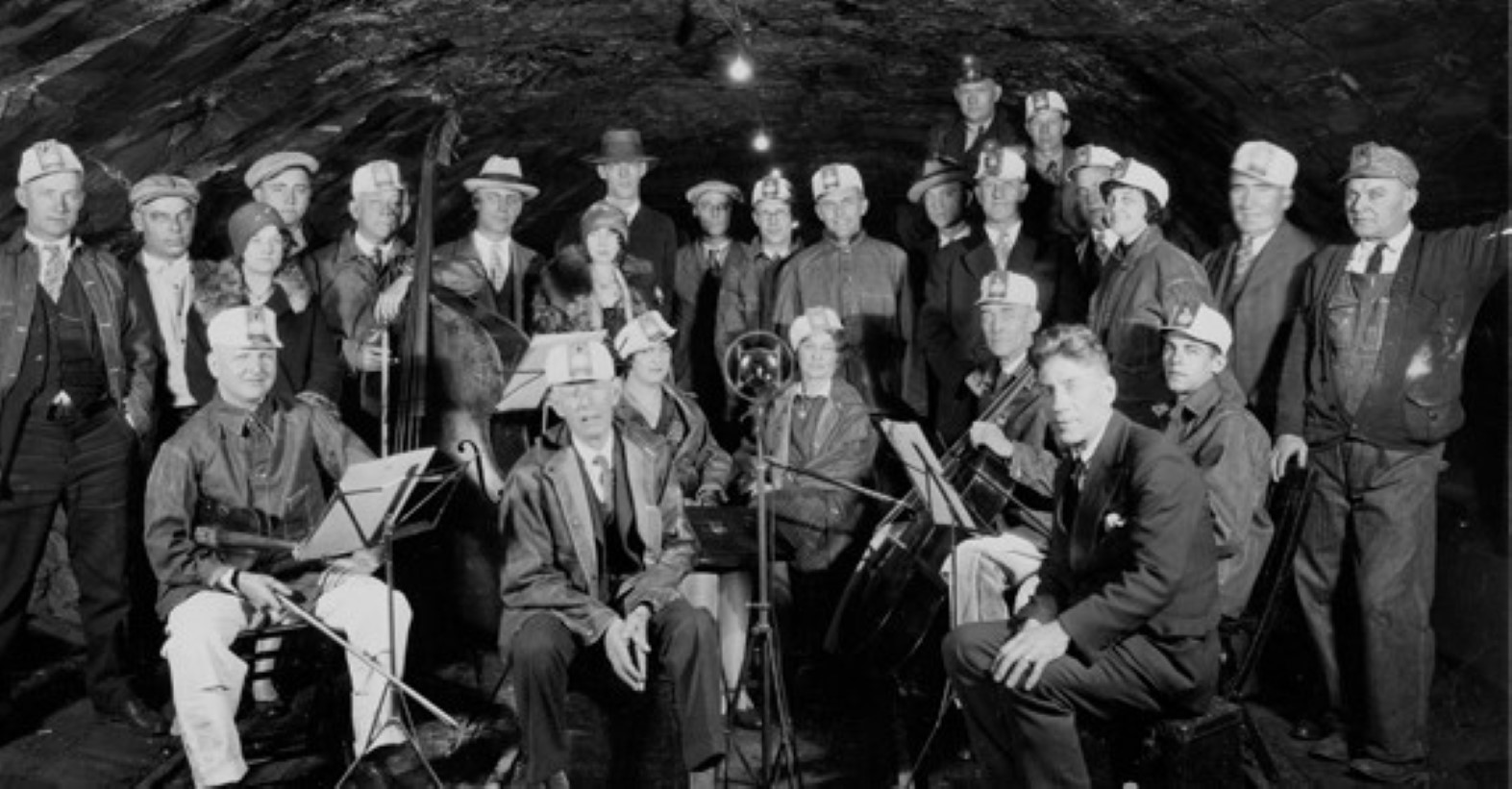
The sit-down strike wave of 1937 reaches Wilsonville, Illinois as 500 miners led by Socialists occupy a Superior Coal Co. mine.
‘Sit-Down Miners of the P.M.A. Carry On the Tradition of its Early Militancy’ by Frank N. Trager and Gerry Allard from Socialist Call. Vol. 3 No. 115. May 29, 1937.
More than 300 feet below the surface of Mine No. 4 at Wilsonville, Ill., 500 miners, led by Jock Fisher, president of Local 1, Progressive Miners of America, are sitting down in protest against the lay-off policy of the Superior Coal Co.
This is probably the first time that American coal miners used the technique of the “stay-down” in order to win its demands. Coal miners abroad have dramatically and successfully employed this weapon beginning in a series of notable strikes at Terbovlye, Jugoslavia, Pecs, Hungary, and Katewice, Poland, all in 1934, and since then in Scotland, Wales and France.
The immediate cause for the strike at Mine 4 was the wholesale lay-off of the men in Mines No. 1 (Eagerville) and No. 2 (Sawyerville) while installing new electric loading machines. The progressive Local 1 immediately demanded that the men be given jobs at other mines without loss of time. Company officials took advantage of a 30 day clause in the old, expired (April 1) contract and they are being upheld by the reactionary officials of the PMA.
During the stay-in the miners have been living fairly well. Food (and blankets) have been provided only in that abundance which experience can make clear if one has ever eaten a miner’s meal in Gillespie when the “boys been working.” The miners have created “Dutch” band composed mainly of Scots and Italians. On Saturday Jock Fischer dispatched 10 crews of 40 each to the surface so that they could bathe. “For one thing,” Fisher said, “the boys were getting pretty grimy, and for another any of the boys who wanted to could have quit.” They all went up and came back!
THE PMA HISTORY
Behind the strike of the progressive-led Local 1 PMA there is a real union struggle. As Gerry Allard (first editor of the PMA’s paper when, it had been progressive) explained in last week’s Socialist Call, the PMA was born out of the strife In the UMWA and justifiable conflict over John L. Lewis’ mine policies in 1932. The PMA failed, however, to continue in its path as a progressive miners’ union. It still disputes with District 12 of the U.M.W.A. the leadership of the Illinois coal miners. But its leaders today are as corrupted and reactionary as anything the miners wished to escape from in the past.
LOCAL 1 LEADS
Leading the fight against this PMA “national” bureaucracy, now seeking affiliation with the AFL, is Local 1, Gillespie. Its record has become a glorious one, as Allard briefly indicated, in miners’ history under the leadership of president Fisher and the progressives of the local.
For that reason the national bureaucracy is trying to “break” the local leadership; is not objecting to provocation on the part of the coal operators and in all probability would try to use some trick to get control of the local and oust the present leadership. In addition because no contract has yet replaced the expired one of April. 1, the men in the mines are open to just such exploitation as led to this strike.

What is needed in Local 1 is a thorough repudiation not only of the “national” bureaucracy, but the extension of its campaign for one industrial union of all miners–built on guaranteed democratic rights, the violation of which caused the fatal break in miners’ unity!
Stay-Down Strike Sidelight by GERRY ALLARD
Speak From Below
The stay-downers are planning to issue a strike bulletin from below for the benefit of those on top. “The Voice of the Entombed Miners” is to be the novel name of the bulletin.
Socialists
The Socialist comrades are active leaders of the stay-down. “Jock” Fisher, the chairman of the local union, hasn’t slept for three nights. Andy Steed, Tom Sorbie, Sid Tippons, and Alex Frame and others work like Trojans on top, while below Mike Campion and “Wee Willie” Fulton, the recording secretary of the local union, spur the men on with fighting speeches.
Rent Strike?
A. tent colony has already been established near the Wilsonville mine. If the strike is prolonged, the sit-down will take place on top with the miners’ families adding their forces to those down below.
Johnny, Jr., 12 year old son of Syndicalist leader John Battuello, is for a sit-down at his school, too, unless the company comes across with that division of work. “I’m already on strike,” he said with intense seriousness.
Socialist Call began as a weekly newspaper in New York in early 1935 by supporters of the Socialist Party’s Militant Faction Samuel DeWitt, Herbert Zam, Max Delson, Amicus Most, and Haim Kantorovitch, with others to rival the Old Guard’s ‘New Leader’. The Call Education Institute was also inaugurated as a rival to the right’s Rand School. In 1937, the Call as the Militant voice would fall victim to Party turmoil, becoming a paper of the Socialist Party leading bodies as it moved to Chicago in 1938, to Milwaukee in 1939, where it was renamed “The Call” and back to New York in 1940 where it eventually resumed the “Socialist Call” name and was published until 1954.
PDF of full issue: https://www.marxists.org/history/usa/pubs/socialist-call/call%203-115.pdf
 Revolution's Newsstand