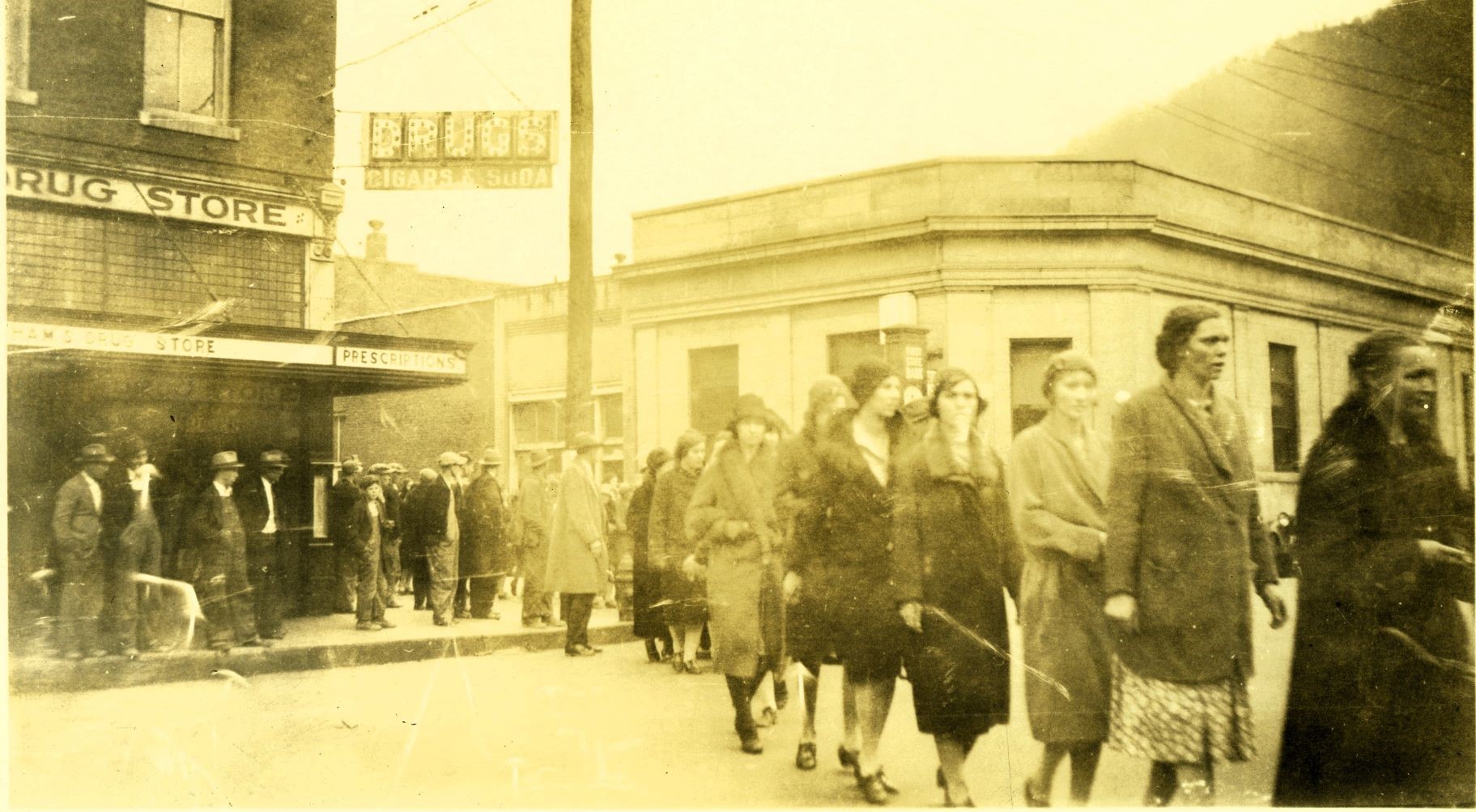
What solidarity looked like during Kentucky’s 1931-32 Harlan War waged by the C.P.-led National Miners Union.
“We Won’t Let the Thugs Get You!” by Clarina Michelson from Labor Defender. Vol. 8 No. 5. May, 1932.
Pineville, Ky. The Kentucky and Tennessee miners gave immediate answer to the arrests of the nine organizers of the National Miners’ Union, International Labor Defense, and Workers’ International Relief, jailed in January, the third day of the strike, on charges of criminal syndicalism. The answer? Mass protest.
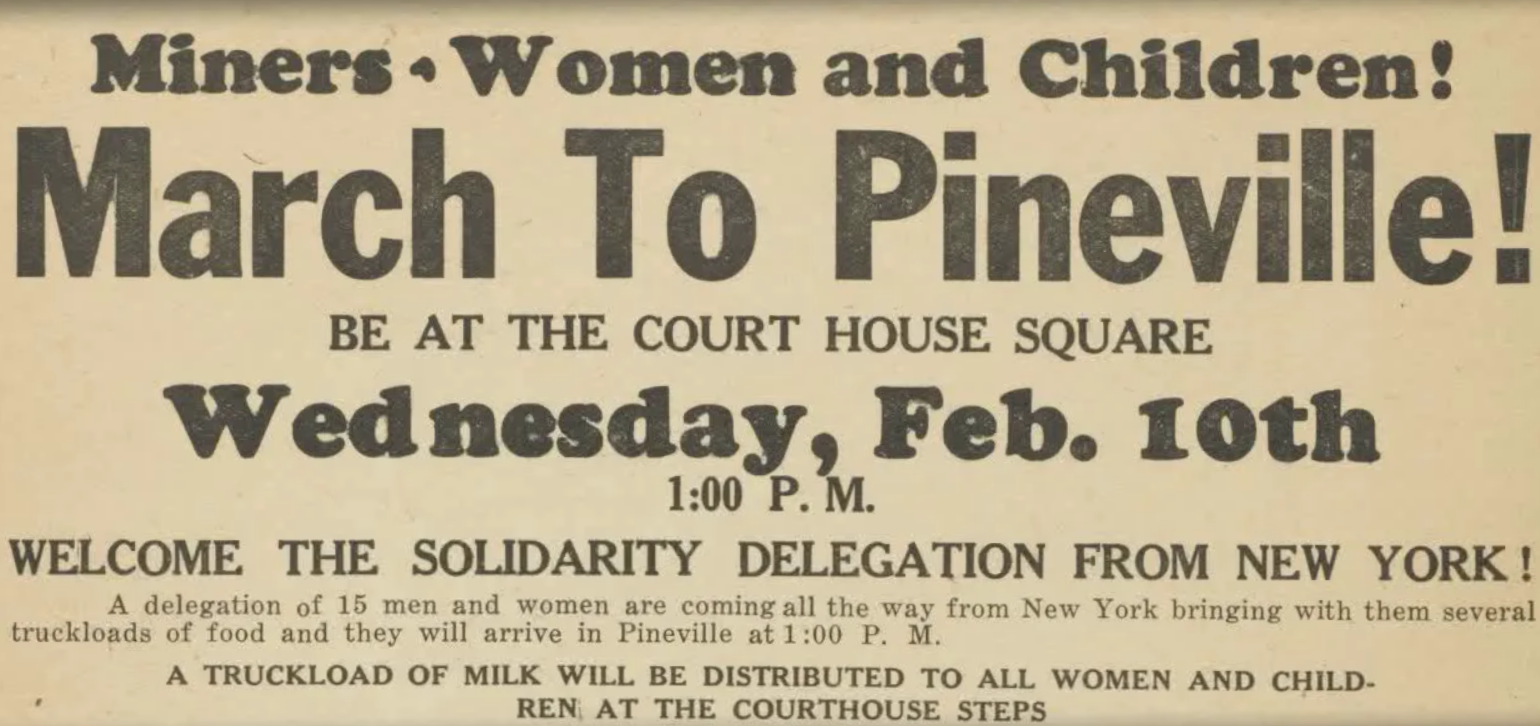
Two hours after their leaders were in the Pineville Jail, over 500 strikers massed in front of the Pineville Courthouse, and speeches demanding their release were made from the courthouse steps. For the entire weeks following the arrests, thousands of miners marched into Pineville, walking 5 and 10 miles each day, over muddy roads, and across the mountains, men, women and children, Negro and white-ragged and many barefoot-as a militant protest against the coal operators and against the county and state authorities.
Those of us who were in jail will never forget the march around the jail, as we watched through the cracks in the walls, the thousands of miners, their wives and children, with banners flying, singing union songs, march around the jail.
A strong guard of armed deputies and gun thugs were kept around the jail, as there were indications the miners were planning to storm the jail and release the prisoners. From 3000, the number increased to 7000, and then close to 10,000 on successive days.
The miners swarmed into the courthouse, one day, forcing the adjournment of court for that day. Committees were elected at the monster mass meetings who visited Mayor Brooks of Pineville, the judge, and the county attorney, where release of the prisoners was demanded.
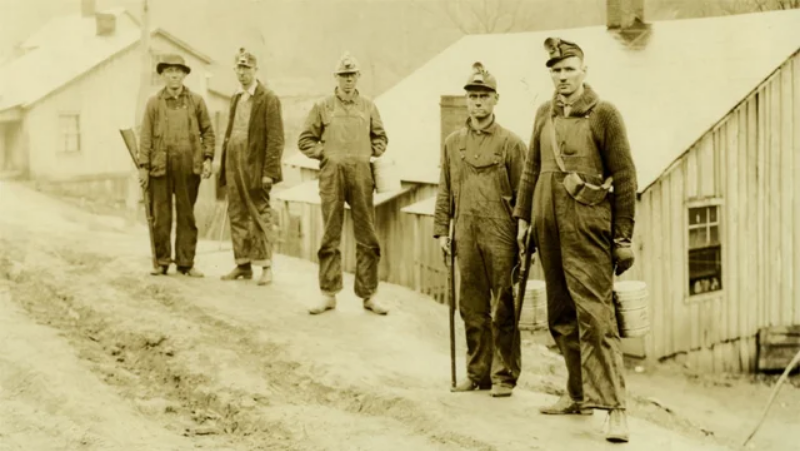
During these mass demonstrations, the town of Pineville was filled with gun thugs, armed with sub-machine guns and high- powered rifles, who were placed around the jail, and in and around the courthouse. To prevent their raiding the jail, the miners surrounded the jail guarding the prisoners day and night. “We don’t aim to let the thugs get to you,” they told us.
The hearing of the criminal syndicalism defendants which was supported legally to be held within 72 hours after the arrests, was postponed three times, and did not take place until 10 days after the arrests, when the thousands of miners were not in town. Even then, the miners were tricked and kept out of the courtroom, which was filled with coal operators and their agents, Red Cross representatives, and members of the American Legion, Judge Van Beber, like a monkey on a hand organ, jumped and danced when County Attorney Walter B. Smith, gave the string a jerk, while Reed Patterson, coal operators’ lawyer, ground out the tune.
One evening, we got definite word that the thugs were planning to raid the jail and take us for a ride that night. A messenger was rushed off to an N.M.U. strike executive meeting, and a committee of miners was elected, who hurried to the jail as fast as possible, arriving at midnight. The committee forced the jailers to let them in to assure themselves the prisoners were safe. They also notified the jail officials that the miners held them strictly accountable for the safety of the prisoners. For weeks, if it had not been for the constant guarding of the jail by the miners, undoubtedly the prisoners would have been taken out by the thugs, to be beaten up or killed, or be shot in jail. For several weeks, we were told to cover the barred windows with blankets, so there would be less chance of our being hit, if the thugs shot at us through the windows.
The Kentucky and Tennessee strike has clearly shown the miners that the interests of the coal operators and state are identical. From the first days of the strike, the whole might of the state was used against the miners, arresting, kidnapping and killing organizers and leaders.
The mass protests of the miners have been political protests. The miners have made demands not only on the operators but also on the city, county and state authorities. From the steps of the Kentucky and Tennessee courthouses, denunciations of the arrests, and demands for the release of the prisoners, demands for free speech and free assemblage, for the right to organize, to strike and picket, have been made. The miners have learned that only through mass organization can the terror be smashed. And they have learned that only through the organized strength of the working class.
Labor Defender was published monthly from 1926 until 1937 by the International Labor Defense (ILD), a Workers Party of America, and later Communist Party-led, non-partisan defense organization founded by James Cannon and William Haywood while in Moscow, 1925 to support prisoners of the class war, victims of racism and imperialism, and the struggle against fascism. It included, poetry, letters from prisoners, and was heavily illustrated with photos, images, and cartoons. Labor Defender was the central organ of the Scottsboro and Sacco and Vanzetti defense campaigns. Not only were these among the most successful campaigns by Communists, they were among the most important of the period and the urgency and activity is duly reflected in its pages. Editors included T. J. O’ Flaherty, Max Shactman, Karl Reeve, J. Louis Engdahl, William L. Patterson, Sasha Small, and Sender Garlin.
PDF of full issue: https://www.marxists.org/history/usa/pubs/labordefender/1932/v08n05-may-1932-LD.pdf
 Revolution's Newsstand