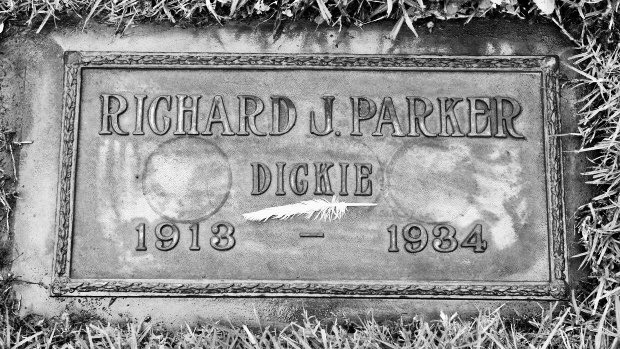
The first to perish in the great West Coast Maritime Strike of 1934 was ‘Dickie” Parker, shot to death on the night of May 14-15, 1934 on the San Pedro docks as militant workers attempted to prevent scabbing. John Knudsen who was also among the dozen strikers shot in the melee, died later. One-the-scene reporting by the Western Worker names the potential gunmen from Los Angeles’ Red Squad.
‘Mass Attack Cleans Out First Batch of Scabs’ by Our San Pedro Correspondent from Western Worker. Vol. 3 No. 22. May 28, 1934.
At about 12 midnight on Monday, May 14, about 400 militant. longshoremen and seamen stormed the scab concentration camp and steamship terminal in the Wilmington West Basin in Los Angeles harbor.
Police and company gun-thugs fired gas shells and bullets at the advancing workers. Men fell in all directions, but the militant strikers never faltered. Dick Parker was shot dead with two bullets in his body–John Knudsen lies in the hospital at death’s door. Six other strikers who were shot were carried away by the police, and many others were taken care of by their fellow-workers.
A shift in the wind drove the gas back on the police, and the strikers drove them back through the entrance of the stockade. One group broke down the fence at the north end of the enclosure and set fire to and destroyed the tents housing the scabs. while another group broke thru the fence on the South side and with bare fists and sticks and Stones hastily gathered drove back and smashed the faces and cracked the skulls of the scabs that had taken their jobs.
As the cry arose, “Come our men, our brothers are being killed,” the fighting strikers drove back the demoralized and thoroughly cowed police. The notorious Captain William Hynes of the Red Squad climbed on top of one of the parked automobiles and pleaded–get that. Red Hynes PLEADED–“Keep law abiding–law and order–they are human beings just like yourselves”. A striker jumped on another car and shouted to the workers that Hynes was just stalling for time.
“HACHE KILLED HIM”
Another cry arose “Hache has killed a man,” and the crowd smashed the automobiles belonging to the scabs and the cops while the cops pleaded with them, “Boys don’t smash my car.” Hynes brutal lieutenant, George Pfeiffer was knocked unconscious. Captain Gehtry of The Harbor Detective agency had his shoulder broken, and Hache was beaten by the infuriated workers.

The fire department appeared and attempted to lay down hose which would play streams of water on the strikers to disperse them. As fast as the hose was laid the workers cut them. The firemen’s attempt to use their pine-wrenches to defend themselves while they laid the hose was unsuccessful.
The battle here lasted for 55 minutes. Then the mass picket line moved to the Grace Line terminal, leaving in their wake 21 scabs who had received an “education” which required hospital treatment. The strikers were stopped by the steel doors at the terminal, but one of them broke through a lavatory window into the office and opened the doors, and the workers swarmed in, driving the fleeing scabs before them. About this time, fifty additional police in six radio ears arrived, and the militant fighters were forced to retreat but managed to in good order, getting most of their own wounded away in their own cars, the police only securing eight of the shot strikers.
QUIT SCABBING.
Early the next morning. police arrested six workers, James Howlby Arthur Harties, Alfred Limpricht, John Hollem, James Pearson, and Archie Royal, on charges of assault with deadly weapon, arson, and inciting to riot. The six workers were immediately bailed out by the ILD and their cases later dismissed, as it was plain that there is absolutely no evidence to make even a frame-up possible.
Hundreds of “educated” scabs deserted their dirty work as a result of this militant demonstration. Hynes has obtained 50 more degenerates to add to his Red Squad, but as a result of this demonstration, the former tactics of long-distance picketing and even fraternizing with the police has ended, and the militancy and determination of the longshoremen and seamen is at a high pitch.
Red Hynes has given the papers a cock-and-bull story about 37 or 70 tons of dynamite supposed to be stolen by the strikers!
In an effort to shift the blame for the murderous shooting from the red squad to the scabs, the harbor detectives also have come out with a story that they took away two rifles and a revolver that the scabs tried to smuggle into their stockade Wednesday night.
The experts in the police department here declare that the bullet which killed Parker came from Hannefield’s gun, (special waterfront policeman) and Ronald Prigen, in the San Pedro hospital, identified Hannefield as the man who shot him in the leg, but, according to the local capitalist press which is trying to cover the whole business with confusion, he cannot identify Hannefield as the thug who had murdered Parker.
Wednesday night, 470 workers jammed the Workers Center to protest the murder of Parker, and at the conclusion of the meeting a delegation of over 200 marched over to the office of the local “News-Pilot” and forced them to print a resolution adopted at the meeting, although the editors locked the doors on the oncoming delegation, when a smaller committee returned the next day the editors decided to print the resolution rather than have another demonstration in front of their offices.
‘Who Murdered Dick Parker’ by Mariam Bonner from Western Worker. Vol. 3 No. 22. May 28, 1934.
What happened in San Pedro the night. of May 14? A young worker, Dick Parker, was shot and instantly killed; fifty workers were wounded. Why? How? I have spent the past two days in San Pedro trying to get an answer to these questions. I have found many strikers willing to tell what they know, but only a few who will sign their names to their accounts; they are afraid of the blacklist.
Scabs had been brought into the region in cars and trucks. Police, the Los Angeles Red Squad, and plain-clothesmen had swarmed down to protect the scabs. On the night of May 14, the strikers determined to drive the scabs out of the stockade. I quote from one of the signed accounts:
WORKERS TELL STORY.
“We were about twenty yards from the road when the teargas, bombs were thrown, wind was in our favor, and blew the fumes toward the police force and the strike-breakers. I proceeded up towards the stockade, when, to my right, I noticed a uniformed policeman slugging a fellow-striker.
“I started over there but did not advance more than two steps when firing broke out, not by the fellow-workers, but by un-uniformed policemen. No striker had any firearms. I noticed in particular two men dressed up in dark clothes, with light caps, men about 200 pounds, and one I recognized as Hache by his talk, his build. and his face. (Hache is the chief of the Red Squad in San Pedro- Ed.) He said ‘Get back, you son-of-a-.’ This was during the firing. Both of the men I mentioned were firing and had guns in their hands.
“All the uniformed city police had gats in their hands too. When the firing ceased I turned around and faced the fellow-workers and hollered, ‘They’re only using blanks’, and one of them said: ‘Blanks, Hell! Look here!’
“About fifteen feet to my right there was a fellow-worker down, and, I should judge, three workers who proceeded to carry him to the road to transport him to a hospital.
“I heard the fellow-workers carrying him say, ‘He’s got a couple in him already and he’s dead.’
“The firing started again, and the fellow-workers were running away from the fire hollering ‘They’ve got three more of us.’ In half a minute or so I heard someone hollering. Here comes the chief of police. He wants to talk to us. So I went up there and I saw Hynes. He tried to lead fellow-workers to the highway from the scene of action.” (Hynes is the chief of the Los Angeles Red Squad- Ed.)
PLAIN-CLOTHES COPS DID SHOOTING.
Another striker told me this “I was within twenty feet of the ship when the firing started. When the shooting started, they hit one of the longshoremen. I went to this man’s assistance and asked the plain-clothesman not to shoot any more because I wanted to help the man he’d already shot. Before I could discover who the man was, I was shot in the left leg. I could not tell whether the man who shot me was a Burns man or a Pinkerton man, but he was in civilian clothes.
“I heard one man who was near Dick Parker when he was killed say that Parker was about twenty feet from Hache. I saw something shining in Hache’s hand when he was scuffling. I can’t say in which hand the shiny object was, because he was swinging his hands in all directions. It looked to me as if it was in his left hand.”
Another worker told me that Hache is left-handed and that his club was in his right hand. What was in his left hand?
The general sentiment among the men I heard was that a man in civilian clothes did the shooting, but none of them would come out with, the name of the man they suspected.
On the morning following the shooting, six strikers were taken to the police station. Some were charged with rioting, some with arson, some with assault. The Herald-Express for May 17 announced that the strikers have been released, and that Walter Hannefield, a former Los Angeles policeman and “special longshoreman” at Los Angeles harbor. is held by police on suspicion of murder.
Who fired the shot that killed Dick Parker? WHO FIRED THE SHOTS THAT WOUNDED FIFTY STRIKERS? One man told me that one of the wounder workers have five shots in him and, that every shot was from a different rifle. Whether Hannefield or some other hired thugs fired the fatal shot is not known now–it may never be found out.
But longshoremen and seamen know this–they know that the Red Squad, the police, and the plain-clothesmen have acted again as the hired murderers of the ship-owners, of the of the capitalist class.
Western Worker was the publication of the Communist Party in the western United States, focused on the Pacific Coast, from 1933 until 1937. Originally published twice monthly in San Francisco, it grew to a weekly, then a twice-weekly and then merged with the Party’s Daily Worker on the West Coast to form the People’s Daily World which published until 1957. Its issues contain a wealth of information on Communist activity and cultural events in the west of those years.
PDF of full issue: https://www.marxists.org/history/usa/pubs/westernworker/1934/v3-n19-22-may-1934.pdf
 Revolution's Newsstand