
A report on the regular brutality meted out to our comrades objecting during World War One.
‘Socialists in Military Prisons Worse Treated of All Objectors’ from The Ohio Socialist. No. 94. November 19, 1919.
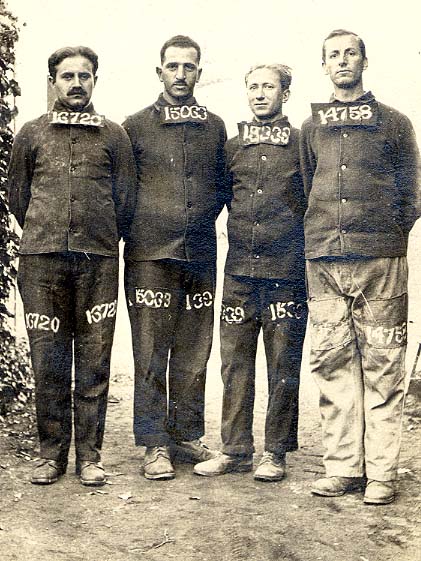
Brutalities to which conscientious objectors were subjected at Fort Riley and Camp Funston were directed mainly against prisoners who differed politically from the administration. Joseph Brandon, a conscientious objector who was freed recently after being sentenced to die by court-martial in October, 1918, and whose sentence was twice commuted by President Wilson, asserted this yesterday.
He charged that the Socialist conscientious objectors and practically all those classed as “radicals” suffered indescribable cruelties, which were directed by the War Department.
“Men are not kept in jail because they are opposed to war,” he said, “but because they are Socialists. Those who took part in the hunger strikes and openly declared their opposition to the present regime were stamped as ‘radicals.’
Solitary for Any Offense.
“We were choked, beaten, kicked and dragged whenever we sought to gain our rights as citizens, and not as criminals, as we were kept. At occasions we were thrown under cold showers, sometimes even five times a day. Once they threw a hose of cold water on me while I was asleep, although I was at that time in poor health.”
Brandon declared that for the least thing a conscientious objector did he was thrown into solitary confinement. He charged that during the showers, through which many of the objectors contracted influenza and pneumonia, their backs were scrubbed with latrine brushes. Many guards, he said, also spat at them, kicked and punched them while doing this.
At Camp Funston, Brandon declared, about 20 objectors were denied cooked food.
“This happened,” he continued, “in an open field under unsanitary conditions. Bugs and other insects were creeping and flying about us, but we were nevertheless told to cook our meals there. We refused to do any cooking at all, and went on a hunger strike.
“On the 11th day after the hunger strike began some of us were sent to the hospital. We were broken down for lack of nourishment.
Thrown Into Latrine.
“I reached the hospital too weak to walk. But, regardless of this, I was told to sweep the latrine. I complained that I was sent to the hospital for medical treatment, and when I tried to go to my bed the captain in charge choked me and threw me to the ground.
“About half an hour later I was examined and thrown into the latrine again, where I remained about three hours.”
Brandon related how Majors Adler and Truett came to the hospital a week later and examined and questioned the prisoners. He said he had the following conversation with Major Adler:
“Why do you refuse to prepare your own meals?”
“Because I was taken away from home against my will, and it is up to the government to take care of me here. I want to be treated like a man. It is up to the authorities to take care of me or let me die.”
Silver Chains-Steel Chains.
“Well, you are having good conditions here. You’re not a prisoner, and there is no reason why you should not take care of yourself.”
“Do you say I am not a prisoner? Does this mean I can go home whenever I want to?”
“Oh no. You have to stay around here, but you have the liberty of the camp.”
“If you were to place silver chains on my hands instead of steel I would be chained all the same.”
“What will you tell people when they ask you what you did during the war?”
“I will tell them I went to jail for democracy.”
Brandon declared he now found out that a short time after his conversation with the major, his father received a letter from the War Department, in which he was described as an agitator. His theories on Socialism and his constant agitation, the letter stated, were the cause of his troubles. One day, Brandon related, a company of 14 objectors, all branded as “radicals,” were hurried out of their cells and forced to military marching. Joseph Kaplowitz, one of the objectors, who was tired and weary unable to march fast enough to keep up with the company, was thrown to the ground with a rifle and remained un conscious for a long time.
Because of this Brandon said, the 14 objectors went on a hunger strike as a protest, and were all thrown into a small cell. There, he said, a letter to the post commander. complaining of the treatment given to Kaplowitz, was drawn up and signed by every one of the 14 objectors, and because he handed the letter to a prison officer, Brandon continued, he was taken to solitary confinement.
Brandon related how Gen. Leonard Wood came to Fort Riley while Major Funston was interviewing the objectors, and spoke to Post Commander Colonel Waterman. The following evening, he charged, those who had been on hunger strikes were transferred to Camp Funston.
“Radicals’ Transferred.
“I was included among those who were transferred continued Brandon. “At first not one of us knew the reason for this, but later it became visible to us that all Socialists and those listed as ‘radicals’ were transferred, and that it was an attempt to subject us to cruelties again.”‘
Brandon stated that he was not among the first to be transferred. He had been confined in the hospital with influenza, but a week later, although still ill, was also taken to Camp Funston. The sergeant who brought him there, he said, had the following conversation with the officer of the guard.
“He is a ringleader and agitator. Take good care of him.”
“We know how to handle these fellows.”
On November 27, 1918, Brandon was transferred to Fort Riley again, where he was court-martialed and sentenced to death. Practically every objector there was put into solitary confinement. A 13-day hunger strike was resorted to by the prisoners as a protest.
Driven Around Field.
While he was at Camp Funston, Brandon said a 10-day strike was on. The officers refused to give them water on the eighth day, but the prisoners held out until the 10th, when they collapsed.

The method of treatment, Brandon charged, was issued by the War Department. He said officers often informed the prisoners that they were instructed to give them “exercise.”
“If we did not want to walk when they ordered us they dragged us. They had no mercy on any of us. Brandon continued:
“One day, in a large, open field, surrounded by a wire fence, we were driven around the field several times. Many people stood around the field grinned and shouted at us, and gave the guards commands to mistreat us which they obeyed.
Food, cigars and other necessities were barred. Everything was thrown away instead of being returned to the senders, he charged.
The Ohio Socialist, published by the Left Wing-dominated Socialist Party of Ohio in Cleveland from January, 1917 to November, 1919. It was edited by Alfred Wagenknecht Wagenknecht spent most of 1918 in jail for “violation of the Conscription Act.” The paper grew from a monthly to a semi-monthly and then to a weekly in July, 1918 and eventually a press run of over 20,000. The Ohio Socialist Party’s endorsement of the Left Wing Manifesto led to it suspension at the undemocratic, packed Socialist Party Convention in 1919. As a recognized voice of the Left Wing, the paper carried the odd geographical subheading, “Official Organ of the Socialist Parties of Ohio and Kentucky, Virginia, West Virginia and New Mexico” by 1919’s start. In November of that year the paper changed to the “labor organ” of the Communist Labor Party and its offices moved to New York City and its name changed to The Toiler, a precursor to the Daily Worker. There the paper was edited by James P. Cannon for a time.
PDF of full image: https://www.marxists.org/history/usa/pubs/ohio-socialist/094-nov-19-1919-ohio-soc.pdf
 Revolution's Newsstand