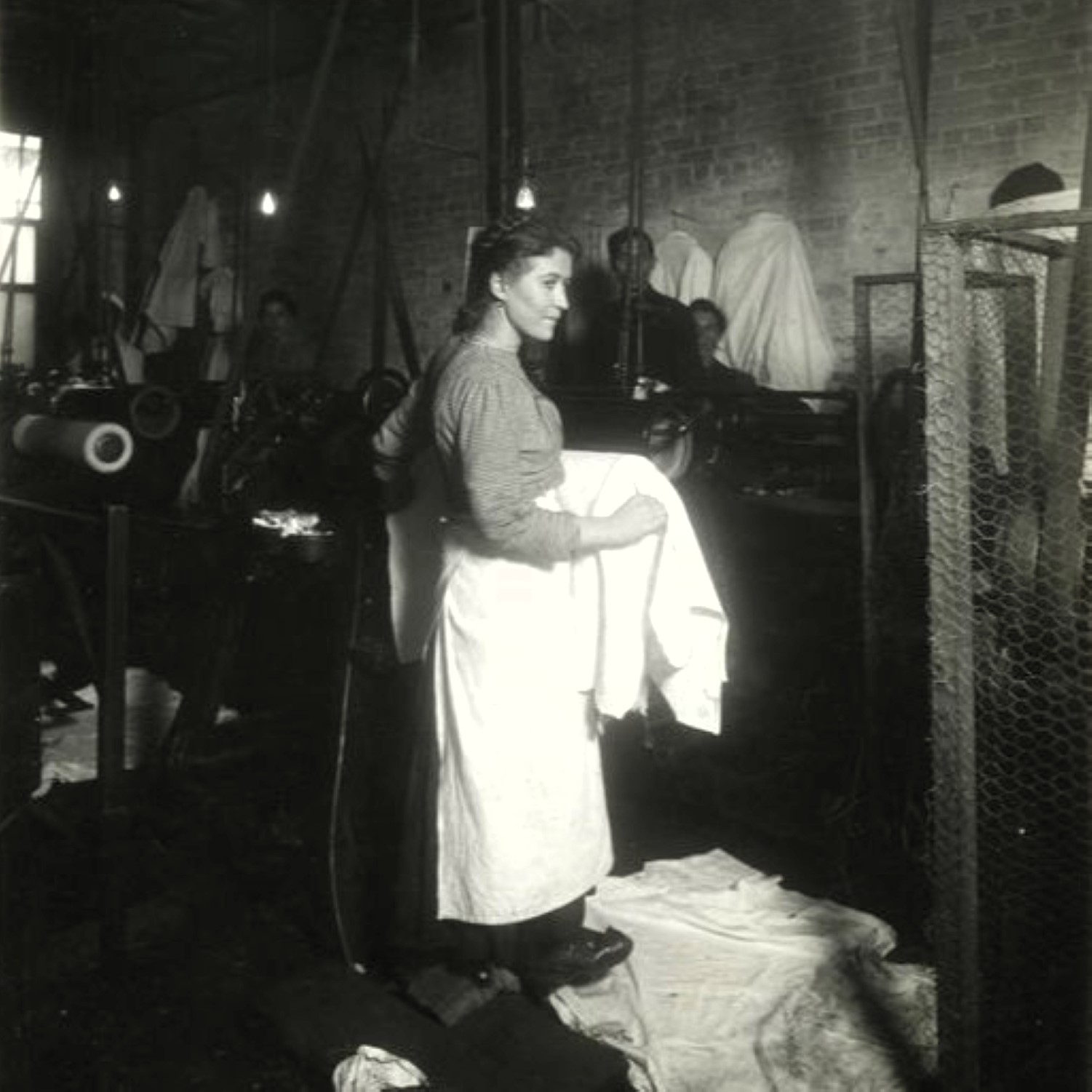
‘Laundry Workers Toil in Worst of City’s Sweatshops’ from the New York Call. Vol. 4. No. 47. February 16, 1911.
The laundry industry in New York today is in the forefront as a sweatshop industry.
It is estimated that there are in Greater New York something like 35,000 laundry workers, mostly women and young girls. Only 700 of these are organized. The rest are non-union workers, and their conditions of work, hours and wages, can be measured only by the lowest standard.
With the exception of the washing, which is done by men, mostly foreigners, who work for $10 a week and put in 10, 12. 14, and even 16 hours a day on certain days, the rest of the work is done by women and girls. Many of the girls are so young that when they reach the age of twenty and are still at work in the laundry, they are old women, if not in years at least in body and mind, and frequently in their appearance.
Judging by talks which a Call reporter has had with laundry workers. the chief indictments against the laundry industry as conducted today by owners of the big steam laundries, as well as of the smaller employers, are the following:
The hours are irregular.
The wages are low, as low as the workers can be forced to accept.
The machinery, which is of a most dangerous kind, is very frequently unprotected and the work is done with such speed that the workers have no time to think about their own safety.
The sanitary conditions in the shops are abominable, even in many of the “model” laundries.
But worst of all is the system of speeding and rushing the workers.
Speed Is the Thing.
The week’s work, which may consist of sixty-five or seventy working hours, is generally done in five days. and very frequently in four and a half days. This means that the first two or three days in the week, say Monday and Tuesday, workers have to put in twelve, fourteen and even sixteen hours a day, as the amount of work
to be done may require. On Wednesday and Thursday the workday may but consist of “only” twelve hours. for this the workers may be recompensed with only half a day’s work on Friday and no work on Saturday, although this is by no means the rule.
But even where the bosses are fair and do not make their employes work after they have rounded out their week, this system of doing a week’s work in five days and less is one of the greatest hardships upon the workers. Ten hours is a big day’s work, for any man or woman. And when hundreds of young girls are made to work twelve and fourteen hours a day, even if they do get their time back at the end of the week, their bodies are overtaxed. It is more than they can stand without injuring their health.
But not all of the bosses are “fair,” even as far as capitalistic fairness is concerned. In many instances women, after having put in an extremely long week’s work in five days, are compelled to come to the laundries on Saturday and do “wash overs.” For this extra work they are not paid, as this is supposed to be their own. fault.
Women in the laundries likewise are frequently made to pay for goods damaged by them or which the employer claims was damaged by them.
Disease Is Rife.
The sanitary conditions in most of the laundries are such, according to officers of Local 126 of the Laundry Workers’ Union, that the lives of the workers are exposed to consumption and pneumonia as well as to numerous other diseases. The same toilet rooms in many of the laundries are used both by men and women.
The washing department, where the men washers work, is in most cases in dark cellars. The floor is wet. The steam is choking. Before leaving these cellars the workers have no place where they can rest and cool off a little. They must enter the cold street air all in a perspiration, and the contraction of a cold, pneumonia and tuberculosis is almost inevitable sooner or later.
As an article in McClure’s Magazine testifies, the women and girls, in addition to being exposed to accidents in many of the shops where the machinery is unprotected, are at all times exposed and subject to all kinds of internal diseases which in many cases unfit them for motherhood through their handling of the machinery at a mad pace and through the excessively long hours. While the work at the machines by itself, or the long hours, might not have proven dangerous, the two when combined turn hundreds of young girls into old and crippled women before they reach the age of womanhood.
Perhaps at its worst the condition of the laundry workers is in the laundries which most of the big hotels in New York conduct in their own establishments.
Hotels Worst of All.
The hotels, which spare no money to make the reception rooms look as attractive as possible, which are generous in their electric light and in all things which tend to give their place standing and justify the large prices charged by them are especially oppressive in the treatment of their laundry workers. This they can do with impunity, since they do not come under the jurisdiction of the department of labor and the girls in the laundries are not afforded even this meager protection at the hands of the law.
The laundries in these “high class” hotels are invariably located deep underground where the where the girls are compelled to work any number of hours that might be necessary to turn out a certain lot of wash for the hotel. They seldom see the light of day.
The 700 organized laundry workers compose locals 126 and 34 of the United Laundry Workers. Local 126 has its headquarters at 2550 Eighth avenue, Local 34 meets at 152 Clinton street.
The New York Call was the first English-language Socialist daily paper in New York City and the second in the US after the Chicago Daily Socialist. The paper was the center of the Socialist Party and under the influence of Morris Hillquit, Charles Ervin, Julius Gerber, and William Butscher. The paper was opposed to World War One, and, unsurprising given the era’s fluidity, ambivalent on the Russian Revolution even after the expulsion of the SP’s Left Wing. The paper is an invaluable resource for information on the city’s workers movement and history and one of the most important papers in the history of US socialism. The paper ran from 1908 until 1923.
PDF of full issue: https://www.marxists.org/history/usa/pubs/the-new-york-call/1911/110216-newyorkcall-v04n047.pdf
 Revolution's Newsstand