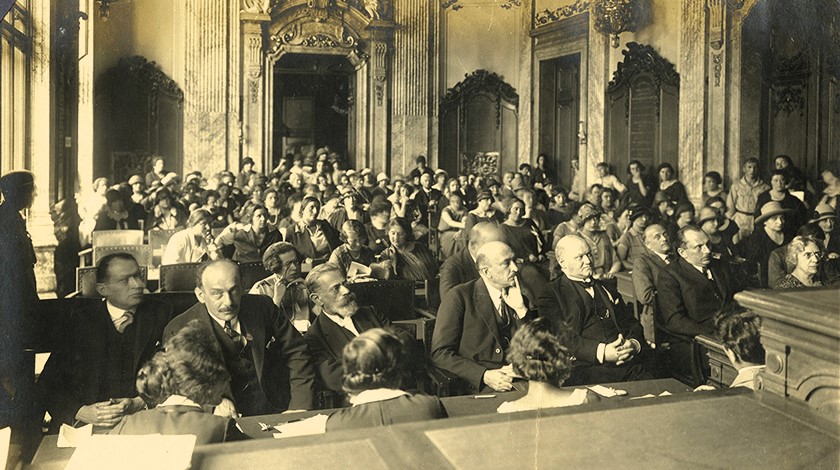
In the run-up to the 14th Zionist Congress in Vienna, Joseph Berger, founder of the Palestine Communist Party, contextualizes Zionism’s rise after World War One, the consequences of which transformed the fortunes of the formerly isolated movement.
‘Zionism and the Jewish National Question’ by Joseph Berger from International Press Correspondence. Vol. 5 No. 65. August 20, 1925.
Never before had the national problem assumed such an acute form as in the period immediately following the war. The war had not only placed capitalist society out of joint from the social point of view, but the national movements, which in the pre-war time had only been held in check with the greatest difficulties, broke out in all their fury. And the solutions which the world bourgeoisie has found for the national questions are just as one-sided and incomplete as are its solutions in the social sphere.
One of the many unsolved questions is the Jewish question. The situation of the Jewish masses in the most important countries in which they are concentrated became, immediately after the war, a very desperate one. The anti-Jewish pogroms in Poland, in Roumania, in former white Ukraine, combined with economic boycott and terrible political suppression, served as an all too forcible “illustration” of those decisions of the Peace Conferences which, it was announced with a great fanfare, were to liberate all the suppressed peoples. There was only One way of solving the desperate situation of the Jewish masses: by the taking over of power by the working class, which at one stroke would put an end to national animosity and oppression. (As a matter of fact, with the entry of the Red troops into the Ukraine the pogroms and persecutions of the Jewish minority immediately ceased.) The capitalists gradually came to realise this “danger”. It therefore became necessary to convert the national liberation movement of the Jewish masses from a revolutionary into a counter-revolutionary factor. The instrument which was to serve this purpose was the Zionist organisation.
Up to the time of the war Zionism was the dream of a handful of Utopians. Whilst the ideal set up by Dr. Herzl of a “Jewish State”, provided the discussion theme for a number of equally unproductive and tedious Zionist Congresses, the practical activity of the Zionist organisation consisted in eagerly deputising present and future political big-wigs and also in settling a few hundred petty bourgeois Jewish families in Palestine. The war and the nationalist atmosphere created by it drove certain circles of the Jewish bourgeoisie (especially in the Western countries) to the Zionist organisation. The Jewish bourgeoisie thereby hoped, by speaking in the name of a people numbering 18 millions, to obtain political weight and, should the idea of the Jewish State in Palestine be realised, to obtain a market of their own. As their interests exactly coincided with the efforts of the Entente Ministers to establish law and order in Eastern Europe, with the Eastern plans of England and the endeavours of the capitalists to preserve the semblance of justice, Zionism in 1918 to 1921 entered on its most prosperous period. The Jewish bourgeoisie succeeded in persuading the Polish and Roumanian Jewish people that mighty England wished to rescue them, and had made the Jews a present of Palestine that it was only a question of a little patience and endurance and the poor Jewish people, just as in olden time they had been led out of Egypt, would now be led out of the Polish slavery into a land flowing with milk and honey. The struggle in “exile”, where the Jew is a stranger and only tolerated, must of course cease, and all forces be directed to the better future in the Promised Land.
In the “Promised Land” however Zionism played a peculiar role: as a small cog in the machinery of the powerful English imperialism, the immigrating Jews were allotted the role of diverting to themselves the forces of the Arab national emancipation movement which were directed against the British conqueror. The Jewish bourgeoisie embodied in the Zionist organisation, is doubly reactionary: as ally of the Polish and Roumanian governments, even in the countries populated by large masses of Jews while at the same time as the enemy of the emancipation movement of the working people in Palestine it has sold and betrayed the interests of the poor Jewish masses for the sake of the few paltry concessions which the bourgeoisie of the more powerful peoples have thrown to it.
The 14th Zionist Congress which is just about to be held in Vienna, is characterised by the fact that the Zionist illusions are beginning to be dispelled from the masses of the Jewish people. The Zionist Polish Agreement, by which Grabski, the Polish Prime Minister, pays the Jewish capitalists, at the cost of the toiling Jewish population, the reward for their lackey service on the one hand, and the nomination of Lord Plumer as High Commissioner in Palestine, who is converting the native home of the Jews into an English military camp, on the other hand, must open the eyes of the most simple follower of the Zionists. When we add that the economic result of the six years intensive Zionist activity in Palestine is the settling of about 3000 persons in agricultural colonies, which are not even yet on a firm economic foundation, with the simultaneous monstrous growth of urban settlements, in which the great number of traders, speculators and other parasites unfortunately reminds one too much of this unproductive type which the champions of Zionism have promised to liquidate then one can easily understand that the 14th Zionist Congress will be anything but harmonious. The innumerable contradictions, of which we have only indicated a few particularly the struggle between the petty bourgeois tendency in Zionism, which feels itself deceived by the results of the activity, and the bourgeois leadership which aims at still fostering the illusions will find expression at the Congress, reflecting the profound discontent of the Jewish masses who are now finally endeavouring to repudiate the Zionist propaganda.
The socialist Zionists will probably play a special role at the Congress. They had always and everywhere rendered faithful flunkey service to the Jewish bourgeoisie, and as the part they played during the period of the revolutionary upheavals in damping down the revolutionary mood of the Jewish masses, as well as in establishing connections with the left governments of the powers patronising Zionism (MacDonald, Blum, Ebert etc.), was not to be underestimated, and as they rendered extra service in keeping down the Communist movement in Palestine, they were rewarded by financial support and privileges. The object of the Congress of the Socialist Zionists before the General Zionist Congress is to lay down with greater precision the tasks they have to perform in this period in their role as lackeys. At the approaching Congress it is probable that they will lose a number of their privileges, especially as regards the budget question.
Whilst in Vienna the Jewish bourgeoisie and social democrats are holding their Congress, accompanied with a great fuss in order, draped in the blue and white flags of innocence and a heap of empty nationalist phrases, to prepare fresh betrayals and deceptions of the people, there is being quietly accomplished in the Soviet Union an important real step to a partial solution of the Jewish question. The proletarian power has not remained satisfied with abolishing all traces of national suppression and putting an end to all persecutions of Jews and granting to all Yiddish speaking workers the widest possibility of satisfying their cultural and national requirements. It has also proceeded to a radical solution of the question of the Jewish minorities living within the territory of the Soviet States. The great agrarian scheme, for which the Peoples Commissar for Agriculture has granted ten thousands desyatins of land, the efforts of the Jewish section of the Russian C.P. to procure the necessary means for cultivation of the soil, and finally, the results of the work recently commenced, which had already many times surpassed the results of the Zionist colonisatory activity, are a further proof that the bourgeoisie is incapable of solving the Jewish national question, and that the only way out for the Jewish masses, disregarding all Zionist swindles, is the proletarian revolution.
International Press Correspondence, widely known as”Inprecor” was published by the Executive Committee of the Communist International (ECCI) regularly in German and English, occasionally in many other languages, beginning in 1921 and lasting in English until 1938. Inprecor’s role was to supply translated articles to the English-speaking press of the International from the Comintern’s different sections, as well as news and statements from the ECCI. Many ‘Daily Worker’ and ‘Communist’ articles originated in Inprecor, and it also published articles by American comrades for use in other countries. It was published at least weekly, and often thrice weekly. The ECCI also published the magazine ‘Communist International’ edited by Zinoviev and Karl Radek from 1919 until 1926 monthly in German, French, Russian, and English. Unlike, Inprecor, CI contained long-form articles by the leading figures of the International as well as proceedings, statements, and notices of the Comintern. No complete run of Communist International is available in English. Both were largely published outside of Soviet territory, with Communist International printed in London, to facilitate distribution and both were major contributors to the Communist press in the U.S. Communist International and Inprecor are an invaluable English-language source on the history of the Communist International and its sections.
PDF of issue: https://www.marxists.org/history/international/comintern/inprecor/1925/v05n65-aug-20-1925-inprecor.pdf
 Revolution's Newsstand