
As ever, capitalism’s shit rolls down hill. Here, an investigation into Chicago’s city dumps where, unsurprisingly, every single one is in a poor, working class neighborhood.
‘City Dumps Carry Death to Plague Stricken Chicago Slums’ by E. Downey from the Chicago Daily Socialist. Vol 4 No. 227. July 20, 1910.
Chicago scrapes the filth from the back doors of the rich and deposits it at the front doors of the workers. That is what the present system of “city dumps” means.
Great Rotting Heaps
Offal from the kitchens and markets of the North Shore, Kenwood, and Hyde Park is dumped in great rotting heaps among the tenements “back of the Yards,” in South Chicago and out on the northwest side.
There are more than a dozen of these dumps, reeking ricks of festering filth, and every one of them is in a working class neighborhood.
Fine for Packingtown
The stock yards workers alone are favored with five of these stench infernos, located at Thirty-fourth street and Center avenue, Forty-third and Leavitt streets, Forty-seventh street and Oakley avenue. Forty-seventh and Robey streets and Forty-seventh street and Western avenue.
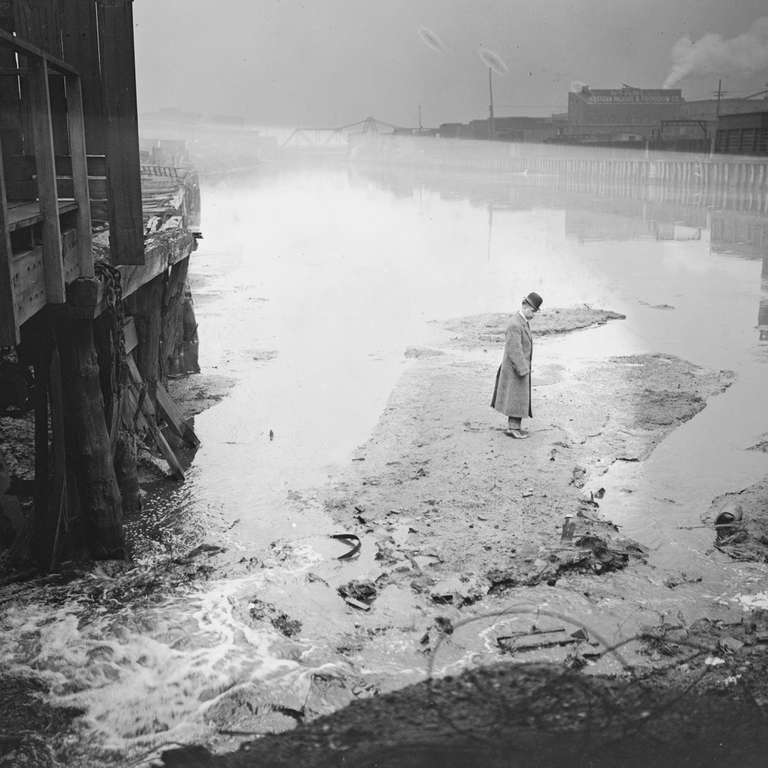
With the Yards to the east, Bubbly Creek to the north and the dumps to the west, the residents of this unfortunate region are nearly surrounded with evil odors.
Largest in City
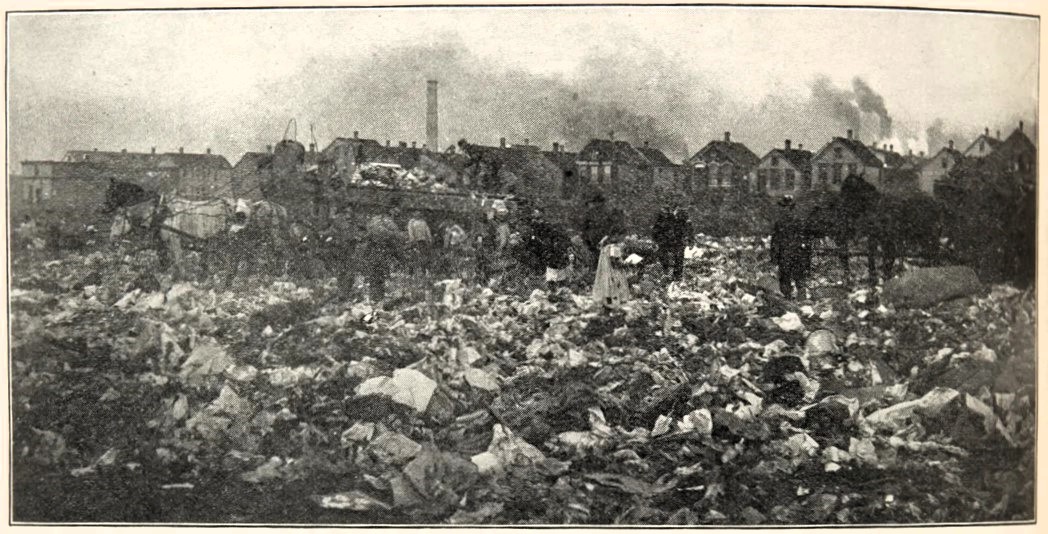
The dump at Forty-third and Leavitt streets is the largest in the city and, next to Bubbly Creek, the greatest source of fetid smells in the whole malodorous district round about the Yards.
Here private scavengers bring 80 to 100 wagon loads per day of offal from hotels, restaurant and business houses in the “Loop,” from outlying groceries and markets, and from family hotels” and apartment houses along the Lake Front.
Here, too, the packing houses send non-utilizable wastes to the amount of several carloads daily. On this dump. accordingly, are piles of rotting melons, decaying fruits, spoiled vegetables, nasty slime from Heinze’s pickle works, spent hops from breweries, horse manure, putrid meat, cast-off bandages from private hospitals, and other choice putrifactions.
Stuff Less Offensive
Less offensive stuff–rags, waste paper, old shoes, cast-off clothes, worn mattresses and other refuse, mingled with ashes and more or less garbage is brought by city wagons from a half dozen wards.
All this waste and filth is dumped indiscriminately in one festering mass, without any effort to cover the foulest stuff with less objectionable matter and with no serious attempt at disinfection.
Hence the indescribable combination of smells, which is readily distinguishable from that of the stock yards, and which is borne by favorable winds as far east as Michigan avenue.
Winds Have Own Fragrance
“When a peculiarly overpowering odor wakes me in the night,” said Miss Mary MacDowell, head of the University Settlement on Gross Avenue, I can tell from the character of the smell whether the wind is from the east west or north.
“The west wind, blowing from the dumps, brings a more disagreeable odor than that from either the stock yards or Bubbly Creek.”
Women and children swarm on the Forty-third street dump, gathering mouldy bread, spoiled vegetables and other tidbits “to feed their chickens.” “God-send it is not eaten by the families,” said Dr. Caroline Hedger, who has closely observed the dumps for years and picking rags, tin cans and old iron for Powers and Dugan who have a monopoly of saleable “finds” on this dump.
Garbage is eaten by the pickers, for the writer saw a starved looking little fellow devouring a half rotten tomato with apparent relish.
Close observers of the dump, like Dr. Hedger and Miss MacDowell, declare that such instances are by no means uncommon.
Malodorous as Ever
The Robey street dump has been temporarily abandoned on account of fire, but is as malodorous as ever and is a favorite foraging ground for children.
The dump across the tracks at Oakley avenue and Forty-seventh street is not used by private scavengers and is much better cared for and less offensive than that at Forty-third street.
At Thirty-fourth street and Center avenue is another stench factory. The city wagons from the Ninth ward dump here and the people of “the Ghetto” do not separate their garbage from miscellaneous waste and, since the reduction plant accepts only garbage that is 95 per cent pure, all the filth of that uncleanly district goes to the dump.
Among Other Dumps
Over on the northwest side, at Irving Park boulevard and Campbell avenue, is another public and private dump, which is a close second to the Forty-third street inferno.
At the North Western avenue bridge is still another on a smaller scale, and in Addison street, just northeast of the Branch, the city is obliging some property owner by filling in sidewalk with garbage and miscellaneous refuse.
Other garbage dumps are located at Taylor street and Fifty-second avenue, Seventy-sixth and State streets. Eighty-first street and Jackson avenue and Ninety-fifth and Yates.
The Chicago Socialist, sometimes daily sometimes weekly, was published from 1902 until 1912 as the paper of the Chicago Socialist Party. The roots of the paper lie with Workers Call, published from 1899 as a Socialist Labor Party publication, becoming a voice of the Springfield Social Democratic Party after splitting with De Leon in July, 1901. It became the Chicago Socialist Party paper with the SDP’s adherence and changed its name to the Chicago Socialist in March, 1902. In 1906 it became a daily and published until 1912 by Local Cook County of the Socialist Party and was edited by A.M. Simons if the International Socialist Review. A cornucopia of historical information on the Chicago workers movements lies within its pages.
PDF of full issue: https://www.marxists.org/history/usa/pubs/chicago-daily-socialist/1910/100720-chicagodailysocialist-v04n227.pdf
 Revolution's Newsstand