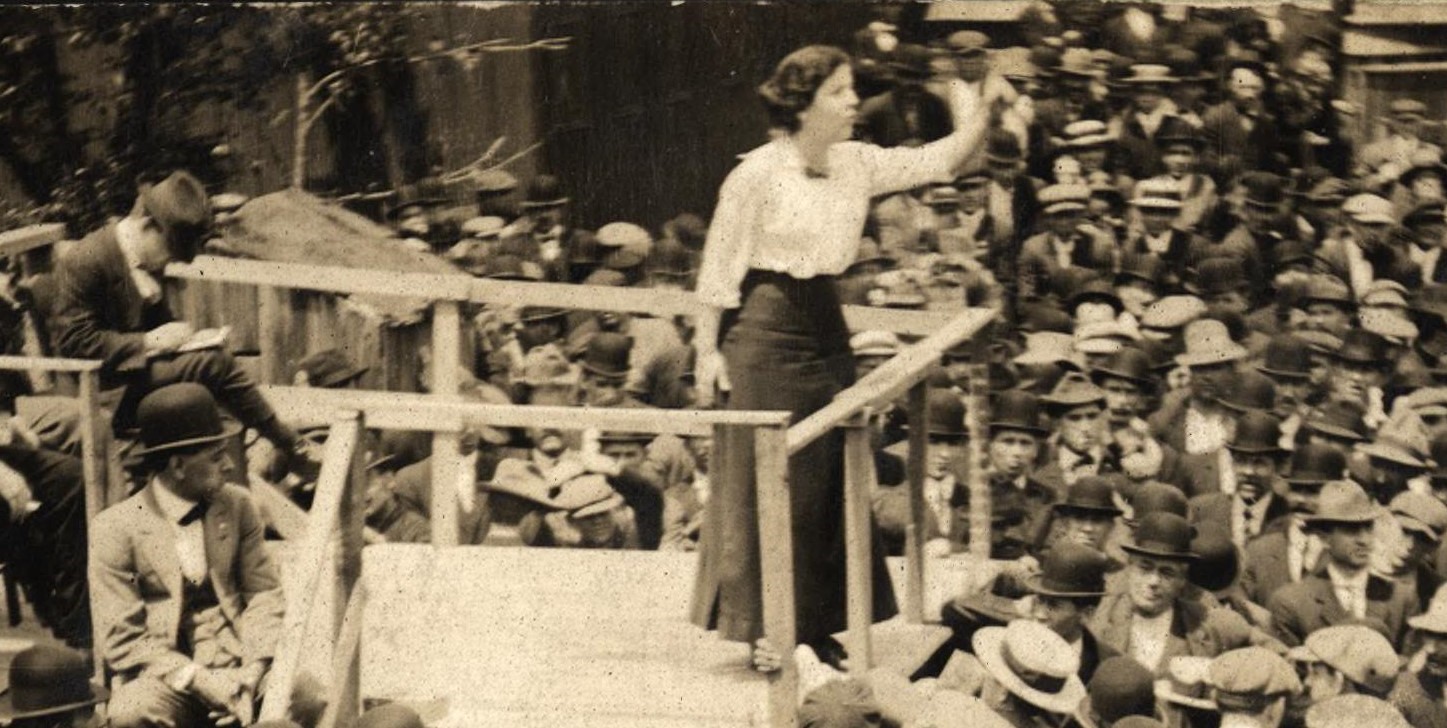
Elizabeth Gurley Flynn looks at the definite, long-established type of the union mis-leader. All in the workers’ movement today will recognize the ugly, honest picture of the labor bureaucrat she presents here.
‘The Labor Leader’ by Elizabeth Gurley Flynn from Solidarity. Vol. 4 No. 39. October 4, 1913.
The labor leader, like the political “grafter” is an exclusively American product. European countries have conservative unions and radical unions, but their representatives are identified in the minds of all intelligent workers as out-and-out “yellow.” They are admittedly capitalist institutions and deceive none. But for callous exploitation of labor’s noblest aspirations and generous efforts, for Janus-faced, double dealing with the toilers and their exploiters, the American labor leader stands alone.
There has been a plentiful crop in the last forty years, especially since the organization of the American Federation of Labor in 1881. Economic conditions as, they existed among the skilled workers, from which the A.F. of L. drew the bulk of its members, molded the minds of the labor leaders considerably, and the structure of the union gave them exceptional opportunities to develop.
An intensely individualistic tendency existed among the skilled workers due to the immature stage of socialized labor and to the competition still rampant in the commercial world. Each man in a shoe factory, for instance, had his own bench, his own tools, his exclusive craft skill, was capable of finishing a pair of shoes and drew comparatively high wages. So in a stone quarry, a machine shop or a textile. mill. This produced independence and isolation. Each man thought in terms of “myself.” “How can I get ahead?” was the tenor of his ambition. He desired to get into business. Having very little co-operative or interdependent relations with the man at the next bench, he regarded him not as a fellow worker, but as a competitor. Naturally, when craft unions were organized, he brought these feelings into the union. He accepted vaguely the idea of organizing to better conditions, but it was only when machinery eliminated skill and subdivided labor that the skilled workers learned how to work together in the shop and then in the union. As trustification grew nation wide, some wisely realized that their chance to “rise” depended on the ability of their class to rise, but many have this lesson yet to learn. The labor leader sprouted in this individualistic, self-seeking atmosphere. Instead of selecting business as his field of adventure, he selected the union. But just as the man who entered business, rose out of the crowd, so the labor leader uses his dupes as a ladder to climb to power and affluence.
The open door for the labor leader lies in the structure of the A.F. of L. With 150 different Internationals; 13,000 local unions; all pow- er centralized in the hands of the officials; the referendum vote largely a dead letter; conventions, love-feasts of paid officials carrying scores of proxy votes–hundreds of labor leaders, large and small, have been developed. But the underlying reason. is the indifferent stupidity of the membership. To many, pliable and unintelligent workers, the labor leader represents in the union what the foreman is in the factory. Physically overworked, they become mentally inert. Accustomed to taking orders, they drift into the habit of letting someone else think for them. It is a noticeable fact that the more subservient and submissive men are in the shop, the easier prey they are to the labor leader outside. The slave mind does not become revolutionary on the street between the shop and the union hall. The doctrines “Identity of interests” and “a fair day’s pay for a fair day’s work” perpetuate this docile attitude and therefor the labor leaders who teach it are “boomed” and eulogized by the capitalist press until their reputations, have become nation-wide as saviors of labor. They have constructed engines with them- selves at the throttle, that they may turn on just enough steam to command attention, but never enough to smash either their own graft or any bulwark of capitalism.
Many labor leaders get a start because of the superficial standards of judging men so prevalent in America, especially among tired workingmen. The “good fellow” in the union, as in politics, becomes the chosen leader. They are elected to office not for ability, but for sociability. Unfortunately “hollow vessels ring loudest”; efficiency and true! personality are not always externally visible, and personal popularity carries many a weak man along. He shakes hands genially, treats “the boys” to a drink, tells a good joke and is all the time building up a machine to keep himself permanently in power. No race are more conspicuous for this easy sociability than the Irish, hence the preponderance of Irish labor leaders and politicians.
This very quality of sociability has led to the corruption not only of the unscrupulous but also of some of the most promising men in the labor movement. A strike occurs and according to the prescribed craft union methods an official or a committee of officials appointed to confer with the employers. Among them may be a bright, honest, and intelligent young man.
He has faith in the cause of labor and is willing to fight for it. He is spotted by the wily capitalists as potentially dangerous, and a process of insidious corruption begins. He is invited to a conference which finishes with a dinner and the sharp edge of class feeling is dulled.
The Civic Federation was organized under the protectorate of Senator Mark Hanna, coal operator, for this specific purpose on a magnificent scale. The captains of industry needed lieutenants of labor and through their yearly banquets and continual associations a distinct chasm in interests has been created between the workers and their spokesmen. (Tim Healy in the dress suit, a sight for the gods, is not Tim Healy in overalls.) The latter eat and drink with the capitalists, dress, live and finally think like them. The employers’ interests must not be violated, contracts become their sacred trust.
John Golden, president of the “United Textile Workers of America,” went into the office of one of the mills in Willimantic, Conn., to confer with the employers on the strikers’ demands. He came forth to issue this ultimatum: “Go back to work, boys; the firm CANNOT AFFORD to give you an increase.” Lewis, president of the United Mine Workers, rushed to the Sunrise mine in Indiana and ordered strikers back to work because they had “violated the contract.” They were demanding SAFE ENTRIES TO THE MINES, yet Mr. Lewis threatened to remove their charter and fill their places with other union men if they did not return. Bosses’ contracts were sacred, miners lives were nothing.
Mahon, of the Street Car Workers’ Union, denied support to the Interborough strikers of New York City because of “violated contracts,” and August Belmont discharged every union man. They lost their strike, their jobs were given to Farleyite strikebreakers, they were hounded by the blacklist. But Gompers, Mitchell and other prominent labor leaders shook the hand of the capitalist, Belmont, wet with the tears of women and children, arid dined with him in the golden ballroom of the Hotel Astor.
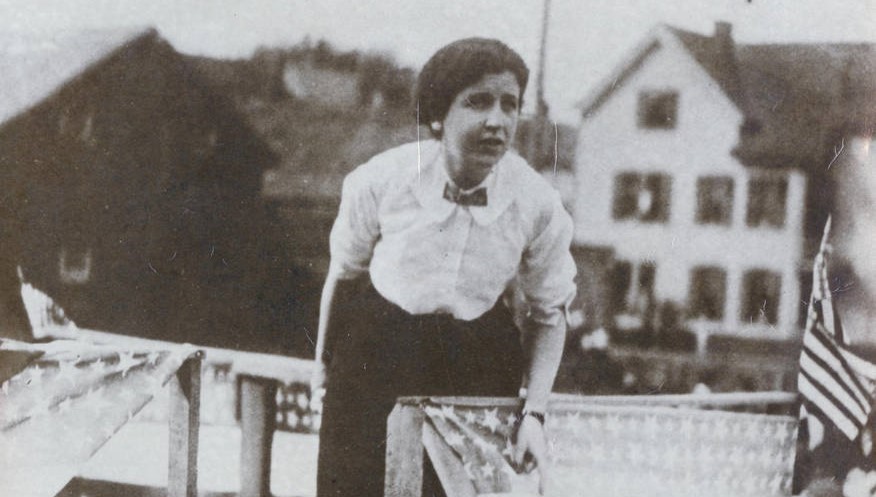
John Mitchell, the labor leader par excellence, with every capitalist paper his press agent, is an active member of the Civic Federation. In 1903, during the coal miners’ strike in Colorado, success was assured through the unity of the Northern and Southern miners; 10,000 unorganized men had answered the call of the union, when John Mitchell hurled “a bolt out of a clear sky”–an order to the Northern union miners to return to work on an offer that held good provided the Southern miners won their strike. Only on the fourth ballot did the men submit and then because support from headquarters was denied their hungry wives and babies. Defeat overwhelmed the Southern Colorado miners following relief of the coal market. Nineteen thousand men and women, after living all winter on the barren hillsides, on an average of 62 cents a week, driven to defeat and despair by a man, who drank their life-blood from capitalist wine glasses and traveled through Europe while they fought their desperate battle! (See “John Mitchell Exposed,” by Robert Randall, 1905 convention United Mine Workers of America.) It is not strange Mr. Mitchell esports a $5,000 diamond, presented by mine owners.
And now he is reported en route for Michigan.
Copper miners of Michigan! Take care lest you go down to the same shameful defeat as your coal miner brothers in Colorado, ten years ago. Do you want success? Rely on yourselves! Do you want failure? Trust your fate to a man whose mind, body and soul belong to your employers: You are fighting for YOUR pay envelope. He is fighting for HIS pay envelope. You are fighting for your crass. He is fighting for THE LABOR LEADER CLASS.
Many labor leaders maintain the attitude that the strike is a weapon) only of last resort Their reason is not difficult to understand. Arbitration and conferences appease the stupid worker and do not cost anything. The treasury remains intact to pay their salaries. A $100 a month walking delegate will scurry around like a rat in a trap to avoid a strike that would rapidly eat up in strike relief a $5,000 treasury, and thus he protects and perpetuates his $100. The rotten and contemptible settlements and iron-clad contracts made in the name of outraged labor bear witness to this deplorable fact.
Similarly, a union man should be suspicious of the labor leader who sneers at “one big union.” One union means unemployed international presidents, vice-presidents, secretaries, walking delegates, and the thought of back to the shop, on with the overalls, no more fancy dinners, fancy drinks, pleasant associations with the masters of the land, harrows theirs souls.
That one big union is the most powerful weapon of the workers in this period of the trustification of industry, does not concern the labor leader.
Ambitious labor leaders use the union as a stepping stone to a fat political job. Lynch, of the Typographical Union, is proposed for N.Y. Commissioner of Labor; Ford, president of the N.J. State Federation of Labor, is government printer; Wilson, the miner, becomes U.S. Commissioner of Labor. Senator Hughes, of New Jersey, arose to power through “friendship” for labor. But once the exalted position is attained, labor–poor, humble, obscure, in factories, mines and streets, is not given further attention. Strikes multiply with their hunger cries, and ever increasing police brutality, jail sentences, suppression of meetings and papers, but the labor leaders of yesterday, the mighty politicians of today, remain silent.
In summing up, the worker may well ask himself, “Who is to blame? What is to be done?” The answer is obvious; the workers alone are responsible. Labor leaders could not lead if there were no sheep-like men to follow. Eternal vigilance is the price of purity in unionism as well as liberty.
A labor union to be effective in the interests of the workers, is one where, paradoxically, the soldiers become the generals and the generals are the soldiers; where all power and orders flow from the mass to and through their representatives; where the membership sits at the throttle and shuts off the power when the engine threatens to jump the track.
He who would be free, himself must strike the blow. When the Giant Labor wakes and shakes off his manacles the labor leader will be hurled, “unhonored and unsung,” into shameful oblivion.
Ring out the clarion call of Industrial Democracy! Bid labor stand erect, self reliant, all powerful, and take the fruits of his sweat and blood into his mighty hands.
The most widely read of I.W.W. newspapers, Solidarity was published by the Industrial Workers of the World from 1909 until 1917. First produced in New Castle, Pennsylvania, and born during the McKees Rocks strike, Solidarity later moved to Cleveland, Ohio until 1917 then spent its last months in Chicago. With a circulation of around 12,000 and a readership many times that, Solidarity was instrumental in defining the Wobbly world-view at the height of their influence in the working class. It was edited over its life by A.M. Stirton, H.A. Goff, Ben H. Williams, Ralph Chaplin who also provided much of the paper’s color, and others. Like nearly all the left press it fell victim to federal repression in 1917.
PDF of full issue: https://www.marxists.org/history/usa/pubs/solidarity-iww/1913/v04n39-w195-oct-04-1913-solidarity.pdf
 Revolution's Newsstand