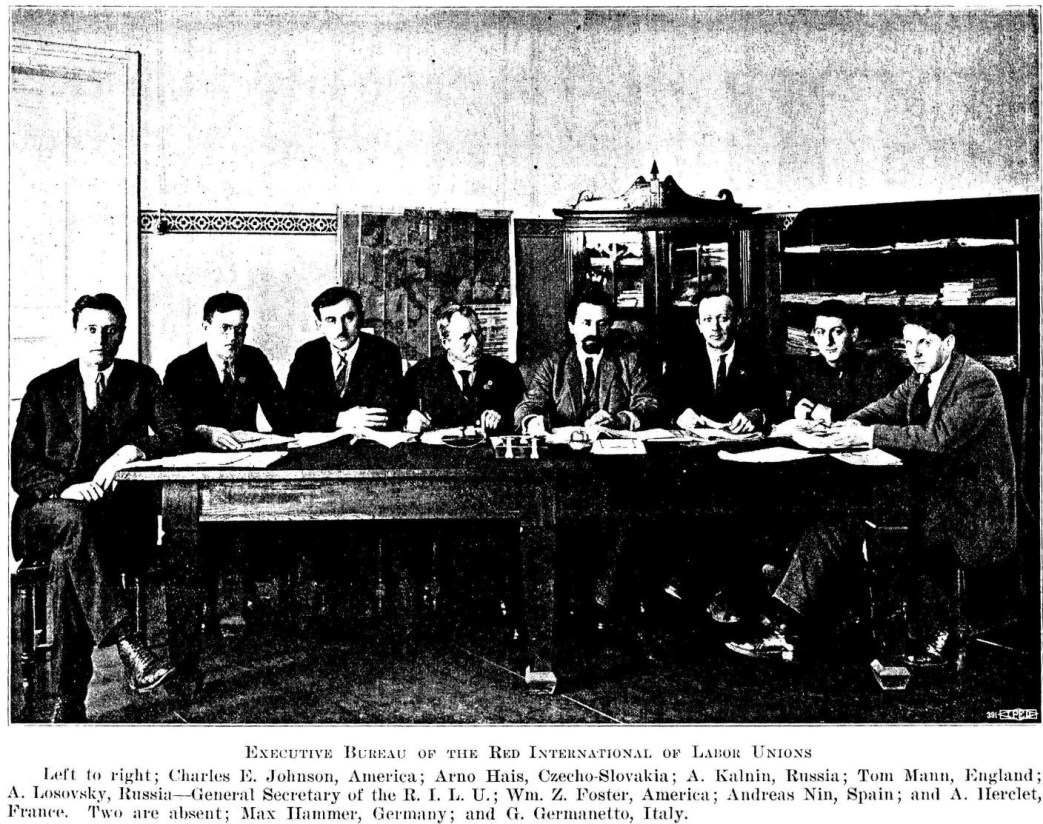
U.S. delegate from the Trade Union Educational League reports on the Fourth World Congress, and final, of the Red International of Labor Unions in 1928.
‘The Red International of Labor Unions’ by Morris Yusem from Labor Unity. Vol. 2 No. 5. June, 1928.
A Real International
TTHE Fourth World Congress of the Red International of Labor Unions opened in Moscow, the capital of the Workers Republic on March 17. While in capitalist countries labor congresses are by no means recognised as important events or given great publicity by the press, or official receptions, in the Soviet Union we found the exact opposite. The workers there consider a R.I.L.U. congress something of the greatest importance and arrange for it as only a working class in power can.
Indeed, as the delegates streamed in from over fifty different countries, one was struck with the fact that it would be hardly possible to hold such a meeting in any capitalist country. There were delegates from China, Italy, Bulgaria, Java and other lands where the labor movement is outlawed, and some of these delegates, coming into any capitalist country, to meet there publicly, would have been sure to have been handed over to their respective hangmen.
The congress hall was one of the finest in Moscow. This structure, with its immense marble columns lining the interior, the numerous giant chandeliers, is typical, on a grander scale of many such structures in the Soviet Union, remaining to remind of the old regime and how it squandered the labor of workers and peasants. The opening of the congress left an impression on the minds of all who were there such as will recall its significance for many years. As you would look down the masses of delegates, you were struck with the fact that here was an international gathering unequaled in the history of the trade union movement. Practically every country was represented. The colonies were there strong. China had about 25 in its delegation; Corea, Egypt, South Africa, the Near East, Australia, Indonesia, were present; in fact hardly a colony was absent. Of course among the victims of imperialism the American continent was not neglected. In addition to the twenty delegates from the U.S.A., there were a total of about forty from Canada, Mexico, Cuba, Central America, and nearly every country of South America. Add to this the three delegates from the Philippines, and we can prove that the R.I.L.U. is the only international that struggles against American imperialism.
There were quite a number of Negro delegates coming from U.S.A., Cuba and from African colonies. European capitalist countries had heavy delegations, and of course the ten million organized workers of Soviet Russia had their leaders there.
The reformist Amsterdam International holds a congress now and then, but none of them to compare with this one. They are never any more able to show representation outside of Europe. Neither does every country of Europe have a section of the Amsterdam organization. Furthermore, delegates coming to an Amsterdam congress are usually of a “respectable” sort, such as have long been out of touch with the class struggle, very much like those coming to one of our A. F. L. conventions.
In contrast to these, we have the delegates of the Fouth R.I.L.U. Congress, actual leaders in the many bitter struggles that have taken place during the past two decades. Many delegates especially such as come from the White Terror ridden countries, have either long prison or death sentences hanging over them. Then there were many that have developed into leadership in situations such as that in the United Mine Workers of America today, in spite of reformist betrayals and scabbery. England has her general strike, and miners’ strike, and Germany her Hamburg dockers’ strike.
A mere summary of the composition of the congress is enough to prove the correctness of the opening words of Losovsky, secretary of the R.I.L.U. who pointed out that in the course of the three and a half years since its third Congress the R.I.L.U. has grown to over 16,000,000 members, while the Amsterdam international has sunk to 13,000,000.; that the R.I.L.U. is a real international, while Amsterdam is, at best, only a semi-European international; that the R.I.L.U. develops out of the actual struggle while decaying Amsterdam is an organ of class peace and in reality is a means of disarming the workers, and that the R.I.L.U. is anti-imperialistic, while Amsterdam completely ignores the organization of the workers in colonial countries.
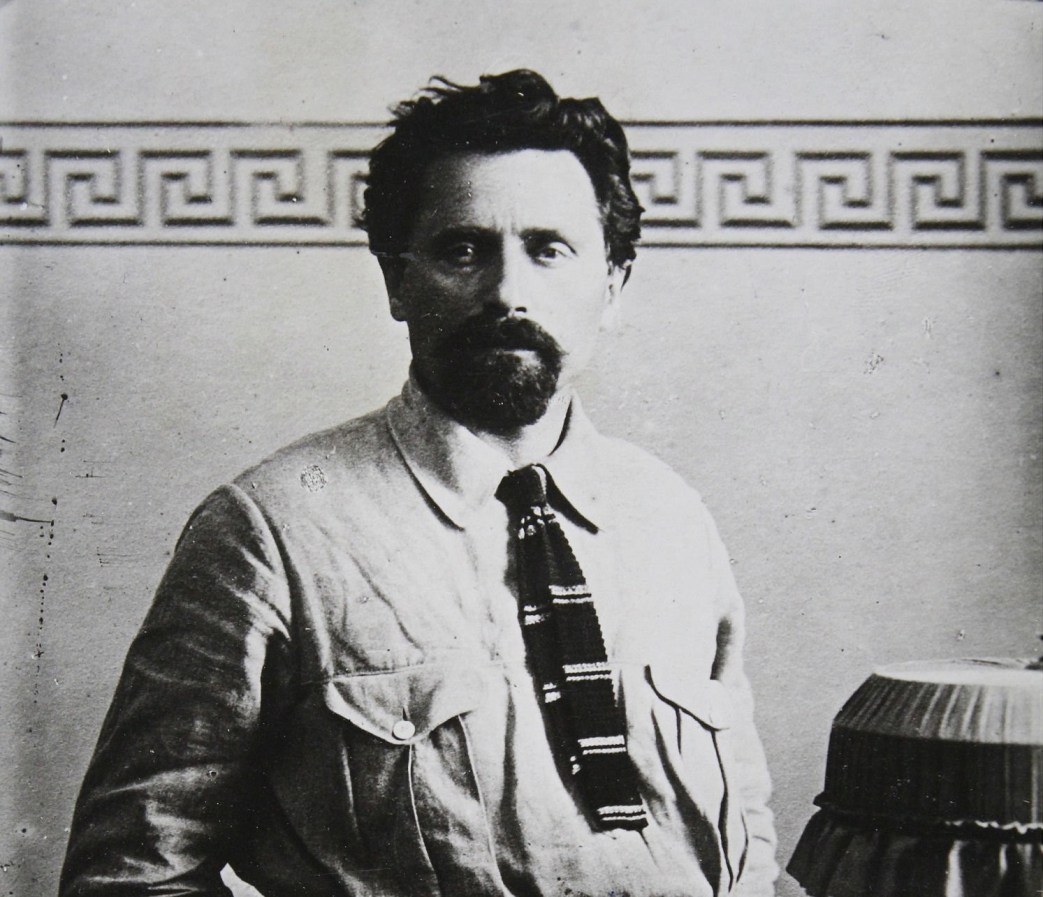
Losovsky’s report on the events of these three and a half years gave a line to the proceedings of the congress. His report alone took almost a day. It was a long summing up of the experiences in the numerous struggles that have taken place, going into details in the important cases in each country, and finally placing before the congress a program of action.
The discussion which went on for about a week was of course, the most interesting part of the congress. The labor movement of every country was represented by one or more speakers, A collection of the speeches delivered during the discussion is the best survey of the world’s trade union movement that we may want, as it is a product of the people best fitted to make such an analysis.
The discussion centered principally around strike strategy, work within the reformist unions, organization of the unorganized, international trade union unity, work in colonies,, against Fascism, and on the conditions of the workers in each country.
One of the points put out very emphatically before the congress was the fact that while the condition of toilers in capitalist countries is getting continually worse, that of the workers in the Union of Socialist Soviet Republics is steadily improving, wages increasing, seven hour day being put into effect, etc. It did not require much speech making to prove this point, however. The chairman of the Moscow Soviet; Tomsky, head of the federation of trade unions in Soviet Russia, and representatives of the government merely invited the delegates to see for themselves. Our delegate credentials served as admission tickets to every factory, factory club, union meeting, public institution, museum, school, etc. that we could find time to attend to between sessions of the congress or after it was over. Many of the delegates made trips to other parts of the country: the Don coal fields, Leningrad, etc.
The work of the congress was not done merely by discussion in full session. At least two weeks was devoted to section and commission meetings in which practically all the delegates were enrolled. The commissions took up about every problem and phase of trade union policy. The R.I.L.U. demonstrated through this that it has a real International leadership for its affiliated organizations. The resolutions and statutes worked out will prove of great value to trade union leaders, organizers, functionaries, in the work among skilled and unskilled, women, youth, Negro and colonial workers. The value of these documents lies particularly in the fact that they are based on the collected experiences of leaders from over 50 countries.
The congress closed after accomplishing a tremendous amount of work. A large executive council representing the labor movements of almost every country was elected, and the delegates scattered to their respective tasks.
To the American left wing the congress was of especial significance. Although a minority movement, everyone felt that we represented a mass of workers, as proven by the recent developments among coal miners, needle workers, textile workers, and others. There was much interest displayed in the problems of the American left wing, the prevailing opinion being that in America we had gone a long way toward the development of a strong opposition movement to the American Federation of Labor bureaucracy. In all meetings American questions occupied a prominent place on the agenda. A resolution specifically applying to America was adopted, outlining to the American labor left wing as a specific and most important task the building up of a powerful mass Trade Union Educational League. The experiences of the left wing in the miners’ strike, the Passaic strike, the needle strikes, etc., was analyzed, and in some cases criticised severely. The emphasis in the future is to be placed on organization (if the unorganized, initiating strikes and leading them, strengthening the T.U.E.L. organizationally, and work among Negroes.
The American delegates learned a great deal at the congress. Particularly have we learned what international affiliation and solidarity means, taking into consideration that the A.F. of L follows a policy of isolating American workers from the rest of the world. The T.U.E.L. is the only trade union movement that connects the American workers to the workers of other countries.
The congress was a great inspiration to our delegation to go back home and work harder than ever to build the left wing and increase its mass support and thereby affiliate greater numbers of American workers to the great and most powerful international, the Red International of Labor Unions.
Labor Unity was the monthly journal of the Trade Union Educational League (TUEL), which sought to radically transform existing unions, and from 1929, the Trade Union Unity League which sought to challenge them with new “red unions.” The Leagues were industrial union organizations of the Communist Party of the United States (CPUSA) and the American affiliate to the Red International of Labor Unions. The TUUL was wound up with the Third Period and the beginning of the Popular Front era in 1935.
PDF of full issue: https://www.marxists.org/history/usa/pubs/labor-unity/v2n05-w24-jun-1928-TUUL-labor-unity.pdf
 Revolution's Newsstand