This report by Varsenika Kasparova, head of the Eastern Department of International Women’s Secretariat of the Comintern.
‘The Women’s Labor Movement in Japan’ by V. Kasparova from International Press Correspondence. Vol. 3 No. 54. August 2, 1923.
Great activity prevails among the women belonging to the Communist Party of Japan. The International Women’s Conference was duly held on March 8. For this purpose a special committee of three was appointed, consisting of the party members Kikue Yamakava, Magara-Salaj, Taij-Takasu, and fifteen candidates, who were entrusted with the task of organizing the International Women’s Week from March 1. to March 8. These comrades resolved to convene public meetings in five large cities: in Tokio, Osaka, Kioto, Kobe, and Nagoja, and forwarded instructions to the party committees in these towns with respect to the organization of the meetings. It was further resolved to make use of the publishing department of the party to translate and publish, on the occasion of the International Women’s Conference, the following leaflets and appeals: “Rosa Luxemburg”, “Klara Zetkin” and “The International Women’s Conference”.
The first public meeting was convened for March 1 in Tokio, in the building of the Christian Youth Union. 10 women comrades were to have given addresses at this meeting. An audience of over 1000 gathered, the proportion of the sexes being six men to four women. As a rule, meetings in which women speak are very noisy, but in this case the audience listened with the most rapt attention. But when Comrade Chatsu-Tanane rose to open the meeting, the members of the Kokussuika (Japanese Fascisti) became exceedingly noisy all over the hall. Upon this the police officer present ordered the meeting to be closed. He further declared that, should the speakers attempt to go to other towns (Osaka, Kioto, Kobe, and Nagoja), for the purpose of delivering speeches at similar meetings, they would be arrested at the first place they visited. In this manner they were robbed of the possibility of carrying out the program arranged, but in every town the comrades had received instructions to distribute the appeals and leaflets in the event of the meetings being stopped.
The women’s department of the party was organized only recently. Several students attending the medical college for women are among the candidates for the party. These intend, after leaving college, to seek positions enabling them to come in close contact with working women, and thus to study the life of these women at its source, and organize and enlighten them in the spirit of communism.
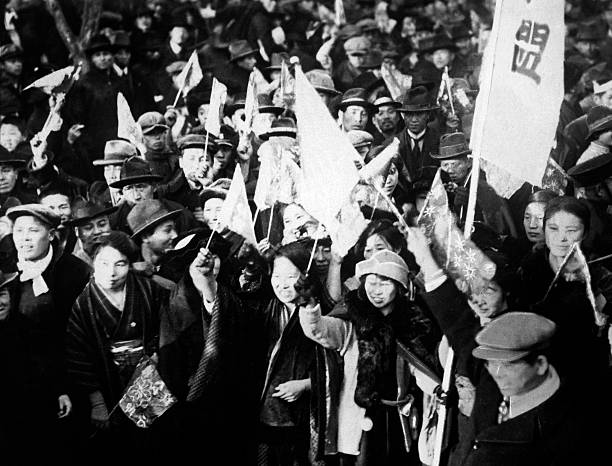
Women’s organizations of a political character in Japan are as follows: Schinsin-Fudschin Kiokaij (New Women’s Association), and the women’s section of the Party of the Kakuschin Club, which has organized a special section under the name of the League for Women’s Suffrage. In February this association took part in a magnificent demonstration in favor of the suffrage, and arranged a public meeting under the same slogan. But the influence of this organization extends only to the petty bourgeoisie, and is limited to the demand for women’s suffrage. Both the above-named organizations do not count more than 100 members each. The attitude to be taken by the women’s section of the Party to this movement is not yet definitely settled.
Women are not yet organized in separate trade unions. The Japanese trade unions do not exclude women from their ranks, but help them. Last year the waitresses in Osaka, about 50 in number, formed a waitresses’ union with the aid of the Juaikai, but this has been dissolved again. At the beginning of March of this year 500 women weavers, employed in a weaving mill at Osaka, declared a strike. The section of the Juaikai at Osaka supported this strike by all available means; it transferred the girls from the quarters belonging to the employer, where they lived, to other dwellings, in order to deprive the employer of the possibility of influencing them. The strike lasted for 10 days, during which time the Juaikai called various public meetings. The strike, however, ended in defeat, and the girls were forced to resume work.
International Press Correspondence, widely known as”Inprecor” was published by the Executive Committee of the Communist International (ECCI) regularly in German and English, occasionally in many other languages, beginning in 1921 and lasting in English until 1938. Inprecor’s role was to supply translated articles to the English-speaking press of the International from the Comintern’s different sections, as well as news and statements from the ECCI. Many ‘Daily Worker’ and ‘Communist’ articles originated in Inprecor, and it also published articles by American comrades for use in other countries. It was published at least weekly, and often thrice weekly. The ECCI also published the magazine ‘Communist International’ edited by Zinoviev and Karl Radek from 1919 until 1926 monthly in German, French, Russian, and English. Unlike, Inprecor, CI contained long-form articles by the leading figures of the International as well as proceedings, statements, and notices of the Comintern. No complete run of Communist International is available in English. Both were largely published outside of Soviet territory, with Communist International printed in London, to facilitate distribution and both were major contributors to the Communist press in the U.S. Communist International and Inprecor are an invaluable English-language source on the history of the Communist International and its sections.
PDF of issue: https://www.marxists.org/history/international/comintern/inprecor/1923/v03n54[32]-aug-02-1923-Inprecor-loc.pdf
 Revolution's Newsstand