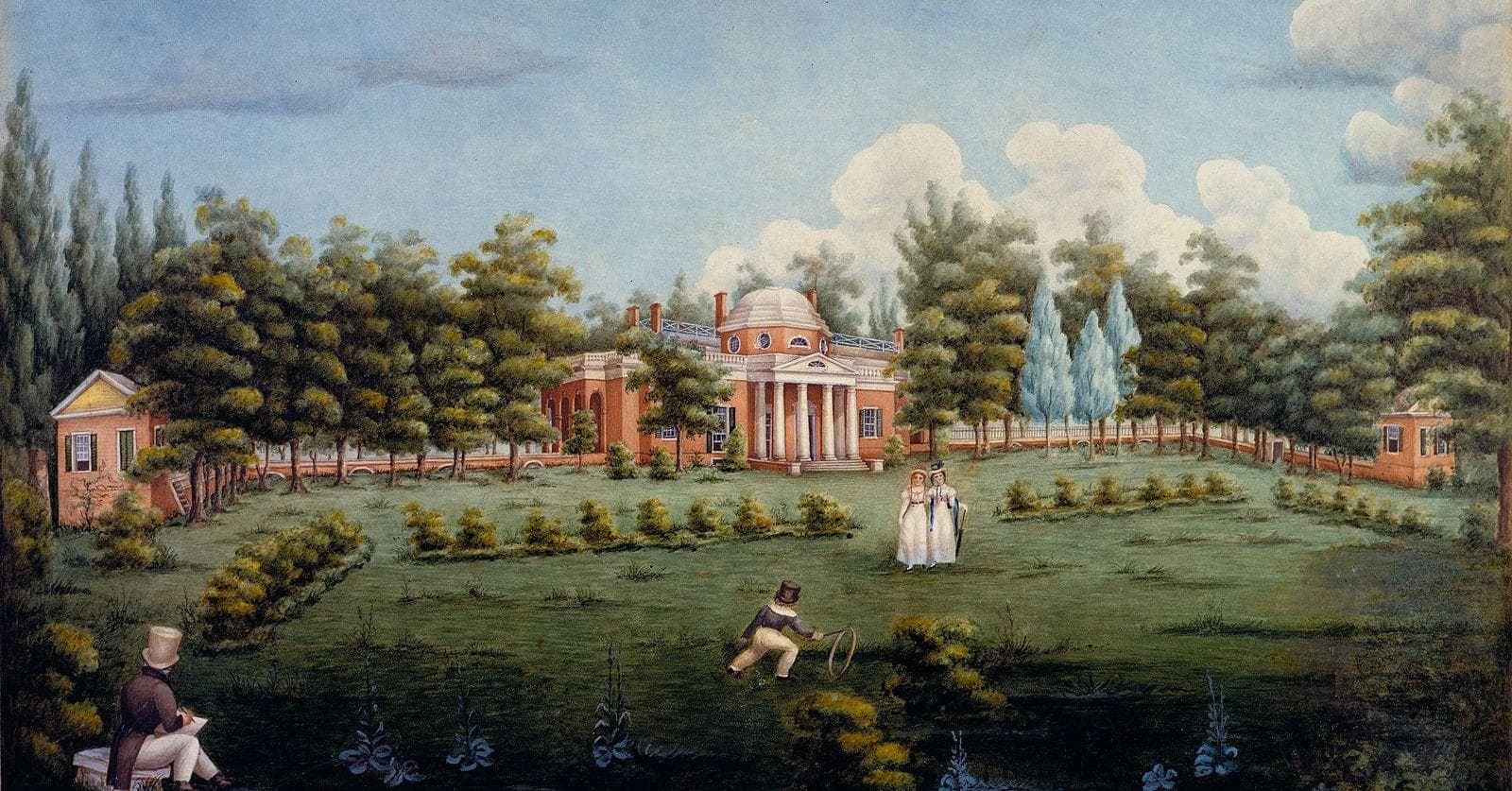
Before the 1930s, the U.S. left largely saw the country’s ‘Founders,’ at best, as rich men who had little to offer the working class of the present day. With the advent of the ‘Popular Front’ the Communist Party recast figures from U.S. history as revolutionary ancestors, with the Communist Party as their legitimate heir. Jefferson, Franklin, Washington, and Madison’s class positions were subsumed into a classless ‘Democracy’ to which the Party would claim to be the foremost defender of. Chris Andrews of the S.W.P. retorts. Not mentioned in the article are Jefferson’s raping of enslaved women or extirpation of Native peoples for their land to be cleared and planted by said enslaved.
‘Thomas Jefferson’s Strange Return to Life’ by Chris Andrews from Socialist Appeal. Vol. 3 Nos. 13 & 14. March 7 & 10, 1939.
The Stalinists Do Violence To The Whole History Of Early America In Order To Present Jefferson As One Of The Patrons Of “Twentieth Century Americanism”
When in 1935 Moscow gave orders to its Communist Parties to make friends with the bourgeoisie, the interpretation of American history entered into a new period of agony. Stalinist speakers, glowing with their new and self-bestowed titles of 20th Century Americans, began to make halting but determined references to Patrick Henry, Paul Revere, and Daniel Boone. Meanwhile the party hacks burrowed into the volumes of the liberal historians–to return rejoicing with the unhappy shade of Thomas Jefferson, Sage of Monticello.
This historical burlesque evoked anger mixed with wonder from the observers, and resentment in many quarters, most recently and most curiously from the stern ranks of the I.W.W., where Covami has declared, “The I.W.W….is the ONLY organization in the United States upholding democracy as defined by Thomas Jefferson.” His querulous protest, of course, was futile and is drowned out; Thomas Jefferson is claimed by Browder and all his zealots. Their clamor does not abate, but only grows wilder.
Now who was Jefferson and what was his “democracy”? What did it mean to the workers of his time? What could it mean today? To Stalin? or to Browder?
A Little Bit of History
The American Revolution was waged between the ruling class of England, and the ruling class of the 13 colonies-merchants, bankers, shippers, planters. resourceful and intelligent men who dominated economic, political, and social life, their victory got them most definite material gains–commercial freedom, the right to develop industry at ‘home,’ the cancellation of the planters’ debts to English creditors, the right to expand to the West–in other words, the power to exploit the untapped resources of a virgin continent and its corresponding right under capitalism, the right to exploit the labor of the workers and farmers who lived and were to live in the new nation.
A most handsome prize–and not to be confused with the Rights of Man or the Pursuit of Happiness except as those phrases applied first and foremost to the above–mentioned bankers, merchants, shippers, and planters.
Masses Must Be Rallied
It is a commonplace of Marxism that human beings erect above the economic basis of their society–which is the final and determining source of their conduct with one another a superstructure of religion, law, politics, and so on. In the decades of preparation for the break with England, the colonial bourgeoisie had written and argued eloquently and well; they had a remarkable group of leaders. Not only did they have to organize themselves for the dangerous task in hand–they were staking their heads–but it was necessary to rally behind the masses. They were needed to face the British Grenadiers.
Even the bourgeois historians will admit that in the Colonial period a class society existed here. To win these poverty-stricken workers and farmers, indentured servants, debt-ridden men and women pushed off the best lands to eke out a living in the back country, kept by poll taxes, religious qualifications, property requirements from any political activity (the record of their misery can be found in the books; it is far enough back in our his- tory so that liberal and conservative alike can be honest about it)-much eloquence and many fine pledges were needed to call them to battle for their local exploiters against their foreign.
Workers Begin to Revolt
The colonial bourgeoisie were not unskilled in this task. In the war propaganda of the day, Thomas Jefferson, who had a genius for resounding phrases, played a well-known part. Among other things, he wrote the Declaration of Independence; its moving and haunting promises have been interpreted differently by the various classes and interests of our society ever since.
In the course of the revolutionary war the embattled masses showed traits most alarming to the businessmen and property-holders who had called them to revolt. After the fashion of agrarians with arms in hand, they burned mortgages, destroyed deeds, confiscated the estates of the Tories and divided them, and issued paper money with the intent of wiping out their status as debtors. In the cities, the workers that had previously fought British Customs Officers and soldiers showed equal lack of respect for wealth and property. After the Peace and before the Constitution–1783 to 1789–they continued revealing a capacity for violence, a contempt for rights of wealthy creditors and speculators, their lawyers, and their courts. The bourgeoisie observed and drew the indicated conclusions, in the same manner that the property-owner has always faced the problem of enforcing respect for his property right from the days of Rome and Greece to those land-holders and financiers who backed General Franco.
Minority Engineered Constitution
The capable American bourgeoisie accomplished its task without war. There was no city proletariat ready to oppose it. The restless and bitter agrarians were confused and divided among themselves. Quite illegally, having gathered together their best leaders in a closed conference ostensibly to discuss a minor navigation problem, the bourgeoisie, including most of the great names of the Revolutionary leaders, drew up a Constitution consolidating their power, presented it to the nation, and forced through its acceptance. Of a population of some 4,000,000 it is estimated that about 120,000 were allowed to vote on the question.
As Charles Beard has ably shown, the Framers were bankers, shippers, merchants, and planters, men who had financial gains to make from the Constitution they created. Small farmers and workers there were none. The Marxist, of course, draws certain grim conclusions from these revealing facts-conclusions about the class character of the government which has been developed through the years, having as its basis a Constitution created in such a manner. And that Marxian analysis was once understood by many of the present Stalinist hacks. The hard facts of History have not changed–but the Party Line has, and has produced those monstrous distortions of History which now litter the dreary pages of the Daily Worker, and the dulled minds of our Twentieth Century American Morons.
Role of Jeffersonian Democrats
This Constitution, conceived in the class interest of the bourgeoisie, was written and supported by most of the men who were later leaders of the Jeffersonian Democracy. Jefferson himself from France wrote to inquirers, “I approved from the first moment, of the great mass of what is in the new Constitution.” Taking a position of independence from politics, he avowed, “I am not of the party of Federalists,” but hastened to add, “But I am much further from that of the anti-Federalists.”
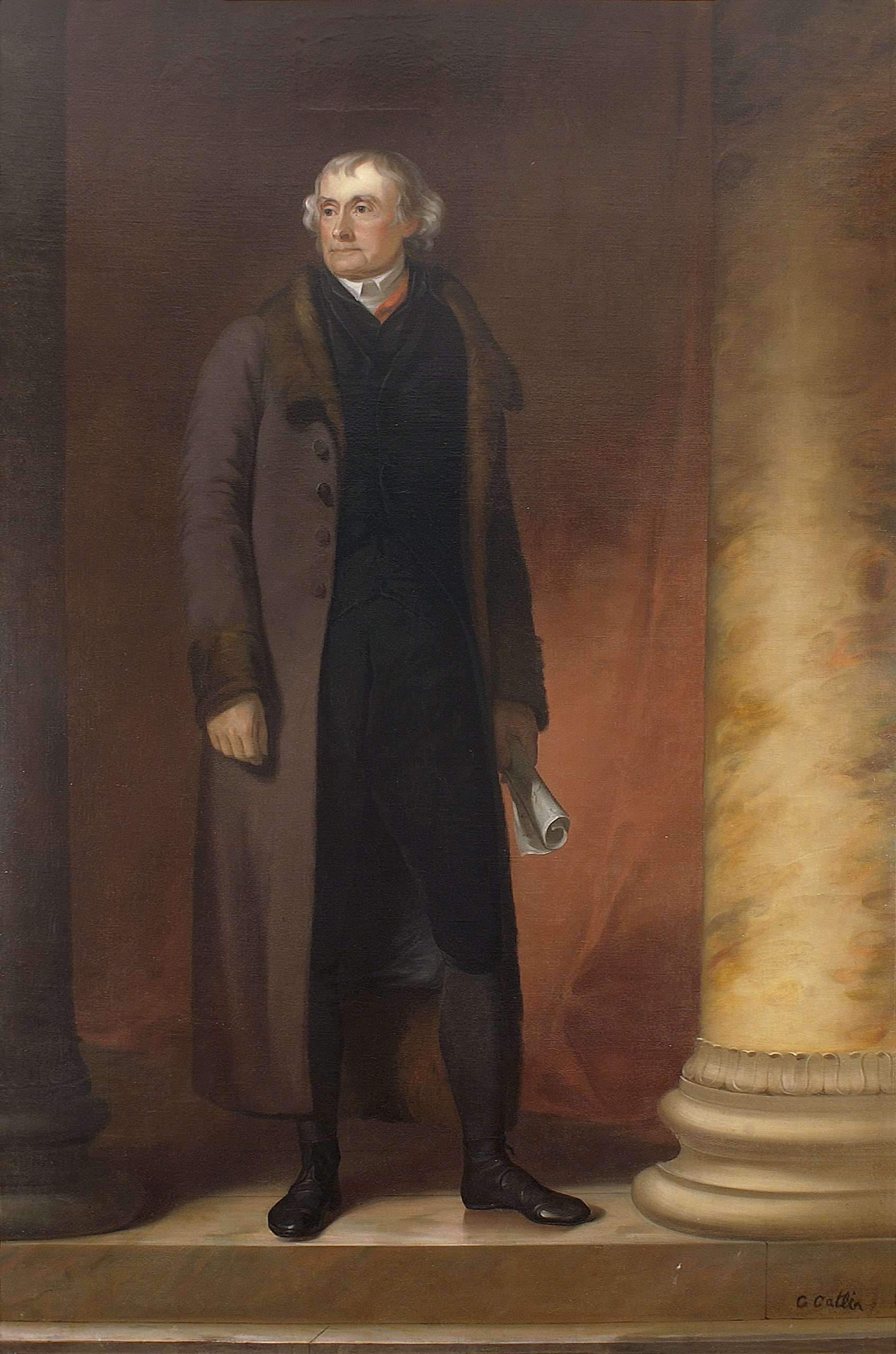
Madison, great friend and ally of Jefferson, and the man Jefferson chose to succeed him in the Presidency, played a leading role in the work of the new Constitution, helping to put shackles on that purer form of democracy which existed during the Articles of Confederation. The new Constitution was most skillfully prepared so as to provide unbreakable obstacles to majority rule; it continues to do its job successfully today.
Bourgeoisie Quarrels
After having united to consolidate their power for the defense of their property and privileged position, the bourgeoisie quarreled among themselves for precedence. Hamilton, leader of the merchant, banker, commercial groups, fought to lay down economic policies for the new nation which would aid the growth of industry and commerce. The planters, aware that the dominance of these groups would be costly to them, aligned themselves in opposition. With them stood Jefferson, Madison, and the other great names of the agricultural regions.
Once again the politicians matched phrases and promises in the fight for the support of the masses. While certain sections of the city workers sided with the Federalists, the agrarians rallied behind Jefferson and carried him to the Presidency in 1800. They supported his attacks upon the banking interests, his concept of a nation of small, independent farmers, his opposition to centralization in government, and his eloquent speeches regarding the rights of the common man.
Practice Different from Theory
Eight years of Jefferson’s administration showed that he was unable to carry out his theories of administration. Strict constructionist, he had to arbitrarily assume broad powers in his purchase of Louisiana. Foe of Hamilton’s financial group and policies, he was forced to play politics with the bankers, and ultimately his followers even had to restore the privately-owned Bank of the United States to its controlling position. Meanwhile the workers continued to suffer under laws restricting and crippling their political liberties, and especially so in those Southern states which were the strongholds of the Jeffersonian “Democracy.” Inconsistent in promise and practice like all capitalist politicians who depend on the masses for support, Jefferson decided, “What is practicable must often control what is pure theory.” His ideal of a static society of small land-holders was simply impossible, given the material resources of the new United States, and the economic forces at work in the world. In spite of Jefferson’s cloudy ideals and incoherent humanitarianism, any realistic historian must see that Hamilton, not Jefferson, was the real progressive of his day. Hamilton’s genius, his superior foresight, laid down policies which laid the foundation of a rapid increase in the productive power of the society they guided. Jefferson’s gaze was averted from the future; it was Jefferson who advised the new nation, “Let our workshops remain in Europe.”
Stalinism has long ago abandoned that axiom of Marxism, “Tell the workers the truth.” In their indecent lust to become “respectable,” the Stalinist lickspittles and toadies have made a ridiculous cult of certain political figures from the history of the American bourgeoisie. They bandy about the names of Paine, Anddrew Jackson, and others with a feverish devotion bordering on lunacy, going so far as to have Earl Browder declaim, “Our program for Socialism is organically linked up with, is a necessary outgrowth from the traditional American Democracy as founded by Thomas Jefferson–whose political descendants we are.” This slippery Stalinist hedges and qualifies enough to admit that the economic basis of an agricultural nation of small land holders has completely disappeared, but that nevertheless, by being loyal to Jefferson’s humanitarianism, we have thereby a complete amalgamation of Jefferson’s teachings with those of Marx, Engels, Lenin, and Stalin. We have the full pro- gram of the Communist Party.”
Misunderstands Industrial Revolution
This historical “lesson” thus dissolves itself into a meaningless and nonsensical generalization. Jefferson’s many utterances on freedom, liberty, and so on, can be used and have been used by any demagogue to back up any program. Every capitalist politician makes similar remarks; what he does in practice with power when he has it is the important test. The stultifying effect this faked and murky “history” has upon the young students and intellectuals associated with or under the influence of the C.P. is disagreeably evident to all who know them. This is the famous “education” the Stalinists were going to bring to their “allies” of the Popular Front!
In an effort to bolster up their phoney “ancestor,” the Stalinists tell us that Jefferson’s aspirations were wrecked by the Industrial Revolution, “which he could not foresee.” This is absolutely false. The Industrial Revolution dates from the middle of the 18th Century, was producing its effect all around Jefferson all throughout his life, and was understood by many observers–Hamilton, for one. Had not Jefferson been blinded by his class interest as an agrarian, he would not have so completely misunderstood the importance of the machine and the new mode of production, for as a man constantly in public life, traveller, observer of the French Revolution, President of the United States from 1800 to 1808, he was in the most favorable position to study these forces which were to shape the future.
Naive Agrarianist
Jefferson had a most naive outlook on the agrarian life. “Cultivators of the earth,” he cried, “are the most valuable citizens,” and “Those who labor in the earth, are the Chosen people of God, if ever he had a chosen people, whose breasts He has made his peculiar deposit for substantial and genuine virtue.” A slave-holder, a large landholder, Jefferson could easily forget that farm life meant back-breaking labor from day to night for all but a few, and thought of it in terms of the leisure and culture which he could enjoy, browsing in the classics of Greek and Roman literature. It was not given to this Virginian gentleman to understand what Marx so bitterly called, “the idiocy of rural life.”
The Marxist understands the cities as the focal points of industry and progress, from whose suffering working population have and will come revolutionary leadership for all the exploited. Jefferson bewailed, “When we get piled upon one another in large cities as in Europe, we shall become corrupt as in Europe, and go to eating one another as they do there.”
On European Events
In Jefferson’s own day, the workers of Paris gathered on the Champs de Mars, to demand from the victorious bourgeoisie–in the name of those fine ideals the bourgeoisie claimed full, manhood suffrage. They were ruthlessly dispersed by armed troops under Lafayette.
The unrest of workers in England and France, the birth struggles of this new class could mean nothing to Jefferson who believed, “The mobs of the great cities add just so much to the support of pure government, as sores do to the strength of the human body.” The proportion of the working class of a country to its farmers, he described as the proportion “of its unsound to its healthy parts.” The unorganized, desperate revolts of the laborers seemed to him like anarchy, and senseless violence; “I consider the class of artificers (city workers of the period) as the panders of vice, and the instruments by which the liberties of a country are generally overturned.”
Jefferson died, still blind to the great historic forces gathering strength in the cities of industrial Europe. Only 22 years after his death, the whole continent was shaking with the Revolutions of 1848, and the young Karl Marx with eyes fixed to the future was writing for the workers he honored and loved, the “Communist Manifesto.” Yet it is the name of Jefferson, idealist who never comprehended the historical role of the machine, and who, like any bourgeois, mistrusted and feared the workers–it is this name that the Stalinist, Browder, would write beside those of Marx and Engels.
No, Thomas Jefferson, a capable and eloquent leader in the revolt of the American bourgeoisie, remains just that and nothing more. He is not the ancestor of revolutionary Marxism-not even of de- generate Stalinism. If he has political descendants today, it is in the ranks of the Southern Agrarians, dilettante reactionaries who seek to crawl backward into history in fright before the mighty problems posed by the collapse of modern capitalism. Their program proves their legitimacy pressed by Herbert Agar, it sees our crisis as primarily a “moral” one–“a selfish and greedy people cannot be free.” Let Mr. Browder return Jefferson to Agar, Allan Tate, etc., if he belongs to anyone, he belongs to them.
Expect Lies to Pass
Why does Stalinism seek to wrap itself in these musty but patriotic robes? Betraying the true interests of workers everywhere, it intends to deliver into the armies of American imperialism its befuddled and deceived followers and sympathizers. Sweating with the anxiety that they will not be recognized and accepted as allies by the powerful American capitalists, the C. P. abandons internationalism for patriotic slogans, and clothes itself in whatever Stalin and Browder think will please the new-found masters. Thomas Jefferson and his “democracy,” his empty but eloquent catch-phrases, have been greedily seized, for Browder’s contempt for his own following is such that he expects the most stupid lies to pass unnoticed.
Nothing, however, will save the Communist Party from the coming split in its own ranks, the results of the anger and awakening of its long suffering rank and file. In so far as American history becomes clear to them, the Stalinist nonsense about Jefferson will add its bit to the final crack-up.
There have been a number of periodicals named Socialist Appeal in our history, this Socialist Appeal was edited in New York City by the “Left Wing Branches of the Socialist Party”. After the Workers Party (International Left Opposition) entered the Socialist Party in 1936, the Trotskyists did not have an independent publication. However, Albert Goldman began publishing a monthly Socialist Appeal in Chicago in February 1935 before the bulk of Trotskyist entered the SP. When there, they began publishing Socialist Appeal in August 1937 as the weekly paper of the “Left Wing Branches of the Socialist Party” but in reality edited by Cannon and other leaders. Goldman’s Chicago Socialist Appeal would fold into the New York paper and this Socialist Appeal would replace New Militant as the main voice of Fourth Internationalist in the US. After the expulsion of the Trotskyists from the the Socialist Party, Socialist Appeal became the weekly organ of the newly constituted Socialist Workers Party in early 1938. Edited by James Cannon and Max Shachtman, Felix Morrow, and Albert Goldman. In 1941 Socialist Appeal became The Militant again.
PDF of full issue 1: https://www.marxists.org/history/etol/newspape/themilitant/socialist-appeal-1939/v3n13-mar-07-1939.pdf
PDF of full issue 2: https://www.marxists.org/history/etol/newspape/themilitant/socialist-appeal-1939/v3n14-mar-10-1939.pdf
 Revolution's Newsstand