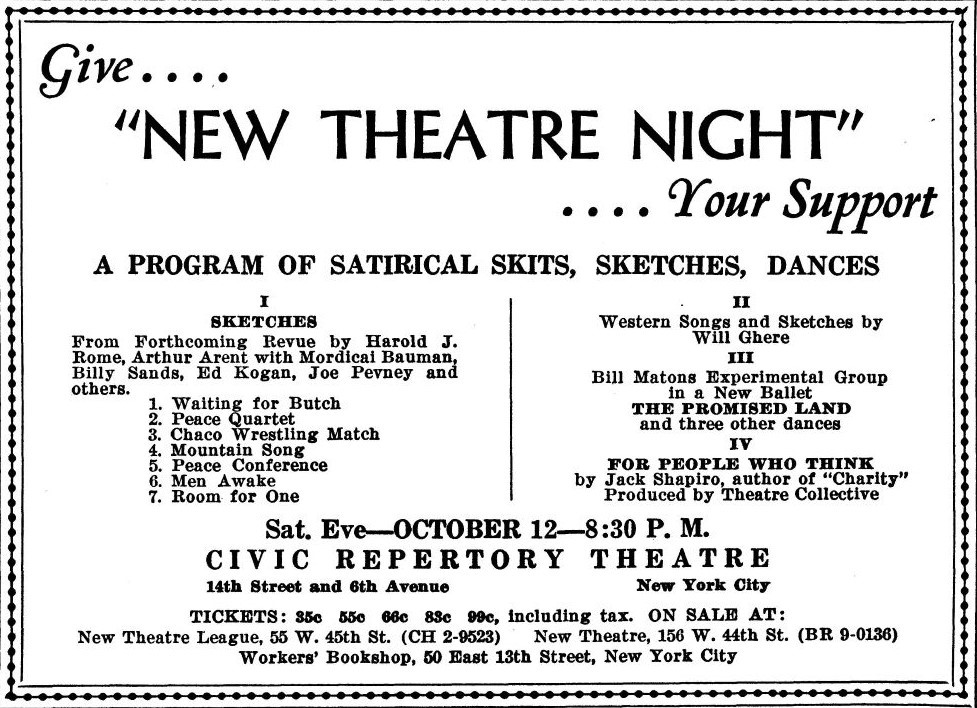
New York City has a rich radical theater tradition. Here, Stanley Burnshaw looks at the first of the “New Theatre” magazine-hosted regular reviews in October, 1935.
“New Theatre Night” by Stanley Burnshaw from New Masses. 17 No. 4. October 22, 1935.
WHEN a future historian writes up the 1935-1936 theater season he will surely describe the night of October 12 when New Theater magazine gave the first of its series of “Nights.” He will tell how ebullient hordes nearly pushed through the walls of the Civic Repertory Theater in their frenzy to assist at the proceedings. And if he loves truth he will report the program itself as the most curious hodge-podge of excellent entertainment and sheer exasperation in the annals of the decade.
To Harold J. Rome and Arthur Arent must go the credit for a handful of delicious ideas, executed often with competence and always with enthusiasm. Rome has Gilbert-and-Sullivanized a college Graduation Day in a sketch of bright rimes and pitter-patter music. Arent takes the audience behind the scenes of a Peace Conference for an amusing few minutes of imperialist contradictions. The sketch is somewhat lacking in surprises by being on the whole too pat, but Rome and Arent fuse their talents in what this reviewer takes to be the first political torch-song, Room for One, in which a young Italian mother tearfully, and subjectively, complains of Mussolini’s child-bearing derbies. If some people found the rimes much too spicily seasoned, the thunderous applause of the house was hardly a plea for blandness. Remembering the Theater Guild’s late “revolutionary revue” Parade, it was pleasant to think of how much Rome and Arent could have contributed. Certainly these two writers must collaborate in the next left-wing variety show.
An excellent contribution to the program was made by Will Ghere, the director of the Hollywood social theater, whose experience in the hands of Hollywood Nazis we reported in May in connection with ‘Till The Day I Die. Ghere gave a piercing performance in Snickering Horses by Emjo Basshe. It is hard to think of a sharper piece of anti-war dramatic writing in the left-wing repertoire, or of one more difficult to produce. It seems to us that the New Theater League could do nothing better at this moment than to broadcast this play (perhaps in adapted form) to its hundreds of member groups for immediate performance all over the country.
And the same suggestion may be made about For People Who Think, Jack Shapiro’s one-act play, produced first by the Theater Collective a fortnight ago. Set in the art department of a powerful gutter newspaper, it demonstrates far more about the Hearstian anti-Soviet campaign than a dozen pages of invective. It is still much too long and the actors haven’t nearly struck their pace, but it is too useful to be limited to one group of actors; it belongs to all of the new theaters.
If it can be said that the songs and sketches were toothsome entertainment it can also be said that the dances were colossal bores. Lynch (John Scott and his group) was as pat and tiresome a composition as we have seen in years; and as for the numerous items by Bill Matons and his group, we throw up our hands in amazement. This reviewer kept his eyes strictly on the stage but for the life of him he cannot say how many compositions were given or what they were about. According to the program one of the numbers was Promised Land but if it referred to the gyrating couples then the ideology was far more Arabian than Marxian. As for the other episodes that bore some kind of kinship it must be that the choreographer had decided to dance the Communist Manifesto–and to give it as chaotic a representation as he knew how.
In justice it should be stated that New Theater Night producers work under great financial handicaps which make it impossible to rehearse numbers in advance. But New Theater magazine has a deep responsibility to its audience as patient, responsive and loyal a following as exists anywhere. They are surely entitled to far better management both in the box office and in the production. If the New Dance League had been asked to pass on the proposed dance numbers the program might have been shorter but it certainly would have been saved from three minor calamities. And if the New Theater League had acted in a similar capacity it would have thrown out the rather pointless John One Hundred and polished up the production in the many places where it was badly needed.
New Theater Nights are important events. In the past they have brought forth some of the finest things in the entire left-wing theater, among them Waiting for Lefty. They have a high record and they must maintain it with all the vigor, strength and art of the brilliant movement of which they are a guide.
The New Masses was the continuation of Workers Monthly which began publishing in 1924 as a merger of the ‘Liberator’, the Trade Union Educational League magazine ‘Labor Herald’, and Friends of Soviet Russia’s monthly ‘Soviet Russia Pictorial’ as an explicitly Communist Party publication, but drawing in a wide range of contributors and sympathizers. In 1927 Workers Monthly ceased and The New Masses began. A major left cultural magazine of the late 1920s and early 1940s, the early editors of The New Masses included Hugo Gellert, John F. Sloan, Max Eastman, Mike Gold, and Joseph Freeman. Writers included William Carlos Williams, Theodore Dreiser, John Dos Passos, Upton Sinclair, Richard Wright, Ralph Ellison, Dorothy Parker, Dorothy Day, John Breecher, Langston Hughes, Eugene O’Neill, Rex Stout and Ernest Hemingway. Artists included Hugo Gellert, Stuart Davis, Boardman Robinson, Wanda Gag, William Gropper and Otto Soglow. Over time, the New Masses became narrower politically and the articles more commentary than comment. However, particularly in it first years, New Masses was the epitome of the era’s finest revolutionary cultural and artistic traditions.
PDF of full issue: https://www.marxists.org/history/usa/pubs/new-masses/1935/v17n04-oct-22-1935-NM.pdf
 Revolution's Newsstand