
Fellow-worker Bernard McCaffrey answers the question at hand by introducing the reader to every worker in the world, and the concept of social labor, in this wonderful appeal for One Big Union of all the world’s true producers.
‘Who Made My Shoes?’ by Bernard McCaffrey from Industrial Union Bulletin. Vol. 1 No. 9. April 27, 1907.
The answer to the above question will not only tell us what an Industrial Union is, but it will inform us as to what portion of the labor which. enters into their composition is drawn from the A.F. of L. and what is true in the making of shoes holds good in the manufacture of any article offered for sale.
If we enter the world’s markets–and, mind you, the world’s market embraces every nook and corner where things are bought and sold; if we enter this great market we will see it stored to the ceiling with the products of human hands, from hats to hairpins. The thing that strikes one with the force of a pile-driver is the fact that living labor, instead of giving, receives its name from dead labor. One man is named after his hod, another from the bricks he lays, others from the switch they turn, freight they handle or mineral they mine; from this it is taken for granted that the labor which forms the article into the thing it is and from which it receives its name, made the object itself.
Suppose I would ask you to introduce me to the individual that made my shoes, you would soon learn that the shoemaker was a complicated sort of a chisler comprising scores of men, women and children. Aye! more; you would discover that your task had just begun when you left the shoe factory’s door and that it would end when every human being producing for the world’s market had received my introduction. Let us go more into detail and trace the production of my pair of shoes and find out how many kinds of labor they contain.
The first thing required in the making of shoes is the building of a suitable factory. A factory consists of stone, brick, wood, iron, etc.; these materials do not grow upon the vine nor, like the manna, do they fall from the sky. They must be delved from the earth and hewed from the forest. To get these materials into form, we must call into service the entire host of miners in the coal fields and iron regions, as well as the lead, zinc, copper, gold and silver mines; we must enlist the hosts of slaves who getting five cents per ton for loading iron ore on the shores of Lake Superior to those being devoured in the furnaces of the U.S. Steel Trust. We must vitalize the men who make the steel girders, the tool and the machine; the men who bake the coke are as essential to the success of the scheme as are those who bring the raw material to the surface. They who coin the gold and silver contribute as much to the completion of the enterprise as does any other branch of social labor. The lumber jacks of Oregon, Washington and Michigan, who carve the timber into logs in conjunction with others who send the logs through the different processes from which they reappear as doors and window sashes or paper, all alike are contributing their share towards the good work. He who digs and hauls the sand is of as much importance to the lighting of the building as is the glass blower who forms the pane of glass. The brickmaker who transforms the clay into brick, the quarryman who blasts the rock, the workers that make the lime used to lay the stone, brick and plaster, one and all are part and parcel of the army of construction.
We now have the material for the factory, but these materials at the places they beheld the light of day are useless unless we can get them on the plot of ground selected for the structure. To get the raw material upon the ground we must go to the agricultural laborer who raises the cow and the horse; to the packing-house boys who remove the pelt from the cow; to the tanners that make it into leather; to the harness maker who produces the harness, and the wagon maker that builds the wagon; the horeshoer that shoes the horses, and last but not least, we must go to the teamster who hitches up and drives the outfit. Yea! we must draft every human being who hauls or transports goods on the land or upon the water. These, backed by the vast millions supplying their food, clothes. and shelter, etc., are required to deliver the raw material to the place. selected for the factory, and yet the building is not erected. To complete the job the labor of him who wields the “No. 2” is as useful as is the labor of the architect who drew the plans of the factory at the start. Every form of labor in the building industry must be brought into action. This done, and our shoe factory is completed.
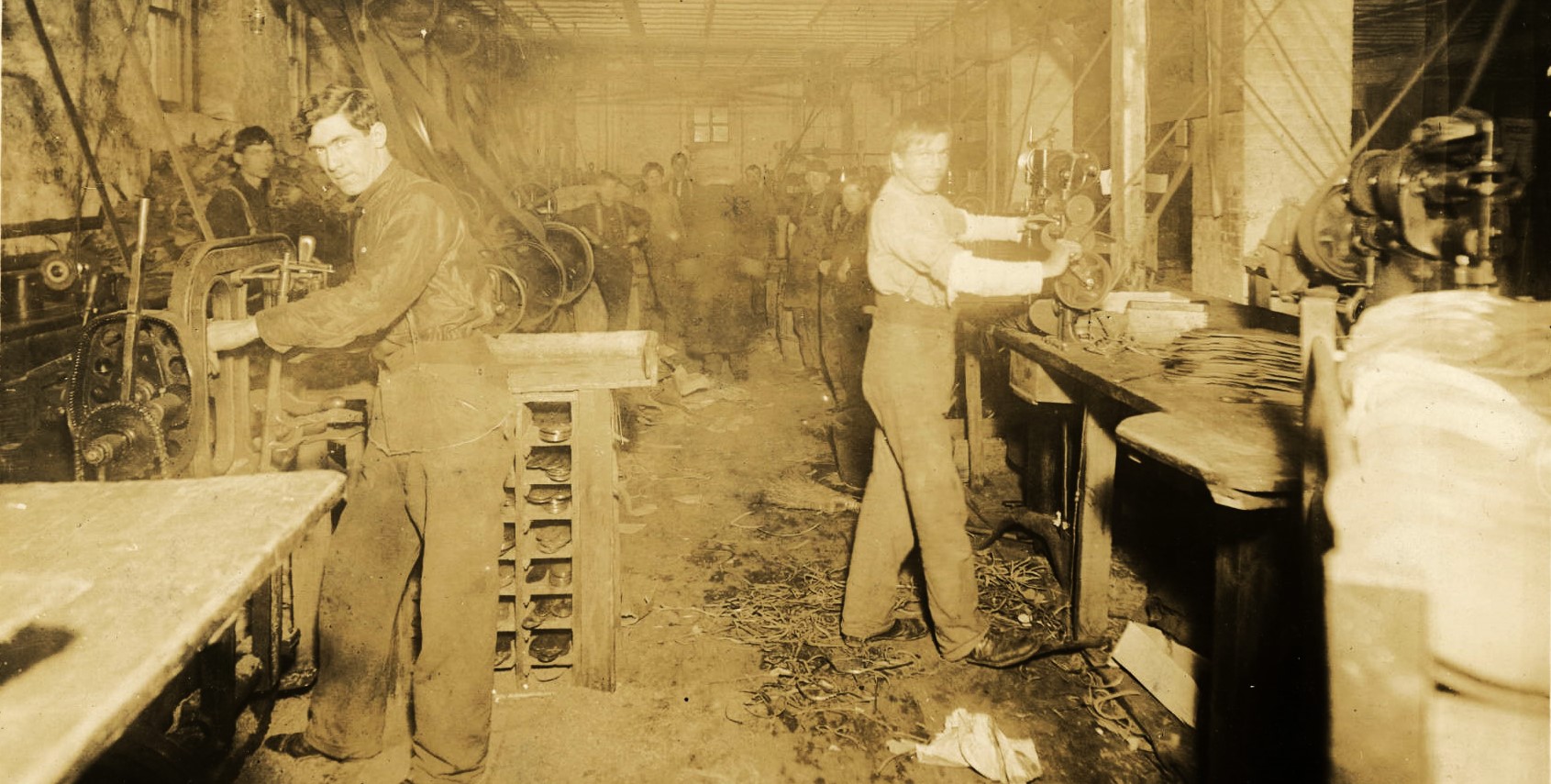
Sheep do not shear themselves, neither do shoe factories make shoes. It requires human beings, developed into social things, called shoemakers, to do this work; but shoemakers are not the product of nature; they are made by society. In the process of turning out shoemakers the teaching factory is as necessary as is the clothing and sausage mills. Shoemaking is the art of transforming leather into shoes. Men must be taught this skill; they must be fed, clothed and sheltered while learning the trade; thus the labor power of the shoe-maker, like any other commodity, is a social product.
We are now ready to make shoes, are we not? No; something else is required before we can start the mills to grinding. Shoes are not produced until they are handled by the clerk in the retail store over the counter to the consumer. Where consumption begins, production is finished. Shoes in the hands of the shoe manufacturer are of no use; I doubt if there is a single manufacturer of shoes who has ever been guilty of wearing a factory shoe. Shoe manufacturers make shoes for sale. To get these shoes to the market requires the services of millions of people in the wholesale, retail and advertising departments of this commodity-producing system.
Once more I ask you, “Who made my shoes?” My shoes were made not by one shoemaker, nor one thousand shoemakers; my shoes contain a portion of the life of every man, woman and child that are daily being ground up piecemeal in the profit mills of capitalist society. The price of my shoes is the money name given to designate the quantity-not of concrete labor called the shoemaking, but the labor of social man. If it were possible to discover the different amounts of the multiform kinds of labor that enters into a pair of shoes, we would be surprised at the small contribution given by the shoemaker. If my shoes could use their tongues to make known to us their origin, the wage system would stand condemned before the world as a slave-pen.
My shoes may have been made by union shoemakers; the shoemakers may have been a union man, but the leather might have been tanned by non-union workers and the nails that pegs the soles may have come from the same source. All of these trades may have been organized, while the miners who mined the coal that furnished power to the factory or those who handled and transported the raw material to the factory or the finished product to the market, might be unorganized. We are told that there are more than twenty million wage-slaves in this country; we are also told that the A.F. of L. has two million of these in its clutches. Admitting that these statements are correct and that the A.F. of L. is a labor union, we have ten men out of every one hundred organized in this nation. This means that my shoes contain only 10 per cent of union labor, the rest, or 90 per cent is non-union; therefore the union labor that enters into the composition of any article on the market today can easily be covered by the scab label. There is no such a thing as a union-made piece of goods on the market, not even the labor-power of the slaves, which is developed upon grape nuts, postum and other scabbery material.
In conclusion I desire to affirm that an organization based upon the fact that labor produces all wealth, consequently should receive all that it produces, based upon the fact that no trade nor craft by itself produces anything; that every article in the world’s market is made by social labor, and a thing to be a union piece of goods must bear the stamp of a union that embraces beneath its folds every wage slave of every industry in capitalist society, an organization of this kind alone is an Industrial Union, The I.W.W. is destined to fulfill this historic mission.
The Industrial Union Bulletin, and the Industrial Worker were newspapers published by the Industrial Workers of the World (IWW) from 1907 until 1913. First printed in Joliet, Illinois, IUB incorporated The Voice of Labor, the newspaper of the American Labor Union which had joined the IWW, and another IWW affiliate, International Metal Worker.The Trautmann-DeLeon faction issued its weekly from March 1907. Soon after, De Leon would be expelled and Trautmann would continue IUB until March 1909. It was edited by A. S. Edwards. 1909, production moved to Spokane, Washington and became The Industrial Worker, “the voice of revolutionary industrial unionism.”
PDF of full issue: https://www.marxists.org/history/usa/pubs/industrialworker/iub/v1n09-apr-27-1907-iub.pdf
 Revolution's Newsstand