
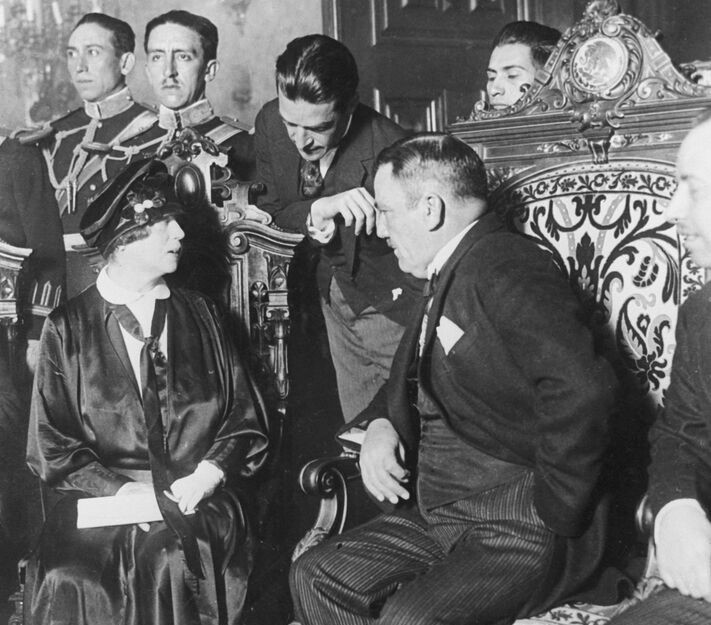
After the defeat of the Workers Opposition at the 11th Party congress in 1922, Alexandra Kollontai was largely removed from internal Party politics and ‘relegated’ to diplomatic work on behalf of the Soviets. In that role she was envoy to Mexico when she gave this talk on the gains made by the Soviet Union to the Russian Club of Mexico City.
‘Speech by Kollontay on Her Arrival in Mexico’ from The Daily Worker. Vol. 4 No. 26. February 12, 1927.
ON Sunday, January 9, there took place, in the City of Mexico, an impressive reception, to Comrade Alexander Kollontay, the Plenipotentiary Representative from the Union of Soviet Socialist Republics. This reception was held at the Russian Club of Mexico City.
In spite of the fact that the reception was advertised to begin at 8 o’clock in the evening, people began coming as early as six. And long before the meeting was formally opened, every bit of available space, including the hallway; was filled to capacity, the crowd even overflowing the sidewalk.
Comrade Kollontay arrived at eight, and the people waiting for her broke into prolonged applause.
The speech of greeting, on behalf of the meeting, was made by Comrade Frenco.
Greeting by Kollontay.
Comrade Kollontay spoke as follows:
“Comrades and citizens:
“I thank you sincerely for this hearty and friendly reception with which I am met here. This reception is the more dear to me that it proves a spiritual connection between the Union of Soviet Socialist Republics and the Russian Colony here.
“Many of those present here have probably left the territory of the union long ago, and others have probably left even earlier. As I am but recently from Soviet Russia, you may rightly request from me an exposition in detail of the conditions now prevailing there. If one were to go there now with the assumption that he would find there a complete realization of Communism, he will undoubtedly feel disappointed. For he will find there only the process of Socialistic construction, an intensive process, taking place at an enforced pace.
“But it is clear that this construction cannot be terminated as yet. I consider it necessary to speak in great detail on this subject as this is one of the chief reproaches directed against us by our enemies. One often hears the reproach that no visible prosperity has been realized in the Soviet Union. Well, imagine yourself, the owner of an enterprise, of an industrial or a commercial establishment, which found itself in a condition of extreme decay. Let us suppose that this enterprise was put in the hands of another person. Imagine also, that at the expiration of a certain period, say of nine months, there have taken place in this establishment notable improvements. Still, in spite of these improvements, those around him are heaping abuse upon the owner, saying in effect, the following:
“What kind of establishment is this? Its productivity, it is true, has increased noticeably, its deficit has been wiped out, there is no doubt of its having made many important improvements. Yet, is there any use in having such an establishment, which does not give all at once a profit of 100%?”
“Are not the charges thrown against the Soviet Government of a similar character?
Beginnings Were Difficult.
“The Soviet Government began its existence in unbelievably difficult conditions. At the time when the Soviet power was just emerging, the country was in a state of a dreadful dilapidation, the inheritance of the war. More than that, the Soviet Government had to suffer a whole lot of natural and other disasters, such as the blockade, intervention, the famine in the Volga districts, etc. Under such circumstances, the reconstruction was very difficult. And only to the superhuman efforts of the Russian proletariat, headed by the Communist Party, is due the resistance to the pressure of the whole capitalist world, only through such efforts did the Russian people outlive all the sufferings endured by them. I repeat, not to the Soviet Government, but to the crimes of other nations, in intervening in Russia, should be charged all that the Russian people have endured.
“The Soviet Government remained true to its cause. Out of the unheard of difficulties it continually lead the country to complete economic restoration. And at the present time, it can be truthfully stated that even in an economic sense there is no more stable government than that of the Union of Soviet Socialist Republics. The advantage of the Soviet Government over other powers consists in that there is no such chaos as can be observed in the capitalist countries. Production, and, in fact, all national economy, is being conducted according to a previously conceived plan. Foreign trade is a state monopoly in the Soviet Union. Thus the state has the means and the power to control industry, and direct it, by, when necessary, reducing production in one branch while at the same time increasing it in another.
“One of the chief indications of the state of the national economy is the national budget. Considering the conditions of the national budget of the union in the years 1923, 1924, 1925 and 1926, we find a continual growth in the Soviet economy. In 1924 the government’s budget had a deficit of 36%. For the year of 1925 the deficit expressed itself in the figure of 4%. And for the year of 1926 the budget had no deficit. Is this not sufficient testimony to the improvement of the economic state of the Union of Soviet Socialist Republics?
“The Soviet Union is a country with an overwhelming majority of the agricultural population of the peasants. From the 144,000,000 comprising the entire population, 120,000,000 live in the small villages, thus leaving only 24,000,000 as the population of the cities. Thus the economic situation of the peasants is of greater significance. Let us look at some statistics concerning the cultivated area, during the years 1913, 1920 and 1924. In the year 1913, the cultivated land of Russia amounted to 88,000, 000 desyatinas (acres). In 1923 it amounted to 73,000,000, and in 1924 it surpassed the pre-war figure, having reached 104,000,000. This is indisputable evidence of a growth and improvement in peasant economy.
Explains Unemployment.
“As to unemployment in the Soviet Republic, it assumes a specific character, that differs most essentially from the unemployment in other countries. The unemployment in the Soviet Union results not from disintegration of industry, not on account of the workers losing their work, but on account of the influx of workers from the villages. This gravitation of the peasants to the towns indicates not so much a still existing difficult situation in certain parts of the peasantry, but more still a desire of the peasant youth to live near centers of culture. The youth wishes to study, wishes to construct its life on a new basis.
“As to the state of commerce at the present moment, there is no comparison with the conditions existing previous to the revolution. As the most striking example, let us take foreign trade. During the czarist days, the principal objects of production were purchased abroad, while at the present time the main commodities imported from abroad are machines for the increasing of production.
“One of the most often heard reproaches against the Soviet Government, is that it is giving big concessions to the capitalists of foreign countries. But this charge is completely groundless. Previously, all the riches of the land where found in the hands of foreign capital. But at the present time, in spite of what our adversaries may say, the concessions granted by the Soviet Government are very few. So, for instance, Germany, which received from us the greatest number of concessions, counts throughout the Republic only twelve concession societies. England has eight such societies, Norway, three.
“The Soviet Government gives much attention to the economic improvement of the Jewish people. Those Jews who wish to remain on the land as agricultural workers receive all kinds of assistance necessary from the government. Many Jews have colonized in the Caucasus, in the Crimea, in White Russia, and in the district of Homel. The majority of these colonies find themselves in a state of prosperity.
“One repeatedly hears against charges the Soviet Government for its severity towards its enemies. It is strange to hear blame for this from a country like the United States. This country led a not less violent struggle for its independence, when it was not yet the United States, but a colony belonging to England, and George Washington, who headed and led the struggle for this independence, is to this day the national hero. The difference between the struggle for independence of the United States and the Russian Revolution is simply this, that the Russian Revolution forced out not only the foreign exploiters, but its own nobility and land-owners, who were not in the least better, but perhaps worse than foreign exploiters.
“The lives of the workers in the Soviet Union are being continually improved. The average worker receives 612 rubles a year. Unemployment is continually diminishing, and for the skilled worker unemployment has ceased to exist long ago. In fact, a lack of 100,000 skilled workers is being felt at the present time.
Medical Treatment Free.
“All the workers have the right to free medical treatment, as well as to sanitariums.
“The Union of Soviet Socialist Republics is a beacon light for the workers of other countries. These see the conquests of the workers of Soviet Russia, and they conceive the hope that the time will come when for them will also be established a new day of greater justice and prosperity.
“Comrades, I will conclude my speech with greetings to you in the name of the Soviet Government, with the exclamation: “Long Live the Union of Soviet Socialist Republics and its final triumph! and this Russian Club in Mexico.” J.T.
The Daily Worker began in 1924 and was published in New York City by the Communist Party US and its predecessor organizations. Among the most long-lasting and important left publications in US history, it had a circulation of 35,000 at its peak. The Daily Worker came from The Ohio Socialist, published by the Left Wing-dominated Socialist Party of Ohio in Cleveland from 1917 to November 1919, when it became became The Toiler, paper of the Communist Labor Party. In December 1921 the above-ground Workers Party of America merged the Toiler with the paper Workers Council to found The Worker, which became The Daily Worker beginning January 13, 1924.
PDF of full issue: https://www.marxists.org/history/usa/pubs/dailyworker/1927/1927-ny/v04-n026-NY-feb-12-1927-DW-LOC.pdf
 Revolution's Newsstand