
The 1912 ‘Bread and Roses’ strike of mill workers in Lawrence, Massachusetts was not the first, or last, strike in that city. Here Brookwood Labor College graduate and strike activist Sam Blakely reports on the 1931 struggle, notable for the workers being divided into three union, the A.F.L.’s United Textile Workers, the local American Textile Workers and the Communist-led National Textile Workers Unions. The strike was defeated.
‘The Lawrence Strike’ by Sam Blakely from Labor Age. Vol. 20 No. 12. December, 1931.
THE, strike of the 23,000 textile workers in Lawrence, Massachusetts, has been broken. All the forces of the boss-controlled town were used to put down this revolt of workers, who were already notoriously underpaid, against a 10 per cent wage cut. The press, the police, the church and the numerous civic organizations united as one against them. Frameups, police brutalities, deportations, and the passive consent of the well-fed, respectable citizens have succeeded in driving down still further the wages of the half-starving textile workers.
In addition to the united front of the bosses, the Lawrence workers were handicapped by the lack of any real leadership from the United Textile Workers, the organization which was strongest in the field at the beginning of the strike, and by the divisive and confusing tactics of the “holy of holies,” the Communist-lead National Textile Workers.
But before making further criticisms let us first consider the immediate cause of the strike and the groups involved. It was on October 4 that the mill bosses announced to the press of Lawrence that a 10 percent wage cut would take effect on October 13. This announcement was made without notifying the workers in any manner whatsoever.
The Workers Walk Out
The reaction was immediate and determined. Not waiting to finish the orders which were at hand, the workers in mill after mill walked out. In two days 23,000 from eleven mills had quit work. Seven of these mills, which were completely tied up, are the largest in Lawrence, and in New England. With the exception of the workers in the Pacific mills, controlled by the American Textile Workers Union, this walk-out was spontaneous, not being called officially by any union.
Horace Riviere, New England organizer for the United Textile Workers, it is true, had been doing organization work two months previous to the strike, and had succeeded in establishing functioning groups in the Shawsheen, the Arlington, and the Monomac mills. (The first two of these mills are among the largest in Lawrence.) And through these groups the U.T.W. was able to get a considerable following—after the strike was on.
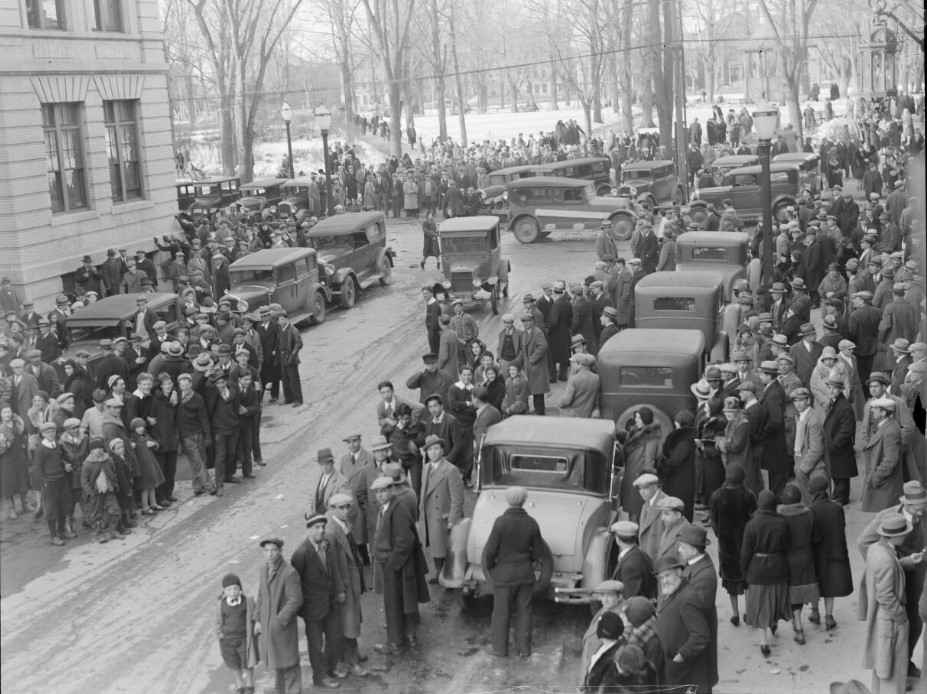
In the central part of the city of Lawrence is a large park, called the Common, which has been the rallying ground of the past great strikes of Lawrence. Here the U.T.W. secured a permit to hold daily meetings. Although in most other things the U.T.W. failed to cooperate with the American Textile Workers, it did share its permit with this new organization and held joint meetings with them on the Common.
The American Textile Workers
The A.T.W. is an outgrowth of the National Textile Worker’s strike last February. After that strike 12 of the active members of the N.T.W. split off and with the help of a local attorney formed the A.T.W. The reason they gave for leaving the N.T.W. is that they did not want to be a “kite-tail” to the Communist Party. They are concerned primarily with the problem of building a union which will get better conditions for the workers, they say, and feel that the N.T.W., with its “brains across the sea’ program, could not or would not do this for them.
At its formation the A.T.W. went out of its way to emphasize its Americanism. It insisted with a good deal of heat that it was an American organization and made its appeal chiefly to Americans. This did not mean, however, that it stood for hundred percentism. It was a tactic made necessary by the Immigration Bureau of the Department of Labor which has been following the policy of deporting all alien leaders of strikes. Thus the N.T.W. strike in February of this year was broken by Doak’s agent, Frank Chase, who arrested all the chief leaders and held them for deportation.
Since the recent strike, however, the officials of the A.T.W., who are workers in the mill and serve without pay, have spoken for redrafting the constitution of the union so that it will conform with the principles of militant, progressive, industrial unionism, but not cater to nationalistic or racial prejudices.
The U.T.W. and A. F. of L.
At the beginning of the strike the U.T.W. attempted to get control of the situation. It sent in Horace Riviere and Fernand Sylvia as organizers, and Francis J. Gorman, vice-president of the U.T.W., made frequent visits to Lawrence. In addition, William F. Green, president of the A.F. of L., sent in Alexander Marks, organizer, as his personal representative to assist the U.T.W.
These officials of the A.F. of L. appealed to the strikers on the ground that the U.T.W. was affiliated with the A.F. of L., the organized labor movement of America and as such could give them much greater help than other groups. Marks, in a speech, early in the strike, even assured the workers that if they showed that they “really mean business” they could depend upon the A.F. of L. “backing relief this winter.”
Early in the strike “Red Mike” Shulman, Socialist Party organizer, Leonard J. Green and the writer, representative of the Conference for Progressive Labor Action and a Philadelphia Socialist, came to Lawrence. These three at once assumed leadership of the picket lines and did other important strike work, cooperating with the U.T.W. and the A.T.W., since these were the organizations representing the mass of the strikers.
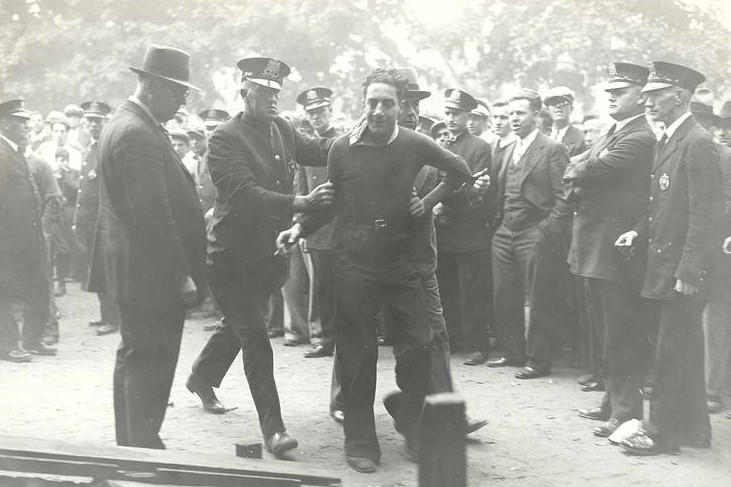
“Red Mike” did especially good work. He captured the imagination of the workers and imbued them with his own spirit of militancy and determination. The effectiveness of his work was soon demonstrated when the agents of the bosses kidnapped him. As a result of this kidnapping, Green with seven others, part of a group of 20 who went to Newburyport to investigate his whereabouts, were arrested and framed on charges of malicious destruction of property. Green was sentenced to a year in the house of correction and the other seven were sentenced to eight months each.
In addition to these three the strikers were also helped by Alfred Baker Lewis, secretary of the New England branch of the Socialist Party, and ministers and students sent by him who participated in the speaking and picketing. Lewis was also instrumental in raising bail for most of the strikers arrested.
Why Has The Strike Failed?
Why has the strike failed? Is it because of the depression which, according to some, makes it impossible to win a strike today? Or is it because of lack of leadership?
With the first point I will not deal. It is a very debatable question and readers of this are already familiar with most of the arguments. However, I will say that the success or failure of a strike.is not determined merely by the success or failure to win demands. A strike may be a success when no demands are won, if the workers go back knowing that they have put up a good fight and are determined to try again. This requires honest, courageous and intelligent leadership, however, and it is on this point that I propose to criticize the Lawrence strike.
From the beginning the U.T.W. officials made many promises to the workers which they not only failed to live up to but which in the opinion of some of the workers they did not intend to keep. For instance, if Marks was sincere in his promise, the workers argue, the A.F. of L. would have backed the strike with relief. Not a cent, however, came in from any of the Internationals affiliated with the A.F. of L. or from the A.F. of L. itself. Was this because the U.T.W. did not make an appeal? As a matter of fact the U.T.W. interfered with other unions in getting relief from nearby towns. It refused to cooperate in the United Action Relief plan, which was sponsored by the A.T.W. At least three-fourths of the relief that did come in, came from the Socialist Party, Workmen’s Circle and United Hebrew Trades unions of New England.
Many of the workers felt that Frank Gorman, Vice-President of the U.T.W. should have been in Lawrence much more frequently and that he left town without explanation at a critical time toward the end of the strike.
The Lawrence Building Trades Council is said to have sent a sarcastic letter to President McMahon of the U.T.W. asking him why he had not appeared on the scene. To this no answer came. When Sylvia was asked the same question by one of the strikers he said, “Did you ever see a General fighting in the front line trenches?” The striker who has never had any previous experience answered, “I may not have but by God that is the kind of Generals we need and want.”
All during the strike the U.T.W. officials in my opinion filled the workers with false enthusiasm and hopes. When the time came for a showdown, with no relief on hand and none in sight, the workers wanted to know how they stood and what they should do. The officials told them that they and not the U.T.W. had called the strike and that it was up to them and not to the U.T.W. itself to see about its close. The U.T.W. had come only to give leadership—a leadership, it seems to me, without courage, which failed frankly to send the workers back after they knew that the strike was over. They failed moreover to tell the workers clearly and convincingly that they had put up a good fight and must struggle to keep up their organization after they return to work.
Although the National Textile Workers had around 40 “organizers” in the field they control only a few departments in the Wood mill and have about 700 followers. They are very vociferous in their condemnation of all other groups taking part in the strike although, actually, the part they played was that of strikebreakers. Of course they claim to have led all the militant picket lines, but what they did was to sabotage all of them. The only line they led was a small group in front of the Wood mill—but there is no use wasting more time and space on them.
The Ray of Hope
Here is the encouraging feature of the strike. The American Textile Workers, an industrial union based upon the mill unit, is holding its own. While it is not yet very anxious to get new members from mills other than the Pacific, it will take them in. I am convinced that once they know which way the strike in the Pacific mill goes they will start an organization campaign in the other mills. At present the Pacific is locked out. The management of the Pacific has given a list of the A.T.W. strikers to the American Woolen which will try to employ them and discharge its own workers. By doing this it hopes to create a surplus of non-union workers for the Pacific when it opens up.
The great need now is relief. Since the U.T.W. has been discredited by the workers and since the N.T.W. hasn’t been able to do anything and since the workers have realized for the first time in the history of Lawrence their great need for an effective union, the A.T.W. has great possibilities. It has a militant, honest leadership which has refused to be discouraged by the outcome of the strike.
But under-paid textile workers cannot fight long unless their friends and sympathizers from the outside help them. They must eat, and to eat they must have money. This money and relief must come from the outside. Thus the final outcome of the brave fight of the A.T.W. rests to a large extent with the support that you who want to see a militant progressive union established in Lawrence are able and willing to give.
 Revolution's Newsstand