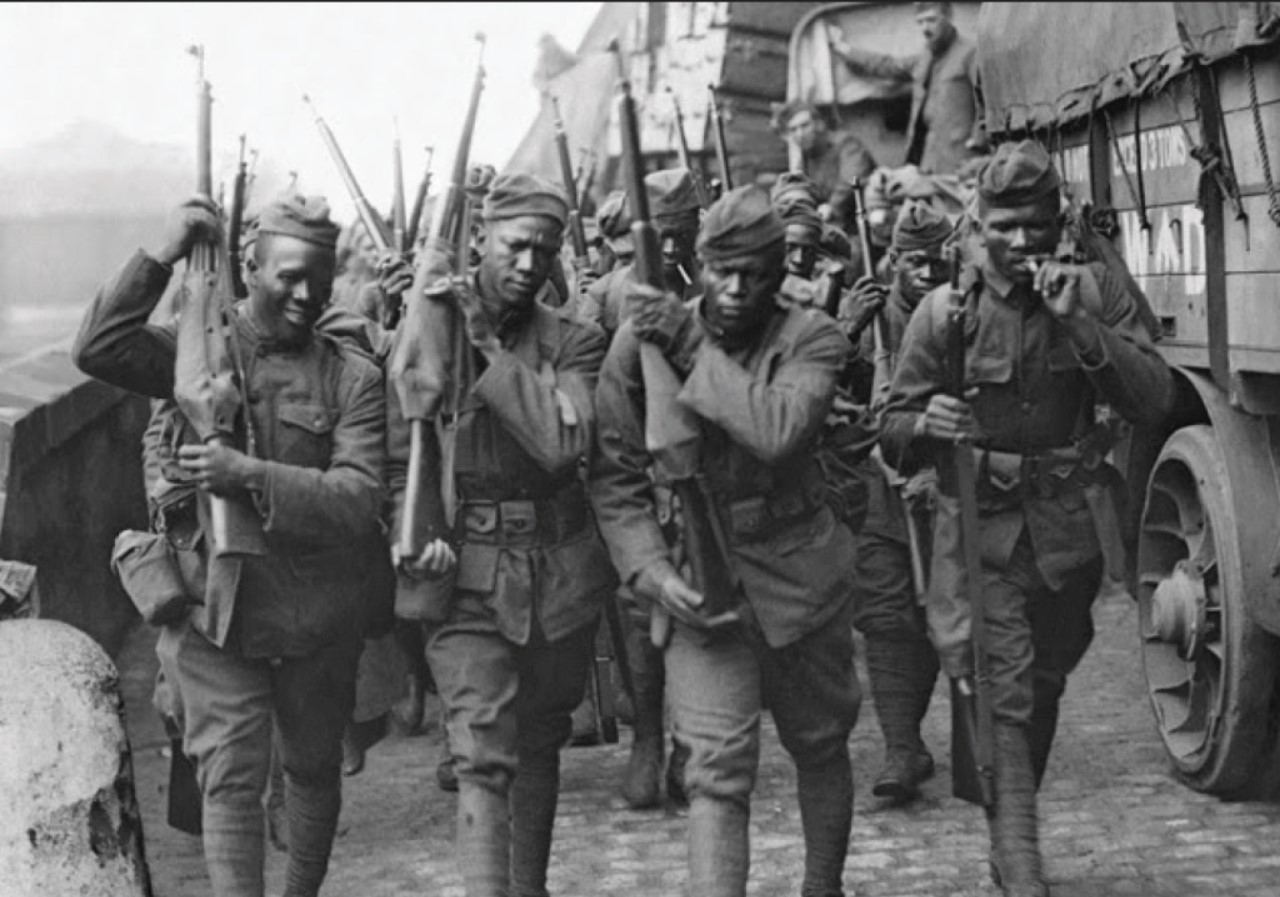
Eugene Gordon, a leading Black Communist during the 1930s, remembers his time serving in France as a young Second Lieutenant during World War One, and the effect it had on him, as it did so many other Black soldiers.
‘The Negro in the World War: A Personal Recollection’ by Eugene Gordon from the Young Worker. Vol. 12 Nos. 16 & 18. July 31 & August 28, 1934.
Most of the 2,290,527 young Negroes who were in the late World War were, I believe, idealists. Certainly I was. I mean that we were idealists in the sense that we believed our fighting in the war would be the beginning of a new era for us as Negroes.
Here was our chance at last, we believed, for us to convince our country of our right and our fitness to serve her. Having convinced her, we should expect her to reward us with such a share of her “precious democracy as would fully repay us. Our great country, we young idealists felt needing us in her crusade against the Hun barbarian, would show her appreciation when, her democracy having been preserved in a world now made safe for democracy, we came back singing songs of victory.
We thought of this fighting for our country’s honor in much the same heady and romantic way that a boy emerging from adolescence thinks of fighting for his best girl. We thought of it as something priceless and very beautiful; not of something very abstract.
It was something very abstract, as later events proved. How many of us went through the process of disillusionment that I did, I do not know. But my own experiences, I feel, are a fairly accurate reflection of the experiences of hundreds of thousands of others.
In Training Camp
In the spring of 1917 the War Department finally acceded to the pleas of the Negro bourgeoisie and made provisions for training Negro officers. The training camp at Plattsburg, N.Y., had been running for some time, and a number of Negro youths had tried to get in. It was “not the policy of the War Department,” however, to train Negroes and whites together, regard less of the terrible danger in which democracy stood. The invariable answer to these pleas was, therefore; that the War Department was sorry that no provisions had been made for training Negro officers; that, until such provisions were made, the Negroes would simply have to serve as enlisted men.
With the aid of Negro politicians the Negro upper class succeeded at last in having a camp allotted to them for training their young men as officers. It was located some ten miles outside the city of Des Moines, Iowa, the site of unused regular army barracks. The camp was opened early in the spring of 1917. It closed that autumn, commissioning a whole battalion of Negro captains, first lieutenants, and second lieutenants.
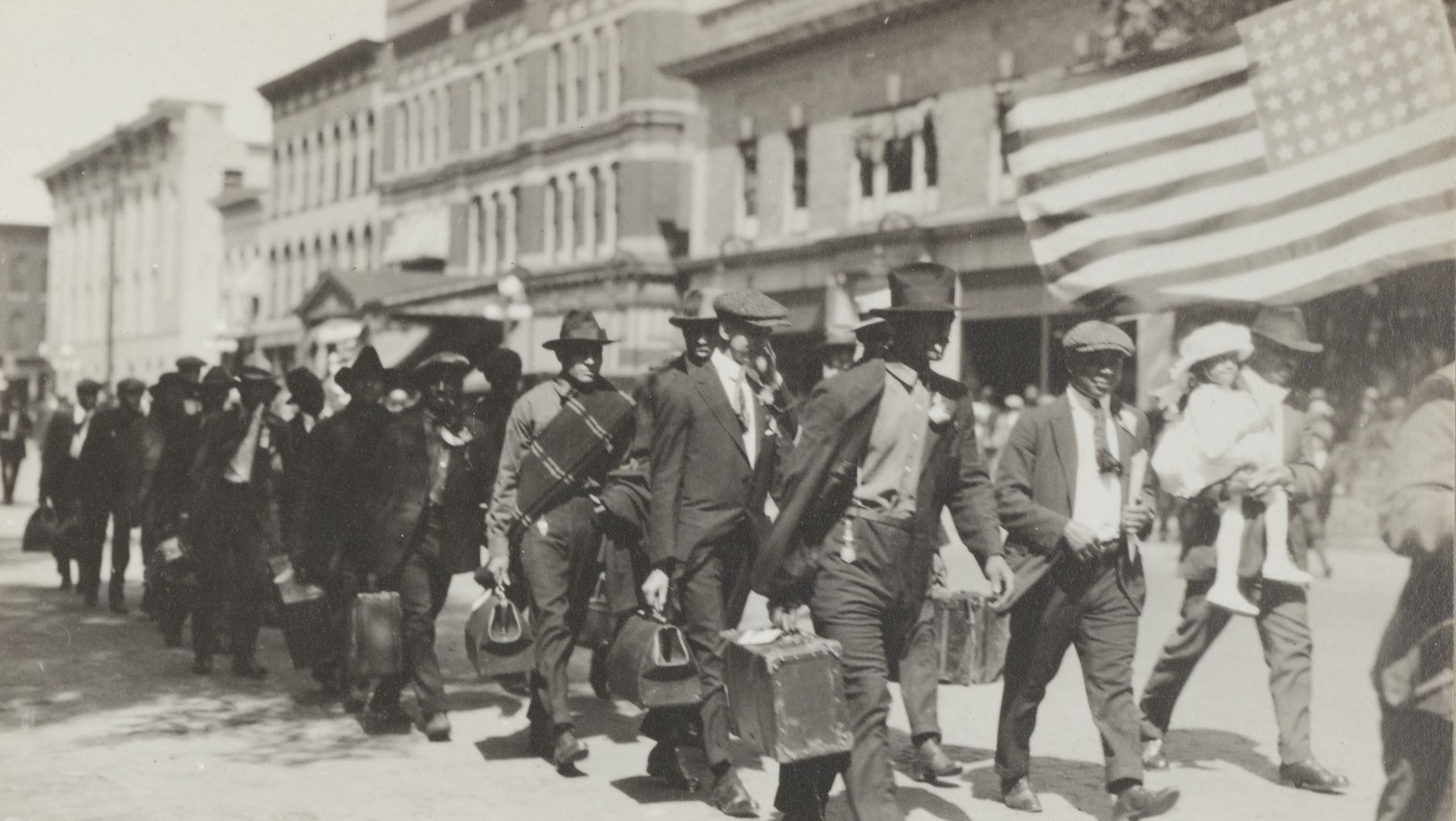
It was “not the policy of the War Department” to commission Negro field officers–that is, officers above the rank of captain. There were, incidentally, a large number of men among them who could have readily served as colonels. These men were from the 24th and 25th Infantry and the 9th and 10th cavalry, Negro organizations officered by whites.
The one Negro colonel from the 10th Cavalry, Charles Young, a graduate of West Point, was not allowed by the War Department to go to France. It was “not the policy” to permit members of an oppressed national minority to command large armed bodies of their kind.
The lesson of Fort Des Moines was not fully comprehended by all those who received it. Many of these men did not question the War Department’s so-called policy in Jim-crowing them. Those who did, feeling that it was better, for the moment, to submerge their resentment in the hope of witnessing genuine democracy after the war, silenced their questionings and walled.
If the Negro graduates of the Ft. Des Moines training camp thought that, having been made “officers and gentlemen” by virtue of being commissioned in the United States. army, they would enjoy the rights and privileges of the white officers, the enlisted men of the 92nd Division had no such illusion. As matter of fact, few of the Negro officers thought that their being commissioned would lift them to that status of “gentleman” that their rank was supposed automatically to imply. The enlisted men whether Negro or white, were simply a group of automata controlled by their snobbish officers. The Negro soldiers, owing to their extra disabilities as members of an oppressed national minority, suffered not only the humiliations and general hardship common to enlisted men; they suffered also the additional humiliations and hardships of being “black” enlisted men.
In France
From the very moment of our reaching the village of Passavant, Haute Saone, we enlisted men were conscious of the effect of the government’s propagandists. The French villagers, the workers and the peasants, flocked out to see us assembled in the square. Those among us who spoke a little French made immediate friends among these people, who had already gone through four years of the War. We learned from them that they had been warned by our white billeting officers, who always preceded us on our entering a village, where we should be quartered while training, that they must have nothing to do with us. Why, they asked? Because, they explained, the Negroes might be spoiled. They are not used to being treated as equals of the whites in the United States. If you treat them as your equals, they might take advantage of your mistaken kindness. “Negroes can’t be trusted,” the white officers told the French workers and peasants, who wanted to be friendly with us.
All this was simply rumored until the Fourth of July, 1918. On that day we were all marched to the square in the center of Passavant. There, under the ancient trees, grouped around the ancient village fountain, mingling with the young French men and women and their elders we listened to Col. James A. Moss as he made a speech first in French and then in English. He was from Louisiana, and could speak French like a native. Those of us who understand French knew that he told the villagers the same thing that a few minutes later he told us.
“Remember You are a Negro.”
He told us that we must remember who we were; that we must be careful not to betray the confidence of our country and the people at home placed in us. Indeed, he said little else. His whole speech, lasting more than three quarters of an hour, was an exhortation to us to remember who we were to remember that we were Negroes who were not accustomed at home to being treated like human beings: “Be careful,” be cautioned, “not to take advantage of the ignorance of these simple French people.” He almost wept as he pointed out the injustice we should be doing these “simple French people” if we responded humanly to their very human treatment of us. “Your folks back in the United States expect you to live up to our traditions; they expect you to do nothing that would make them hang their heads in shame.”

What did he mean? He meant simply that the United States Government and the War Department expected the oppressed Negro in France to remember that he still belonged to an oppressed national minority. He meant that if the Negro for a moment forgot who he was, he would be quickly reminded. We frequently “forgot,” and as frequently we were reminded.
After the armistice, when the white troops were permitted a degree of relaxation and the white officers were permitted to go to school in Paris and London, the Negro troops and their black officers were kept as busy drilling as before the armistice. Order followed order from general headquarters; orders restricting the movement of Negro soldiers within the press they happened to be occupying: orders forbidding Negro soldiers from entering the residential sections of the villages; orders threatening arrest and court-martial to Negroes who were seen talking to French civilians; orders hinting at execution of Negroes against whom charges were brought for associating with French women.
That these orders were not merely idle threats was proved in the number of arrests and convictions of Negroes during the period between the armistice and our sailing for the United States. It has been proved also that a number of the arrests were instigated by “white officers and gentlemen” who were forced to compete with Negro enlisted men for the favors of French women.
I had been commissioned a second lieutenant while in France, so on the return trip occupied the quarters of an officer. I should add that they were the quarters of a Negro officer. The boat was the White Star Olympic, and it carried, at the same time, a large number of white bourgeois civilians, among them being the capitalist Charles Schwab, who had made millions in the war.
I think it was on this trip home that the final blow was given to our youthful idealism such a shadow of it as still remained with us. There were 50 Negro officers aboard, all traveling first class. We were segregated not only with respect to sleeping quarters, but were given a separate dining room and assigned waiters who would serve us only.
A committee was elected among us to take a complaint to the ranking officer aboard, a general whose name I do not now recall. He simply shrugged, and said: “But what’s the matter with that private dining room? Why, Charles Schwab himself has often been served there. I think you’re lucky, if you ask me.”
The loyalty of the Negro troops has always been unprecedented, say the politicians and the war makers at the approach of every new slaughter.
As an ex-serviceman, I serve I notice upon these slinking vultures that my disillusionment ended long ago; that my role in the next war will be like that of thousands of other ex-servicemen; to help our fellow workers, put up for slaughter to fight for the only kind of democracy that is genuine democracy: the democracy that the workers and poor farmers can enjoy under their own government.
The Young Worker was produced by the Young Workers League of America beginning in 1922. The name of the Workers Party youth league followed the name of the adult party, changing to the Young Workers (Communist) League when the Workers Party became the Workers (Communist) Party in 1926. The journal was published monthly in Chicago and continued until 1927. Editors included Oliver Carlson, Martin Abern, Max Schachtman, Nat Kaplan, and Harry Gannes.
For PDF of full issue: https://www.marxists.org/history/usa/pubs/youngworker/v12%20n14%20-%2025%20Young%20Worker%201934%20July%20Dec.pdf
 Revolution's Newsstand