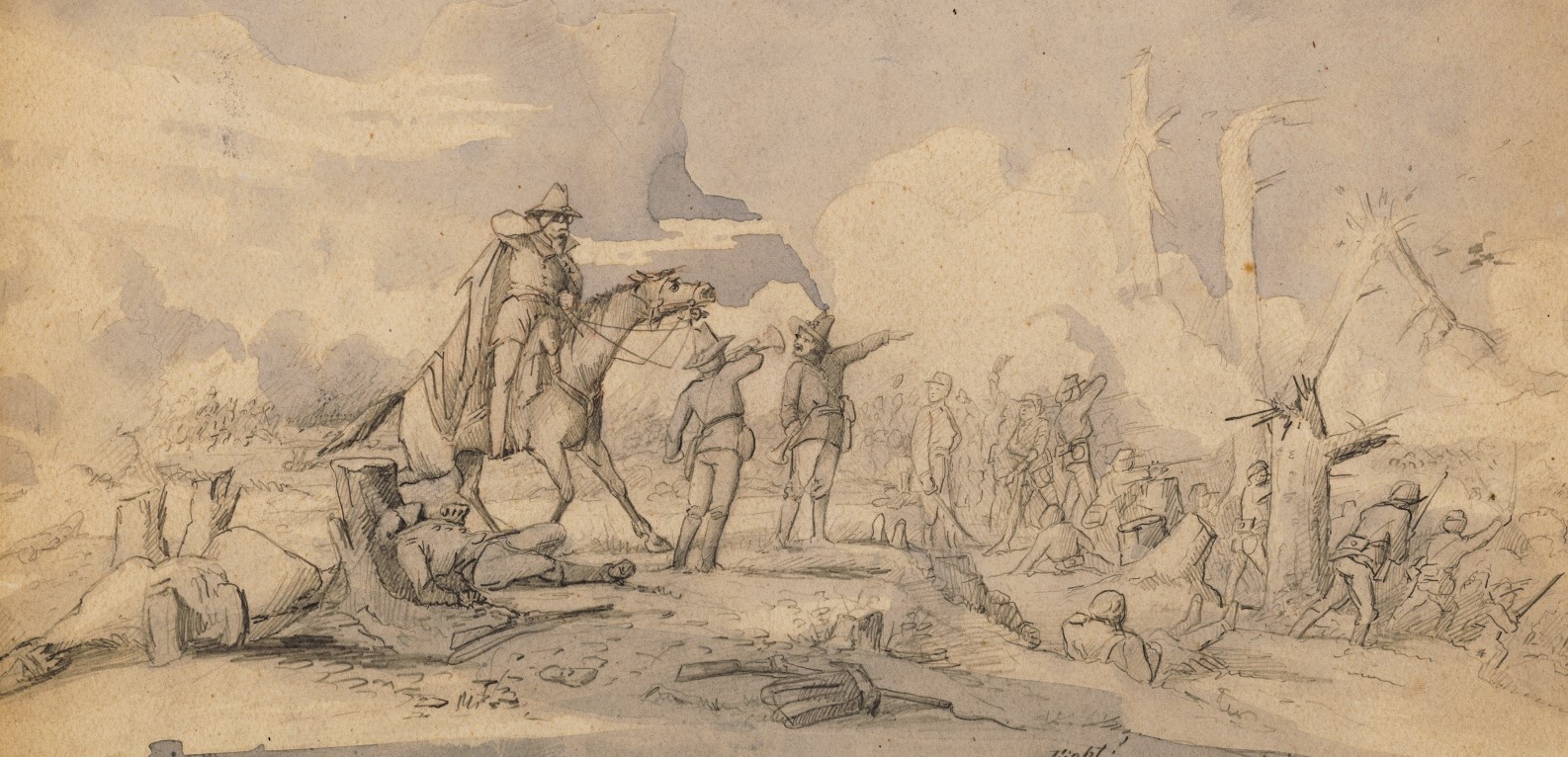
A comrade from August Willich’s adopted state of Ohio writes to the New York Call suggesting Socialists around the country gather to celebrate the 100th anniversary of the revolutionary general’s birth on November 19, 1910.
‘August Willich, Socialist and Union General’ by E.S. Smith from the New York Call. Vol 3 No. 273. September 30, 1910.
Editor of The Call:
The approaching hundredth anniversary of the birth of August Willich should not be allowed to pass without some kind of commemoration by the Socialists of this country. As the date, November 19, falls this year upon Saturday it affords an excellent opportunity to the Socialist organizations of our cities to hold commemoration meetings either on the evening of that date or upon the next day, Sunday, November 20. It will be a peculiarly appropriate occasion for a reunion of European-born and American-born Comrades in honoring the memory of a pioneer who in his career distinguished himself on two continents,

August Willich was born November 19 1810 in Braunsberg, Prussia, a town of some historic importance, situated about thirty-five miles southwest of Konigsberg. He received a military training and was commissioned as lieutenant at the early age of eighteen. Having become imbued with democratic convictions he gave up his commission in 1847 and, adopting the carpenter’s trade, became a leader of the revolutionary workingmen who were at that period gaining some prominence in Germany.
In the uprising of 1848 he took an active part among the revolutionary forces, appearing first at Cologne as the leader of a large deputation which forced its way into the hall of the city council urging that the council present the demands of the people of Cologne to the King of Prussia.
Later on Willich was given command of all the revolutionary forces. After the last vestige of hope for the success of the revolution was gone. Willich and the remnant of his command made their way into Switzerland, and from there Willich passed into France. He lived in England for several years among the group of exiles who found there a friendly refuge.
Carl Schurz in his “Reminiscences” gives an interesting account of the life of the refugees in London as he found them in 1851. They were accustomed to meet in the evening in the hospitable drawing room of the Baroness von Bruning, in St. John’s Wood Terrace. She was herself a voluntary exile from one of the German provinces of Russia, a born aristocrat, but devoted to democratic ideals and a bitter opponent of despotism and injustice. Willich was one of the circle which made the Bruning house its rendezvous. He was known at that time as a Socialist leader, and Schurz states that the Socialistic workingmen gathered partly around Karl Marx and partly around August Willich.
Willich remained in England until 1853, when he came to America. He found employment on the government’s coast survey and later on edited the Cincinnati German Republican, an organ of the working class. On the outbreak of the civil war he joined the Union army and rendered distinguished service in the cause of human liberty and in the destruction of chattel slavery. The limits of this article will not permit a detailed account, but the record of his deeds forms a part of the history of the civil war and furnishes indisputable evidence of his courage and ability as a strategist and a leader of men.

After the war he retired with the rank of brevet major general and returned to private life, choosing St. Marys, Ohio, as his home. There he lived as an honored citizen until his death, which came January 22, 1878. He was buried at St. Marys and a monument was there erected to the memory of this grand old man.
The name of August Willich is one to be remembered with feelings of gratitude by the Comrades of today, and we ought not to neglect the opportunity to honor his memory on the 100th anniversary of his birth.
E.S. SMITH. Warren. Ohio, Sept. 13, 1910.
The New York Call was the first English-language Socialist daily paper in New York City and the second in the US after the Chicago Daily Socialist. The paper was the center of the Socialist Party and under the influence of Morris Hillquit, Charles Ervin, Julius Gerber, and William Butscher. The paper was opposed to World War One, and, unsurprising given the era’s fluidity, ambivalent on the Russian Revolution even after the expulsion of the SP’s Left Wing. The paper is an invaluable resource for information on the city’s workers movement and history and one of the most important papers in the history of US socialism. The paper ran from 1908 until 1923.
PDF of full issue: https://www.marxists.org/history/usa/pubs/the-new-york-call/1910/100930-newyorkcall-v03n273.pdf
 Revolution's Newsstand