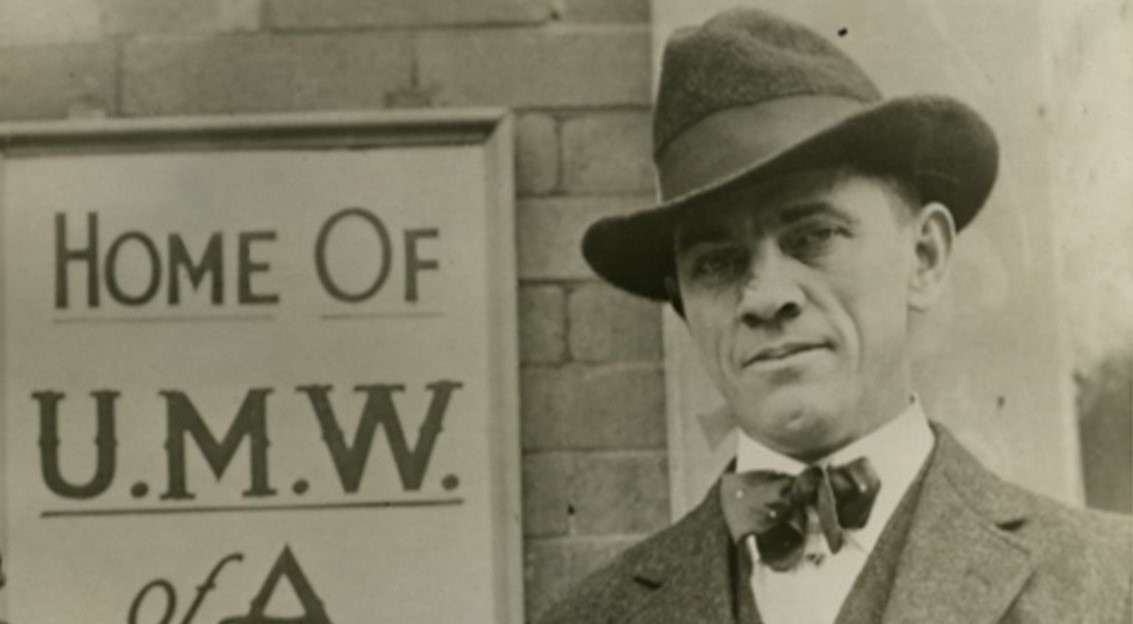
Outstanding working class leader Frank Keeney, president of U.M.W.A. District 17, is acquitted of murder in a trial stemming from West Virginia’s 1921 Battle of Blair Mountain.
‘Keeney Freed in West Virginia Murder Trial’ from the New Leader. Vol. 1 No. 10. March 22, 1924.
Conspiracy Charge Collapses and Mine Leader Exposes Feudalism in His State.
Fayetteville, W. Va. C. Frank Keeney, president of District 17, United Mine Workers of America, was found not guilty of being accessory to murder by a Circuit Court jury.
The indictments against the union chief grew out of the march of armed men from the union coal fields of the State to the nonunion Logan County field in 1921. The accessory charge was lodged in connection with the death of John Gore, a Logan deputy sheriff, who was killed during the fighting on Blair Mountain. Five weeks were required to hear the evidence in the case.
The main issue in the trial was whether Keeney and other union officials encouraged and assisted in bringing about the march, as claimed by the prosecution, or whether it was a purely spontaneous action of men in the coal fields enraged by what they believed was persecution of union miners.
The acquittal of Keeney marks the end of one of the most remarkable trials in all labor history. Ably defended by Harold W. Houston, veteran Socialist lawyer, Keeney made the witness stand a forum to expose the iniquities of corporation ruled West Virginia.
During the trial, Keeney wrote a letter to Arthur W. Page, editor of the World’s Work, replying to an article in a recent issue of that magazine, “Must Murder be the Price of Coal?” Keeney compared conditions in the coal fields of southern West Virginia to feudalism, and charged the existence of a “gigantic conspiracy of non-union operators to own and control the Government of the State, and through seizure and misuse of its powers to drive the United Mine Workers from the State.”
The non-union fields are said by Keeney to be “seeking to precipitate strikes and disorder in the unionized, fields this spring, and as aiming to prevent harmonious relation between the union and the mine operators who employ unionized workers.
“There has been violence and lawlessness in West Virginia,” he says, “but to attempt to put the full responsibility for it upon the shoulders of the United Mine Workers, and to grant a clean bill of health to the coal corporations with their armies of gunmen, mine guards and special deputies is to ridicule and deride the known facts and actual conditions.
“An attempt to discuss the Paint Creek and Cabin Creek strikes and yet neglect to mention the infamous armored train-box cars lined with boiler plate which, without lights or signals prowled through the mining camps during the night and poured machine gun volleys through portholes into the tent colonies of workers and their families, is to overlook the cause of more than three-fourths of the violence and bitter feeling in that struggle.” Keeney specifically denies the existence “of a conspiracy in the central competitive field to unionize the coal mines of West Virginia,” and the allegation that “the miners’ union expended $2,557,000 in one single unionization campaign in Mingo county.
“The non-union fields of West Virginia are now the one guarantee that the nation shall have at least partial coal supply during strikes,” Keeney says.
“On the other hand,” he contends, “the basic and fundamental evil of the coal industry as a whole is that the non-unionized producing fields do not, and will not respect the agreements entered into by the miners’ union with the unionized operators.”
Elaborating upon this last point, Keeney says that “it is a well-known fact, as indicated by recent utterances of Secretary of Commerce Hoover, that there has been widespread hope and considerable effort among non-union operators this winter to the end that no wage agreement be made in the scale conference at Jacksonville, Fla.
“These operators,” Keeney says, “wanted the orgy of profits that have come to them in former shut-downs of unionized mines.
“It has been recognized generally by both Government officials and men in the coal industry that a strike of the miners would not take place this spring unless the plot of a certain element of operators to bring it about was successful.”
New Leader was the most important Socialist Party-aligned paper from much of the 1920s and 1930s. Begun in 1924 after the S.P. created the Conference for Progressive Political Action, it was edited by James Oneal. With Oneal, and William M. Feigenbaum as manager, the paper hosted such historic Party figures as Debs, Abraham Cahan, Lena Morrow Lewis, Isaac Hourwich, John Work, Algernon Lee, Morris Hillquit, and new-comers like Norman Thomas. Published weekly in New York City, the paper followed Oneal’s constructivist Marxism and political anti-Communism. The paper would move to the right in the mid 30s and become the voice of the ‘Old Guard’ of the S.P. After Oneal retired in 1940, the paper became a liberal anti-communist paper under editor Sol Levitas. However, in the 1920s and for much of the 1930s the paper contained a gold mine of information about the Party, its activities, and most importantly for labor historians, its insiders coverage of the union movement in a crucial period.
PDF of full issue: https://archive.org/download/sim_new-leader_1924-03-22_1_10/sim_new-leader_1924-03-22_1_10.pdf
 Revolution's Newsstand