
‘Lessons of the General Strike in Frisco’ by Jack Weber from The Militant. Vol. 7 No. 33. August 18, 1934.
A Demonstration of Power
Despite the reactionary A.F. of L. bureaucracy, despite the lack of revolutionary leadership with rare exceptions in the trades unions, the San Francisco workers came out solidly in a sympathy general strike with their striking fellow workers on the waterfront. This movement, taking the capitalists completely by surprise, had the force of an elemental upheaval, and as such indicates profound current of change in the depths of the working class. Considering the circumstances under which the strike occurred, with a general nation-wide drive by the bosses for the open shop, with a vast unemployed reserve army that threatens to become larger again with a new slump in business, the Frisco workers showed that courage and faith in each other which is the prerequisite for united action. In their elemental struggle they have demonstrated anew, no less to themselves than to the entire working class the tremendous power of labor, united in action. A valuable lesson!
Growing Kit Between Masses and Reactionary Leaders
The role of the reactionary A.F. of L. bureaucracy in the wave of militant strikes that is sweeping the country has become axiomatic. This leadership is engaged in wholesale strike-breaking, in delivering the workers to the boss class. But a distinctly molecular change is already visible in the relation between the misleaders and the rank and file. The very fact that in every big strike the masses override the opposition of the bureaucrats and demand action, is itself proof that the labor hirelings of capitalists no longer sway the minds of even the most backward I workers to the extent they have in the past. What the new generation of inexperienced workers has still to learn is how to democratize the union so as to displace the fakers and put honest workers at the head of their organization. However, when even the bourgeois press praises the Vandeleurs, the Caseys, the Kidwells and the William Greens for their aid to “law and order” in breaking the strike, can there be any doubt that trade unionists learn from their struggle the meaning of this type of leadership? Can there be any question that the teamsters who came out even before the general strike was declared, who in fact were key men in exerting pressure on the rest of the one hundred thousand who downed tools, can there be any question that they feel outraged and betrayed at the role unwillingly assigned to them by the Caseys of helping to break the longshoremen’s strike? It was not the teamsters but the reactionary clique of misleaders who brought the strike to an inglorious end by permitting scab drivers on the streets. The proof will be repeatedly forthcoming that any movement for unity of the working class and militant struggle has the immediate effect of setting the rank and file against the corrupt bureaucracy. This struggle is now transferred back into the unions.
Class Consciousness and Politicalization of Struggle
An elemental action of American workers that leads to a general strike must be hailed unqualifiedly as a tremendous step forward in the building up of class consciousness. Two things become clear by study of the recent events. First of all, the workers in their trades unions are ripe for new leadership, are in fact in their own fashion casting about for leaders with correct policies to direct their struggles, for they show every willingness to struggle. That means that the left wing elements must intensify their efforts as never before to establish their influence in the unions. Again we see the criminal folly of the Stalinists in stupidly separating real fighters from the masses in the unions. But secondly, is it not surprising that a general strike with all its indications of class solidarity, should pass without having left a trace of any but the most elementary trade union slogans? Basic as are these slogans it is evident that with a correct approach we can begin to propagandize for wider aims of struggle. In this epoch the class struggle cannot be carried on in distinctly isolated stages, first economic, then political. Our struggle is a “combined” one in which we must learn to combine issues properly so as to lead the entire class one step or two steps or many steps forward along the road to power. Only by conscious experimenting can we learn how many stages can be “skipped” and how many combined through the present struggles. Any preconceived, fixed notions of distinct and separate steps, each one taking so much time will prove to be pedantic and sterile.

Workers’ Control of Production
The workers demand recognition of the union as a step in the direction of the closed shop. The bosses refuse recognition of any “outside” union and fight for the open shop.
In this fight the workers–the longshoremen, for example, who want control over the hiring halls–are really setting up the slogan of control of their own labor power as a united group. This is actually a demand, a first demand, for self-determination of the working class, although, obviously, the workers do not see it in this light. What we must make clear to the workers is what it is that the bosses fear in the closed shop. It is first of all a united working class bargaining over hours, wages and conditions. And the bosses cannot tolerate this, when they are engaged with the help of the bourgeois government, in enlarging profits by beating down the standards of living of the toilers. But the bosses fear that the closed shop will lead next to demands of the workers that the boss justify any lay-offs or any attempt to tower wages by permitting the union to examine the firm’s books. It is but a step from this to the idea of workers’ control of production, to finding out where the boss gets his materials and where he markets his goods, how much profit he is making and why the worker must be penalized if the boss is not making enough profit. These ideas must be propagandized! now. But far more important in the struggle for the union and against the open shop is to show how this drive of the bosses becomes part of the process of the crystallizing of fascism in America.
Process of Fascist Crystallization
Everywhere right now in America the boss class, under the hegemony of big finance capital (Ford, Rockefeller, Sloan, Swope, Morgan, etc.) is financing with its new profits the open shop drive. The Frisco this drive is being conducted under the notorious Industrial Association, financed by the bankers. This Association has a long record, dating back to the building trades struggles of 1921, of strike-breaking, labor espionage, gangster tactics and murder of labor leaders. With the aid of the entire bourgeoisie, frantic with fear that the general strike might take the path to revolutionary violence, the Association financed gangster raids on the meeting halls, print shops, homes of Communists and Communist sympathizers. The gangsters were aided by vigilantes consisting of business men, by the American Legion and by the police. In their usual attempt to split the workers the press tried to place the onus of these raids on conservative strikers, longshoremen and teamsters. This lie it is unnecessary to refute. Of course we must always point out that such an attempt to separate the “sheep “from the “goats” could never have been made if the Stalinists had not prepared the way for it by separating their followers from the masses in the trade unions. Such raids would have met the united resistance of all the strikers had the Communists been in one organization with the rest of the working class. But these raids duplicate those of the war days or those of the Palmer period of 1919.
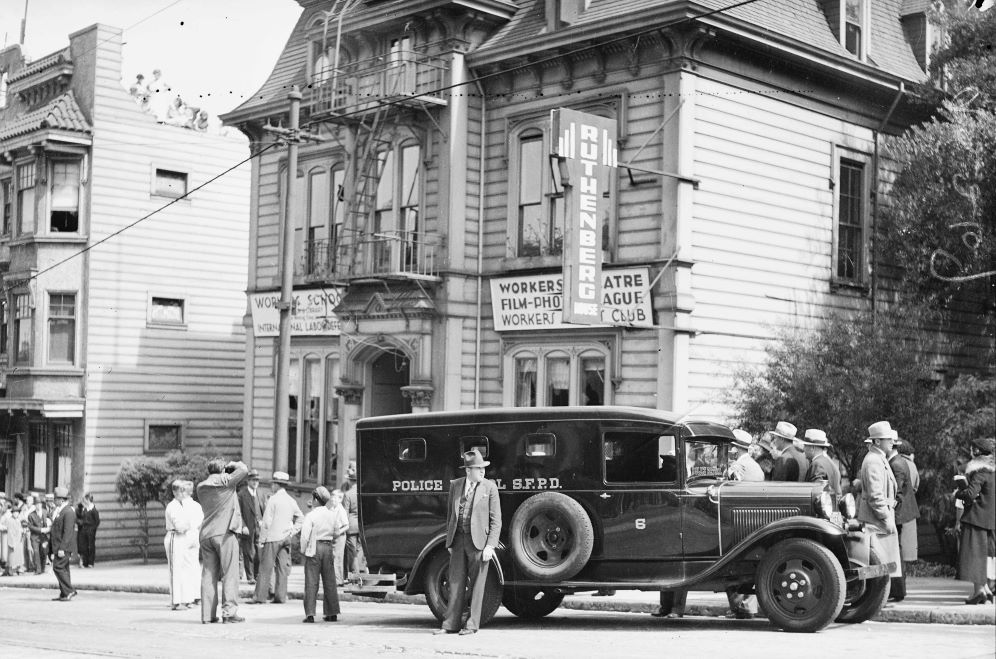
The general strike has united the forces of reaction against the working class in its attempt to organize. These raids, conducted now to break the unions and to establish the open shop, although they start by attacks on the “reds”, under present conditions gather momentum, form part of a process of crystallization out of the forces of utter reaction, determined to crush all democratic rights. It is hardly an accident that the inception of this process on such a scale should occur in the city that witnessed the frame-up of Tom Mooney. It is the same A.F. of L. bureaucrats who betrayed Mooney that also betrayed the General Strike. Only the united front of workers’ organizations, including all trade unions, can meet properly the attack of the incipient fascists whose forces are being gathered now to prevent the closed shop. The reactionaries are not yet making their bid for state power but we must prepare to meet this bid.
-JACK WEBER.
The Militant was a weekly newspaper begun by supporters of the International Left Opposition recently expelled from the Communist Party in 1928 and published in New York City. Led by James P Cannon, Max Schacthman, Martin Abern, and others, the new organization called itself the Communist League of America (Opposition) and saw itself as an outside faction of both the Communist Party and the Comintern. After 1933, the group dropped ‘Opposition’ and advocated a new party and International. When the CLA fused with AJ Muste’s American Workers Party in late 1934, the paper became the New Militant as the organ of the newly formed Workers Party of the United States.
PDF of full issue: https://www.marxists.org/history/etol/newspape/themilitant/1934/aug-18-1934.pdf
 Revolution's Newsstand