Sager was a name used by James Hartfield, Comintern representative in the colony and then Secretary of the Porto Rican Section of the Anti-Imperialist League.
‘The Struggle for Independence in Porto Rico’ by J. Nevares Sager from The Daily Worker. Vol. 3 No. 69. April 2, 1926.
Mayaguez, P. R., March 24, 1926.
The ever sharpening revolts of the colonial and semi-colonial peoples the world over also finds its echo in the little island country of Porto Rico. Like their Philippine brothers, the masses of Porto Rico are determined to set their island free from Yankee domination, which has shackled them for almost three decades.
Tho the movement for independence is but recently taking on a mass character, the desire for independence dates back to Spanish times. This desire manifested itself at various periods under the Spanish domain, by insurrections of various revolutionary groups; one of the outstanding insurrections against the Spanish tyranny was the one led in 1870 by Ramon Betances, who was an ardent fighter for independence. As a result of these insurrections the Spanish crown was finally compelled to grant the island to some extent autonomy and grant civil government, giving the island the status of a province of Spain.
In 1898 Porto Rico was occupied by the victorious American troops un-der the command of General Nelson Miles, who came with the pretense of saving the Porto Rican people from the clutches of Spanish tyranny and favor them with the blessings of American institutions of democracy and liberty. The population of Porto Rico soon came to learn what yankee democracy and liberty means. An unscrupulous, rigid military dictatorship was imposed upon the civilian population, and after two years of suffering under the military heel of the democracy-loving yankee invaders, the unfortunate Porto Rican people were finally permanently deprived of the few liberties gained under Spanish rule, and reduced to cutter political slavery and humiliation by the imposition, first, of the Foraker act and later of the similarly infamous Jones act.
Thus politically throttled, the sugar and tobacco trusts and the banks began the systematic and ruthless expropriation of the numerous small holders and peasants of their lands. Extensive sugar and tobacco fields and numerous sugar and cigar factories were established and into them the propertyless masses were driven to be most ruthlessly exploited. So intense was the exploitation and so impossible grew the conditions of life that they soon gave birth to organized resistance in the form of labor unions.
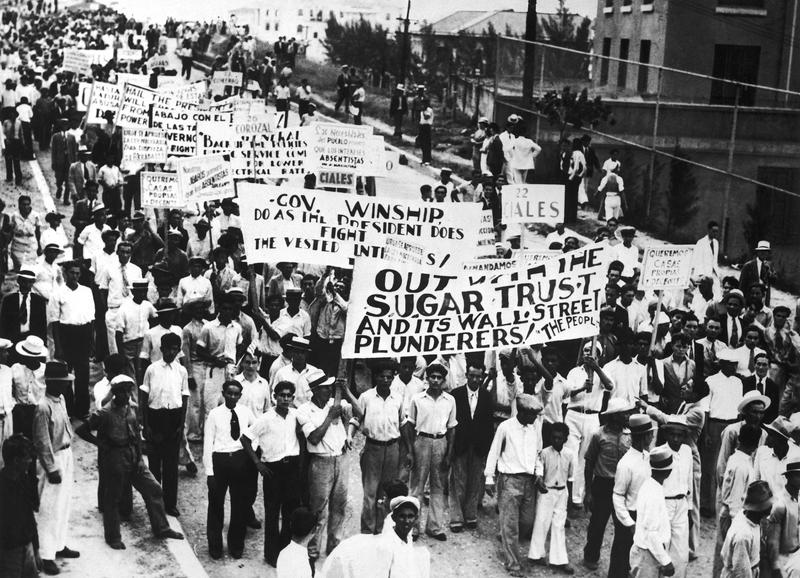
The newborn labor movement promised to follow militant lines; it became threatening to the landlords and manufacturing corporations. But the situation for the imperialists was saved by the American Federation of Labor. The Gompers bureaucracy undertook to guide the Porto Rican labor movement upon the sure path of Gompersism. The American Federation of Labor succeeded in placing at the head of the Porto Rican Free Confederation of Labor and at its political adjunct, the socialist party, one of the vilest of Wall Street’s labor lieutenants namely, Santiago Iglesias, a labor fakir of the first magnitude.
Yet, in spite of the reactionary leadership forced on the movement, the years during and those immediately following the war witnessed great general strikes, which in many instances almost assumed the character of armed revolts. However, these mass movements were finally crushed by the superior imperialist forces, aided by the Iglesias outfit. It is interesting to note that for his service to imperialism against the working class of Porto Rico fakir Iglesias was recently awarded the desirable post of Spanish secretary of the Pan-American Federation of Labor (known to intelligent Latin-American workers as the Pan-American Federation of the Betrayal of Labor.)
After these defeats the working masses became passive and indifferent towards further resistance; the situation looked hopeless. However, it is now apparent that the situation will in the near future be altered. The successes gained by the revolting colonial people, the insistent stand made by the Filipinos for independence, are instilling a new breath of hope into the masses of Porto Rico.
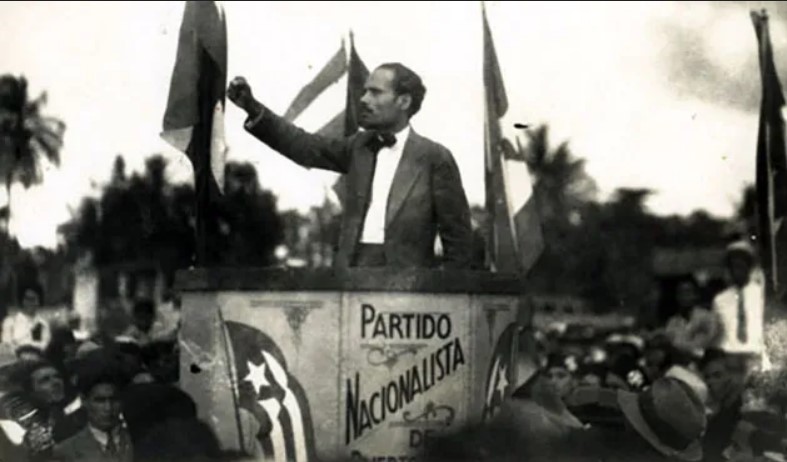
The struggles for independence is taking on new life and will proceed more surely. Thus we have the birth of a new nationalist party, which demands the immediate and absolute independence of Porto Rico, and that it means business is demonstrated by its activity. It organizes the nationalist youth for the struggle; it exposes the native cliques who act as lickspittles of the imperialist invaders; it has gone so far as to call upon the people not to pay taxes and to boycott the insula government thru the resignation of all Porto Rican employes, and finally it has issued a call for a constitutional convention to create the republic of Porto Rico.
Another significant development is the Porto Rican section of the All-American Anti-Imperialist League. The section was initiated thru the organization at Mayaguez of a united front committee consisting of members of the nationalist and socialist parties and trade union locals. Tho yet in its infancy, the section has already attracted wide attention and is winning adherents from among all anti-imperialist elements.
The sharp resolution adopted by the section in connection with the Mella affair in Cuba has created such an impression thruout the island that it forced the consul of the Machado government to issue a statement in the press, which not only failed to weaken the resolution but rather gave it strength in that it admitted that Machado is selling Cuba to Wall Street for a loan.
Together with the growth of the nationalist movement, the near future holds in store the realignment and revival of a militant class struggle. The proletarian struggle will coordinate with the nationalist movement, for in Porto Rico national political independence is the first step to be gained on the road to the proletarian revolution, which will be achieved under the leadership of the coming Communist Party of Porto Rico.
The Daily Worker began in 1924 and was published in New York City by the Communist Party US and its predecessor organizations. Among the most long-lasting and important left publications in US history, it had a circulation of 35,000 at its peak. The Daily Worker came from The Ohio Socialist, published by the Left Wing-dominated Socialist Party of Ohio in Cleveland from 1917 to November 1919, when it became became The Toiler, paper of the Communist Labor Party. In December 1921 the above-ground Workers Party of America merged the Toiler with the paper Workers Council to found The Worker, which became The Daily Worker beginning January 13, 1924.
PDF of full issue: https://www.marxists.org/history/usa/pubs/dailyworker/1926/1926-ny/v03-n069-NY-apr-02-1926-DW-LOC.pdf
 Revolution's Newsstand