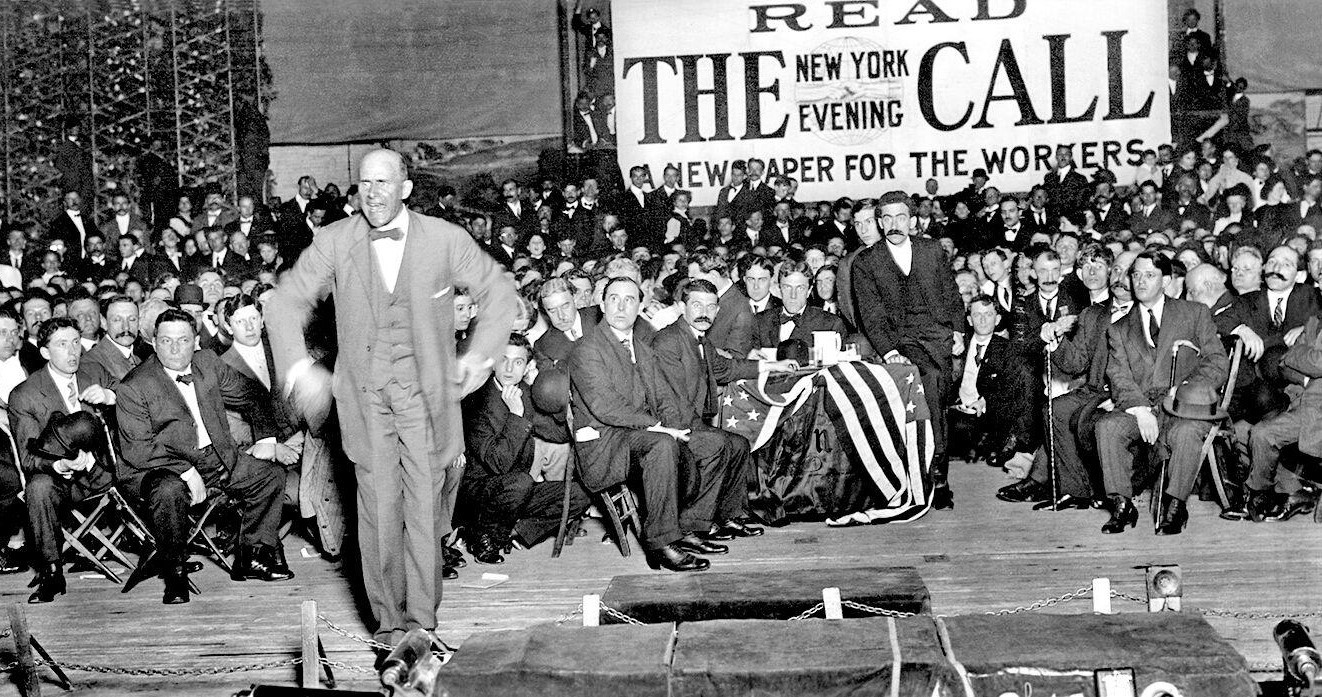
The Red Special rolls into New York City’s Grand Central Station where the standard-bearer of Socialism is greeted with immense excitement and exuberance.
‘Red Special Met by Cheering Thousands’ from The Chicago Daily Socialist. Vol. 1 No. 110. October 5, 1908.
Grand Central Station Scene of Astonishing Reception to Socialist Candidate–How He Was Greeted at the Big Meetings–Love and Devotion Go Out to the Great Working Class Champion.
Debs Has to Fight His Way Through Them.
When the “Red Special” pulled into the Grand Central Station at 2 o’clock Sunday afternoon two thou- sand people gave it a tumultuous greeting. They had been gathering for two hours. At the first sight of the famous train a great cheer went up and the cheering grew in volume when Eugene V. Debs appeared.
The Socialist candidate was accompanied by his brother, Theodore, and S.M. Reynolds of Terre Haute, both of whom have accompanied him upon his record-breaking journey on the “Red Special” Henry L. Slobodin, representing the local party, had boarded the train outside the city and accompanied the party to the Grand Central Station.
Mr. Debs looked thin and tired. That the work incident to the journey has told upon him was apparent, but there was the same eager gleam in the eyes, the same cordial, sincere smile, the same buoyant spirits, the same ardor and enthusiasm that re- veal the unquenchable soul which is Eugene V. Debs, and no one else’s. No wonder the waiting crowd cheered when they saw him. There is only one ‘Gene Debs, after all.
An Excited Crowd.
The crowd was jammed so closely against the gates in the depot that it could not be thrust back to allow them to be opened. Debs and his party had to make their exit through the baggage room on the Vanderbilt avenue side.
They reached the street just as the crowd came sweeping around the corner from the depot entrance. That crowd was determined not to be denied.
From then on there was a scene unprecedented in all of Debs varied experience.
The mob–and it was little less–made a grand rush for him. Theodore Debs and Mr. Reynolds each held one of his arms and tried to save him from the onslaught of frenzied admirers, who sought to touch him and to shake his hand. Horace Traubel, Ludwig Jablinowsky, Henry Slobodin and William Mailly helped to keep back the crowd as best they could.
So persistent and pitiless were the excited people in their efforts that, for sheer self protection, they had to be beaten back. But they returned again and again. And again and again they were beaten back.
And so, fighting, struggling, shoving and pushing, the little group, hanging together and bracing themselves against the successive shocks of attack, fought their way, literally inch by inch, from the depot to Forty-fourth street along Madison avenue and down Forty-second street to the Grand Union Hotel. A champion football rush was tame compared to it.
Yelling and scrambling and protesting, the crowd tried frantically to reach Debs, but it was no use. The hotel was finally reached with the Socialist leader and his bodyguard exhausted and sore from their experience.
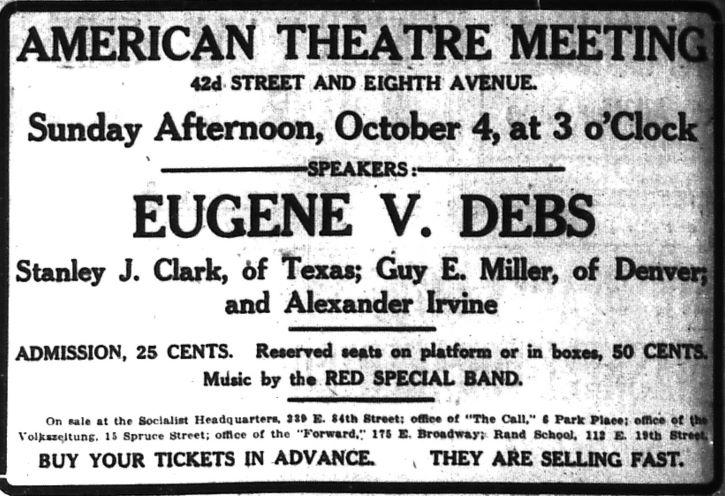
It was only by stubborn resistance that the crowd was prevented from following Debs into the hotel, and the police had to clear the sidewalks and drive the people into the street. There they waited patiently, until getting discouraged, they gradually dispersed to go to the already crowded Hippodrome and American Theatre.
At the Meetings.
In the meanwhile Debs himself rested. It was 4:50 p.m. before he left the hotel for the meeting places. He went to the American Theatre first. He only spoke there a few minutes as he had to reserve himself for the larger meeting at the Hippodrome.
Guy Miller was speaking when Debs appeared on the American Theatre stage. Miller had to stop right there. One sight of Debs was enough. The audience arose and gave its welcome.
For ten minutes Debs had to stand while the cheering went on. When it stopped he did not wait to be introduced by Chairman Lee. When he was through he was hurried away to the automobile waiting outside. The Hippodrome was reached in a few minutes.

It was hoped to get Debs into the building and onto the stage quietly enough not to interrupt the proceedings. The United Workmen’s Singing Society, 250 voices strong, was lined up in the front of the big stage getting ready to sing another song. But they never sang that song.
Just at that moment a murmur ran through the immense building, starting from the stage entrance at the rear and running to the topmost seat in the farthest balcony, that Debs had come. That was sufficient to bring a dramatic climax to the events of the afternoon.
As if galvanized by an electric shock the 10,000 people arose at once and let out a stupendous yell “Debs!” “Debs!” “Debs!”
They Wanted Debs.
That was the beginning of a long, sustained roar of enthusiasm that lasted a full twenty-five minutes. There seemed to be no end to it, and there was not even a lull in it.
And while they stood and cheered the vast audience, waved red handkerchiefs that swayed back and forth in circling crimson waves that surged over the stage up to the dizzy roof. It was an unforgettable, indescribable scene.

The program had been observed closely up to that point, but it had to be put aside. Debs was wanted, and only Debs.
Slowly the members of the United Workmen’s Singing Society retired. Chairman Spargo managed, after strenuous efforts, to get silence long enough to have Debs introduced.
He spoke for over an hour and immediately left the building for the hotel, where he retired to rest early. The “Red Special” left at 6 o’clock this morning with Mr. Debs and his party on board, bound for Boston.
The New York Call was the first English-language Socialist daily paper in New York City and the second in the US after the Chicago Daily Socialist. The paper was the center of the Socialist Party and under the influence of Morris Hillquit, Charles Ervin, Julius Gerber, and William Butscher. The paper was opposed to World War One, and, unsurprising given the era’s fluidity, ambivalent on the Russian Revolution even after the expulsion of the SP’s Left Wing. The paper is an invaluable resource for information on the city’s workers movement and history and one of the most important papers in the history of US socialism. The paper ran from 1908 until 1923.
PDF of full issue: https://www.marxists.org/history/usa/pubs/the-new-york-call/1908/081005-newyorkcall-v01n110-debshippodrome.pdf
 Revolution's Newsstand