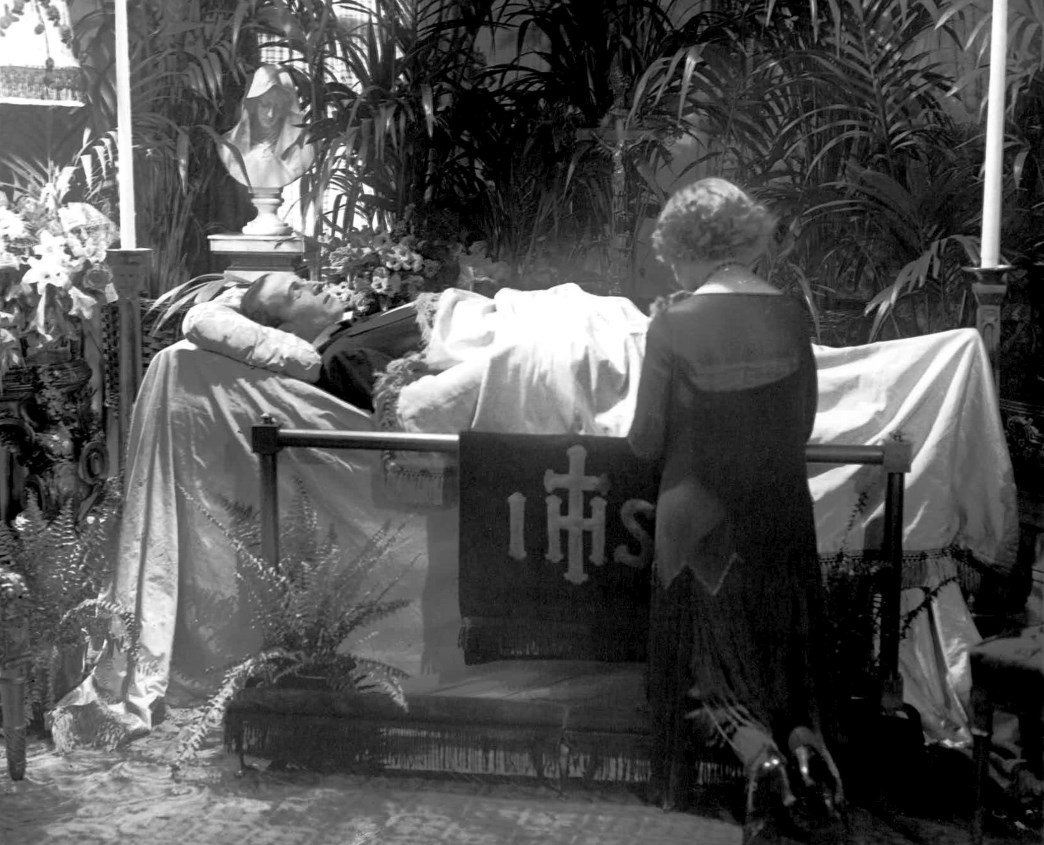
The Cult of Celebrity has a function. J. Louis Engdahl reports on the death of screen idol Rudolph Valentino.
‘Rudolph Valentino Was Creature of Bourgeois America As It Is Today’ by J.Louis Engdahl from the Daily Worker. Vol. 3 No. 192. August 26, 1926.
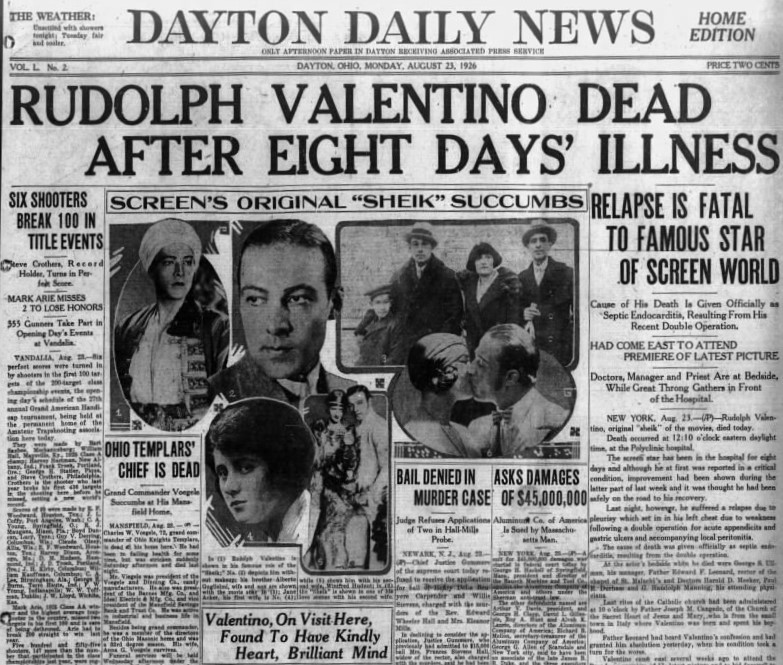
FRONT page headline, full inside pages of type interspersed with pictures, and then a full page of pictures for good measure.
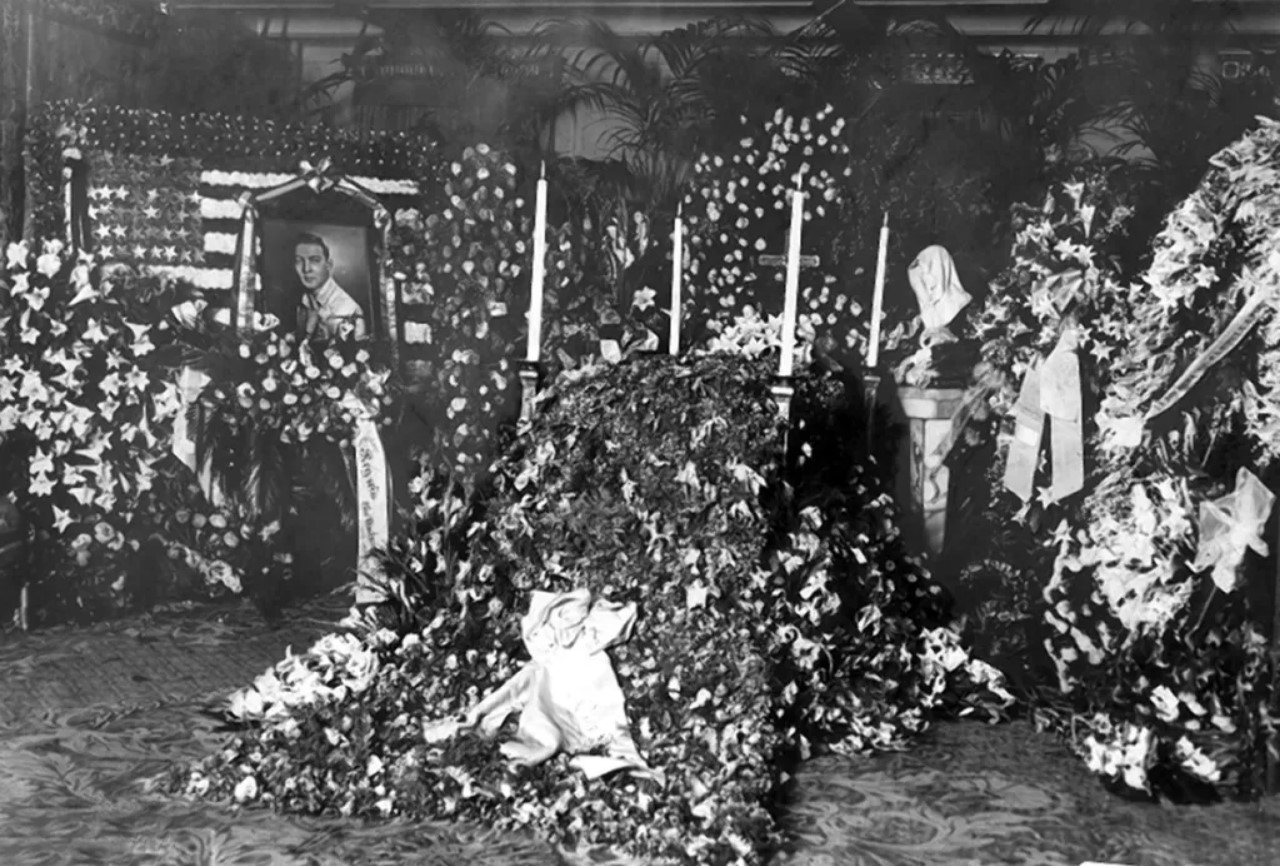
Thus the daily press records the passing of Rudolph Valentino as “Millions of Women Weep” for “The Greatest Lover of the Screen” as the headlines tell the story.
There is no doubt that not another death of an individual in the United States at this time would have received as much attention, Cal Coolidge, Jack Dempsey, or Babe Ruth couldn’t have done as well. Charles W. Elliot, president emeritus of Harvard University, passed away almost at the same time that Valentino died, but his going was almost unnoticed. This in spite of the fact that Elliot had been one of the most widely quoted spokesmen of capitalism, and thru his writings and speeches had managed to keep continually in the public eye. But it was only the “cultured” bourgeoisie that “Five-Foot” Elliot really reached with his appeal. Elliot measured bourgeois culture by the number of inches one covered in reading his five-foot shelf of selected books.
But few workers even remember that Elliot declared, “A scab is the highest type of American citizen.”
Valentino made a well-nigh all-inclusive appeal. When Valentino died no one turned to ask, “Who is Valentino?” Everybody knew him, or had heard of him, especially the millions of the working class, upon both sexes of which the screen sheik exerted an extremely soporific influence insofar as their own class interests were concerned.
Douglas Fairbanks may have gained some pleasure out of portraying the rebellious spirit of “Robin Hood.” Charley Chaplin is known to have contributed to radical causes. No one ever heard that Valentino ever wavered by even the width of a sleek, jet black hair from the line that would win the greatest applause from the largest number.
The pictures in which he appeared always stressed the “sex and blood” appeal that is supposed to approach the universal. In “Monsieur Beaucaire,” “The Four Horsemen of the Apocalypse,” “The Sainted Devil,” “The Eagle,” “The Sheik,” “The Young Rajah,” “The Son of the Sheik” and all the rest, Valentino portrays the role that, according to Ashton Stevens, the Hearst dramatic critic, “made spinsters forget their years and old women remember their youth.” And again, “I have seen women stand in the rain, wet to their noses, to crash a Valentino film.”
Thus the shop girl or the factory girl, touched by the “flesh and blood” of a Valentino film, forgets for the moment her drudgery and agony on the job, much as the weary worker seeks surcease from toil in drink. It thus becomes the best propaganda for the employers’ interests.
Valentino, the original sheik, set the pace for whole strata of the youth of the American population. He was seriously mimicked by large numbers of the young men of the working class, who tried to ape as best they could the impression that Valentino had made upon their woman folk. This problem for the working class youth became greater and obliterated any working class problem that might engage their attention.
Stevens wrote before Valentino’s death, “Men envy him with green hearts. Perhaps they tried to see themselves as Valentinos–and their imagination buckled. Man is a masquerading creature who loves to wear a fez or a badge, or a uniform…”
So one finds the men of the middle class, who belong to the Elks or some similar fraternal organization, strutting about in public with sheik trousers and the Valentino sideburn, trying in vain to escape from their humdrum social surroundings. But they are all Babbits still.
There will be other sheiks of the screen. Valentino’s place will be filled as long as there is a demand for that sort of stuff.
The Valentino films doubtless would create but little impression in the Soviet Union. “Monsieur Beaucaire,” where a noble is supposed to degrade himself by masquerading as a barber, would be hooted out of the Workers’ Republic, where all nobles have been eliminated and nothing considered nobler than being a worker.
Labor realizing its own interests in time in the United States will demand something better from the screen, leaving the hogwash of “sex and blood” to a decaying bourgeoisie. There will be a greater demand for the films coming out of the Union of Soviet Republics that Douglas Fairbanks praised so highly during his recent visit there.
Now, with Valentino the sheik of the screen, the American movie censors bar “Potemkin,” the Soviet film that was recently given a private showing and privately lauded for its excellence in New York City. It was never allowed a public showing. No protest came from the American working class. It never knew, except that section of it that reads the Communist press.
The early trials of Valentino hunting jobs in New York City almost parallel similar experiences of Bartolomeo Vanzetti, another Italian. They both went hungry on the streets of the great city.
Valentino, however, won his way into the good graces of the class that rules, that lionized him and now slobbers over his memory. Vanzetti took the hard road. He fought for his class against the class that rules, that sought as a result to crush him. While Valentino was in the limelight, Vanzetti was hidden away in his prison cell, forced to await the workings of the death sentence meted out to him. There he sits still.
Valentino, the hero of the social order that is passing, won his temporary applause. He disappears with the yesterdays. He has typified the days in which we now live in these United States.
Vanzetti, with Nicola Sacco, condemned with him, as heralds of the new social order, will live even in death as the standard bearers of labor’s struggle. They will not be forgotten down thru the years. They are of the tomorrows.
The Daily Worker began in 1924 and was published in New York City by the Communist Party US and its predecessor organizations. Among the most long-lasting and important left publications in US history, it had a circulation of 35,000 at its peak. The Daily Worker came from The Ohio Socialist, published by the Left Wing-dominated Socialist Party of Ohio in Cleveland from 1917 to November 1919, when it became became The Toiler, paper of the Communist Labor Party. In December 1921 the above-ground Workers Party of America merged the Toiler with the paper Workers Council to found The Worker, which became The Daily Worker beginning January 13, 1924.
PDF of full issue: https://www.marxists.org/history/usa/pubs/dailyworker/1926/1926-ny/v03-n192-NY-aug-26-1926-DW-LOC.pdf
 Revolution's Newsstand