
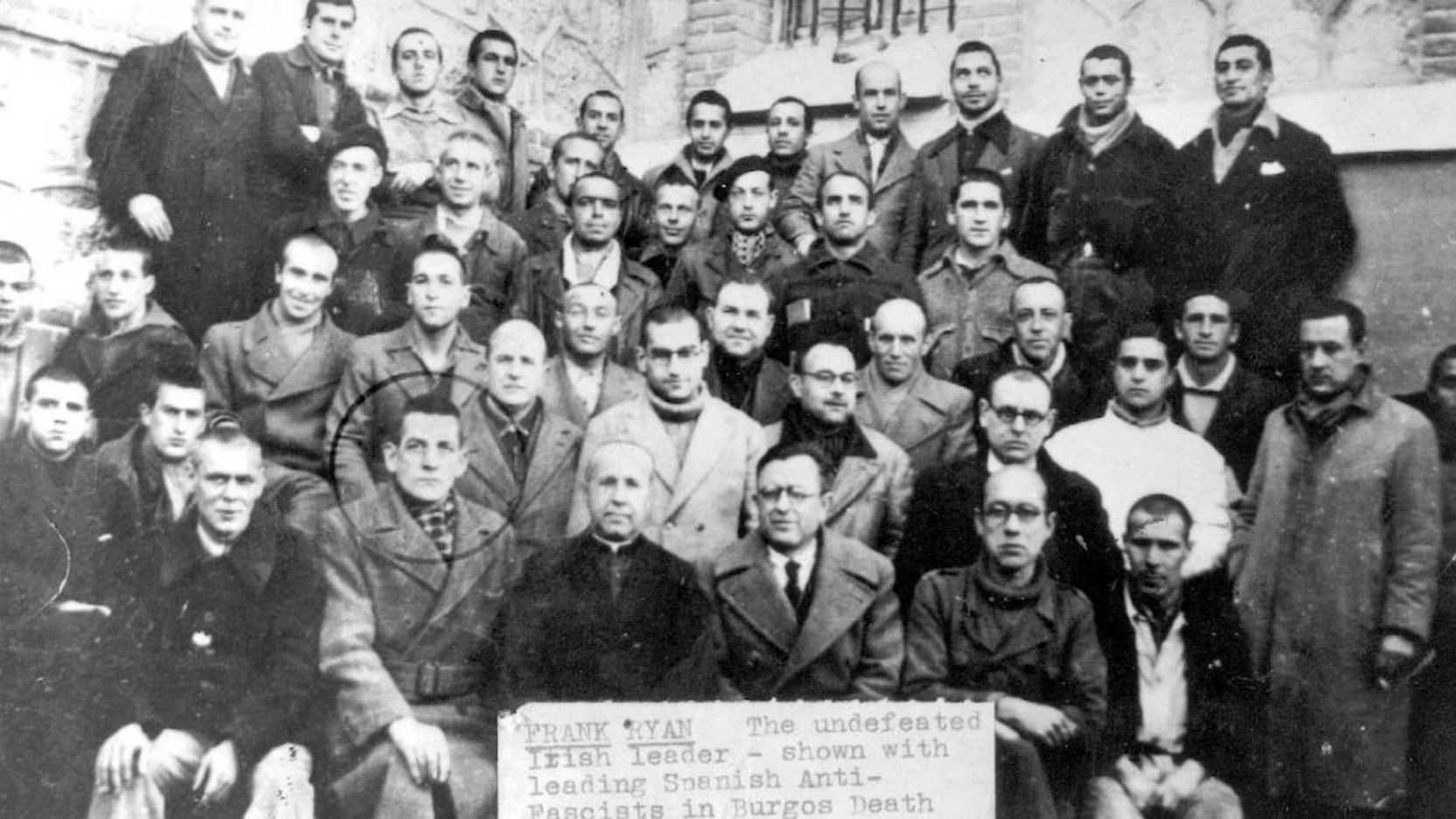
A letter from Frank Ryan, leader of the Irish Republican Army and the now-called ‘Connolly Column’ of the International Brigades, to a wounded comrade returned to Ireland with news from the front and of the remaining Irish volunteers. Two weeks after this letter, Ryan was captured by Fascist soldiers.
‘Letter from Frank Ryan in Madrid’ from the Daily Worker. Vol. 15 No. 125. May 25, 1938.
One Irish Fighting Man to Another: Frank Ryan Writes to Veteran of Spanish Loyalist Army on What ‘The Lads’ Are Doing
The following letter was written by Frank Ryan, leading Irish Republican who has been fighting with the Loyalist International Brigade of the Spanish Republican Army since it was organized. It is written to Paul Burns who returned from Spain wounded and with the rank of Captain. Burns is the National Commander of the Veterans of the Abraham Lincoln Brigade and recently became a member of the editorial staff of the Midwest Daily Record.
Albacete, Spain Feb. 26.
Dear Paul:
Your fine story on Mick Kelly which I have just read in the Sunday Worker jogged me to hunt for a letter which I got from you a month ago. At that time I was doing a 24-hour day and had no opportunities for letter-writing. stowed your address so carefully away that it has taken me a few hours now to find it.
First, to answer your questions. Jacky Power is still here doing a good job in a training camp, but worrying me with repeated demands for a gun and a seat in a camion to the front. Paddy is home. Billy is still here. Peter O’Connor is home since last September. He was pretty sore when I pulled him out after Brunete–felt that after surviving that he just could never get killed. Had a letter a few days ago from Joe Monks. He and Frank Edwards are now doing their bit–and doing it well–on the home front. In all there are a few dozen at home, seven of whom have lost the use of one hand at least. They are all sticking well together and news about them is very encouraging.

I am enclosing copies of the two poems by Charley Donnelly. Poor old Charley, his death is one of the tragedies of those breathless days just a year ago when men just had to fling themselves across the path of the fascist advance. Today we are in a better position to utilize men of Charley’s calibre in their proper sphere. It’s not the death of the poet I lament–for I never thought of him in that role; modern poetry is something I generally prefer to see written as prose–it is the revolutionary thinker I mourn. With a few more year’s experience, for he was still too much of the student, Charley would have been invaluable to us. I always wanted to pull him out of the Battalion, but as you may recall the circumstances in January, 1937, didn’t give me many chance. Charley and I used to be in opposing wings when he first came into the movement in Ireland. He was all theory then and had little use for my “nationalism” as he called it. He went to work in London–dishwashing for a while! for a year and then wrote me to agree that there was a lot in my point of view. In fact he made the mistake of swinging temporarily too much away from internationalism. But, after that year in London, and had he survived this war, what an asset he would be to the Irish revolutionary movement.
Just a few days ago I went along on a tour of through the old Jarama battlefields where he and so many others of ours fell. It was a sad journey for I couldn’t keep them out of my mind and though it ended for me in a fiesta in a town in which I had once slept cold and hungry on the way to that battle 12 months ago all I could do was to wine–and that too well–to try to forget. (Incidentally, having broken a doctor’s rule, I’m paying for it since I’m no longer the hefty two-fister I used to be.)

So you are writing up the Connolly section. May I suggest that for the moment you confine it to a series of newspaper articles on them, and then combine yours with my information on the original Number one section? Which brings me to my next point.
I can guess how you all felt when we took Teruel, and how you feel now. It was in its last stages about 40 Brunetes rolled into one, and then some more. Certainly the staffs of modern armies have been able to learn a lot about the power of aircraft, as a result of this war in Spain. When it’s machine versus men, the machines win. Well, we’ll just do our best to equalize on the machines, that’s all there is to it. While I won’t say the final result leaves me unmoved, it certainly leaves me unperturbed.
Incidentally the Brigade still lives. All those reports about its annihilation were bunk. And it distinguished itself. You remember how we felt after Brunete? There was, this time, a far better feeling among the lads. And, considering the intensity of the fighting casualties were low. So, none of you need worry.
In case you think, too that I am hourly risking my carcass, I want to tell you that all this month old Madrid has been my base. My main work is the unsoldierly task of editing the Brigade Book, a record of soldiers’ narratives from the first days up to Xmas. I will send you a copy in a week or so by which time I will be back at the Bde. It will be printed in a few different quality papers–SO acute is the paper problem.
Madrid is as ever quickly covering up its scars after every bombardment. Now and then I hear the shelling, most times folk tell me about it. (Great to be deaf!) I used to have a knack which I have lately lost of blundering into every bombardment, and blundering out again. I do find though that the farther away from the front I am, and therefore the less willing to take a chance, the more funky I get. One shell whizzing over the chimney pots of my abode puts me more in the jitters than a whole bad day at the front.
Well, a mhic, I will finish this. I have had no news from Ireland for weeks; our folk there seem to be damnably lazy. There is a damn sight more political stagnancy on the left there than I like to see. You probably know Gerald O’Reilly, get in touch with him. He is my best friend over that side, and an indefatigable worker for us. I used to be a fairly good correspondent of his; lately I’ve lapsed a lot.
Say me to the O’Flaherties and tell them what I think of them for failing to go back via Ireland that time. Drop me a line now and then. Maybe you’ll see me in the fall. Meanwhile in all propaganda ye make over there ye should stress why really we are here: not just as a counter-blast to O’Duffy, but because the freedom of our own country is vitally affected by the war here.
(But why should I be propagandizing you? Go, do your stuff!)
Beannachta,
-FRANK RYAN.
The Daily Worker began in 1924 and was published in New York City by the Communist Party US and its predecessor organizations. Among the most long-lasting and important left publications in US history, it had a circulation of 35,000 at its peak. The Daily Worker came from The Ohio Socialist, published by the Left Wing-dominated Socialist Party of Ohio in Cleveland from 1917 to November 1919, when it became became The Toiler, paper of the Communist Labor Party. In December 1921 the above-ground Workers Party of America merged the Toiler with the paper Workers Council to found The Worker, which became The Daily Worker beginning January 13, 1924.
PDF of full issue: https://archive.org/download/per_daily-worker_daily-worker_1938-05-25_15_125/per_daily-worker_daily-worker_1938-05-25_15_125.pdf
 Revolution's Newsstand