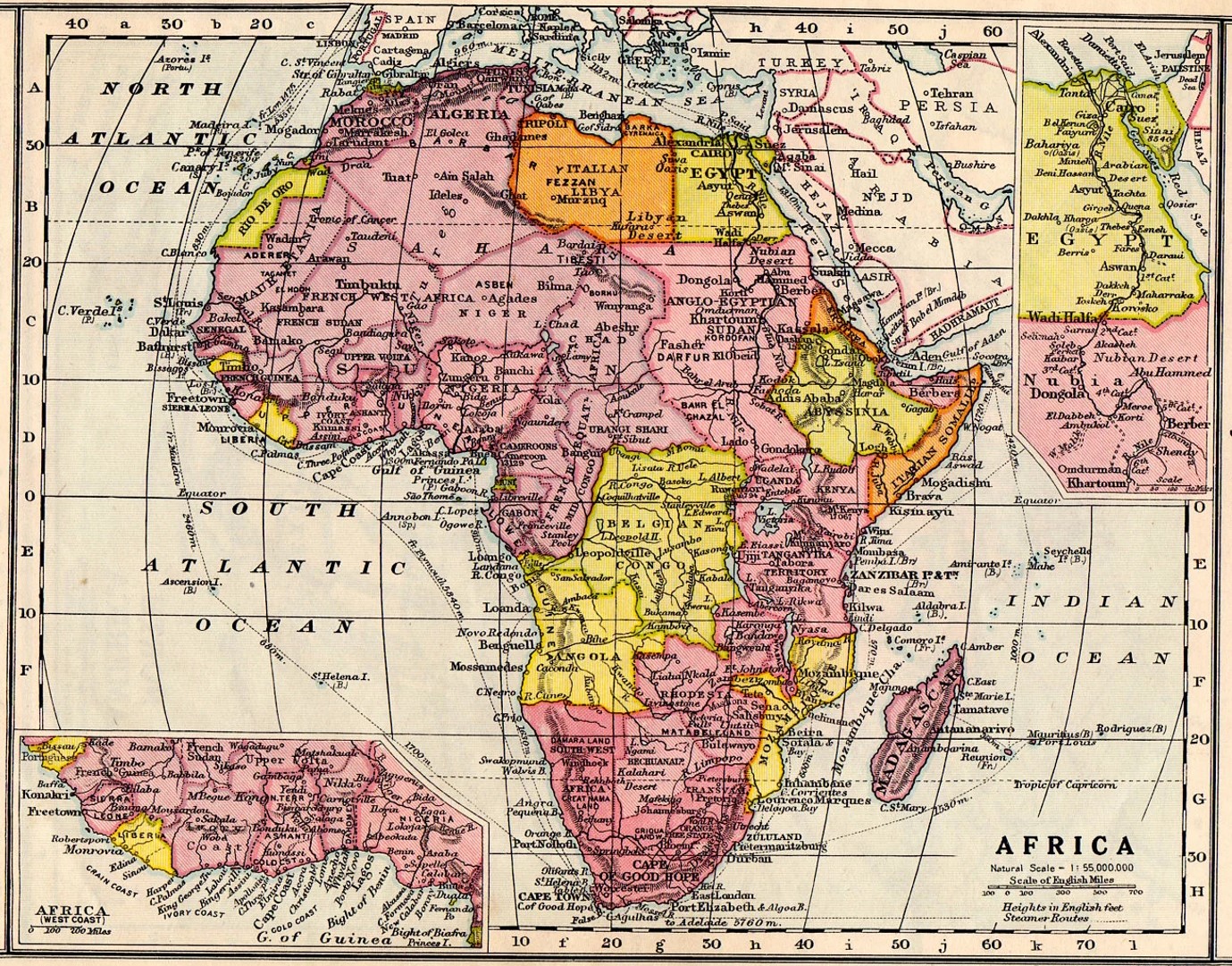
George Padmore looks at the quickening pace of conflict among imperialist powers in the run-up to World War Two.
‘A New World War for Colonies’ by George Padmore from the Crisis. Vol. 44 No. 10. October, 1937.
IN our previous article we treated the population question in its relation to empire. Here we propose to take up the several other issues involved. We will turn first then to the problem of raw materials.
Which of these products constitutes the essential elements of a modern industrial state? They are coal, iron, copper, lead, chrome ore, bauxite (for producing aluminum), antimony, asbestos, gold, silver, platinum, graphite, manganese, nickel, mercury, mangasite, tin, zinc, tungsten, vanardium, molybdenum, petroleum, potash, phosphates, nitrates, sulphur, iron pyrites, cotton, jute, manila, manila hemp, wool, palm oil, rubber, sisal, soya, sesame, linseed, timber, ground nuts, tea, sugar, coffee, cocoa, copra, flax, colza. All of these are important, but the six of most importance are iron, coal, petroleum, rubber, cotton, copper. The nation which controls these is not only able to maintain its industrial system working at all times, but has a great military advantage over an opponent in time of war.
It was precisely because of the importance of raw materials that the capitalist classes of Europe began to parcel the backward regions of the world among themselves during the latter part of the last century and the first decade of the present. However, this struggle for territorial monopolies is not yet over. Rather it has become an even more intensified battle between those nations which possess raw materials the “Haves” and those who seek to possess the “Have Nots.” It is therefore necessary to see which powers control these products, and to what extent, if any, the non-controlling powers are denied access to raw materials.
Three Nations Self-Sufficient
Great Britain, the U.S.A., and U.S.S.R., are, relatively speaking, self-sufficient, while France, Germany, Italy and Japan are deficient in the control of essential raw materials.
America is the world’s largest producer of cotton, petrol, coal, lead, zinc, phosphates, sulphur, molybdenum, cotton seed, and second in the production of silver, copper, iron, oxide, bauxite and wool, with big reserves of timber, mercury, magnesite, gold and tungsten.
Next is the British Empire, including the dominions and colonies. Within this far-flung empire are to be found 71% of the world’s gold resources, 58% of rubber, 99% of jute, 86% of nickel, 59% of platinum, 42% of tin, 43% of lead, 71% of asbestos, 32% of zinc.
The Soviet Union is also rich in natural resources. She possesses tremendous amounts of manganese (28%), chrome ore (7% to 28%), asbestos (7% to 27%), magnasite (15%), flax and hemp, as well as great quantities of other products necessary to her rapidly expanding industrial system. She ranks among the world’s greatest producers of petrol, a vital commodity which Germany, Italy and Japan lack.
These latter three powers, although not as favorably placed as those above, nevertheless, are not altogether lacking in raw materials. Germany is the largest producer of potash (59%), and has large reserves of coal (9%) and zinc (9%) and nitrates. But she has to import rubber, cotton, wool, copper, lead, manganese, tungsten, mercury and petrol.
Italy is the second largest producer of hemp, sulphur, mercury and olive oil, but is deficient in iron and coal, both of which she has to import. Japan, while being the largest world producer of silk and graphite (from Korea), is a large importer of rubber, petrol and cotton, none of which she has direct access to.
It is interesting to note where France comes in, for she controls the second largest colonial empire in the world. However, she obtains very little of the raw materials essential to her industrial life from within her empire. Although she has access to iron, potashes (from Tunis, Morocco. Algeria), nickel and chromium (from New Caledonia), graphite (from Madagascar), and vegetable oils (from West Africa), she is deficient in coal, rubber, lead and zinc, and possesses no petroleum or cotton, two of the most essential commodities in peace and war. Nevertheless, France is not a dissatisfied power. Unlike Germany and Italy, she does not demand more colonies. Nor does she complain about not being able to obtain raw materials.
Why? Because France is rich. She has always been a country with vast financial reserves. Thanks to this she is able to buy all she needs in the open market.
In this respect there is much in Sir Norman Angell’s statement that “It is not true that the main economic needs of modern nations are territory for raw materials and markets problem is more one of glut than one of scarcity. No country in the world refuses to part with the raw materials and markets that it produces. All are ready to sell to anyone with money. Money must be forthcoming, whether the raw material is bought from conquered territory or from foreign countries.”
Lack of Purchasing Power
This, however, is not the whole truth. The problems of the world’ are not so easily disposed of, for while it cannot be denied that Italy and Germany have the same right as England, France and the U.S.A. to buy whatever raw materials they need, it must also be recognized that they do not possess equal ability to buy. For the simple reason, that they do not enjoy the same advantages to sell their manufactured products in the colonial and semi-colonial territories and other areas under the political or financial domination of their more favored imperialist rivals. Because of the policy of economic nationalism pursued by all great imperialist nations, Italy and Germany find it very difficult to pay for the materials they need. Their problem is one of markets, for it is an elementary principle of economics that imports can only be paid for by exports, and to a more limited extent, by credits for services rendered to foreigners, or, as in the case of Italy, by remittances sent home by Italian immigrants in America. Herein lies the whole crux of the problem. Therefore, it is sheer humbug and hypocrisy for the “Haves” to say that there is no discrimination against the “Have Nots;” that the latter can obtain all the raw materials which they need while at the same time the “Haves” keep the commodities of the “Have Nots” from their metropolitan and colonial markets.
It is this very “closed door” or monopoly policy which has accentuated currency difficulties in Germany and Italy, making it even more difficult for these countries to obtain valuta, that is to say, foreign currency with which to purchase their raw materials. Generally speaking, the difficulties of Germany and Italy, like most other States, arise out of the disorganized world capitalist economy, the result of the breakdown of the whole capitalist system.
These market and currency difficulties instead of proving the argument advanced by certain apologists for British imperialism that colonies are of no advantage to the possessing power, prove just the opposite. For due to the monopoly character of imperialism, the nations which possess colonies have two advantages, especially at this time of intensified economic nationalism and shrinking world markets. First, they can link up their colonies with their own currency systems and in this way obtain the raw materials produced in the colonial areas, without the necessity of having to find valuta to pay for such products. Secondly, the imperial nations also have the opportunity of selling their manufactured goods to the peoples of the subjected nations at high rates of profit. This form of exploitation is achieved by the simple process of keeping out the goods of rivals by tariff laws, imposing discriminatory and preferential import taxes, and other trade regulations.
British “Closed Door”
This is exactly the policy which England, the traditional leader of free trade, has resorted to, particularly since the Ottawa Conference. Gone are the days when the British capitalists are able to boast, as did Chamberlain in the ‘nineties of the last century: “We in our colonial policy as fast as we acquire new territory, develop it as trustees for civilisation, for the commerce of the world. We offer in all these markets over which our flag floats the same opportunities, the same open field to foreigners, that we offer to our own subjects and upon the same terms. In that policy we stand alone, because other nations as fast as they acquire new territory… seek at once to secure the monopoly for their own products by preferential and artificial methods.”
The British bourgeoisie has. gone wholeheartedly over to the policy of the “closed door.” Prior to the adoption of this policy, Japanese goods were squeezing British products out of many colonies. For example, Japanese textile exports rose from 25,000,000 yards in 1927 to 63,000,000 yards in 1933 in certain East African colonies alone; while British goods fell from 23,000,000 yards in 1927 to 10,000,000 in 1933. But since the initiation of preferential and protective tariffs, Britain has been able to exclude Japanese textiles from many parts of Africa, the West Indies and other Crown colonies, which have been more or less converted into markets exclusively for the more expensive Lancashire goods.
Britain, however, is not the only country pursuing such a monopoly policy. Japan is also doing the same in Manchuria, Korea, Formosa and Sakhalin; and France in her West Indian colonies, Madagascar, Reunion and Indo-China, where “economic assimilation” has advanced to such a stage that these territories afford 100 per cent preferences to the mother country. Since the French Colonial Conference in 1935, this “closed door” policy has been universally applied to the French colonial empire.
The issue, therefore, is not merely a question of imperialist powers affording non-colonial powers or imperialist nations with few colonies, access to raw materials, but one of greater importance, namely, sovereignty. It must be constantly borne in mind that in the epoch of imperialism, the capitalist system has passed from the stage of free competition to monopoly. This being so, the bourgeoisie of the great industrialized nations have not only monopolized the industrial life of the metropolitan countries, but are constantly striving to achieve exclusive control over backward areas of the world, so as to bring them more completely under the domination of finance-capital. For only in this way is it possible for one group of monopoly capitalists to preserve their commercial position against the rivalry of other groups of imperialists on the one hand, and to secure super-profits on their in- vestments, on the other. Therefore, to appeal to the imperialist bourgeoisie to abandon such practices is asking them to do the impossible, for the quintessence of the capitalist system is cut-throat competition among a few great trusts operating on a world scale.
Sovereignty Essential
This brings us to the chief feature of imperialism, which is the export of finance-capital in contradistinction to consumption goods. This process is best facilitated by maintaining direct or indirect political control over the regions in which capital is invested. In this way the controlling power can protect the investments of its nationals and see that its own capitalist class gets the best contracts for public undertakings, such as the construction of railways, harbors, docks, warehouses, bridges, etc.
Even in mandated territories like Tanganyika, where the “open door” policy is supposed to obtain, we find the same monopolistic practices in vogue. This is facilitated by a device which enables the administrators, who are British, to divert all purchases for what are described as public works to the English market. For the clause states that “all purchases made by the mandated territory out of the proceeds of the loans or guarantees must be made in the lending country,” which naturally is England. By this procedure British imperialists kill two birds with one stone: they are able to invest their surplus capital in Africa at higher rates of interest than can be obtained at home, and at the same time, find an outlet for the products of the metallurgical and other heavy industries.
Furthermore, sovereignty over backward areas enables the ruling class of the controlling state to rob the indigenous population of its land (South Africa, Kenya), and then force the people, through taxation, to go to work in the mines and plantations for the imperialists at starvation wages. This is exactly the reason why Mussolini declined all concessions offered him during the Abyssinian crisis short of complete conquest. No imperial power will ever be satisfied with merely the right to buy raw materials and trade with the colonies of its rivals, for its real imperialist aims the exploitation of the natural resources and the labor of the colonial peoples can only be achieved by first establishing absolute control over these regions. Sovereignty is the crux of the whole colonial question, and this can never be solved by peaceful means. For it is obvious that no colonial possession nation will voluntarily share its right of sovereignty with a rival. This applies equally to those territories designated mandates.
Colonies also provide employment for a large number of middle class people and skilled workers in the military and civil services, as well as commercial, banking, shipping, mining and agricultural enterprises, and missionary work, and in this way serve as an outlet for the energies of people who might otherwise be unemployed and contribute to political discontent.
“In the thousands of young men who formed the original fasci there must have been many who, in a country with a large colonial empire, would have been soldiers and officials. It is to be hoped that there may be a real stocktaking of the position, based on recognition of the fact that one reason why colonies are an asset of imperial control is the possibility they offer of a career for young men who, failing that, may well be potent factors in revolutionizing their own countries and, in the not very long run, making a peaceful Europe impossible.” Thus wrote D.V. Brogan in The Spectator, October 27, 1935. This is exactly what happened in Germany, where large sections of the middle class, ruined during the inflation period of 1923, without any possibilities for rehabilitating of the Nazis. But even those who do not themselves overseas, fell into the hands find a career in the colonies indirectly benefit from the super-profits obtained by the ruling class through the exploitation of the colored peoples, a fact which accounts for the bourgeoisification and political corruption of the upper strata of the proletariat of all imperialist nations. This corruption reflects itself in the theory and practice of social democracy and British Labour Party policies on the colonial question.
The imperialists consider colonies as the safety valve against social revolution. And it is precisely for this reason that the European workers can never hope to free themselves without rendering the colonial peoples and subject races of “their” empires the maximum amount of support in their struggle for national freedom and social emancipation.
Valuable Military Adjuncts
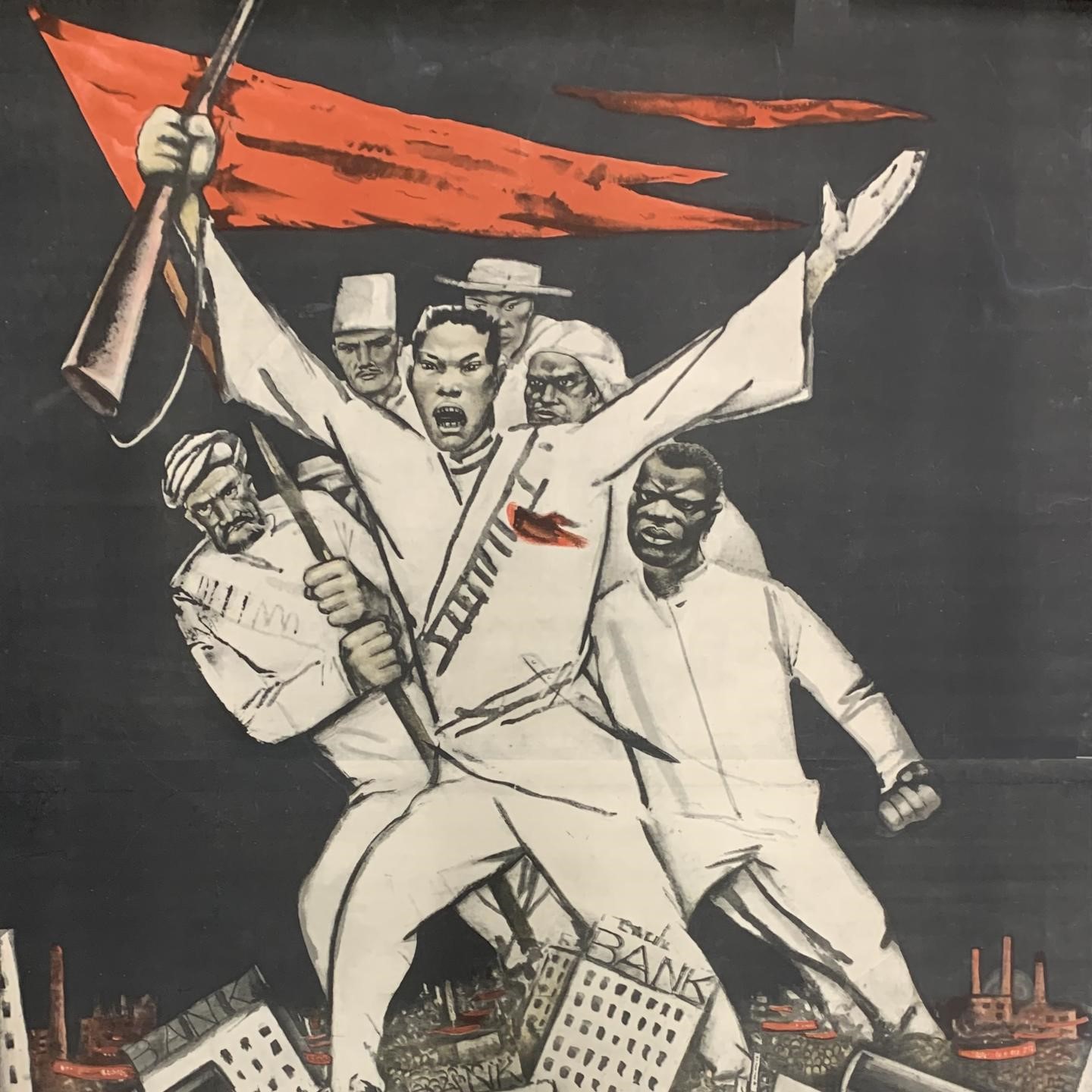
There is yet another aspect of the colonial question which in this epoch of imperialist wars and social revolutions has become of the greatest importance for the ruling class, and that is, the military value of colonies. Apart from providing strategic military, naval and aerial bases, they also serve as reservoirs for cannon fodder. This was demonstrated during the World War, when colonial troops, especially Africans and Indians, were used in whole army corps in major operations in Europe, Africa and the Near East. Over 545,000 African native soldiers were employed by France, chiefly as shock troops in stemming the tide of the German advance during the most critical periods of the war.

At the present time, one-third of the French standing army garrisoned in France is composed of colonial professional troops. These fighters will be the first to be used against Germany when the impending conflict breaks out. The reason for this is obvious. cause of their political backwardness they are considered more reliable than European troops, most of whom are recruited from the peasantry, industrial workers and toiling youth, masses infected with revolutionary ideas and pacifist sentiments. Not without reason, the French general staff looks upon the colonial army as the bulwark of French security on the one hand, and a force to crush any attempt by the workers to achieve a social revolution.
Black Italian Troops
Mussolini also intends to exploit the blacks to further his military ends, as has already been demonstrated during the East African War, when Askaris Italian native soldiers were made to do most of the fighting by placing them in front of the white troops to open the Abyssinian lines for the Italian Blackshirts. The truth is that every European power is beginning to resort more and more to the use of black troops, not only for imperialist wars, but as mercenaries to stamp out democracy and socialism in Europe. Sir Norman Angell, in an address to the annual meeting of the Anti-Slavery and Aborigines Protection Society, in 1936, said, “The real motive of the Italian invasion (of Abyssinia) was not to find It an outlet for its population was not for raw materials. It was to obtain manpower we shall find Italy with a million black conscripts, not to fight in Africa, but in Europe.”
The use of Moorish troops by Franco confirms this, and should serve as a warning to European workers and democrats. This danger threatens France more than any other European country, but British workers should have no illusions that the Francos of England would have any scruples in using Indian and African troops against them. For they have no greater attachment to “Liberty, Equality, Fraternity” than the French bourgeoisie, who have often resorted to the use of black troops in quelling strikes and social un- rest in France.
Re-distribution as a Solution
So much for the general statement of the colonial problem. Now what is the solution, if any? Our contention is that there can be no peaceful solution to the colonial question within the existing social order. However, there are many eminent authorities on imperial and colonial matters who think otherwise. Let us examine their points of view. We shall begin with Lord Lothian, who, as Philip Kerr, was private secretary to David Lloyd George. He served as Parliamentary Under- Secretary of the India Offices 1931-35. This distinguished publicist advocates returning to Germany her colonies and distributing others among dissatisfied powers in order to appease them. Such a suggestion should cause no surprise, for was it not his Lordship who was one of those largely responsible for the annexation of the territories of the defeated powers under the camouflage of mandates? Evidently Lord Lothian is trying to make amends at this late hour. But apart from the shameful idea of treating Africans as chattels, it is hardly necessary to say that the Tories, whose slogan is: “What we have we hold,” would never tolerate such a suggestion. For if German and Italian imperialisms consider colonies necessary for their national well-being, it is logical that the same applies to British imperialism. We can well imagine L.S. Amery saying, “What is good for them is good for us.” The trouble with Liberals like Lord Lothian is that they do not understand, or rather they do not want to understand, that, thanks to the law of the uneven development of capitalism, there can be no such thing as an equitable distribution of territory. For in the imperialist stage of capitalist development the ruling classes of every industrialized nation are all striving after the same objective, namely, monopoly. Monopoly of markets, monopoly of raw materials, monopoly of spheres for capital in- vestment, monopoly of every phase of economic exploitation. It is precisely this monopolistic feature which occupies the first place in the national economics and politics of the great world powers and mitigates against the application of the “Open Door.”
International Control
As against this idea of a voluntary distribution of territories by Lord Lothian, there are others like J.L. Hammond, who suggests that “one by one the problems of colonies should be detached from the rivalries of nations and put under international control,” as a solution of the problem. Let us examine this brilliant idea. Before Mr. Hammond’s project could get started, it would be necessary to prevail upon the predatory imperialists to surrender control over their territories in favor of some international authority. Could anybody imagine such a thing happening? But even if by some miracle the British and other imperialist classes could be induced to commit hara-kiri- which such a surrender of sovereignty would amount to–then, and only then, could Mr. Hammond’s International Civil Service be set up.
But no sooner started than we would be up against another formidable difficulty. For, in order to make such a civil service truly international, it would have to be composed of the representatives of all the great powers, reflecting their different national ideologies–Fascism (Italy), Nazism (Ger- many), Republicanism (France), Socialism (Norway), Imperialism (Britain), communism (Soviet Union), not to mention Catholicism, Protestantism, Zionism–for to disregard these religious elements would be courting disaster. No, no, Mr. Hammond’s idea is too Utopian to admit of any possibility of success. Lord Lugard expressed the opinion that though Mr. Hammond’s wider suggestion is a “great and attractive idea,” experience both in the colonies and on the Man- dates Commission prove it to be unworkable in practice, chiefly for lack of a “common standard.”
The Mandate System
The most serious suggestion, and the one which meets with the widest sup- port in British Liberal and Labor circles is the idea put forward by Sir Arthur Salter, for eight years director of the economic and finance section of the League of Nations, and professor of political theory and institutions at Oxford. In this he is supported by Professor Norman Bentwich, formerly attorney-general to the government of Palestine, and professor of international relations at the University of Jerusalem, and Leonard Barnes, formerly an official in the British Colonial Service, and author of several books on Empire. Dr. Salter’s idea is that the present mandates system be extended to embrace all territories which are at present administered as Crown colonies and protectorates in tropical Africa. At the same time they advocate giving the Mandates Commission the right to visit the mandated territories. Mr. Barnes further contends that in carrying out such an idea the British–and presumably the French–government should demand from the Fascist powers as a quid pro quo certain guarantees for letting them share in the mandates. What are these guarantees?
(1) That they should apply the principle of “trusteeship,” that is to say, the Fascists are to undertake to treat the blacks even better than they treat the Jews, workers, democrats and liberals at home, for trusteeship means paramountcy of native welfare.
(2) That the dictators should agree to disarm.
(3) That they should enter a system of co-operative defence. Defence against whom? Presumably the blacks, for since we take it that Mr. Barnes’ suggestions are being put forward with the object of eliminating imperialist rivalries and wars, we do not know who else he can have in mind. For if Mr. Barnes’ solution is really the solution to the colonial question, then there will be no need for a system of “co-operative defence” except against those whom the united imperialists of Europe will be exploiting, namely, the Africans.
Surely Mr. Barnes, who is undoubtedly in sympathy with the colonial peoples, as expressed in his The Duty of Empire, will admit that even under the most perfect mandatory system, exploitation will continue as long as the economic basis of such a system is predicated upon the principles of capitalism. It is the economic system that has to be changed. The economic and social emancipation of the subject peoples will automatically follow.
Will Be Settled by War
As we have already indicated, the mandatory system is nothing else than a camouflaged device by the Allied powers for annexing the territories of Germany and Turkey without bringing upon themselves the odium of having openly annexed them. The fact which cannot be too often emphasized is that these territories are considered by the mandatory powers as much an integral part of their imperial systems–legal quibbles notwithstanding–as any of the territories acquired by direct methods of conquest.
The attitude of the British Imperial Government on this question was clearly indicated as early as 1927, on the occasion when Sir Donald Cameron opened the newly constituted legislative council of Tanganyika. After reviewing the circumstances under which Britain acquired the mandate, Sir Donald said: “There is no provision in the mandate for its termination or transfer. It constitutes merely an obligation and not a form of temporary tenure under the League of Nations. This obligation does not make the British control temporary, any more than other treaty obligations (such as those under the Berlin and Brussels Acts or the Convention revising those Acts) render temporary British control over Kenya or Uganda, which are no more and no less likely to remain under that control than is the Tanganyika territory. I make this statement with the full authority of His Majesty’s Government. And let this not escape the attention of all who may hear it or read it Tanganyika is a part of the British Empire and will remain so.”
This attitude has been endorsed from time to time by other spokesmen of His Majesty’s Government. Sir Philip Cunliffe-Lister, now Lord Swinton, said in 1934: “His Majesty’s Government has no intention of surrendering the trust which we accepted fourteen years ago. No Government, now or in the future, could contemplate such a step,” while Sir John Simon stated in the House of Commons, in May, 1935, “I make it perfectly clear to Herr Hitler that the transfer of mandates was not a discussable question.” And that staunch defender of the people, J.H. Thomas, Colonial Secretary, assured the House of Commons on February 12, 1936: “His Majesty’s Government have not considered and are not considering the handing over of any of the British colonies or territories held under man- date.” The French imperialists are also opposed to the idea of surrendering their mandates. M. Trentard, Director of the French Mandated Territories, broadcast on April 13, 1936, that France will not give up her mandates in Africa to Germany.
For these reasons we contend that the colonial question must lead, as it did in 1914, to another World War. For only through armed conflict is it possible for the dissatisfied powers to effect a re-division of the world and satisfy their imperial needs.
The Crisis A Record of the Darker Races was founded by W. E. B. Du Bois in 1910 as the magazine of the newly formed National Association for the Advancement of Colored People. By the end of the decade circulation had reached 100,000. The Crisis’s hosted writers such as William Stanley Braithwaite, Charles Chesnutt, Countee Cullen, Alice Dunbar-Nelson, Angelina W. Grimke, Langston Hughes, Georgia Douglas Johnson, James Weldon Johnson, Alain Locke, Arthur Schomburg, Jean Toomer, and Walter White.
PDF of full issue: https://archive.org/download/sim_crisis_1937-10_44_10/sim_crisis_1937-10_44_10.pdf
 Revolution's Newsstand