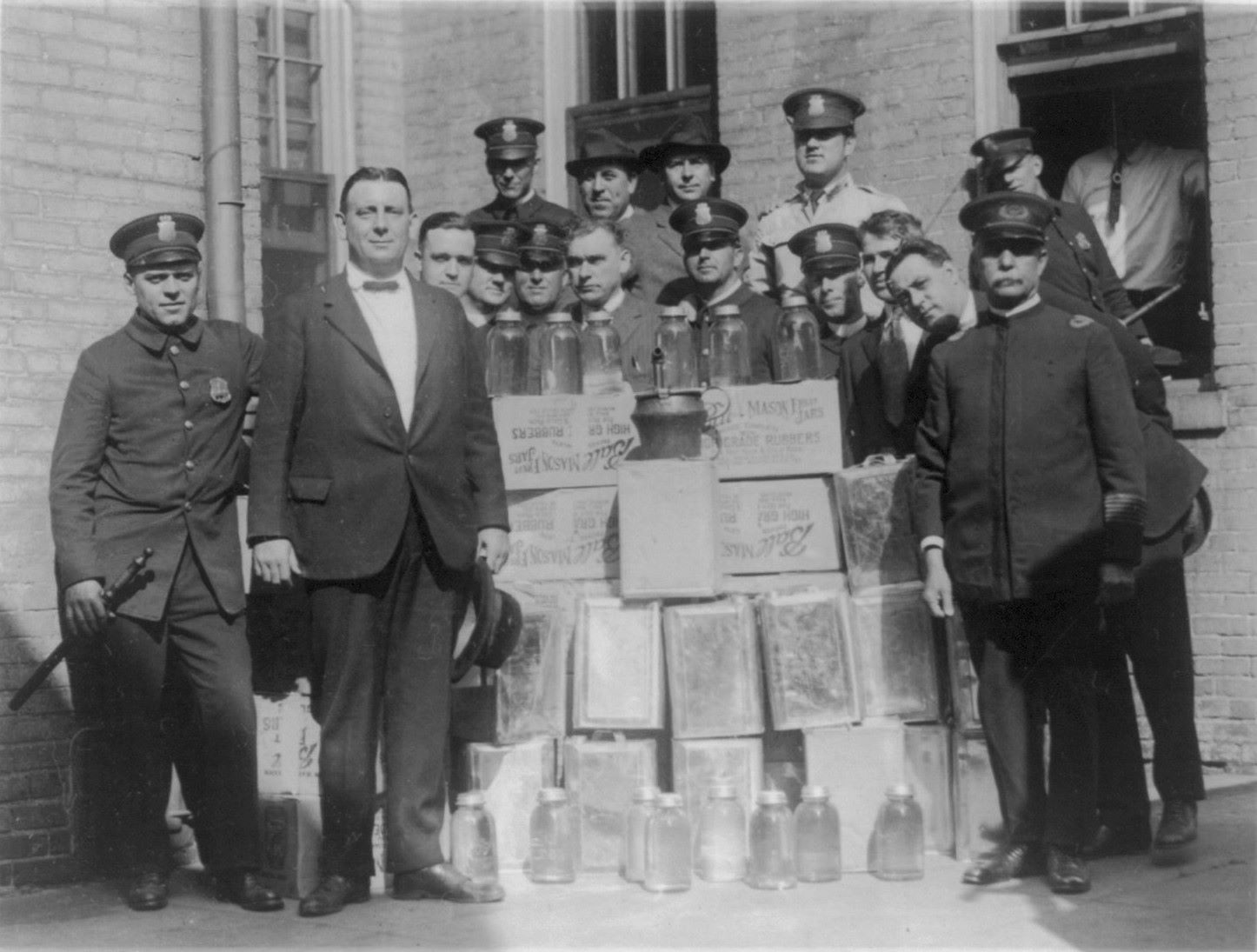
The Communist Party position on the banning of booze. Federal prohibition of alcohol passed as the 18th amendment of the Constitution in 1919 during the wave of reaction following World War One. Impossible to enforce, prohibition saw rise to both vast criminal enterprises and expanded policing powers of the state. A lose-lose for workers. By the late 1920s, when the Communist Party issued this statement as part of their 1928 electoral campaign, prohibition was increasingly unpopular. It would be repealed in 1933.
‘Prohibition’ from The Daily Worker. Vol. 5 No. 124. May 26, 1928.
Prohibition, as it is “enforced” and violated in this country is one of the most outstanding examples of capitalist corruption and hypocrisy.
The Workers (Communist) Party takes the following stand on the prohibition issue.
Prohibition was introduced in the interests of the manufacturers. As the Pennsylvania Manufacturers’ Journal put it: “We believe there is no question of greater importance to American manufacturers, the great employers of labor, than prohibition.” The prohibition of the consumption of liquor decreases the needs of the workers, and thus tends to decrease the price of his labor power. The introduction of prohibition was part and parcel of the big rationalization campaign of the employing class. It makes the worker more efficient, more adaptable to the machinery. It is the link in the chain of the general speed-up. The enforcement of prohibition is a typical class measure. Rich people are exempt from its enforcement. Its whole burden falls upon the proletarian elements.
Prohibition embodies in the most classic manner the basic views of the employers toward the workers. The worker gives his life not only during the working hours but all day and all the time to the capitalist. Eating, drinking and sleeping, the worker serves only one sole purpose: the maintenance of his labor power for the capitalists. The very fact that the worker consumes the food which he buys for his wages forces him to sell his labor power again. It does concern the capitalist how the worker eats and drinks. If the worker spends his wages for liquor, if he gets drunk Sunday night, if he is not fit for work Monday morning-that does not constitute a violation of the interests of the worker but it constitutes high crime against capital–it amounts to a defraudation of the labor power which belongs to the capitalists.
These and none other are the views of the capitalists concerning the private life of the workers. Prohibition is nothing but the realization of these views.
On the other hand, the driving force behind the movement against the enforcement of prohibition, for the repeal of the Eighteenth Amendment and the Volstead Act, is the powerful alcohol capital which still has tremendous vested interests in the beverage industry.
The “enforcement” of prohibition created a huge governmental machine of prosecutors, spies, provocateurs and courts. This machine tends to increase the power of the capitalist government and is a virtual part of its strikebreaking apparatus.
The lack of enforcement of capitalist prohibition has created a powerful bootlegging industry with a capital of hundreds of million dollars. The hazards of this industry are compensated by extremely high profits. An elaborate system of an underground capitalist world is hiding itself under the surface of respectable capitalist society. It has its own spies, provocateurs and gunmen, who are often utilized against the labor movement. against striking workers. The combination of the twin brothers, capitalist prohibition enforcement and capitalist bootlegging, has created an unheard of amount of corruption, crime and hypocrisy.
The stand of the republican and democratic parties on the prohibition issue is a model example of capitalist demagogy. It is not an issue between the two parties but rather one within both. Very often from wet throats issue dry voices. The playing up of prohibition as a major political issue serves only one purpose. It covers up the lack of any real difference between the capitalist parties, and distracts the attention of the workers from the real major class issues of the toiling masses. Especially shameful is the position of the Socialist Party of America on the prohibition enforcement, because “further persistence in this tragic farce threatens a complete breakdown of law and order.” Many members of the employing class also, who favor prohibition from the point of view of capitalist efficiency, are against strict enforcement, because they realize its impossibility under present conditions and likewise are concerned lest the faith of the masses in “law and order” be shaken.
Alcoholism is one of the most terrible social diseases of capitalist society. Alcoholism is caused by capitalism itself. Insecurity of life, the monotony of standardized factory work, the low cultural level of the masses and desperate poverty are the reasons for this social disease. Only a Communist society can cure alcoholism by elevating the cultural level of the masses, by diversifying labor, by putting an end to insecurity of life, and by eradicating poverty. The struggle against alcoholism is a part of the general struggle against capitalism. Only the overthrow of capitalism will sweep away the despicable bootlegging industry and the equally despicable, corrupt, hypocritical capitalist prohibition enforcement.
Demands:
1. The Workers (Communist) Party favor the repeal of the Volstead Act and the Eighteenth Amendment.
2. Dissolution of the federal and state prohibition enforcement apparatus.
3. Energetic propaganda against alcoholism as one of the most malignant social diseases under capitalism.
The Daily Worker began in 1924 and was published in New York City by the Communist Party US and its predecessor organizations. Among the most long-lasting and important left publications in US history, it had a circulation of 35,000 at its peak. The Daily Worker came from The Ohio Socialist, published by the Left Wing-dominated Socialist Party of Ohio in Cleveland from 1917 to November 1919, when it became became The Toiler, paper of the Communist Labor Party. In December 1921 the above-ground Workers Party of America merged the Toiler with the paper Workers Council to found The Worker, which became The Daily Worker beginning January 13, 1924.
PDF of full issue: https://www.marxists.org/history/usa/pubs/dailyworker/1928/1928-ny/v05-n124-NY-may-26-1928-DW-LOC.pdf
 Revolution's Newsstand