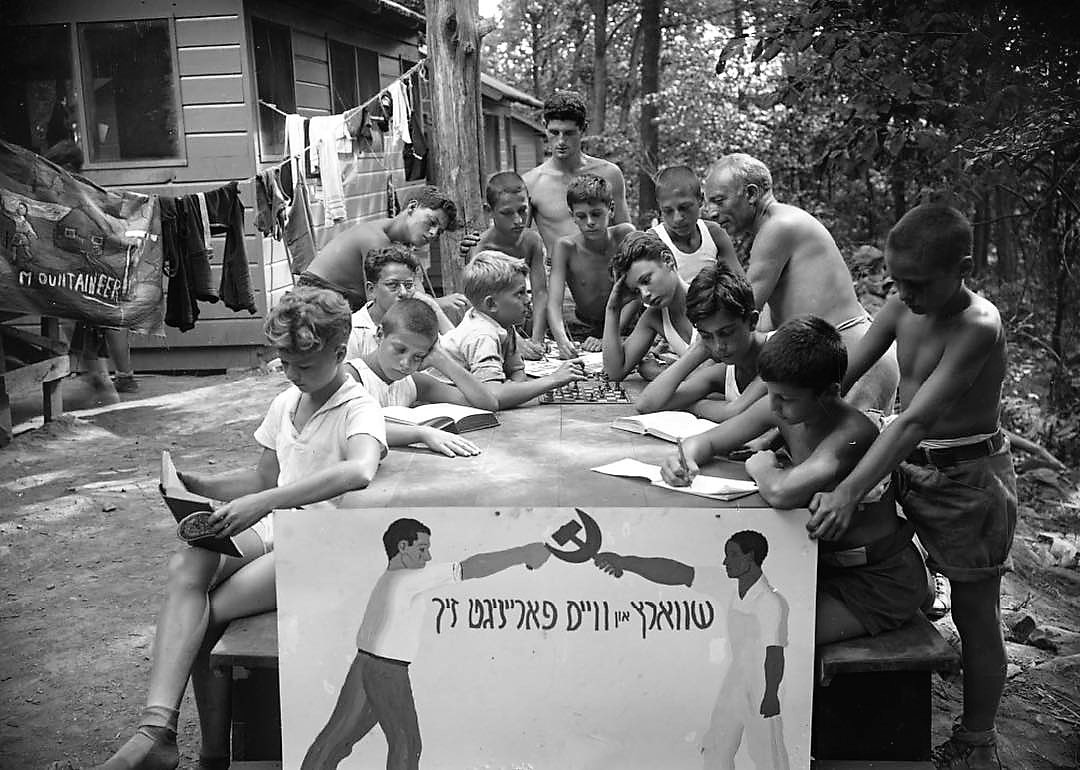
‘Education in Workers’ Children’s Camps’ by Miriam Gerbert from the Daily Worker. Vol. 3 No. 220. September 30, 1926.
BESIDES the vacation value and the importance to the health of the worker’s child who is brought to the camp from the slums and tenements, the camp affords us an opportunity to develop the class consciousness of the children and to draw them closer to the Pioneer organization. It also gives us an opportunity to train the Pioneers to work among workers’ children and give them a clear understanding of their functions as Pioneers.
Forms of Activity.
Every phase of camp life can be utilized to teach the children the lessons which we want to bring home to them. Thus we can utilize discussions, readings of books and newspapers, lectures, dramatics, slogans, correspondence to the Young Comrade and labor press, cartoons, living newspapers, camp bulletins, clippings and news bulletins, wall papers, games, songs, excursions and even camp discipline.
What to Teach.
We must teach the children certain fundamental lessons which they need to know as children of the workers. We must teach them about the capitalist system, about the class struggle, the role of the government, the role of the schools, of the press, movies, etc.
The children must also learn about working class solidarity, the persecutions of the workers, about working class heroes, the importance of organizations such as unions, labor party the Communist Party and the Young Communist League to the working class. In this connection our Pioneers will be able to approach the more advanced children and teach them the role of the Pioneers and the Communists. At this point especially will our Pioneers get their most valuable training.

The discussion on religion must be approached with great care. The problem can be best handled in small groups or in individual discussions. It will be easy to explain the class character of religion if the leader is armed with specific facts, such as the attitude of a whole section of the clergy in the Passaic strike, the role of the church in Mexico, etc. In addition we must give the children a scientific approach to all problems, a scientific attitude. We must explain to them the natural phenomena that surround them, give them the naturalistic explanation of religion and teach them the lessons of evolution. Then, too, we must teach them the elemental lessons of sex and sanitation.
Current Events.
In the discussion we must utilize current events to illustrate the points we wish to develop. Discussions must not always be formal, but should be encouraged at any and all times when the children are talking about their experiences or telling stories, or preparing to do something. The leader must be alert and must be able to make use of these discussions and give them a definite turn. Our Pioneers also must be taught to do this. When discussions are prepared for in advance it may prove profitable to have a Pioneer prepare to lead or introduce the given topic. We must make sure to draw lessons from Russia and the lives of the workers there. Lectures as such should not be held frequently. We should make special efforts, however, to have workers relate their experiences in the shops, the struggles they actually went thru. These must not be long talks, nor must they be abstract. The workers invited must tell of their own actual experiences and the lessons to be drawn from these experiences should then be discussed by the children. The talks should be of such a nature that one or two of the lessons mentioned above be made clear to the children. The leaders at camp should help in the preparation of these talks, as otherwise they may be rambling, abstract and boring for the listeners.
Reading Material.
Reading material can be utilized with great advantage. Workers’ fairy tales, Jack London stories, Upon Sinclair, etc. If the story is too long to be read in one sitting it is advisable to form reading groups to read the book thru. We must discuss and point out the lessons to be drawn as we go along. Take, for example, the “Apostate,” by Jack London. The boy miner there renounces the faith of toil and decides never to work again. Certainly this is not the solution for the emancipation of the working class and this story should be utilized to explain just this point Many similar examples can be found where we may have to use negative examples to teach our lessons.
Newspaper Corner.
There should be a special newspaper corner at camp, where the children can come and read the daily newspapers. Here, too, we should have the party press, strike bulletins and The DAILY WORKER, and scientific and educational magazines (geographical magazines, science and invention, mechanics, etc.).

We might in connection with this work have a bulletin board with clippings and cartoons from the daily newspapers on important items or we might mark special articles to draw the attention of the children to them. We must not be afraid to use the capitalist press and even pictorial newspapers for this. We can make marginal notes or comments for the bulletin board on certain news items to counteract the influence of the capitalist press and to help clarify the children.
Leaders Must Be Awake.
In closing, too much emphasis cannot be laid upon the need for alertness and resourcefulness of the leaders. This article is not meant to be an exhaustive study of the subject, but simply to offer a few suggestions as to the work at the camps. The leaders at the camps should discuss these suggestions on the basis of their own experiences and exchange their experiences with the comrades at other camps. Only thru the exchange of experiences can we build up a strong workers’ children’s camp movement.
The Daily Worker began in 1924 and was published in New York City by the Communist Party US and its predecessor organizations. Among the most long-lasting and important left publications in US history, it had a circulation of 35,000 at its peak. The Daily Worker came from The Ohio Socialist, published by the Left Wing-dominated Socialist Party of Ohio in Cleveland from 1917 to November 1919, when it became became The Toiler, paper of the Communist Labor Party. In December 1921 the above-ground Workers Party of America merged the Toiler with the paper Workers Council to found The Worker, which became The Daily Worker beginning January 13, 1924.
PDF of full issue: https://www.marxists.org/history/usa/pubs/dailyworker/1926/1926-ny/v03-n220-NY-sep-30-1926-DW-LOC.pdf
 Revolution's Newsstand