
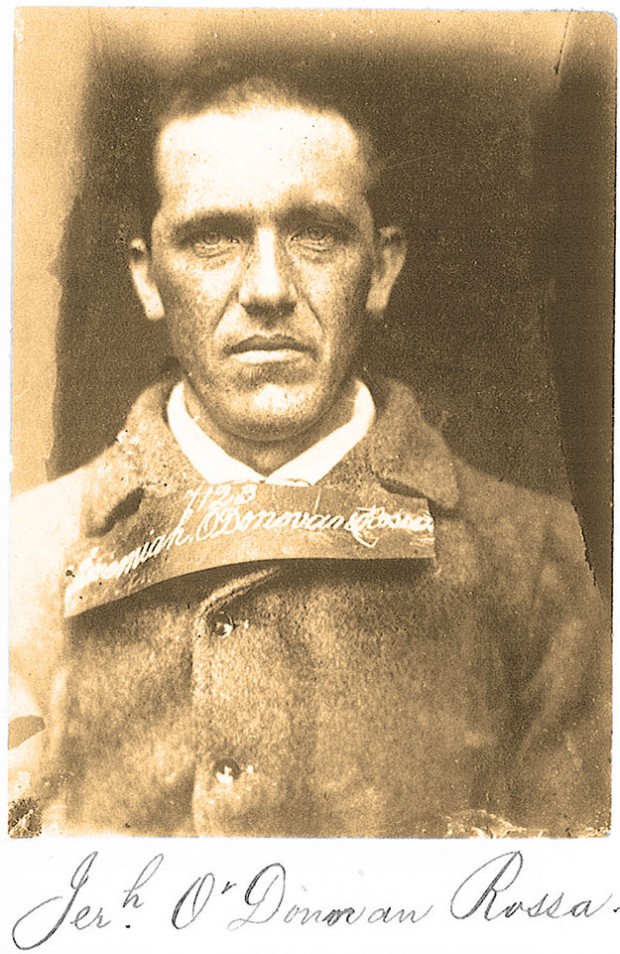
The passing of the generational baton as legendary Fenian Jeremiah O’Donovan Rossa speaks at an Irish Socialist Federation meeting in 1909. Gathered to commemorate the United Irishmen, Irish support for the Democratic Party’s Tammany Hall regime and fealty to the Church were denounced. Among the speakers are Justus Ebert, Patrick Quinlan, and Elizabeth Gurley Flynn’s mother Annie reciting a poem.
‘Irish Socialists Meet’ from the New York Call. Vol. 2 No. 265. November 1, 1909.
Speakers at Dinner Say That Tammany is the Ruin of Their Race.
Half a hundred members of the Irish Socialist Federation met at Coddington’s Sixth avenue restaurant last night to celebrate the one hundredth anniversary of the founding of the United Irish Society, an organisation that originated with the death of Robert Emmet
O’Donovan Rossa described some of his experiences while in an English prison. “The English parliament,” he said, “was forever promising Home Rule to Ireland—tomorrow. But tomorrow never comes. You’ll see no Home Rule from parliament.”
“If ever people were used to do slimy work,” said Patrick L. Quinlan, “and did it unconsciously, I have seen it in this campaign. The Irish race is dragged in the mud to secure votes, like molasses spread to attract flies.”
Mr. Quinlan objected to the nomination of McCaffery from coroner as a leading Irishman, he said he thought men should be nominated solely for their own worth, and not because they represent some race. “But then,” he concluded, “it looks as though Mr. [unreadable] next job will be to hold an inquest on Tammany.”
Patrick Donohue took the same view of the Irishmen out of Ireland. “As soon as they reach America or Canada,” he said, “some Tammany Hall harlot gain them and they forget all about Ireland.”
Timothy Walsh, Miss Bredin, and Mr. Baxter also spoke. The former thought the Irish owed many of their troubles to their devotion to the church. “We have got to ween them away from the church,” he said, “then we shall have the great body of Irish socialists possible.” Miss Bredin said that until she became a Socialist she had no inspiration in life. “Now,” she said, “I feel I must work unceasingly to bring about the brotherhood of men.”
Other speakers were W.S. Bredin, Justus Ebert, and O.M. FitzGibbon. Mrs. Flynn recited a poem, “On the Firing Line.”
The New York Call was the first English-language Socialist daily paper in New York City and the second in the US after the Chicago Daily Socialist. The paper was the center of the Socialist Party and under the influence of Morris Hillquit, Charles Ervin, Julius Gerber, and William Butscher. The paper was opposed to World War One, and, unsurprising given the era’s fluidity, ambivalent on the Russian Revolution even after the expulsion of the SP’s Left Wing. The paper is an invaluable resource for information on the city’s workers movement and history and one of the most important papers in the history of US socialism. The paper ran from 1908 until 1923.
PDF of full issue: https://www.marxists.org/history/usa/pubs/the-new-york-call/1909/091101-newyorkcall-v02n265-DEFECTIVE.pdf
 Revolution's Newsstand