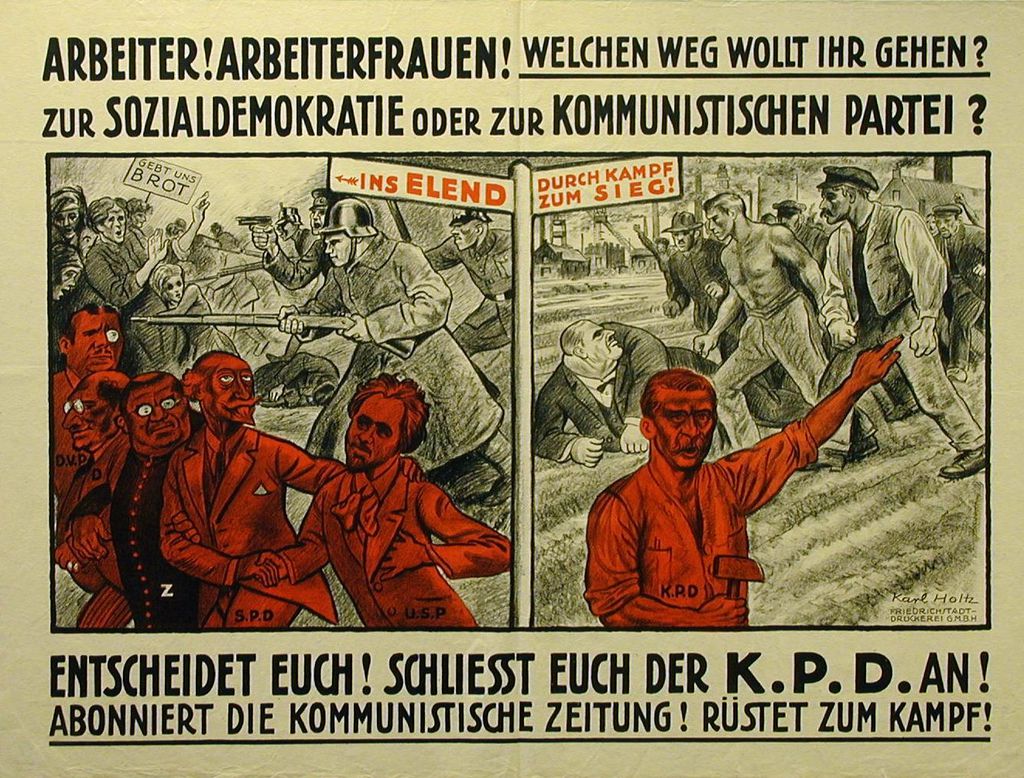
One of the most important gatherings of German Communist happened in the aftermath of 1923’s failed ‘German October.’ The 9th Congress of the K.P.D. was held in secrecy during April, 1924 at Frankfort. The ‘Left Wing’ led by Maslow, Thalmann, and Fischer would assume power, at least temporarily, with the former leadership (the ‘Right’) around Brandler and Thalheimer deposed. A third, ‘Center’, tendency associated with Ernest Meyer was also active in the meeting, as well as the Comintern. All four groups interventions are included here.
‘Report of The Frankfort Conference of the Communist Party of Germany’ from International Press Correspondence. Vol. 4 Nos. 30 & 31. May 22 & 29, 1924.
The conference of the C.P.G. was held under illegal conditions during the second week of April. Following upon a thorough-going discussion, a resolution on “The immediate tasks of the CPG.” was adopted unanimously and an Executive was elected whose members were almost exclusively representative of the left wing. On publishing this resolution, “Die Rote Fahne” was prohibited for ten days. We give below the first installment of a report of this conference which is of supreme importance for the entire international proletariat. Ed.
Report of the Conference.
Before the agenda was submitted to the meeting the provisional chairman made the following declaration:
“We who are gathered here today solemnly call to mind the tremendous loss that the entire proletariat of the world has recently suffered in the death of Lenin, the leader of Communism. (The delegates rise from their seats.) We feel the magnitude of the loss even more than do our Russian comrades because we are struggling along new paths, seeking new directions. But if Lenin be dead, Leninism survives and is spreading itself everywhere amongst the proletariat of the world, everywhere where the exploited and the oppressed are to be found.
“We would also call to mind the many comrades who sacrificed themselves in the streets of Hamburg. In the crisis of last October they were alone in blazoning forth the revolutionary aspirations of the working class. They took up the fight and met their death in the belief that the last and final struggle with the German capitalists had arrived. It remains our task to ensure that this hope of theirs will very shortly be realised.
“We would also call to mind the thousands of our comrades incarcerated in German prisons, who are thereby unable to participate in the discussions at cur conference but who otherwise would certainly be with us. Especially do our thoughts turn to Comrades Urbans, Stetter, Schneck and Pfeiffer, who are only prevented by class justice from taking part in our deliberations. After the agenda had been drawn up, the opening speech was delivered by
the representative of the E.C., Comrade Ivanov.
On behalf of the E.C. of the Comintern and the C.C., of the C.P.R. Comrade Ivanov welcomed the Conference and hoped that it would accomplish fruitful work. The revolution in Germany would not take the same course as in Russia. In Russia one of the driving forces of the revolution was the contrast that existed between the land monopoly of the big landowners and the land hunger of the millions of poor peasants. The C.P.R. offered peace to the masses of the peasantry that were serving as soldiers in the trenches. It thereby received the support of these masses whose numbers ran into millions. In Germany, on the other hand, Scheidemann’s party, the party which had conducted the war, was able to deceive the German proletariat into the belief that it was the party that brought peace. Thus the German proletariat has suffered itself to be lead along a long and sorrowful path to Golgotha. The E.C. and the C.C. of the C.P.G. recognises that the trend the revolution has taken in Germany places the C.P.G. before extraordinary difficulties. These difficulties have been increased by the big blunders that were made by the majority of the Central Committee and which contributed to the great defeat in October. The E.C. is also fully cognisant of the psychological reaction that this defeat has effected among the members of the Party generally.
In the theses submitted by the left-wing majority of the conference, the principles of which were thoroughly discussed with the representatives of the E.C., it was established that
the German Revolution has survived,
and that a new revolutionary wave is to be expected in the near future. But at the same time the possibility of a slow development is also to be reckoned with.
In either case the leadership of the German Party is confronted with difficulties of the first magnitude, difficulties, which would exist for any other group which took over the leadership. In the trade union question, especially, the Party is confronted with decisions of a most momentous character. Large sections of the workers have left the old unions and are resolutely clamouring for the creation of new industrial organisations. Such new revolutionary industrial organisations, moreover, will impose heavy obligations upon the party and the workers will not be slow in imposing these obligations. The E.C. has therefore given the closest attention to this problem, and in view of the fact that it is of international, as well as of national importance, follows the development with greatest concern.
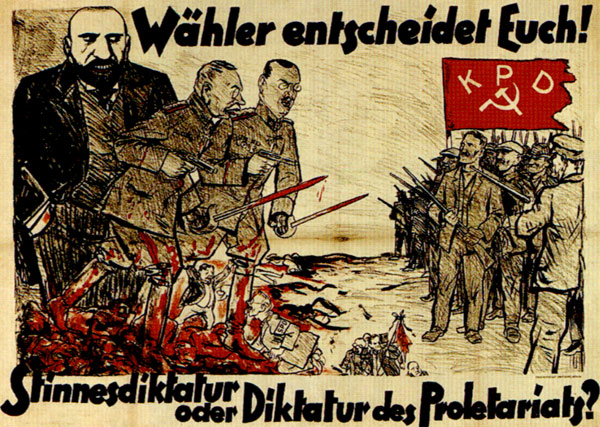
The E.C. herewith declares that the new executive of the Party will receive the unlimited support of the E.C. The E.C. appeals to the minority of the conference to render brotherly support to the new leadership. The E.C. will not tolerate any attempt to undermine the authority of the new leadership of the Party.
For the first time in the Comintern the left wing undertakes the leadership of a big party. There is the danger from the very outset that right wing groups will take advantage of the first false step of the new leadership to launch an attack against it. For this reason it is incumbent upon this conference to put an end to the formation of groups and create a united Communist Party.
The E.C. appeals to the conference majority to work in the most harmonious agreement with the Comintern and to come to the right decisions. On behalf of the Communist Party of Russia, Comrade Ivanov declares that every member of the Russian Party would rejoice to hear that a close alliance has been formed between the German and the Russian Parties. The Russian Party is fitted to enter upon such an alliance, not only because of the seizure of power in October 1917, but also because the conclusion of the Party discussion found it more firmly consolidated than ever. In January the Party conference decided by 200 votes against 3 in favour of the policy of the C.C.
Long live the XI Congress of the C.P.G.! Long live the Communist Party of Germany! Long live the Communist International! (Loud applause.)
General Report and Memoranda of the Moscow Congress and the Tactics of the Party.
The Left Wing Representative.
The preparations for this congress revealed the fact that the great majority of the Party members was in favour of the adoption of new tactics. The great majority of the members found itself in opposition to the theory of the Leipzig Conference, and was ready to throw overboard those theoretical and practical ideas that had formed the policy of the Party up to and during October last. This is not the first crisis that our Party has passed through. The Heidelberg split came as a result of the union with the left wing of the USPD, and the first crisis in which the Party was faced with liquidation followed upon this union. Then there was the Paul Levi affair, this being followed later by a second crisis in which the whole organisation threatened to break up. Finally, there was the Friesland case and the dispute with the KAG. (Levi group.) Such movements within the Party, therefore, need not be overestimated and follow almost invariably upon a heavy setback on the part of the proletariat. Such is the present case. It must also not be supposed that the process of development within the Party is thereby brought to an end.
What is the significance of
the re-organisation of the Party
in favour of the left-wing? It means that among the rank and file of our members there exists a strong desire to reform and develop the Party into a real revolutionary and communist organization. It means that there is a strong demand for real revolutionary tactics. The great majority of the Party endorsed the Saxony policy, and all that has been served up as being the tactics of the united front, solely in the hope that it would thereby lead more rapidly to decisive encounters with the bourgeoisie. What were the fundamental mistakes that were made by the old Party leadership and the old Party majority? The prime mistake was that of converting the tactic of the united front into a tactic of an alliance with the Social Democrats. The second fundamental mistake was made at the Jena Conference subsequent to the Third World Congress: it was that the Party became fixed in the belief that a long period of preparation lay ahead and that consequently it was unable, on the outbreak of the Ruhr conflict, to adapt itself with sufficient speed to a rapid revolutionary development.
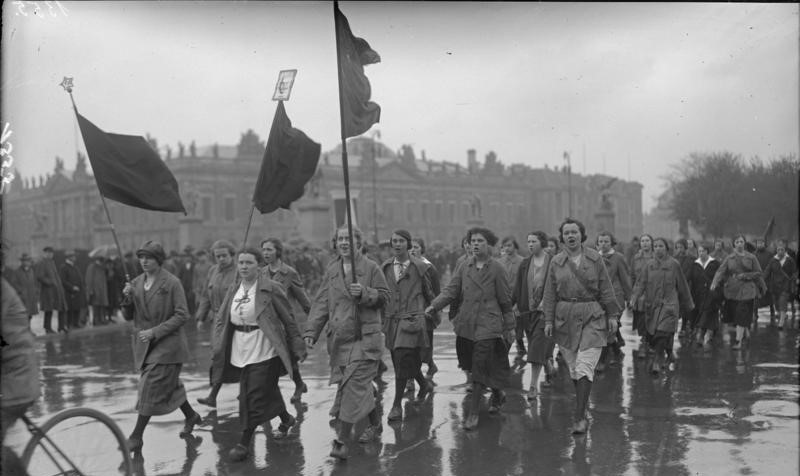
The condition of the working class in Germany prior to the October events differs considerably from the present condition of the working class. Before October we were caught up in a growing revolutionary movement within the camp of the bourgeoisie. At the present time we are witnessing the final phase of the Ruhr conflict. The apparent stabilisation of the German mark has allayed the fears of certain sections of the middle class and even of the working class. But
there has been no basic change as regards the objective revolutionary facts.
The reparation crisis is no nearer solution, neither has the German industrial crisis been overcome. The stabilisation of the German mark is such that any day can see a new collapse. Unemployment is as rampant as ever, the German economy is not consolidated, the political conflicts are still extremely acute and the Bavarian question is still to the fore. The separatist aspirations remain a factor of supreme importance, whilst within the bourgeois parties the disruptive process has been intensified by the attempts to keep pace with the agitational methods adopted by the national Fascist Parties. (Splitting of the German Peoples Party.) The Fascist Parties themselves are breaking up. The Hitler process, it is true, gave them many favourable moments for increasing their adherents, but their inner crisis is growing more acute. The Socialist Party and the reformist trade unions are passing through a similar crisis. The only difference between the situation prior to and subsequent to the October events is that in the former period matters were developing rapidly, whereas now they are taking a somewhat slower course of development. The intensified offensive of capitalism is being met by the working class by a passiveness that threatens to become fatal. The raising of the state of siege by the bourgeoisie is a sure sign of the weakness of the working class. Nevertheless, after months of passiveness we can already see signs of
a reawakening of the energy of the proletariat.
There have been the dock disputes in Hamburg, severe conflicts in the chemical industry in Ludwigshaven, unrest among the railway workers. In short, the workers are beginning to fight for the positions they have lost, for the eight hour day, for a living wage. Before October last the working class of Germany was considerably further ahead: it was then engaged in momentous fights of a political nature and for political ends. Yet in spite of the set-back the worst has been overcome.
Thus although the working class suffered a severe defeat, although there was much amiss within the Party and although there was a series of persecutions and attempts by the Social Democrats, allied with the bourgeoisie, to suppress the Party, nevertheless the communist movement has not been weakened. Sufficient proof of this is given by the factory council elections, also by the parliamentary elections, the increase in our Party membership, the circulation of our newspapers, the spread of our organizations. Our Party is in such sure touch with the masses that nothing can sever this connection.
In October the fight could have been taken up. The leaders of the C.P.G. did not seize the opportunity, because Graupe and Zeigner left them in the lurch, and now they maintain that the objective conditions did not allow of the possibility of an open fight. But up to the present
the attitude of the central group to the October events
is still inexplicable to me. Whilst in their first theses they expressly state that it would have been impossible to take up the fight, they now maintain that the challenge could have been accepted. The left wing did not direct its criticism against the methods of winning over the masses. It did not oppose the principle that the communists must always be in the forefront of the daily struggles of the proletariat, but the essential demand of the opposition has been, throughout the whole year, that the Communist Party must understand how to conduct these daily struggles so that they will grow into political struggles; that when and wherever communists take part in these daily struggles the communist views must be put forward clearly and distinctly and kept to the fore in the daily, practical, concrete tasks. The Party believed it possible to win over the masses by making use of the communist conception of the dictatorship of the proletariat and the struggle for power as a kind of sermon, but did not understand how to unite
the propaganda for the proletarian dictatorship
with the ordinary daily tasks. It was maintained that an alliance I could safely be entered upon with the United Socialist Party. The demand was formulated that the tactic of the united front should be “honourably” carried out and so forth. This conception of the tactic of the united front was bound of course to lead to a revision of the Communist Party’s conception of the state and of what constituted revolution. The Workers’ Government could only be regarded as a slogan for gaining followers, as a synonym of the proletarian dictatorship. Otherwise the fateful question put to the Fourth World Congress by Smeral as to whether the Workers’ Government was nothing more than a form of government of the proletarian party within the bourgeois democracy must be answered definitely in the affirmative, as indeed Brandler did answer it. If it is admitted that it is possible to pursue a real working class policy with the means supplied by the bourgeois democracy, if it is not accepted that democratic rule is merely a mask to hide the class supremacy of the bourgeoisie, if it is maintained that this rule leads to the classless society, then there is nothing in the political field to distinguish us from the Second International. It is this policy that has brought uncertainty into the ranks of our membership, the sound proletarian core that is to be found within our Party has been checked in its growth.
It is consciously maintained that
Fascism has triumphed over the November Republic,
but not over the working class, that Fascism and the working class face each other as deadly enemies and that it goes without saying that the November Republic must receive every support in the attempt to crush fascism. November Republic and Fascism are two forms in which the dictatorship of the bourgeoisie manifests itself. The bourgeoisie makes use at different times of the democratic and the Fascist methods to suppress the workers. The differences of opinion within the bourgeois camp can in no case serve as a basis for laying down the lines of our own policy. The Party is united in the belief that the winning over of the middle classes is one of the chief tasks of the communists in Germany. But it must be understood that these middle classes will not be won over with the aid of the Menschevik gospel.
The policy pursued in Saxony
was the putting into practice of the democratic theory of intermediate steps. A number of comrades is still to be found maintaining that the policy of Saxony was right from beginning to end. Böttcher has written a pamphlet to prove that the failure of the policy was due entirely to the continual blundering of the E.C. It must therefore be pointed out that at the IV World Congress the majority of the German delegates, against four votes, voted for unconditional participation in the government. Our suggestions were invariably turned down.
With regard to the Central Group,
between that which the central group stands for at present and that which we stand for, the difference is so essential as to justify the further existence of an “own group”. The central group will either veer round to our standpoint or it will throw in its lot with the right wing. Every opposition in a Communist Party constitutes a misfortune. The sole justification for an organized opposition lies in the struggle to prevent disruption and to combat dangers from the right. For ourselves, we were always well aware that our opposition was something to be deplored. But be were unable to relent because we should have been swallowed up by liquidationism.
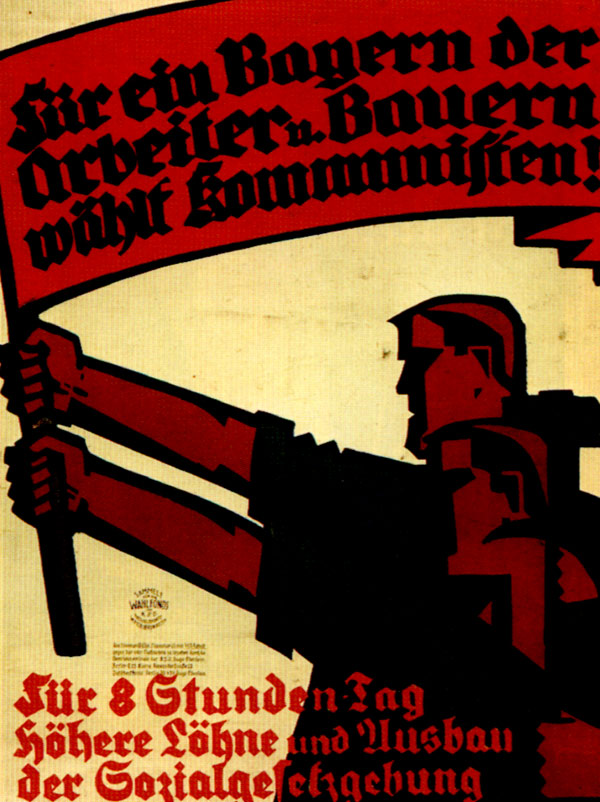
In the case of the central group the whole problem is different and we seriously and emphatically declare that the new Party majority will no longer tolerate any artificial grouping within the Party. Should the districts of Chemnitz, Halle etc. find themselves in disagreement with the decisions of the congress, we shall have to take the matter up with them until the will of the majority of the Party is brought into effect in every instance. But if individual comrades endeavour to retain separate groups for organizatory reasons, we shall let them know that such things will not be tolerated. The central group maintains that it is a safeguard against Communist Labour Party deviations. But it will be incumbent upon the Party as a whole to fight against Communist Labour Party deviations. We do not need any specialists for this work. What we need is a united party and that we must and will create.
A full discussion of the future tasks has yet to be held. We must not repeat the mistakes, especially must we be careful of being too short-sighted and of allowing the German Party once again to fix its mind on only one possibility and when events break out, as in the case of the Ruhr conflict, of being unable to rise to the occasion and exploiting the opportunities to the full. It is imperative that the two possibilities of development be kept in view and that clear-headed decisions be arrived at when the crisis comes. At the present moment our task will be to organize the masses in the daily fights and at the same time to conduct an active and thoroughly communist propaganda. But we shall have to conduct these daily struggles in such a way that every communist will know, from our attitude as well as from our action, that the decisive struggle can set in at any moment. The majority of the Party is backing up the new leaders. We enjoy the confidence of the members. The past wounds will heal and the severe crisis being over the really conscious and active elements in the C.P.G. will stand shoulder to shoulder more able and more determined to fulfil the task that confronts them. This task is to create in Germany a really revolutionary Communist Party which will rescue the German working class from want and misery.
The Representative of the Party Minority.
The speaker explained at the outset that it would be easy to convince the central group of there being no need for the existence of a special group if the last speaker had treated the political questions with more clearness, and had shown that if there were differences between the left wing fraction and the central group that they were differences of no account. But the left wing had conducted itself with too little modesty whilst it was in opposition; in its present attitude to the political questions is has become considerably more modest.
The nature of the crisis in the Comintern as portrayed by the last speaker in his report is not correct. We must be perfectly clear as to the character, the importance, and the origin of this crisis, and we must not allow this conference to fall into the belief that a catastrophe has occurred. The crises which the Comintern has had to pass through have been the direct result of its organic growth, and they are indeed a symptom of health.
Take the crisis of 1923. What brought it about? The real causes of this crisis are to be found in the wave of pacifism, allied with democratic illusion, that was started by the advent to power of the Labour Party in England, in the difficulties with which Russia has to contend, in the retreat before German reaction. Undoubtedly in some countries Russia, Germany, France, Holland, Poland, Bulgaria, etc. this crisis created a movement to the right in the superficial life of the parties. But it can be safely maintained that today in almost every case this crisis has been overcome. The fact that it was overcome so readily proves better than anything else could, how sound at heard our Party really is.
The big problem that confronts us now that the movement to the right has been defeated and now that the crisis in the Comintern has been overcome, is the following:
how we are to apply the tactic of the Comintern in the given situation.
When we come to analyse the conceptions of the tactic of the united front held by the left wingers, we find that there exist three distinct views. Firstly, there is the view that the tactic of the united front is a dangerous one and that one should have nothing to do with it at all. Secondly there is the view that it can only be accepted when the united front brings no dangers with it. Lastly, the view prevails that the Party should make use of the tactic only when it is sufficiently powerful and healthy to risk doing so.
In answer to the first assertion the speaker declared that to turn down the tactic of the united front is tantamount to renouncing all attempts to win over the majority. No one has yet discovered any other method that would enable us to win over the majority of the working class. Therefore this view must be totally discarded.
The second view according to which the united front is only to be accepted when it brings no inherent dangers with it, must be rejected with equal decision. It is by making mistakes that one finds the right way. If one is fearful of dangers that an application of the tactic of the united front might bring in its train, one must give up all hope of winning over the masses of the working class. A communist who goes into a workshop in order to conduct propaganda must “adapt” himself to the masses. Should that prevent us from getting into contact with the masses, from carrying on our propaganda among the masses? We must see that we are and remain a real Communist Party, but the soundness of our Party will not in itself succeed in beating the foe. It is wrong therefore to uphold the theory: “Fight for the majority, but cautiously!”
The most important question that remains for us to tackle and which must serve as the starting point for the laying down of a tactic is: Where do we stand?
How do we view the immediate future?
This brings us to the problem of the stabilisation. We have to look carefully into this problem and examine in how far this alleged stabilisation of German economy is already undermined. This stabilisation was effected as a result of three main factors. The international factor, especially the endeavour to get France and England embroiled over the German problem, has already been played out. By means of a skillful tactical move Poincaré was able to settle the sharp differences that existed between France and England. The allied powers have, to all intent and purposes, re-established the united front against Germany. The short pause in the carrying out of the Treaty of Versailles has ended and the old difficulties are coming to the fore once more. But even the third factor, the defeat and dejectedness of the German proletariat, can now be ruled out. The German proletariat has been able to get the better of this dejectedness which enabled the German bourgeoisie to effect the stabilisation towards the end of 1923, and it is now engaged in a severe struggle with is exploiters. When the last speaker referred to the strikes that have taken place in recent months as being “only” economic strikes, he must have shut his eyes to the real facts. These economic strikes give birth to a tremendous amount of revolutionary energy which evaporates if we do not understand how to turn it to good account. With regard to the questions:
Wherein lay the mistakes made in October?
Why did we not make it absolutely clear how matters stood, and what were the real facts of the situation? These questions must be answered without delay. In those October days no differences existed between the left wingers and these around whom the central group had formed. The question resolves itself at present into one of the rightness or wrongness of the retreat. Our standpoint is that it was not a retreat at all, but a failure of the Party to go into action, an evasion of the fight. It was, however, our bounden duty to take up the fight. We were just as determined to take up the fight as the left wingers were. But now we see you putting the question in a demagogic light: Could we have won through or not? You also maintain that a retreat should never be undertaken as we undertook it. That is not so. A retreats a fight for the majority of the proletariat; the Party has to explain to the masses why the avoidance of the fight is necessary and then it will be able to retain its hold upon the masses.
The second question that divides us, other than the question of the cause of the October reverse, is the
Question of the United Front.
We would like you to give us a clear and definite answer: Are you opposed to the United Front or not? is it only to be endorsed when no danger threatens? Are we to attempt to create a party first and then set out to capture the masses, or are we to combine the two tasks, to make ourselves sure that our ideological basis is sound and at the same time to carry on the struggle for winning over the masses? We hear much of late of the Bolshevisation of the Party. Quite rightly, the Party needs to be Bolshevized. It means that an ideological warfare will be waged with the remnants of the Social Democracy, that attacks will be directed against every reformist attempt to side tract, but it also means that K.A.P.D. (Communist Labour Party) tendencies to side tract will likewise be vigorously attacked. The speaker went on to quote from a number of articles written by left wingers and asked the Party majority whether it was of the opinion that the closing of the door upon opportunism, whilst at the same time throwing the windows open, was what was understood by the Bolshevisation of the Party; whether it would not rather characterise such procedures as “KAPDism” pure and simple. Then there is the trade union question. We have still a great deal to do before we can remove the differences that have arisen as a result of unsound reasoning. And it is pure demagogy when the question is framed in such a way that it serves as a bone of contention between the left wing and the central group. The left wingers maintained that we should have taken up the fight, we, the central group, did not see our way to take up the fight. The real problems upon which we have to bestow our attention, are the problems of our attitude toward the Fascist parties and the Social Democrats, and the
Application of the Tactic of the United Front from below.
It would be false to assert that the German Fascist party is to be attacked not from a national angle, but only from a social one. We have also to fight against the Versailles Peace Treaty, we have to convince the proletariat and the middle classes that we are the party that will be able to regain for Germany her lost national liberty. On the other hand we shall have to counteract the temper of the masses and not allow this temper to carry them off their feet: to counteract the anti-trade union movements, the disruptive movements, the movements directed against Moscow, and the K.A.P.D. movements. What attitude does the Party majority adopt with regard to the
Trade union question?
It could be readily believed that it would make the main problem the organization of the unorganized, but in the classic home of organization, in Germany, the problem of the masses organized in the trade union is the outstanding problem. The problem of the unorganized can find its solution only when it is brought to bear on the fight against the Social Democrats and the Fascist organizations. It is this fight that must be systematically organized and carried out according to plan. The organization of this fight, the organization of the revolution, is the one basis on which the whole Party can be made into a solid fighting body. If the Party majority intends to make this present conference a first step for the consolidation of the Party, it would be well to make as little as possible of the quarrel among its fractions, but see to it that the road is made clear for a big political campaign. The struggle to get the masses with us, the endeavour to act with clear revolutionary reasoning that is the objective. If the Party majority acts in such a spirit it will find that the central group will put no difficulties in its way. There no call for pessimism, the movement towards the left that the Party has experienced, is all for the good. We are faced with the struggle against reformism, and against attempts to deviate from the proper course. This fight needs courage. Unity can be re-established as a direct outcome of this new phase. If we all stand shoulder to shoulder against the common foe, there will be but one group, but one fraction, just the united Party. Our goal is: to make the party the real leader of the German proletariat, to make it the advanced guard of the German revolution.
The Representative of the Former Majority.
The content and purport of the decisions arrived at by the Moscow Conference were, according to the speaker: great opportunist mistakes were made during the October retreat; those responsible for these mistakes must give up their positions in the Party. A new body of leaders must be formed from members of the centre and the left wing; this new grouping will act as a dam against dangers from the left but the chief danger lies to the right and everything must be done in the Party and in the International to counteract these opportunist dangers that lurk in the right wing.
At present the situation is different from what it was in January. The representative of the central group declared today that both internationally and here in Germany the chief danger is to be sought, not in the opportunism of the right wing, but in the opportunist side tracking made by the left wingers. The letter of the Executive and of Comrade Zinoviev, that were placed before the conference today, also refer to the dangers from the left. That proves that the hypotheses, that the tactical lines drawn up in Moscow, were false. From that one should draw one’s own conclusions.
We carried out the January decisions although we believed them to be false. We maintained that the idea of a danger from the right and the designation of our group as being the German and the international danger to be two absurd constructions created solely for party ends. The centre group did not fall out with us because we were acting as Social Democrats or as opportunists, but because we were supposed to be blind to our own Social Democratic blunders and needed to be warned against them. It was never asserted that big opportunist mistakes had been committed.
The central group has made concessions to the left wing in the trade union question, concessions that are most dangerous and the speaker thought the Party would do well to take his warning. The new line of tactics will have fatal consequences for the whole Party.
According to the letters sent by Zinoviev and the Executive and which passes the severest criticism, the Moscow decisions are held to be wrong. If only a fraction of what is being said now had been set down in the January resolution the splitting up into centre group and right wing had not been possible. This criticism is not made less effective by the excuse that there 18 a time for everything. Nevertheless, the speaker admitted that the old party leadership made big mistakes. The old executive allowed itself to be guided by the standpoint that was characterised by Lenin in his book on “The Infantile Malady of Communism” as being the program of the
attraction of the majority of the working class
to the proletarian advance-guard that has already been created. It presupposed that it would no longer be necessary for us who are in the Party to discuss the question of the dictatorship of the proletariat, the question of the organization of the revolutionary forces. The chief mistake was that it considered the state of the Party to be so far developed that an insistence upon and training in the fundamental principles of our agitation for the dictatorship to be unnecessary. That explains why the old executive regarded the left wingers as being confusionists and intellectuals, whereas in truth they signalised a big movement that was spreading not only through the C.P.G. but also through the masses of the workers. This lack of insight caused the speaker and his friends to commit the big mistake at Leipsig of uniting with the centre instead of making the above facts the basis of an alliance with the left wing. That was the decisive blunder. Had this not been made there would have been no split.
The fact that the
Theses of the Leipsig Congress
on the united front and the workers’ government are already out of date was, in the opinion of the speaker, a good sign of progress. Nevertheless he was not ashamed of the Leipsig decisions. In those days we had to put the general theoretical formulation of the International into practice. When it came to the actual application in our work of agitation many blows were delivered in the air, but not as a result of any desire on our part to be opportunist We went so far as to regard the formulation of our agitation as being tactical decisions, decisions that under the then existing conditions should not have been applied even in the matter of agitation. We did not realise that we were expecting more of the members than they could undertake to carry out. This lesson has been an expensive one. During action, any discussion with a hostile fraction within the Party cannot be permitted. But the time is now ripe for us to thrash the matter out and come to some sort of a decision on the outstanding problems. The crisis is more acute within the Party than in the working class itself; that is clearly shown by the factory council elections, the elections in Saxony, Thuringia, Mecklenburg and now in Bavaria. If our October retreat had been the black crime it is made out to be by certain fractions, it would certainly have had the consequence that the masses would have left the Communist Party.
The main contention of the left wing, namely, that we did not realise in time the danger that lurked in the Ruhr crisis, is to a certain extent, true to the facts, but the left wingers were also not so far-seeing, and the truth is that mistakes were committed by both sides. If in the Ruhr question, the Party leaders had taken up the tactic advanced by the left wing we should have met with disaster then, instead of being in a position in October to evade it.
With regard to the
Policy pursued in Saxony,
much good has accrued to the whole international movement as a result. Generally we have found that the advice of the left wing amounts to this: that if a difficult situation arises the best thing to do is to run away. In spite of all the blunders, the Party in Saxony has been able to get again in close touch with the masses and consequently the crisis has made itself less felt here than anywhere else. If the Social Democrats have not been routed it is because the left wing of that party is nothing but the reflex of the pressure exerted by our Communist propaganda. The slogan “Destruction of Social Democracy” has not been made use of. Just as we took up the slogan, the Social Democrats began to consolidate their forces.
The chief mistake committed in October was that we were too slow in drawing our conclusions from the revolutionary situation as a whole. But it would be well to take a glance into the past. As early as May we could plainly see that the Ruhr conflict would force us into making a storm attack upon the bourgeoisie. It was first necessary to create in the Ruhr the ground-work for a movement that would reflect the temper of the conflict. We failed to do that because the party had not been reorganized on the basis of the shop nuclei. That, however, was not our fault, as Zinoviev points out. It was a concession that we had to make to the U.S.P.D. during the alliance. Nevertheless, we made our preparations to take up the fight in October. But when the State of Siege was proclaimed we found we could not mobilise the masses in fact, we did not make a serious attempt to do so. We believed that it would no longer be necessary because: “The policy creates the opponent.” The belief that we were strong enough to take up the fight, the over-estimation of our own forces and the under-estimation of the opponents’, that was not an opportunist blunder, but one that came to us from the left wing. We did not disturb the enemy with the result that he retained the initiative. When we decided to
enter the Saxon Government
we were under the conviction that all preparations were now made and so we dropped the more detailed work. The decision to participate in the Saxon Government was not to be found in the Leipsig theses, and Brandler was opposed to it on the ground that the masses were not mobilised, because there were no armed groups and no control committees–a congress of factory councils would have been ineffective in Saxony. As a result of these sins of omission the opponent could claim the initiative even whilst we were in office, and was able to make his attacks without waiting for us to prepare.
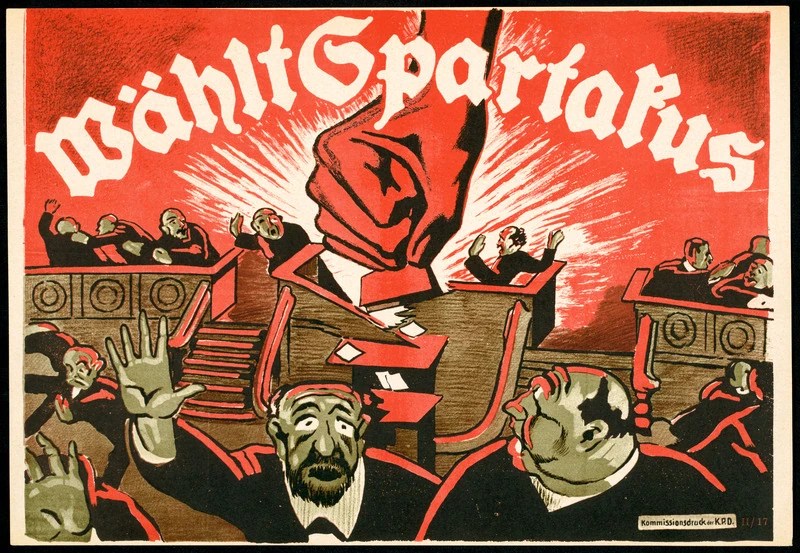
It was not until the Chemnitz Conference that it became clear that we had lost contact with the masses. In the situation as it then presented itself we should have taken up the fight with the government troops and shown the same powers of resistance as did our comrades in Hamburg. We must be careful not to make the same mistake as we made in the old Spartacus days, the mistake of calling upon the workers to take up the fight even when defeat is certain. If we want to keep the masses in touch with the advanced guard it is necessary that we make it clear to them that we shall be in a position to win through and will not lead them to defeat.
The speaker finally touches upon the work of the Party during the last four months when he and his friends were no longer responsible for what was being done. The Party, he maintained, has failed to retain a platform; it has not known how to make full use of the industrial movements that have broken out spontaneously in this period. The theses that have been submitted by the left wing majority are not a suitable basis for laying down the new tactical lines for the Party. The radicalisation of the workers and of the Party is to be welcomed. But this radicalisation is more a matter of sentiment and does not strike very deep as yet; it will take some time before it receives a really revolutionary character. He maintained that it would be possible for the new leaders to break up the whole Party in the space of twenty four hours: if they did not understand how to adapt the tactic of the united front to the new circumstances, or if they adopted a wrong tactic in the trade union problem. But if the Party majority promptly does what is necessary in regard to both these questions, then such other matters as have arisen as a result of the reorganisation of the Party will not be dangerous to the Party. Then the Party will be able to concentrate its whole forces on the task of radicalising the working masses and the masses within the Party, and in this way attaining to a genuine Communist policy.
International Press Correspondence, widely known as”Inprecorr” was published by the Executive Committee of the Communist International (ECCI) regularly in German and English, occasionally in many other languages, beginning in 1921 and lasting in English until 1938. Inprecorr’s role was to supply translated articles to the English-speaking press of the International from the Comintern’s different sections, as well as news and statements from the ECCI. Many ‘Daily Worker’ and ‘Communist’ articles originated in Inprecorr, and it also published articles by American comrades for use in other countries. It was published at least weekly, and often thrice weekly.
PDF of full issue: https://www.marxists.org/history/international/comintern/inprecor/1924/v04n30-may-22-1924-inprecor.pdf
PDF of full issue 2: https://www.marxists.org/history/international/comintern/inprecor/1924/v04n31-may-29-1924-inprecor.pdf
 Revolution's Newsstand