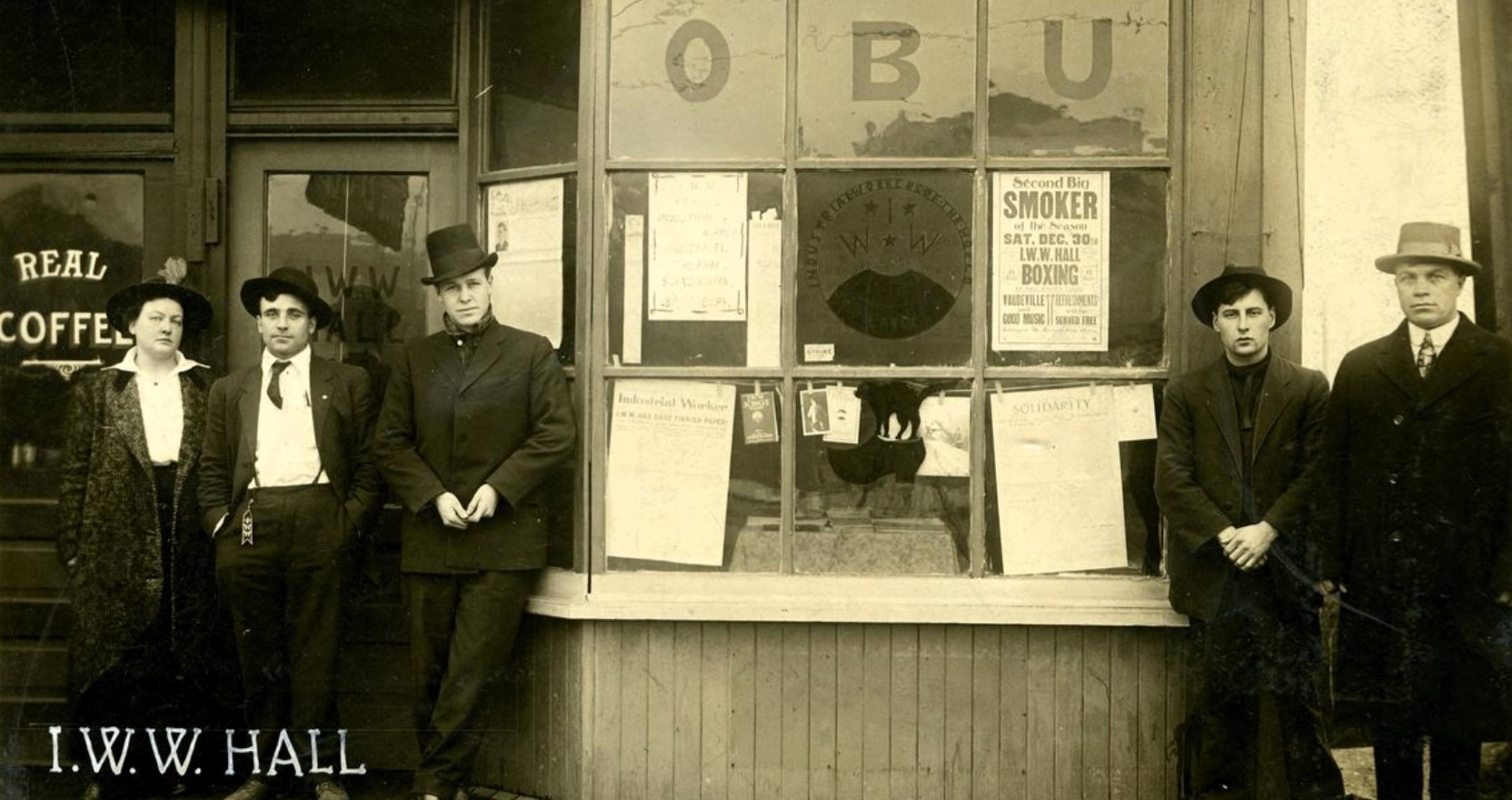
Vincent St. John’s report to the 1912 I.W.W. convention, the year of ‘Bread and Roses’ strike in Lawrence, covering finances, local unions, assessments, dues, newspapers, strikes and lockouts, arrests and convictions, as well as the advice of a respected leader to the gathering.
‘Report of the General Secretary-Treasurer to the Seventh Convention, Industrial Workers of the World’ by Vincent St. John from Industrial Worker. Vol. 4 No. 30. October 17, 1912.
To the Delegates of the Seventh Annual Convention, Industrial Workers of the World. Fellow Workers: In accord with the constitution, I herewith submit to you my report as Secretary and Treasurer, covering the fiscal year ending August 31st, 1912.
Since the last convention the office force has had to be increased. The present outlook is that it will have to be further increased in order to properly handle the work of the general organization.
Seven thousand and forty-six letters have been handled by the office in the fiscal year just closed. This number represents the correspondence alone, and does not take into account, reports, bulletins, and circular matter handled by the office force.
Since the adjournment of the last convention, one National Industrial Union, four National Administrations and 122 Local Unions have been organized. Fifty-three Locals have disbanded in the same period. Attached to this report is a list of the locals organized and disbanded, the various industries of which they were a part, and the cause of the locals becoming defunct. One hundred fifty-four Local Unions are in good standing with the General Organization.
Finances.
The fiscal year covered by this report will show a marked increase in the receipts of the General Office. The demands made upon the finances have increased at approximately the same rate, so that the balance cash on hand is but $457.40, as against $479.95 last year.
Due to the progress made by the organization in the railroad construction, textile and lumber industries, the organization has been called upon to measure strength with the employing class from one end of the continent to the other. This has meant that in spite of the increase in membership and the receipts of the general office, the funds at the disposal of the General Organization have not been sufficient to meet the calls for organizers coming in from different parts of the country.
Old Debts.
The tabulated statement of the indebtedness of the organization shows that most of the indebtedness incurred by the General Organization in the years 1905, ’06 and ’07 is still owing. While the last convention decided that five per cent of the income of the General Organization was to be set aside to retire this debt, the calls upon the resources of the General Organization in the year past to finance strikes and defend the interests of the membership in various parts of the country has made it impossible to carry out the decision of the convention in that respect.
It is my sincere wish as a member, as well as an officer, of the organization that the present membership will in no way seek to shirk this responsibility and that this convention will devise ways and means whereby this debt can be retired.
Assessments.
The financial report shows that the assessment levied by the referendum vote of the membership following the sixth convention brought in a total of $4,165.80. This means that an average of 2777 members paid the assessment. The amount that would have been collected through the assessment was materially reduced by reason of strikes being handled by the largest local unions and the National Industrial Union of Textile Workers and the National Industrial Union of Forest and Lumber Workers.
Official Organs.
A complete report of the financial and physical standing of Solidarity and the “Industrial Worker” are appended to the report as submitted by the editors in charge of the two papers.
It is gratifying to report that under the management of Fellow Workers Walker C. Smith and Fred W. Heslewood, the “Industrial Worker” has not only been self-supporting, but has paid off the entire indebtedness owing by the paper when taken over by the General Organization. In addition to this achievement, the “Industrial Worker” has accomplished the task of issuing an eight page special edition on the Ettor-Giovannitti case of 75,000 copies. This is a record in the annals of labor journalism.
Quarterly Reports from Local Unions.
Very few of the unions comply with the constitutional provision requiring that locals send in a quarterly report to the general office. this matter it is well to call the attention of the delegates to the fact that if the membership of the various locals will but see to it that their local secretaries send in the quarterly report regularly, it will enable the general office to help them keep a check upon the finances of the local unions.

Attached to the financial report is an inventory of the property of the General Organization in the General Office.
It is safe to say that a big percentage of the Local Unions becoming defunct in the past year could have been kept in existence if the General Organization had sufficient funds at its disposal to keep an efficient corps of organizers in the field.
The problem of locals becoming defunct is one that should receive the earnest and careful attention of this convention.
Steps should be taken to institute a training school for organizers wherein the members could be trained to handle the affairs of the Local Unions in an efficient manner.
Steps should be taken to keep in the field members who are competent to act as auditors and instruct local union officers how to handle the financial and other business of the organizations.
It is safe to assume that the near future will see the agents of the employing class interfering with the General Office by arresting the Executive Officers upon trumped up charges. The organization should take the precaution to have competent members available to fill the places of any and all officials who may be arrested in order that the affairs of the General Organization be not thrown into a tangle that will cause the loss of time and money during a critical period.
Per Capita Tax.
As some of the Local Unions have submitted amendments to the constitution that propose to lower the tax paid by the locals to the General Organization, I deem it wise to call the attention of the delegates, and through them to their respective locals, to the many demands that have been made upon the organization for organizers in the year past that could not be responded to because of lack of finances.
It is safe to assume that with the increase of the organization in the different industries the demand for organizers and finances will grow greater. If this be true, it will be worse than suicidal to make any material reduction in the tax paid to the General Organization. For the purpose of convenience, the tax might be reduced from fifteen cents (15c) to twelve and one-half cents (12c) for local unions. Tax for National Industrial Unions should be allowed to remain as it is at present.
The Due Stamp System.
It is incumbent upon every member when paying dues to insist upon a stamp being placed in his due book as a receipt for each month’s dues that are paid.
In doing so, the membership will be safeguarding the interest of the local union as well as that of the General Organization. The use of due stamps furnishes a check upon the money paid to the financial secretaries for dues by the membership and his stamp account can be instantly checked up.
If the membership of the local unions do not Insist on having stamps as a receipt for dues paid, there is no way of checking up the money handled by the secretaries for dues.
Strikes.
Local Union No. 10-Electrical Supply Workers, Fremont, Ohio. One strike; 30 men on strike. Lost because of inability to extend same and shut down plant.
Local Unions Nos. 161 and 169-Textile and Shoe Workers, Haverhill, Mass. Two strikes involving 572 members. Lasted seven weeks altogether. Both strikes successful. Sixty members arrested and 15 of them convicted and sentenced to jail for from one to four months.

Local Union No. 194-Clothing Workers, Seattle, Wash. Ten small strikes lasting from a few hours up to two months. All of the strikes successful except one. Fifteen arrested, one convicted. Two members held in jail nine weeks for deportation; finally released. Number of workers involved not specified.
Local Union No. 326-Railroad Construction Workers, Prince Rupert, B.C. Two strikes, both of which were successful. Two thousand three hundred and fifty workers involved; 12 members arrested, all of whom were convicted and sentenced from six months to three years. This Local also assisted in winning a strike for unorganized workers at the Shenna Crossing.
Local No. 327-Railroad Construction Workers, Lytton, B.C. One strike, lasting from March 27th, 1912, and still on. Five thousand involved; 300 members arrested; 200 convicted and sentenced from one to six months.
National Industrial Union of Forest and Lumber Workers. Two strikes involving seven local unions and 7000 workers. One strike lasted two months and the other three weeks. No record of number of members arrested, but several hundred were arrested. Three members convicted and sentenced from one to three months in jail. Strike was partially successful in raising wages in the industry.
Local Union No. 436, Lowell, Mass., Textile Workers. Two strikes; one of which resulted in victory and the other lost; 18,000 involved, Number arrested in strikes, 26; all of whom were convicted and sentenced to from one to six weeks in jail.
Local Union No. 557-Piano Workers, Boston, Mass. One strike; 200 members involved. Strike lasted five weeks and was lost.
Local Union No. 20-Textile Workers, Lawrence, Mass. Five strikes involving 29,000 workers; 333 arrested, 320 of whom were convicted and fined from $100 down and to one year in jail. Most of these cases, however, were settled for a nominal fine on appeal to the higher court.
Local Union No. 157-Textile Workers, New Bedford, Mass. Lockout; 13,000 workers involved. Lockout is still on. Number of arrests not known.
In addition to the above there were other strikes of smaller size, but the locals and members involved in the same have not furnished the General Office with any information, so we cannot include data concerning same in this report.
Summary of Members on Strike and in Jail Because of Strikes, Etc.
Total number on strike…75,152
Total time involved in strikes…74 weeks
Number of strikers arrested during strikes…1446
Number of convictions…577
Progress made by the organization in the year past should furnish the encouragement necessary to spur every member to greater efforts in the work of education and organization. Conditions in industry are forcing the wage workers of the world to seek for the method by which they can gain relief from the present oppressive conditions.
In the struggles that have passed into history, the principles and program of the I.W.W. have proven equal to the occasion. Only in those cases where the workers involved could not, or would not, use the tactics advocated by the I.W.W., have the struggles for better conditions resulted in a failure.
The membership of the organization should be alive to the fact that regardless of how efficient the methods of the organization may be at this time, changes that are ever taking place in industry at all times require that the membership use their best efforts and judgment to see that the methods of the organization at all times be up to date and efficient.
In conclusion, I desire to call the attention of the delegates present to the fact that the convention of the Industrial Workers of the World is engaged in the serious task of outlining a program for the work of organization in the coming year and that this work is in the nature of laying the foundation for the future society.
It is incumbent upon the delegates present that they realize the responsibility resting upon them and that they discharge this responsibility to the very best of their ability.
The practice of attempting to rush through the work of the convention will not result in arriving at sound conclusions, any more than the practice of wasting time will do so.
Every proposition should receive the careful consideration of the delegates and their actions and deliberations should be guided by the principle of the common economic interest of the class of which we are members.
Trusting that the deliberations of the seventh annual convention will not only result in strengthening the organization as a whole, but that it will furnish encouragement to the working class in this country and the world over, I am,
Yours for Industrial Freedom,
VINCENT ST. JOHN, General Secretary-Treasurer.
The yearly financial report showed cash on hand September 1, 1911, to be $475.95; total receipts for year, $28,269.71; total disbursements, $28,292.26; cash on hand September 1, 1912, $457.40; resources are $15,076.22, and liabilities, $6,210.07.
The Industrial Union Bulletin, and the Industrial Worker were newspapers published by the Industrial Workers of the World (IWW) from 1907 until 1913. First printed in Joliet, Illinois, IUB incorporated The Voice of Labor, the newspaper of the American Labor Union which had joined the IWW, and another IWW affiliate, International Metal Worker.The Trautmann-DeLeon faction issued its weekly from March 1907. Soon after, De Leon would be expelled and Trautmann would continue IUB until March 1909. It was edited by A. S. Edwards. 1909, production moved to Spokane, Washington and became The Industrial Worker, “the voice of revolutionary industrial unionism.”
PDF of full issue: https://www.marxists.org/history/usa/pubs/industrialworker/iw/v4n30-w186-oct-17-1912-IW.pdf
 Revolution's Newsstand