The origins of Bolivia’s modern Socialist movement are reported to the 1907 International Socialist Congress at Stuttgart by representatives of the Labor Union of the First of May.
‘Bolivia, Report to the International Socialist Congress’ by Nicolas Tejeima and Mateo Skarnic from The Worker (New York). Vol. 17 No. 21. August 24, 1907.
On May 8, 1905, a group of young men, in unison with some mechanics and laborers, undertook to constitute a center of resistance and to make an active propaganda in favor of the ideas of Socialism. They set themselves to work to bring this young group into solidarity with the other labor organizations existing in the country. At this meeting it was resolved to name the society “The Labor Union of the First of May” and at once to issue a manifesto inviting all the proletarians of the country to join its ranks.
The idea launched and the circle definitely established, it found itself the object of a fierce attack on the part of the local authorities, the police, the clergy, and the bourgeoisie. But, far from discouraging us, the persecution served to give more energy to the members, who daily increased in number.
Propaganda has been and is made by all the means in our power, especially by means of correspondence with persons of advanced ideas. It has been carried on also by means of theatrical performances. The first of these has brought down a decree of excommunication from the Roman clergy, whom we are obliged to combat with the utmost vigor, because they are the chief cause of the intellectual backwardness and inertia of some of our fellow workingmen.
As we have completely separated ourselves from the dominant politics of the country, we have deemed it necessary to take part in the municipal elections. Here we have won two complete victories in the only two elections in which we have participated. Today we have a majority in the commune of Tapiza. We even hope to obtain some success in the approaching parliamentary elections.
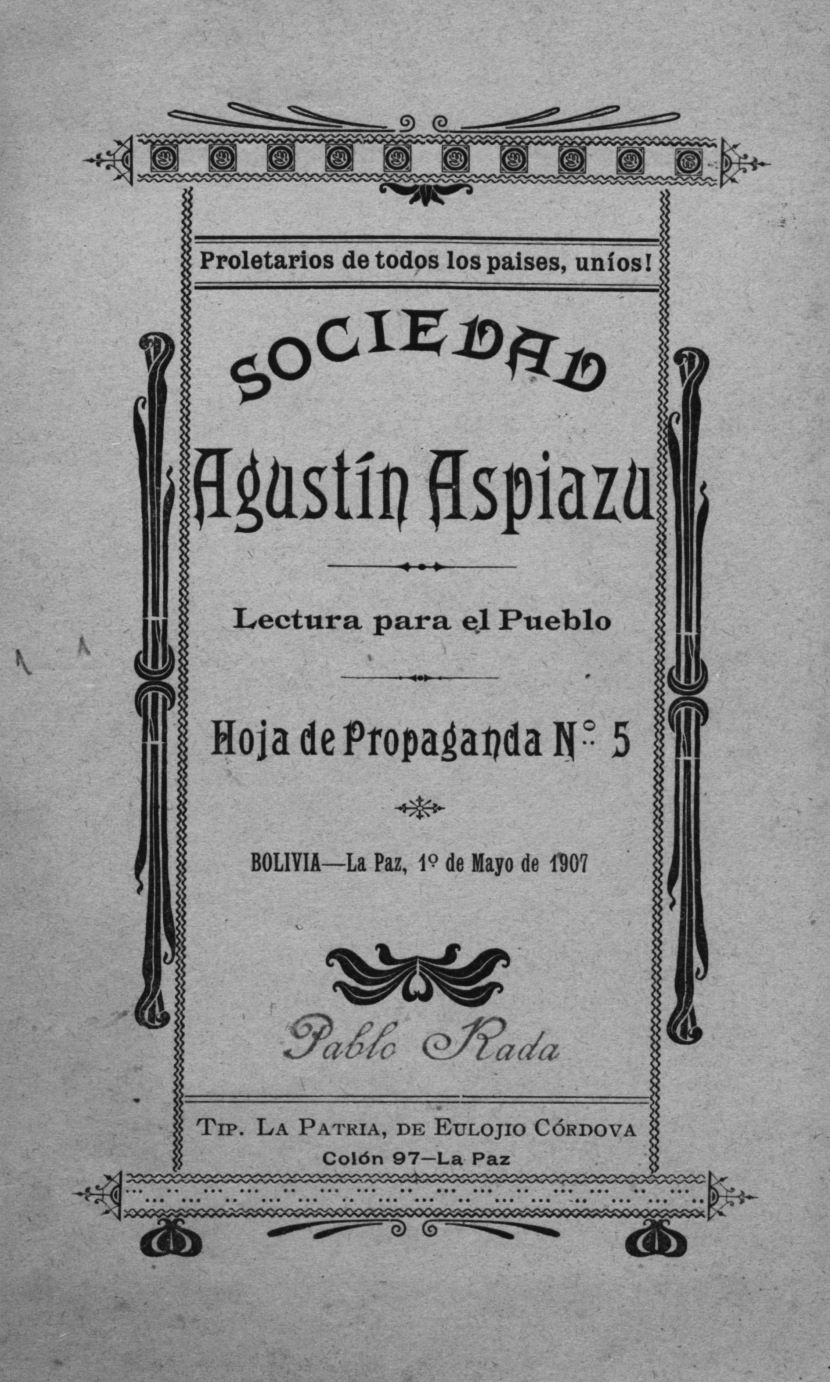
Up to the present two associations have adhered to our cause. The one Is the Society Augustin Aspiazu de la Paz, composed of the younger element among our professors and students in the national colleges. The labors of this society will, we hope, give good results. The other Is the Labor Union, constituted in the city of Potosl. It is composed of mechanics, but there are still some of them who remain partizans of antiquated ideas. We shall seek gradually to eliminate them.
Many journalists, lawyers, and public men have responded to the invitations which we have extended to them and are taking part in the Socialist propaganda in the various centers where they live.
We have adopted the program of the Argentine Socialist Party, with some amendments suitable to this country. We have also submitted it to the Society Aspiazu, which has accepted it. In order to avoid acute conflicts with the authorities we resolved to revise our constitution in such a manner that it can be approved by the government. This approval was obtained on June 2, 1906.
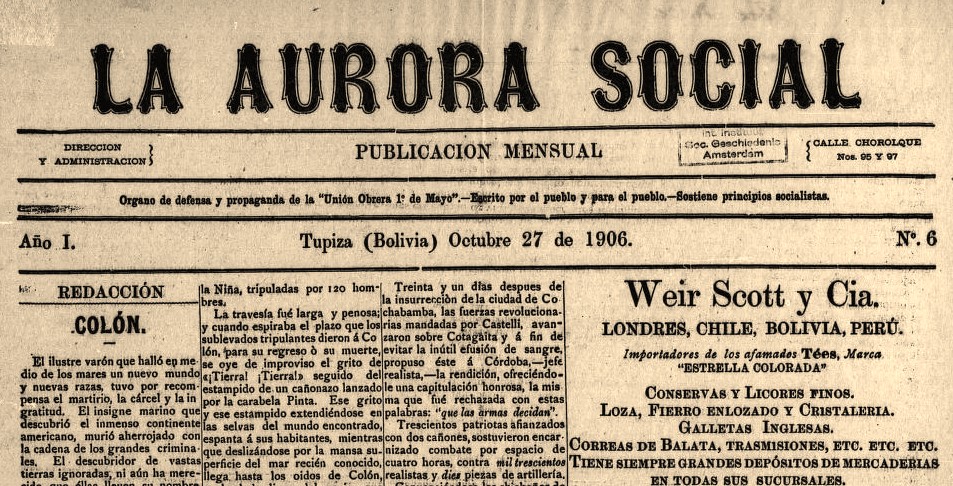
The only Socialist paper in the country is our organ, “Social Dawn”. It has been favorably received, not only by our partizans, but even by the bourgeois press of the country, which frequently reprints our articles.
We are in close relations with the Socialist organizations of Chile, Peru, and the Argentine Republic, and we hope to make our relations universal. We have formed a library for our group, which was definitely established at the beginning of 1907.
We have made several demonstrations. The first was organized for the purpose of demanding the release of some of our comrades who had been unjustly imprisoned by the police. The last was on the occasion of the First of May (1907); it was the first of its kind in this country and was very impressive.
Lectures are held frequently in order to instruct the masses composing our association. The results obtained have been surprising.
We have planned to hold a congress in the month of August, 1907, and have sent out Invitations. If we succeed in this project. the principal subject of our deliberations will be the approval of the program, the definite constitution of the party, and the taking of measures for the rapid development of our ideas.
While as yet our movement cannot be compared to that of any great that of party, we hope that in a short time it will become powerful and that, by our co-operation with our brothers abroad, the triumph of our cause will be made more easy.
In our country there exist powerful minds of the masses, constitute one of fellow workers as well as the aborigines, with the aid of the government, the bourgeoisie, and the clergy. These last, whose doctrines yet haunt the minds of the masses, constitute one of the forces which most strongly oppose us and against which we fight without cessation. The progressive elements of the population have fortunately succeeded in reforming Article 2 of the Constitution and abolishing the military and ecclesiastical privileges. This reform has facilitated our work be cause we are no longer obliged to support the Christian religion and recognize the Apostolic Roman Church as the only sect authorized by the state which was the case theretofore.
The Worker, and its predecessor The People, emerged from the 1899 split in the Socialist Labor Party of America led by Henry Slobodin and Morris Hillquit, who published their own edition of the SLP’s paper in Springfield, Massachusetts. Their ‘The People’ had the same banner, format, and numbering as their rival De Leon’s. The new group emerged as the Social Democratic Party and with a Chicago group of the same name these two Social Democratic Parties would become the Socialist Party of America at a 1901 conference. That same year the paper’s name was changed from The People to The Worker with publishing moved to New York City. The Worker continued as a weekly until December 1908 when it was folded into the socialist daily, The New York Call.
PDF of full issue: https://www.marxists.org/history/usa/pubs/the-people-the-worker/070824-worker-v17n21.pdf
 Revolution's Newsstand